1. The Philosophy of Art: Aspective Reality vs. Perspective
To modern viewers conditioned by Renaissance art, ancient Egyptian figures can appear rigid, flat, or anatomically distorted: heads turned in profile while the eye stares straight forward; shoulders squared toward the viewer while hips, legs, and feet face sideways.
In Egyptological theory, this was not due to an inability to draw natural depth, but was the deliberate application of Aspective Representation (تمثيل المظاهر المتكاملة), pioneered conceptually by art historian Heinrich Schäfer:
- Perspective vs. Aspective: Perspective captures how an object appears to an observer from a single, fleeting, subjective vantage point at one split second in time. Aspective art presents the object as it truly and permanently is—combining each element from its most complete, characteristic diagnostic angle;
- Anatomical Synthesis: The human face is most recognizable in sharp profile, but the human eye is most expressive and complete viewed from the front; the torso and broad shoulders reveal their full physical power facing frontally, while walking legs and feet display their musculature and movement seen from the side with the arch showing;
- The Purpose of Eternity: Egyptian art was functional and magical, not decorative. Because a relief on a tomb wall was intended to magically sustain the deceased's soul (Ka) forever, showing someone in three-quarter perspective with one arm foreshortened or hidden behind the body would risk the soul being resurrected into eternity missing an arm. Completeness was mandatory for biological resurrection.
2. The Canon of Proportions: The 18-Square Mathematical Grid
Egyptian artistic consistency across thousands of years was governed by an exact mathematical grid system known as the Canon of Proportions (قانون النسب الرياضية):
From the Old Kingdom through the end of the New Kingdom, draftsmen snapped red pigment-soaked cords against smoothed plaster walls to create a grid of equal squares. A standing human figure was drawn strictly across 18 vertical squares measured from the ground line to the hairline (excluding crowns and wigs):
- Grid Line 1 to 5: Foot, ankle, and lower calf (knee aligned at Line 6);
- Grid Line 6 to 12: Thigh and pelvis (lower edge of buttocks at Line 9; waist and navel at Line 11);
- Grid Line 12 to 16: Ribcage, chest, and nipples (armpits and broad shoulders at Line 16);
- Grid Line 16 to 18: Neck, chin, and face (base of nose at Line 17; hairline at Line 18);
- The Unit of Measure: Each individual square corresponded exactly to the width of the deceased's fist (including the clenched thumb), meaning the human body was calculated as 18 clenched fists tall;
- The Late Period 21-Square Reform (26th Dynasty): Under the Saite Renaissance (c. 664 BC), Egyptian artists altered the canon, shifting to a 21-square grid measured from the ground to the level of the eyes, creating more elongated, slender figures mimicking classical Old Kingdom proportions.
3. Chromatic Symbolism (Iwn): The Six Sacred Mineral Colors
In ancient Egypt, color was designated by the word Iwn (إيون), which also translated to "character," "nature," or "being". To paint an object was to bestow upon it its true cosmic identity.
Artists utilized six primary inorganic mineral pigments, bound with animal glue, egg white, or acacia tree gum:
- 1. Red (Desher - دشر): Mined from natural red iron ochres ($Fe_2O_3$). Symbolized solar energy, physical fire, masculine vitality, and victorious power, used for the reddish-brown skin tones of men working in the sun. Negatively, it symbolized the scorching desert and the chaotic fury of Seth;
- 2. Yellow (Khenet - خنت): Extracted from yellow ochre or poisonous bright orpiment (arsenic trisulfide - $As_2S_3$). Symbolized the eternal, untarnished flesh of the gods, the solar radiance of Ra, and used for the pale cream skin tones of noblewomen secluded indoors;
- 3. Blue (Khesbedj - خسبدج): The world’s first synthetic pigment: Egyptian Blue (calcium copper silicate - $CaCuSi_4O_{10}$), synthesized by fusing quartz silica, lime, copper shavings, and natron in kilns at 850°C. Symbolized the primeval waters of Nun, the cosmic heavens, and the lapis lazuli hair of the gods;
- 4. Green (Wadj - واج): Derived from pulverized malachite (copper carbonate) or green frit. Symbolized vegetation, the fertile Nile flood, flourishing life, and eternal resurrection (exemplified by the green-skinned face of Osiris);
- 5. White (Hedj - حج): Derived from raw calcium sulfate (gypsum) or chalk (calcium carbonate). Symbolized moral purity, sacred ritual cleanliness, and light, used for linen clothing and priestly robes;
- 6. Black (Kem - كم): Produced from carbon lampblack or powdered charcoal. Symbolized the rich fertile alluvial silt left by the Nile inundation, regeneration, and the underworld womb of Osiris.
4. Relief Carving Techniques: Bas-Relief vs. Sunk Relief
Egyptian architectural walls were vast stone canvasses carved in two distinct physical relief techniques, chosen specifically based on environmental lighting conditions:
1. Bas-Relief / Raised Relief (النقش البارز)
The sculptor carved away the entire surrounding stone background, leaving the figures, hieroglyphs, and details raised several millimeters above the surface:
- Requires immense labor and technical precision;
- Reserved primarily for temple interiors, dark subterranean sanctuaries, and inner tomb chapels where soft flickering oil lamplight cast gentle shadows across the raised contours (superbly exemplified in the Temple of Seti I at Abydos).
2. Sunk Relief / Incised Relief (النقش الغائر - Cavo-Rilievo)
The stone background remained untouched at the original surface plane, while the sculptor cut deeply into the stone along the outlines of figures, scooping out the internal modeling below the surface:
- Fast, durable, and highly cost-effective;
- Utilized almost universally on exterior temple facades, massive pylon gateways, and outer courtyard columns. Under the blazing, vertical Egyptian desert sun, deep incised grooves cast sharp, black, dramatic shadows, making carvings easily readable from hundreds of meters away (as seen at Karnak, Edfu, and Medinet Habu).
5. Tomb Wall Painting: Fresco Secco & The Layered Technique
Contrary to popular belief, ancient Egyptian tomb murals were not true frescoes (Buon Fresco, where paint is applied to wet plaster). They were executed in Fresco Secco (التصوير الجداري الجاف) on bone-dry walls across a meticulous multi-stage industrial process:
- Wall Preparation: Irregular limestone bedrock walls were smoothed with a coarse layer of Nile mud mixed with chopped straw (Muna), then coated in fine white gypsum plaster (Gesso) to create a luminous, chalky white drawing surface;
- Snapping the Grid: Master draftsmen snapped red cords dipped in pigment to lay down the 18-square proportional grid across the plaster;
- Preliminary Sketch: The master draftsman sketched preliminary outlines of figures and hieroglyphic captions in fluid red ink with a fine reed brush;
- Correction: The chief royal scribe inspected the walls, making necessary anatomical and proportional corrections in bold black ink;
- Color Application: Apprentices and painters filled in the broad chromatic planes using thick mineral paints mixed with water and animal adhesive binders;
- Final Black Outlining: Master painters returned to trace crisp, razor-sharp black or dark red contours around every figure, finger, eye, and hieroglyphic bird;
- Protective Varnishing: In the 18th and 19th Dynasties, artists applied a clear natural tree resin (pistacia resin) over selected details, creating a luminous, glossy protective glaze that preserved vibrant colors for over 3,500 years.
6. Monumental Statuary: The Law of Frontality & Direct Gaze
Egyptian three-dimensional sculpture was governed by the Law of Frontality (قانون الواجهة والتناظر), formulated rigorously by art historians:
- The Direct Gaze: Statues were designed to be viewed strictly from the front. The head and torso never twist, lean, or rotate; the figure faces straight ahead into eternity with unblinking eyes, engaging directly with the viewer or the deity;
- Bilateral Symmetry: If an imaginary vertical line is drawn through the center of the nose, chin, navel, and pubic bone, the left and right halves of the body are symmetrical mirrors;
- The Stepping Pose: Male statues are almost universally depicted standing with their left foot forward, yet with both soles planted completely flat on the base and the hips level—a stance expressing readiness for eternal action without creating unstable physical imbalance;
- Block Integration: Egyptian stone statues were carved out of single monolithic blocks of hard stone (granite, diorite, quartzite, basalt). To avoid fragile protruding limbs that could snap over millennia, arms remained clenched tight against the torso, and spaces between the legs and behind the back were anchored to a solid vertical stone pilaster (the Back Pillar).
7. Hierarchical Scale: Visual Power & Social Dimension
In Egyptian artistic compositions, physical size was not determined by physical distance from the camera or viewer, but by social, political, and spiritual importance (Hierarchical Proportion - الحجم التراتبي):
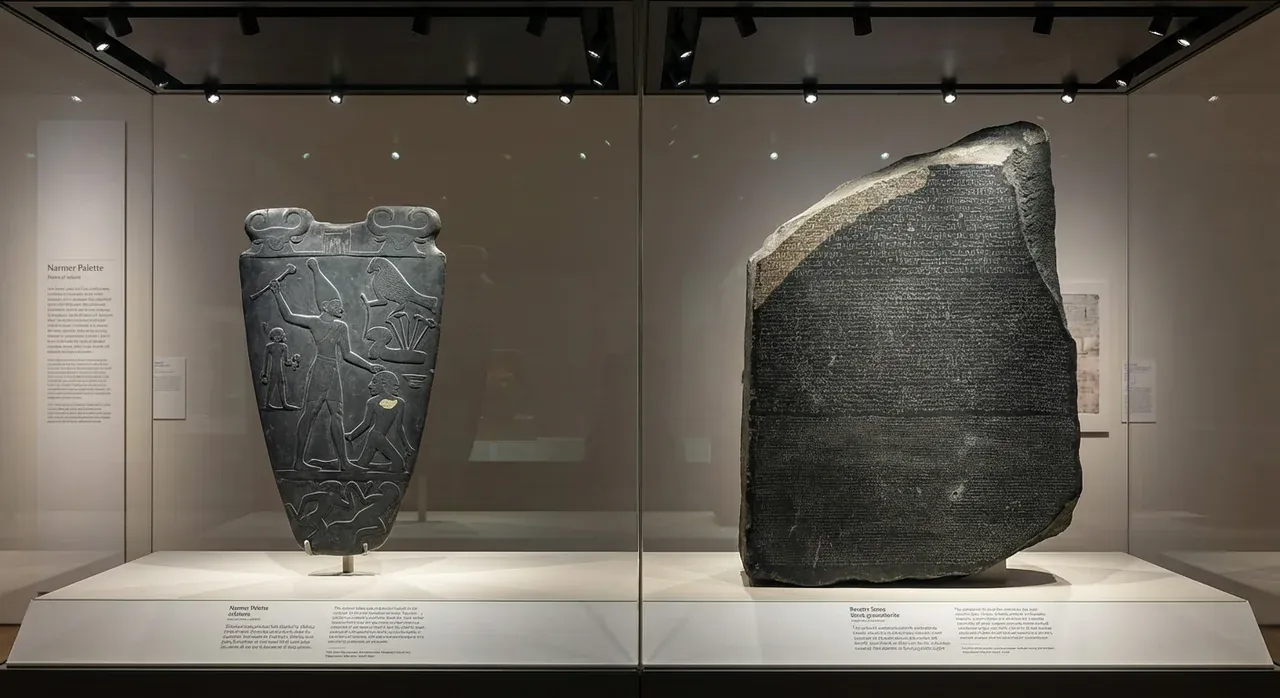
- The Pharaoh as a Giant: The reigning king is depicted as a colossal titan, towering over his enemies, court officials, and foreign captives (as seen on the Narmer Palette, where King Narmer towers over his fleeing foes, and at Abu Simbel, where Ramesses II stands 20 meters high);
- Gods and Kings as Equals: Only deities are rendered on the same scale as the pharaoh, visually confirming his divine co-equal status with the gods;
- Wives, Children, and Servants: In noble tombs, the tomb owner dominates the scene at monumental scale; his wife is depicted standing beside him at roughly half or three-quarters his height, while his children appear as miniature adults clutching his calves, and agricultural laborers are shown in tiny registers performing daily chores.
8. The Amarna Heresy: Radical Naturalism & Solar Expression
In the middle of the 14th century BC (18th Dynasty), Pharaoh Amenhotep IV (Akhenaten) shattered the 1,500-year-old canon of Egyptian art, ushering in the revolutionary Amarna Style (فن العمارنة):
Under the doctrine of the Aten (the visible sun disc), art abandoned traditional idealized athletic perfection in favor of raw naturalism, emotional vulnerability, and radical physical distortion:
- Radical Royal Anatomy: Akhenaten and his family were depicted with elongated skulls, heavy drooping jaws, almond-shaped hooded eyes, thin spindly arms, fleshy bellies, wide swelling hips, and thick thighs—visualizing the pharaoh as both father and mother of humanity imbued with the life-giving energy of the sun;
- Unprecedented Domestic Intimacy: For the first time in Egyptian history, a pharaoh was depicted kissing his daughters, bouncing children on his knees, and holding hands with Queen Nefertiti beneath the radiating protective arms of the Aten;
- Dynamic Curvilinear Motion: Rigid vertical grids gave way to fluid, flowing, organic curves, relaxed postures, and expressive, naturalistic animal studies (such as the leaping calves and waterbirds in the Amarna green room murals);
- Master Sculptor Thutmose: Excavations at Amarna unearthed the workshop of chief sculptor Thutmose, revealing stunning plaster portrait casts and the world-famous painted limestone bust of Queen Nefertiti (now in the Neues Museum, Berlin), balancing natural bone structure with sublime royal majesty.
9. Masterpieces of Ancient Egyptian Art Across Dynasties
The following matrix details celebrated masterworks of ancient Egyptian sculpture, painting, and relief, their chronological periods, and museum repositories:
| Artistic Masterpiece | Dynastic Period | Material Medium | Significance & Global Repository |
|---|---|---|---|
| The Narmer Palette | 1st Dynasty (c. 3100 BC) | Green Siltstone / Greywacke | Egyptian Museum, Cairo; foundational canon of royal victorious relief. |
| Statues of Rahotep & Nofret | 4th Dynasty (c. 2570 BC) | Painted Limestone, Rock Crystal Eyes | Egyptian Museum, Cairo; hyper-realistic lifelike inlaid obsidian eyes. |
| Khafre Enthroned | 4th Dynasty (c. 2540 BC) | Gneiss / Anorthosite Diorite | Cairo Museum; supreme example of monumental royal frontality and Horus protection. |
| The Seated Scribe | 5th Dynasty (c. 2450 BC) | Painted Limestone, Quartz Eyes | Louvre Museum, Paris; naturalistic elite portraiture in working posture. |
| Geese of Meidum Mural | 4th Dynasty (c. 2550 BC) | Fresco Secco on Plaster | Cairo Museum; "The Mona Lisa of Ancient Egypt"; botanical and avian precision. |
| Bust of Queen Nefertiti | 18th Dynasty (Amarna Period) | Stucco-coated Limestone | Neues Museum, Berlin; zenith of Amarna royal feminine portraiture by Thutmose. |
| Gold Mask of Tutankhamun | 18th Dynasty (c. 1323 BC) | Solid Gold, Lapis, Carnelian, Glass | Egyptian Museum, Cairo; 10.23 kg masterwork of royal goldsmithing and divine casting. |
| Tomb Murals of Nefertari | 19th Dynasty (Valley of Queens) | Polychrome Relief & Plaster | QV66, Luxor; peak of New Kingdom vibrant, shadowed polychrome elegance. |
10. Specialized Art History & Epigraphic Tours with Ultra Egypt Travel
Dissecting the original red gridlines beneath unfinished tomb walls in the Valley of the Kings, analyzing the raised low-reliefs of Abydos, or studying the masterworks of the Egyptian Museum demands deep academic curatorial context.
Operating under Ministry of Tourism License #874 (Class A) and IATA Accreditation #90229930, Ultra Egypt Travel organizes bespoke art history and epigraphic itineraries:
- Scholarly Epigraphic Field Seminars: Private on-site art history lectures at the Temple of Seti I at Abydos, Medinet Habu, and the Tombs of the Nobles (Sheikh Abd el-Qurna) led exclusively by university-educated, licensed Egyptologists;
- VIP Access to Unfinished Tombs: Securing official Supreme Council of Antiquities permits to inspect royal and noble tombs preserving unfinished stages of drafting, red-line grid snapping, and charcoal corrections (such as Horemheb KV57);
- The Masterpieces Museum Trail: Private guided viewings through the masterwork galleries of the Egyptian Museum in Tahrir, the Grand Egyptian Museum (GEM), and the Luxor Museum of Ancient Art;
- VIP Ground Protocols: Climate-controlled luxury Mercedes-Benz executive transport across Cairo, Minya, and Luxor with white-glove concierge care.