1. Material Culture: The Sacred vs. The Mundane
In ancient Egypt, the division between utilitarian functional objects and sacred magical instruments was virtually non-existent. An everyday headrest used for sleeping was carved with protective images of the demon-god Bes to ward off nightmares; a cosmetic spoon for body ointments was shaped like a swimming maiden presenting a lotus bud; and a board game played in evening courtyards doubled as an initiatory simulator for the soul's journey through the netherworld.
Artifacts operated on three integrated functional levels:
- Practical Utility: Serving daily bodily needs: holding cosmetic eye paint, storing Nile beer and emmer wheat, lighting houses with castor-oil clay lamps, or cutting linen;
- Apotropaic Protection (Magical Defense): Shielding vulnerable human thresholds—childbirth, sleep, sickness, and the corpse—from malevolent chaotic spirits (Isfet) through sacred shapes and stones;
- Social Stratification: Advertising bureaucratic rank, divine royal lineage, or temple priesthood through restricted precious materials like gold, imported lapis lazuli, and carnelian.
2. Egyptian Faience (Tjehnet): The Self-Glazing Ceramic
Often mistakenly confused with modern tin-glazed earthenware from Faenza, Italy, authentic Egyptian Faience contains no clay whatsoever. Natively termed Tjehnet (تحنت)—meaning "That which is dazzling" or "Shining like the sun"—it was antiquity's earliest synthetic material:
Fabricated by grinding crushed quartz pebbles or clean desert sand (approx. 95% silica), mixed with alkaline natron salt or plant ash (soda and potash), lime (calcium carbonate), and mineral colorants—predominantly malachite or roasted copper scrap ($CuO$).
The Efflorescence Glazing Breakthrough: As the shaped wet paste dried, dissolved sodium salts and copper ions wicked to the surface through capillary action, forming a white crust. When fired in kilns at temperatures between 800°C and 1000°C, the surface salts melted into a vitreous, glassy turquoise-blue silicate glaze without requiring a separate dip or second firing.
To the Egyptians, the brilliant blue-green color embodied Wadj—the green of fresh Nile papyrus shoots, cosmic fertility, the life-giving Nile flood, and eternal resurrection. Millions of amulets, bead necklaces, drinking cups, and Ushabtis were mass-produced in ceramic molds from this sacred self-glazing medium.
3. Apotropaic Amulets: The Magical Body Armor
Amulets (known natively as Meket, Nehet, or Sau) were portable magical batteries worn around the neck, wrists, and ankles of living men, women, and children, and systematically arranged between the linen wrapping layers of mummies:
- The Eye of Horus (Wedjat - وجات): The supreme protective symbol of wholeness, physical integrity, and healing, representing the divine eye torn out by Seth and magically restored by Thoth;
- The Scarab Beetle (Khepri - الجعران): Representing the dung beetle rolling its egg ball across the earth, symbolizing daily solar rebirth and transformation (Kheper). Placed over the mummy's chest as a large green basalt Heart Scarab inscribed with Spell 30B commanding the heart not to testify against the deceased in the Hall of Judgment;
- The Djed Pillar (عمود الجد): The stylized spine of Osiris, granting eternal vertical stability, endurance, and resurrection;
- The Tyet / Isis Knot (عقدة إيزيس): Carved in blood-red carnelian or red jasper, representing the menstrual blood and protective maternal magic of Isis, placed at the throat of the deceased;
- The Ankh (مفتاح الحياة): Symbolizing physical life, divine breath, and immortality, held in the hands of gods and pharaohs.
4. Ushabtis & Shabtis: The Workers of the Underworld
In the afterlife paradise of the Field of Reeds (Aaru), the blessed dead were required by divine cosmic order to cultivate fields, dig irrigation canals, and reap barley. For elite nobles and kings unaccustomed to manual labor, Egyptian religion developed a brilliant theological proxy: the Ushabti (الأوشابتي):
Derived from the Egyptian verb Wosheb (وشب), meaning "To answer":
- Spell 6 of the Book of the Dead: Inscribed in hieroglyphs across the mummiform body of the figurine: "O Ushabti, if [Name] is summoned to do any work in the realm of the dead—to cultivate fields, irrigate banks, or transport sand from east to west—you shall stand forth and say: 'Here I am!'";
- The Complete 401-Figurine Troop: By the Third Intermediate Period, a complete royal or noble burial kit contained exactly 401 Ushabtis:
• 365 Workers: One for every calendar day of the solar year, depicted carrying agricultural picks, hoes, and seed baskets slung over their shoulders;
• 36 Overseers (Reis): One for each ten-day Egyptian week, depicted wearing pleated linen kilts and holding whips to supervise the worker troops; - Evolution of Materials: Ranging from early Middle Kingdom carved wax and wood to glittering cobalt-blue faience in the 21st Dynasty (as seen in the thousands of royal Ushabtis discovered in the Deir el-Bahari cache DB320).
5. Royal & Elite Jewelry: Cloisonné, Pectorals & Collars
Egyptian jewelry was not merely decorative vanity; it was an intricate wearable armory of divine theology and apotropaic color harmony:
A crescent-shaped collar composed of multiple concentric rows of tubular and teardrop-shaped beads of gold, carnelian, turquoise, and lapis lazuli, terminating in two semicircular falcon-head terminals resting across the collarbones. Worn by royalty, military heroes as the "Gold of Honor," and placed around the neck of mummies to protect the throat and chest.
- The Cloisonné Technique: Egyptian goldsmiths soldered paper-thin gold wires or ribbons onto a gold baseplate to create tiny cellular compartments (cloisons). Master craftsmen then carved precious gemstones—dark blue lapis lazuli (imported from distant Badakhshan in modern Afghanistan), turquoise from Sinai, red carnelian from the Eastern Desert, and feldspar—to snap perfectly into each cell without adhesives;
- Royal Pectorals: Massive gold chest pendants worn on heavy cords, displaying complex mythological vignettes (such as the pectoral of Princess Sithathoriunet from Lahun and the openwork gold pectorals of Tutankhamun depicting winged scarabs carrying the solar and lunar barques).
6. Cosmetic Artifacts: Kohl Pots, Mirrors & Palettes
Personal grooming and cosmetics in ancient Egypt were matters of hygiene, medical survival under the harsh desert sun, and spiritual beauty:
- Kohl Pots and Applicators: Used daily by both men and women to outline the eyes with thick black kohl made from finely ground galena (lead sulfide), or green eye paint made from crushed malachite (copper carbonate). Modern chemical analyses confirm ancient kohl acted as an antibacterial agent protecting against eye infections, while reducing blinding desert sun glare;
- Solar Bronze Mirrors: Egyptian mirrors were never made of glass; they were circular discs of beaten bronze or silver polished to a blinding reflective shine, symbolizing the radiant sun disc of Hathor. Handles were carved in the form of papyrus stalks or graceful nude young girls holding lotus buds;
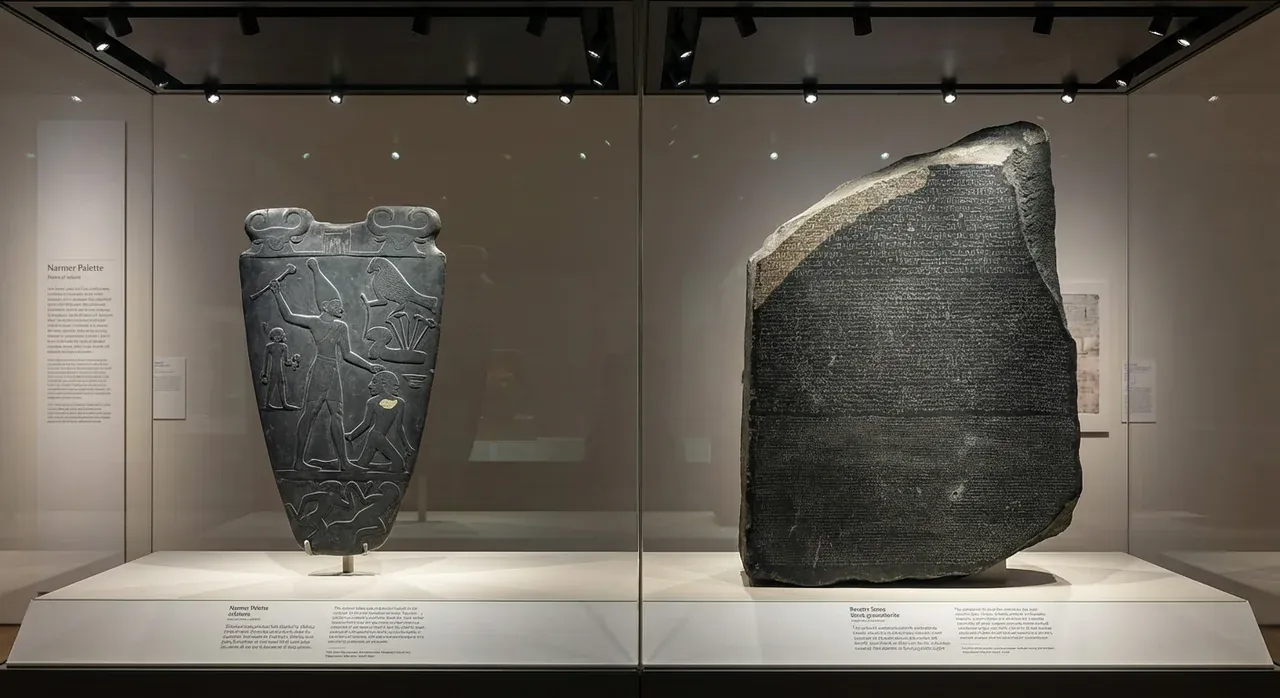
- Pre-dynastic Siltstone Palettes: Flat greywacke stones carved in the shapes of fish, turtles, and ibises used to grind mineral pigments, culminating in monumental ceremonial masterpieces like the Narmer Palette (3100 BC) recording the unification of Upper and Lower Egypt.
7. Board Games & Leisure: Senet, Mehen & The Hounds
Board games were popular pastimes in Egyptian villas, but in funerary contexts, they transformed into philosophical simulators of the afterlife:
- The Game of Senet (لعبة السنت): Meaning "Passing". Played on a grid of 30 squares arranged in three parallel rows of ten. Two players moved gaming pieces (spools and cones) across the board using throw-sticks or knucklebones instead of dice:
• The final five squares bore hieroglyphic signs: Square 26 was the "House of Beauty" (Per-Nefer), Square 27 was the "Water of Chaos" (where an unfortunate roll meant drowning), and Square 30 was the "House of Horus";
• Passing one's pieces safely off the board simulated the justified soul successfully traversing the hazards of the Duat into eternity, as immortalized in the famous tomb mural of Queen Nefertari playing Senet alone against an unseen divine opponent; - Mehen (The Serpent Game): Played on a circular board carved in the shape of a coiled snake whose head rests in the center, symbolizing the solar barque navigating through the coils of the protective serpent god Mehen;
- Hounds and Jackals (58 Holes): A popular Middle Kingdom race game featuring an ivory board on animal legs with ten carved ivory pegs topped with heads of desert jackals and hunting hounds.
8. Metallurgy: Gold, Electrum, Bronze & Meteoric Iron
Egyptian metallurgists achieved masteries that continue to astonish modern materials scientists:
- Gold (Nub): Mined from quartz veins in the hyper-arid mountains of the Eastern Desert and Lower Nubia (Wawa and Kush). Because gold never tarnished or rusted, it was religiously defined as the "flesh of the gods";
- Electrum (Djam): A luminous, naturally occurring or artificially alloyed mixture of gold and silver (typically 75% gold, 20% silver, 5% copper), prized for its brilliant pale-yellow solar luster, used to cap the pyramidions of colossal obelisks;
- Meteoric Iron (Bja-en-pet - "Iron of Heaven"): Centering centuries before the terrestrial Iron Age, Egyptians forged ceremonial daggers and amulets from nickel-rich meteorites that fell from outer space. The famous gold-handled iron dagger discovered wrapped against the right thigh of Tutankhamun was scientifically confirmed via X-ray fluorescence spectroscopy in 2016 to contain 10.8% nickel and 0.58% cobalt, confirming extraterrestrial meteoritic origin.
9. Master Typological Artifacts Matrix
The following matrix details the primary categories of ancient Egyptian artifacts, diagnostic materials, and historical breakthroughs:
| Artifact Category | Dominant Materials | Primary Function & Significance | Signature Masterpiece Example |
|---|---|---|---|
| Egyptian Faience | Quartz, Natron, Copper oxide | Self-glazing turquoise ceramics; rebirth and life. | William the Faience Hippopotamus (Metropolitan Museum / 12th Dyn.). |
| Apotropaic Amulets | Carnelian, Lapis lazuli, Gold | Protective force fields against demons and disease. | Wedjat Eyes, Djed Pillars, Heart Scarab of Tutankhamun. |
| Ushabti Figurines | Glazed Faience, Wood, Bronze | Funerary agricultural proxies answering manual labor calls. | Royal Ushabti Troops of Pharaoh Psusennes I (Tanis) and Tutankhamun. |
| Cloisonné Pectorals | Gold, Semi-precious stones | Chest pendants asserting theological protection. | Pectoral of Princess Sithathoriunet with royal Horus falcons (Lahun). |
| Ceremonial Palettes | Mudstone, Greywacke | Grinding mineral eye paints; early state annals. | The Narmer Palette (Egyptian Museum, Cairo / 3100 BC). |
| Cosmetic Vessels | Egyptian Alabaster (Calcite) | Storing perfumed unguents, animal fats, and kohl. | Tutankhamun Carved Calcite Unguent Jar with Lion and Ibex finials. |
| Leisure Board Games | Ebony, Ivory, Faience | Leisure race games; simulation of underworld transit. | Gilded wooden Senet box with animal-foot stands from KV62. |
10. Curated Artifact & Museum Handling Expeditions with Ultra Egypt Travel
Inspecting the microscopic gold granulation of Middle Kingdom jewelry, admiring the iridescent glaze of 3,000-year-old faience, or examining the extraterrestrial iron dagger of Tutankhamun requires an experienced academic partner.
Operating under Ministry of Tourism License #874 (Class A) and IATA Accreditation #90229930, Ultra Egypt Travel organizes specialized material culture and museum study itineraries:
- The Grand Egyptian Museum (GEM) Material Galleries: Private viewings through the complete 5,398-piece Tutankhamun assemblage, examining pectorals, jewelry boxes, cosmetic jars, and Ushabtis led by licensed scholarly Egyptologists;
- The National Museum of Egyptian Civilization (NMEC): Private guided tours through the main chronological exhibition, tracing material technology from Predynastic pottery and stone knives to Islamic glass and textiles;
- Exclusive Egyptian Museum Tahrir Jewelry Room Access: In-depth academic study of the Royal Jewels of Tanis (21st–22nd Dynasties), Princess Khnumet’s gold diadem, and the Dahshur Middle Kingdom gold treasures;
- VIP Ground Protocols: Climate-controlled luxury Mercedes-Benz executive transport across Cairo and Giza with dedicated concierge care.