1. Sacred Nature: Medu Netjer & The Magic of Writing
In the modern world, writing is a functional code used to transcribe acoustic speech into abstract graphic symbols. In ancient Egypt, writing was an act of divine creation. Known natively as Medu Netjer (مدو نتر), hieroglyphs were conceived as direct visual emanations of the god Thoth (Djehuty), the patron of wisdom, scribes, and cosmic measurement, and his female counterpart Seshat, the mistress of architects and records.
This divine status shaped every aspect of the script:
- The Ontological Reality of the Sign: Ancient Egyptians believed that a hieroglyphic carving did not merely represent a lion, serpent, or bread loaf; it was an active magical double of that entity. What was carved upon a temple wall became eternally real in the universe;
- Mutilated & Suppressed Hieroglyphs: Because dangerous animals (such as horned vipers, lions, and scorpions) could magically come alive inside the dark confines of a tomb and harm the deceased, scribes deliberately drew them incomplete—carving the horned viper severed in half, headless, or transfixed with a bronze knife;
- Monumental Exclusivity: Hieroglyphs were reserved almost exclusively for monumental, sacred, and formal stone inscriptions (temples, royal stelae, tombs, and sarcophagi), while everyday administrative, commercial, and literary writing was executed in fast cursive scripts (Hieratic and Demotic).
2. The Linguistic Mechanics: The Tripartite Writing System
For over a millennium after the fall of the Roman Empire, European scholars erroneously believed that hieroglyphs were purely symbolic allegories—cryptic mystical pictures representing hidden philosophical truths without phonetic value.
In reality, ancient Egyptian hieroglyphic writing is an intricate, highly sophisticated linguistic system that operates simultaneously across three functional categories:
1. Ideograms (Sense Signs / Logograms): A sign that directly depicts the object it represents (e.g., the sun disc with a vertical stroke means "sun" or "day").
2. Phonograms (Sound Signs): Signs that do not mean the object depicted, but represent one, two, or three specific consonant sounds of the Egyptian language (rebus principle).
3. Determinatives (Generic Classifiers): Silent signs placed at the end of a word to indicate its semantic category (e.g., a seated man indicates male occupations; walking legs indicate motion).
Crucially, the Egyptian script was an abjad: it recorded only consonants. Vowels were spoken fluently in living conversation, but were never written down in hieroglyphic inscriptions, much like traditional unpointed Arabic and Hebrew.
3. The Uniliteral Inventory: The 24 Consonantal Signs
At the phonetic core of the Egyptian writing system lies an inventory of 24 uniliteral signs (single-consonant signs), effectively forming the world's earliest functional consonant alphabet:
Although the Egyptians possessed this complete 24-letter alphabet as early as 3000 BC, they never abandoned their complex multi-sign script to write with single letters alone. To the Egyptian scribal mindset, multi-consonant signs and determinatives provided essential visual beauty, dignity, and semantic clarity:
- Vulture: Represents the glottal stop aleph (ꜣ);
- Reed Leaf: Represents the glide yod (ỉ);
- Pair of Reeds / Diagonal Strokes: Represents the long vowel/glide (y);
- Forearm with Palm Up: Represents the voiced pharyngeal fricative ayin (ꜥ);
- Quail Chick: Represents the labio-velar glide (w);
- Foot and Leg: Represents the voiced bilabial stop (b);
- Stool of Reed Matting: Represents the voiceless bilabial stop (p);
- Horned Viper: Represents the voiceless labiodental fricative (f);
- Owl: Represents the bilabial nasal (m);
- Water Ripple: Represents the alveolar nasal (n);
- Mouth: Represents the alveolar liquid (r);
- Reed Shelter in Fields: Represents the voiceless glottal fricative (h);
- Twisted Flax Wick: Represents the voiceless pharyngeal fricative (ḥ);
- Placenta / Sieve: Represents the voiceless velar fricative (ḫ);
- Animal Belly with Teats: Represents the voiceless palatal fricative (ẖ);
- Door Bolt: Represents the voiced alveolar fricative (z);
- Folded Cloth: Represents the voiceless alveolar fricative (s);
- Water Pool: Represents the voiceless postalveolar fricative shin (š);
- Hill Slope: Represents the voiceless uvular stop qoph (q);
- Basket with Handle: Represents the voiceless velar stop (k);
- Jar Stand: Represents the voiced velar stop (g);
- Loaf of Bread: Represents the voiceless dental stop (t);
- Tethering Rope: Represents the voiceless palatal stop tj (ṯ);
- Hand: Represents the voiced dental stop (d);
- Snake / Cobra: Represents the voiced palatal stop dj (ḏ).
4. Biliteral & Triliteral Signs: Phonetic Compression
Beyond the 24 single-consonant uniliterals, the Egyptian script utilized hundreds of multi-consonantal signs that functioned as phonetic shorthand:
- Biliteral Signs (علامات ثنائية): A single pictorial sign representing a sequence of two consonants. For example:
• The Sun Disc over Horizon represents ḫꜥ ("to appear");
• The House plan represents pr ("house" or "to go forth");
• The Sun-dried Brick represents mn ("firm, established");
• The Duck represents zꜣ ("son"); - Triliteral Signs (علامات ثلاثية): A single sign representing three consonants in sequence:
• The Sandal Strap represents ꜥnḫ ("Life");
• The Heart and Windpipe represents nfr ("Beautiful, Good, Perfect");
• The Scarab Beetle represents ḫpr ("To come into being, Transform");
• The Staff of Power represents wꜣs ("Dominion"); - Phonetic Complements (المكملات الصوتية): Egyptian scribes almost universally accompanied biliteral and triliteral signs with uniliteral signs repeating part of their sound. For example, when writing Ankh (ꜥ-n-ḫ), scribes drew the Ankh sign followed by the water ripple (n) and placenta (ḫ). These were not pronounced twice; they were visual reading aids ensuring the reader pronounced the correct phonetic value.
5. Determinatives: Silent Semantic Classifiers
Because Egyptian wrote without vowels and without spaces between words, distinct words sharing identical consonantal skeletons could easily create catastrophic ambiguity. To solve this, scribes appended one or more Determinatives (المخصصات) to the end of every noun, verb, and adjective:
- Seated Man: Indicates male humans, occupations, titles, and kinship (father, brother, priest, baker);
- Seated Woman: Indicates female humans, family, and feminine professions;
- Walking Legs: Attached to verbs of motion (to walk, run, flee, approach, return);
- Striking Man with Stick: Attached to verbs of physical force, effort, violence, and labor (to strike, build, conquer, divide);
- Abstract Scroll of Papyrus Tied with String: Attached to abstract concepts that cannot be physically drawn (truth, love, thought, knowledge, eternity, counting);
- Water Waves / Triple Water: Attached to liquids, rivers, seas, drinking, tears, and sailing;
- City Enclosure with Crossroads: Attached to towns, cities, settlements, and geographic regions.
6. Direction of Reading & Architectural Aesthetic Rules
Unlike modern languages that adhere strictly to a single reading direction (left-to-right in English, right-to-left in Arabic), ancient Egyptian hieroglyphs possessed extraordinary visual flexibility:
- Reading into the Faces: Hieroglyphs could be carved in horizontal lines from right to left, horizontal lines from left to right, or in vertical columns reading top to bottom;
- The Cardinal Orientation Rule: To determine which way to read an Egyptian inscription, always look at the faces of the animate figures (humans, birds, animals). You read toward the front of the figures—facing into their gaze:
• If an owl, vulture, or man faces to the right, you read from right to left;
• If they face to the left, you read from left to right; - Architectural Symmetry (Bilateral Symmetry): Temple gateways and pylon portals were designed with mirrored inscriptions. On the right side of a temple door, hieroglyphs faced right and read into the temple; on the left side, they faced left, creating breathtaking aesthetic harmony flanking the processional axis;
- The Quadrant Rule (Grouping in Squares): Hieroglyphs were never written in sloppy, sprawling strings. Scribes organized signs into invisible rectangular compartments (Quadrants). Broad horizontal signs were placed above or below slender signs to avoid unsightly gaps (Horror Vacui), ensuring the text resembled a balanced, harmonious piece of graphic art.
7. The Royal Cartouche (Shenu) & Fivefold Titulary
Whenever the sacred name of an Egyptian pharaoh or royal queen appeared in an inscription, it was isolated within an oval enclosure known as a Cartouche (الخرطوش الملكي):
- The Shenu Ring: Known natively as Shenu (شنو), the cartouche was an elongated loop of double rope tied with a horizontal knot at the bottom, symbolizing the infinite protective circuit of the cosmos circled by the sun god Ra. Encasing the king's name within the Shenu magically protected his identity across the universe;
- The Fivefold Titulary (الألقاب الملكية الخمسة): A reigning pharaoh possessed five distinct sacred names:
1. The Horus Name: Inscribed within a palace facade frame (Serekh) topped by the Horus falcon;
2. The Two Ladies Name (Nebty): Under the protection of the vulture goddess Nekhbet and cobra goddess Wadjet;
3. The Golden Horus Name: Proclaiming the king’s eternal victory over darkness;
4. The Throne Name (Prenomen - Nesu-Bity): Preceded by "King of Upper and Lower Egypt" (the Sedge and Bee), written inside the first cartouche;
5. The Birth Name (Nomen - Sa-Ra): Preceded by "Son of Ra", written inside the second cartouche (e.g., Tutankhamun, Ramesses).
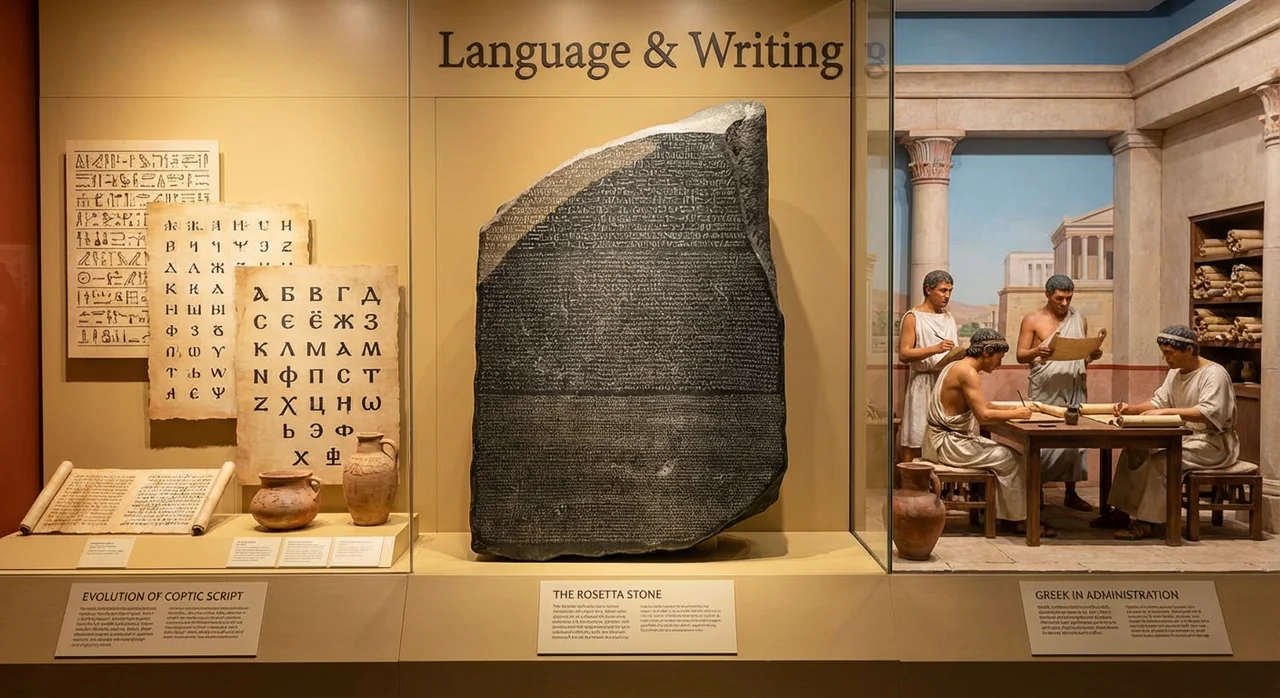
8. The Decipherment Drama: Young, Champollion & Rosetta
When Roman Emperor Theodosius I closed all pagan temples across the empire in 391 AD, the knowledge of hieroglyphic writing vanished from human memory for over fourteen centuries.
The breakthrough began with the 1799 discovery of the trilingual Rosetta Stone near Alexandria:
- Thomas Young’s Initial Insight (1814): British polymath Thomas Young recognized that the demotic and hieroglyphic scripts were closely related, and correctly deduced that the cartouches on the stone contained the phonetic foreign name of King Ptolemy (Ptolemaios);
- Jean-François Champollion’s Genius (1822): French linguistic prodigy Jean-François Champollion, fluent in classical Arabic, Hebrew, Syriac, Chaldean, and above all Coptic (the late liturgical form of the Egyptian language written in Greek letters), compared the cartouche of Ptolemy on the Rosetta Stone with the cartouche of Cleopatra on the Bankes Obelisk from Philae;
- "Je tiens mon affaire!" (September 14, 1822): By cross-matching identical phonetic letters (P, T, O, L), Champollion cracked the alphabet. When he subsequently read native, non-Greek pharaonic cartouches from Abu Simbel containing the sun disc (Ra) + unknown sign (mes) + two folded cloths (s-s), his fluency in Coptic enabled him to recognize the name: Ra-mes-su—Ramesses ("Ra has fashioned him")! Champollion sprinted to the Académie des Inscriptions et Belles-Lettres, shouted "I've got it!", and collapsed unconscious from sheer exhaustion, announcing his historic decipherment in his Lettre à M. Dacier on September 27, 1822.
9. Gardiner's Sign List: Standardized Typology
In 1927, British Egyptologist Sir Alan Henderson Gardiner published his seminal Egyptian Grammar, introducing the standardized alphanumeric classification system utilized by Egyptologists, linguists, and Unicode fonts worldwide:
Gardiner categorized approximately 750 standard Middle Kingdom hieroglyphic signs into 26 thematic categories (A through Z) based on the real-world physical subjects they depict:
- Category A: Man and his Occupations (A1 seated man, A17 child, A24 man striking);
- Category B: Woman and her Occupations (B1 seated woman, B3 woman giving birth);
- Category C: Anthropomorphic Deities (C1 god with sun, C2 falcon-headed god);
- Category D: Parts of the Human Body (D2 head in profile, D21 mouth, D36 arm);
- Category E: Mammals (E1 bull, E14 dog/jackal, E23 lion);
- Category F: Parts of Mammals (F4 forepart of lion, F35 heart and windpipe);
- Category G: Birds (G1 Egyptian vulture, G17 owl, G43 quail chick);
- Category H: Parts of Birds (H6 feather of Ma'at);
- Category I: Amphibious Animals & Reptiles (I9 horned viper, I10 cobra/snake);
- Category K: Fish & Parts of Fish (K1 Nile tilapia, K3 bulti fish);
- Category L: Invertebrates & Lesser Animals (L1 dung beetle/scarab, L2 bee);
- Category M: Trees & Plants (M1 tree, M17 reed leaf, M23 sedge plant);
- Category N: Sky, Earth & Water (N1 sky, N5 sun disc, N35 water ripple);
- Category O: Buildings & Parts of Buildings (O1 house, O4 courtyard);
- Category P: Ships & Parts of Ships (P1 boat, P5 sail with wind);
- Category Q: Domestic & Funerary Furniture (Q1 headrest, Q3 reed mat/stool);
- Category R: Temple Furniture & Sacred Emblems (R4 offering table, R8 cloth flag/god);
- Category S: Crowns, Dress & Staves (S29 folded cloth, S34 ankh strap);
- Category T: Warfare, Hunting & Butchery (T14 throwstick, T30 knife);
- Category U: Agriculture, Crafts & Professions (U1 sickle, U28 fire-drill);
- Category V: Rope, Fiber, Baskets & Bags (V1 coil of rope, V30 basket);
- Category W: Vessels of Stone & Earthenware (W1 oil jar, W24 water pot);
- Category X: Loaves & Cakes (X1 bread loaf, X8 conical loaf);
- Category Y: Writings, Games & Music (Y1 papyrus scroll, Y3 scribal palette);
- Category Z: Strokes, Signs derived from Hieratic & Geometric Figures (Z1 stroke, Z2 plural);
- Category Aa: Unclassified & Enigmatic Signs (Aa1 placenta/sieve).
10. Representative Hieroglyphic Signs & Phonetics Matrix
The following matrix details iconic hieroglyphic signs, their Gardiner codes, phonetics, and symbolic meanings:
| Sign & Image | Gardiner Code | Transliteration | Physical Subject | Sign Function & Symbolic Meaning |
|---|---|---|---|---|
| Ankh (☥) | S34 | ꜥnḫ | Sandal Strap / Mirror | Triliteral: "Life", physical breath, divine eternal existence. |
| Djed Pillar | R11 | ḏd | Spine of Osiris | Biliteral: "Stability", enduring strength, resurrection. |
| Was Scepter | S40 | wꜣs | Canine-headed staff | Triliteral: "Power", divine dominion, royal authority. |
| Scarab (Khepri) | L1 | ḫpr | Dung Beetle | Triliteral: "To become", transformation, morning sun. |
| Eye of Horus | D10 | wḏꜣt | Human eye with falcon markings | Ideogram: "Sound, intact, healed", protective amulet. |
| Feather of Ma'at | H6 | mꜣꜥt | Ostrich Feather | Ideogram: "Truth, balance, cosmic justice", counterweight to heart. |
| Water Ripple | N35 | n | Waves of Nile water | Uniliteral: Consonant 'n', preposition "of" / "to". |
| Bread Loaf | X1 | t | Round bread loaf | Uniliteral: Consonant 't', feminine grammatical suffix. |
| Horned Viper | I9 | f | Cerastes horned viper | Uniliteral: Consonant 'f', 3rd person masculine pronoun ("his"). |
| House Plan | O1 | pr | Rectangular mudbrick house | Biliteral: "House", root for Per-aa (Pharaoh - "Great House"). |
11. Epigraphic Fieldwork & Study Tours with Ultra Egypt Travel
Reading the original hieroglyphic wall reliefs of Karnak, deciphering the cartouches of Abu Simbel, or studying the Rosetta Stone's linguistic lineage requires an operational travel partner with academic curatorial depth.
Operating under Ministry of Tourism License #874 (Class A) and IATA Accreditation #90229930, Ultra Egypt Travel delivers specialized epigraphic and archaeological study expeditions:
- Scholarly Epigraphy Field Seminars: Private on-site temple reading seminars at Karnak, Luxor Temple, Abydos, and Edfu led exclusively by licensed, university-educated Egyptologists holding postgraduate degrees in ancient Egyptian language;
- The Chicago House Epigraphic Protocol: Educational inspections demonstrating the high-precision architectural and textual recording methodologies developed by the Oriental Institute at Medinet Habu;
- Exclusive After-Hours Temple Reading Access: Securing official Supreme Council of Antiquities permits for private, crowd-free access inside the decorated chapels of the Temple of Seti I at Abydos, the Temple of Hathor at Dendera, and private tombs at Saqqara;
- VIP Chauffeured Protocol Fleet: Executive climate-controlled Mercedes-Benz transport across Cairo, Luxor, and Aswan with dedicated concierge management.