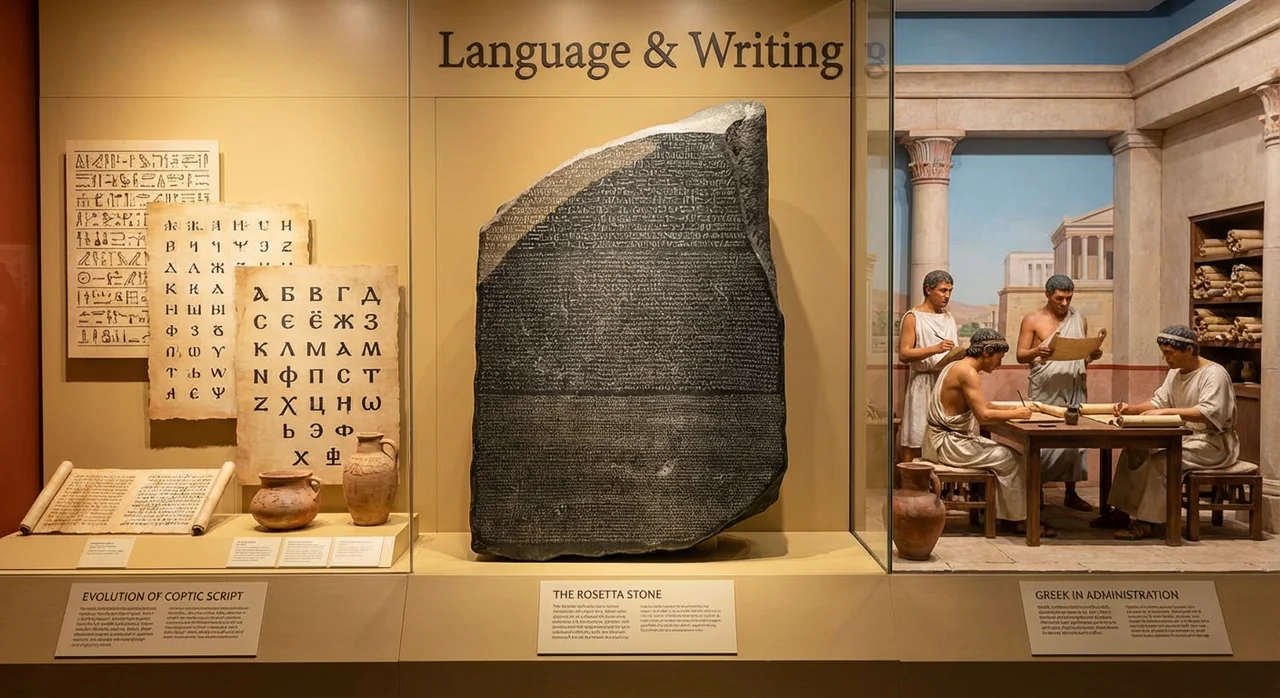
1. Evolution: From Protodynastic Tags to the Coptic Alphabet
The Egyptian language is one of the longest-recorded human tongues in history, possessing an unbroken written record stretching over 4,000 years (from c. 3200 BC to medieval Coptic manuscripts).
A common misconception is that the Egyptians discarded their older writing systems whenever a new script emerged. In reality, multiple scripts coexisted simultaneously, each serving strictly defined social, economic, and religious niches:
- Protodynastic Origins (c. 3250 BC): The earliest identifiable Egyptian writing was discovered in Tomb U-j at Abydos (Umm el-Qa'ab) by Günter Dreyer—comprising small perforated bone, ivory, and ebony tags tied to oil and linen jars, inscribed with early phonograms indicating regional estate origins and tax revenues;
- The Organic Functional Split: As state bureaucracy expanded during the Old Kingdom, carving elaborate pictorial signs into hard limestone was far too slow for recording grain inventory, tax arrears, and legal contracts. Thus, a rapid flowing cursive script (Hieratic) was born alongside formal monumental Hieroglyphic;
- The Demotic Revolution (c. 650 BC): Under the 26th (Saite) Dynasty, state administration condensed Hieratic into an ultra-cursive, highly contracted script (Demotic), while Hieratic was restricted to religious temple scrolls;
- The Christian Transition (c. 100–400 AD): With the rise of Christianity, Egyptian scribes abandoned pagan pictorial signs entirely, transcribing the spoken Egyptian tongue using the Greek alphabet supplemented by seven Demotic letters, creating Coptic.
2. Hieroglyphic Script (Medu Netjer): Sacred Monumental Art
Known natively as Medu Netjer (مدو نتر)—the "Words of the Gods"—and designated by the Greeks as Hieroglyphika grammata ("Sacred carved letters"), the hieroglyphic script was the premier monumental medium of the state:
- Visual Monumentality: Comprising approximately 700 to 800 standard pictorial signs during the classical Middle Kingdom, expanding to over 5,000 signs during the Ptolemaic and Roman eras. Signs depict humans, animals, birds, cosmic bodies, plants, weapons, and architectural buildings in profile;
- The Animate Reality of the Sign: Hieroglyphs were not merely decorative letters; they were believed to be living entities endowed with magical agency. On tomb walls, dangerous signs (e.g., scorpions or horned vipers) were often rendered headless or severed in half to prevent them from spiritually harming the deceased;
- Directional Freedom: Hieroglyphs could be written horizontally from right to left, horizontally from left to right, or in vertical columns running top to bottom. Reading direction was always determined by looking into the faces of the animate creatures (birds, animals, humans), which look toward the beginning of the line.
3. Hieratic Script: The Rapid Cursive of Scribes & Papyri
Developing concurrently with hieroglyphs as early as the 1st Dynasty, Hieratic (الهيراطيقية)—from the Greek hieratikos ("priestly")—was the daily workhorse script of ancient Egyptian civilization:
- Universal Right-to-Left Direction: Unlike hieroglyphs, Hieratic was written strictly from right to left, usually in horizontal lines across papyrus rolls or limestone ostraca;
- Domains of Use: Used for all everyday state documentation: legal trial transcripts, agricultural leases, temple accounting, military registers, diplomatic dispatches, personal letters, and masterworks of classical literature (such as the Tale of Sinuhe and the Ebers Medical Papyrus);
- The Professional Scribe's Script: Scribes were trained in Hieratic first in scribal academies; only specialized temple artists and engravers (the Draftsmen of Amun) advanced to mastering the full formal monumental hieroglyphic canon.
4. Demotic Script (Sekh Shat): Law, Commerce & Popular Prose
Introduced during the reign of Pharaoh Psamtik I (26th Dynasty, c. 650 BC), Demotic (الديموطيقية)—from the Greek demotikos ("popular" or "of the people"), natively called Sekh Shat (سخ شات - "Writing for Documents")—represented a dramatic simplification of cursive writing:
- Extreme Ligatures & Shorthand: Demotic condensed words into complex, highly stylized ligature clusters where individual pictorial components are virtually unrecognizable to the untrained eye. It functioned as an efficient stenographic shorthand;
- Total Administrative Monopoly: For nearly a millennium (from the Saite Period through the Ptolemaic and early Roman eras), Demotic was the mandatory legal, administrative, and economic script of Egypt, used for marriage contracts, land deeds, tax receipts, and court proceedings;
- The Literary Medium: Spanning rich narrative cycles, folklore, and wisdom literature (such as the Instructions of Onchsheshonqy and the epic tales of Setne Khamwas);
- The Middle Script of the Rosetta Stone: Demotic occupied the central band of the Rosetta Stone, representing the vernacular, legally binding administrative script understood by native Egyptian scribes and bilingual Hellenistic officials.
5. Coptic Script: The Final Phonetic Stage of Egyptian
Emerging in the 1st and 2nd centuries AD and fully established by the 4th century, Coptic (القبطية) represents the final evolutionary phase of the ancient Egyptian language:
- The Greek Alphabet Foundation: Coptic adopted the 24 letters of the classical Greek alphabet, but added seven additional letters derived directly from Demotic (Ϣ Shei, Ϥ Fai, Ϧ Khei, Ϩ Hori, Ϫ Janja, Ϭ Chima, Ϯ Ti) to represent distinct Egyptian phonemes that had no phonetic equivalent in the Greek tongue;
- The Decipherment Anchor: It was Jean-François Champollion’s complete, fluent mastery of spoken and written liturgical Coptic that enabled him in 1822 to recognize that the phonetics inside pharaonic cartouches (such as Ra-mes-su and Thoth-mes) were living Egyptian words, unlocking the Rosetta Stone;
- Liturgical Survival Today: While Arabic replaced spoken Coptic in everyday life following the medieval era, Coptic survives to this day as the sacred liturgical language of the Coptic Orthodox Church of Alexandria, preserving the direct acoustic pronunciation of ancient Egyptian speech in modern Sunday liturgies.
6. The Scribal Profession: Training, Status & Per-Ankh
In a largely illiterate civilization where writing held the keys to state administration, religion, and taxation, the Scribe (Sesh - سش) held an elite, privileged rank in society:
- The Satire of the Trades (The Teaching of Khety): A famous Middle Kingdom educational text studied by apprentice scribes, contrasting the miserable, backbreaking labor of washermen, coppersmiths, farmers, and cobblers with the prestigious, clean life of the scribe: "Be a scribe! It saves you from manual labor, protects you from hard toil, and directs you above all professions";
- The House of Life (Per-Ankh - بر-عنخ): The intellectual academy, library, and scriptorium attached to major state temples (such as Heliopolis, Abydos, Karnak, and Dendera). Here, senior master scribes trained young students, copied sacred theological books, calculated lunar calendars, and codified medical and astronomical encyclopedias;
- Social Mobility: Although many scribes inherited their positions from bureaucratic families, talented boys from modest provincial backgrounds could enter scribal schools, rise through military or treasury ranks, and achieve supreme national offices—including vizier and royal chancellor.
7. Scribal Instruments: Palettes, Pigments & Reed Pens
The physical tools of the scribe were so culturally iconic that they merged into the composite hieroglyphic sign Gardiner Y3, symbolizing the concept of "writing" (Sesh):
| Scribal Tool | Ancient Material | Functional & Chemical Purpose |
|---|---|---|
| The Palette (Gesti) | Carved Wood, Walnut, Ivory | Rectangular board with two circular ink cavities and central storage slot for reeds. |
| Black Ink Cake | Carbon Soot & Gum Arabic | Indestructible, non-fading carbon ink used for standard running body text. |
| Red Ink Cake | Red Iron Ochre & Gum Arabic | Used for rubrics: title headings, punctuation, calendar dates, and grammatical corrections. |
| The Reed Brush (Calamus) | Rush (Juncus maritimus) | Stems cut diagonally and chewed at the tip to fray botanical fibers into a soft resilient brush. |
| Water Pot / Shell | Faience, Clay, Stone | Small water vessel used to wet the dry ink cakes before applying the brush. |
| Ostraca Flakes | Pottery Sherds & Limestone | Inexpensive waste surfaces used for school exercises, drafts, letters, and grocery tallies. |
8. The Rosetta Stone: Deciphering the Multilingual Decree
Unearthed in July 1799 by French engineering officer Pierre-François Bouchard during Napoleonic fortifications near the port city of Rashid (Rosetta) in the Nile Delta, the Rosetta Stone is antiquity’s supreme epigraphic key:
- The Decree of Memphis (196 BC): A priestly tax concession and coronation decree issued by the synod of priests assembled at Memphis under the Ptolemaic King Ptolemy V Epiphanes;
- The Trilingual Strategic Partition:
• Top Band (14 lines of Hieroglyphic): The sacred script of the gods, read by the priesthood;
• Middle Band (32 lines of Demotic): The native administrative and legal script of daily state business;
• Bottom Band (54 lines of Ancient Greek): The administrative language of the ruling Greco-Macedonian Ptolemaic royal court; - The Decipherment Resolution: Because scholars could readily read the Greek text, they possessed the exact semantic meaning of the decree. By cross-referencing royal names enclosed within cartouches across scripts, Jean-François Champollion proved in 1822 that Egyptian writing was neither purely symbolic nor purely phonetic, but a magnificent hybrid of phonograms, ideograms, and determinatives operating simultaneously.
9. Comparative Matrix of Egyptian Scripts
The following matrix details the chronological lifespans, physical mediums, and primary functional applications of the four Egyptian writing systems:
| Writing System | Historical Timeline | Physical Medium & Tools | Primary Cultural Function |
|---|---|---|---|
| Hieroglyphic | c. 3250 BC – 394 AD (~3,600 Years) | Carved in Stone, Painted Plaster, Reliefs | Sacred temple architecture, royal stelae, monumental tombs, and funerary amulets. |
| Hieratic | c. 3100 BC – 250 AD (~3,350 Years) | Reed Brush & Ink on Papyrus, Linen & Ostraca | Daily state bureaucracy, legal contracts, medical papyri, and literary prose. |
| Demotic | c. 650 BC – 452 AD (~1,100 Years) | Split Reed Pen on Papyrus & Stone Stelae | Commerce, legal deeds, marriage contracts, domestic literature, and civil law. |
| Coptic | c. 100 AD – Present Day (Liturgical) | Ink on Papyrus, Parchment & Vellum | Christian theological treatises, Biblical translations, Gnostic codices, and church liturgies. |
10. Specialized Epigraphic Field Tours with Ultra Egypt Travel
Reading authentic hieroglyphic inscriptions carved into the pylons of Karnak, deciphering cursive Hieratic upon ancient ostraca, and inspecting Coptic monastic manuscripts in Old Cairo demands profound scholarly guidance.
Operating under Ministry of Tourism License #874 (Class A) and IATA Accreditation #90229930, Ultra Egypt Travel organizes bespoke epigraphic and linguistic expeditions:
- Academic Guided Epigraphic Fieldwork: On-site linguistic reading seminars at Karnak, Luxor, Abydos, and Edfu led exclusively by licensed, university-educated Egyptologists holding postgraduate degrees in ancient Egyptian language;
- The Cairo Museum & GEM Inscriptions Trail: Private curated inspections of foundational epigraphic monuments—including the Narmer Palette, the Rosetta Stone casts, the Diary of Merer, and royal stelae;
- Coptic Cairo Manuscript Explorations: Private visits through the Coptic Museum in Old Cairo (Babylon Fortress), examining early Christian vellum manuscripts, papyrus fragments, and liturgical scrolls;
- VIP Ground Protocols: Climate-controlled luxury Mercedes-Benz executive transport across Cairo, Luxor, and Aswan with dedicated concierge management.