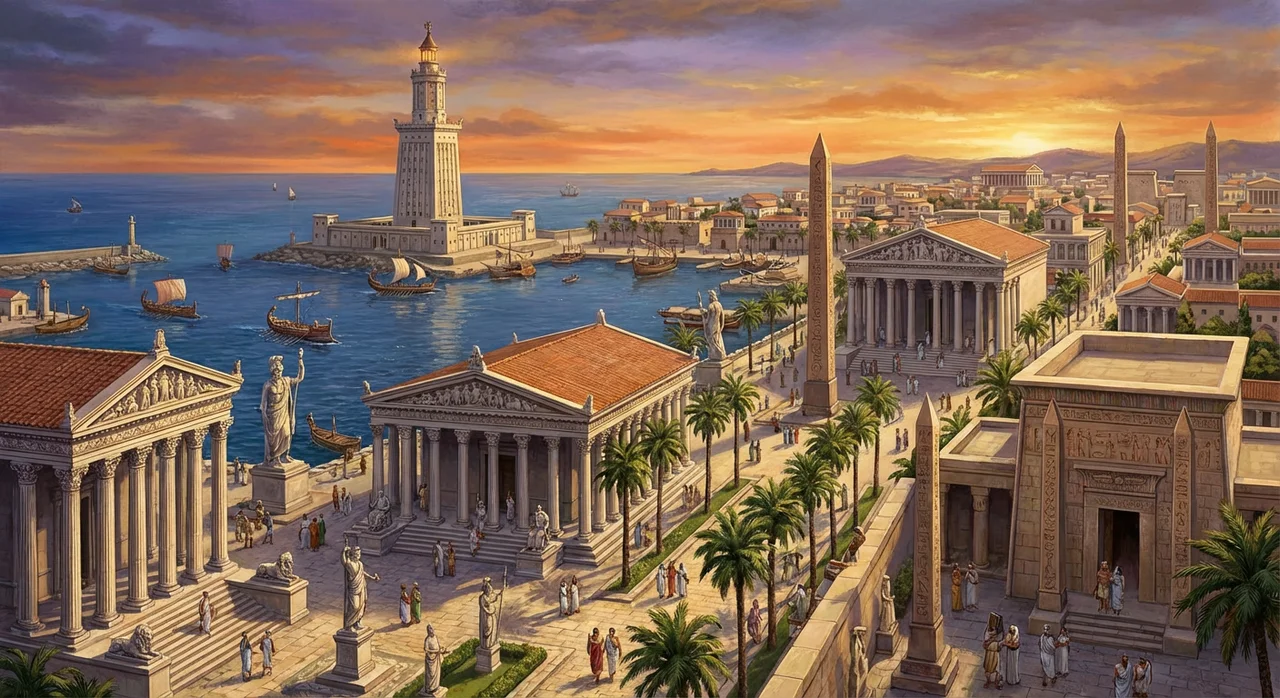
1. The Annexation of 30 BC: Augustus & The Emperor's Private Estate
Following the defeat of Mark Antony and the suicide of Cleopatra VII in August 30 BC, Octavian (shortly to become Emperor Augustus) established an entirely unprecedented administrative status for Egypt:
- The Emperor’s Private Domain: Unlike provinces governed by the Roman Senate, Egypt was treated as the personal property of the Emperor. Augustus decreed that no Roman senator or prominent patrician could visit Egypt without the emperor's explicit personal permission, under penalty of death;
- The Strategic Calculation: Roman historian Tacitus noted that Augustus recognized that a single rebellious general in Alexandria could seize the Nile's grain supply and bring the city of Rome to starvation within weeks;
- Reorganizing the Corvée and Canals: Augustus deployed his legions to clear the silted canal networks across the Nile Delta and Valley, which had fallen into neglect during late Ptolemaic civil wars, restoring grain production to unprecedented historical levels;
- Securing the Southern Frontier: When the Kandake (Queen) of Kush launched an invasion of Upper Egypt in 25 BC, Prefect Gaius Petronius counter-attacked, marching south to sack the Kushite religious capital of Napata and establishing a permanent fortified Roman border at Primis (Qasr Ibrim).
2. The Prefectural Administration: Equestrian Governance & Three Legions
Because senators were barred from the province, Augustus broke Roman constitutional tradition by governing Egypt through the knightly Equestrian Order (Ordo Equester):
The governor of Egypt was the Prefect of Egypt, second in power only to the Praetorian Prefect in Rome. Possessing imperium over life and death, the prefect held royal authority, commanded imperial legions, supervised grain collections, and conducted annual judicial assizes (conventus) across Upper, Middle, and Lower Egypt.
- The Garrison Legions: Augustus permanently stationed three full Roman legions in Egypt (later reduced to two under Hadrian: Legio II Traiana Fortis and Legio XXII Deiotariana), headquartered in the vast military fortress of Nicopolis outside Alexandria and at the fortress of Babylon (modern Old Cairo);
- The Epistrategoi: The province was divided into three broad regional administrative districts (epistrategiai): the Delta, the Heptanomia (Middle Egypt and Faiyum), and the Thebaid (Upper Egypt), each managed by an imperial procurator supervising traditional native nomarchs and scribes.
3. The Imperial Breadbasket: The Annona Fleet & Alexandria's Granaries
The foundation of the social contract in the capital of the empire was summarized by the satirist Juvenal as "bread and circuses" (panem et circenses), and Egypt was the literal engine providing that bread:
- The Annona Civica: Egypt supplied approximately 20 million modii of grain (an estimated 150,000 to 175,000 metric tons) to Rome each year—representing roughly one-third of the empire's capital grain consumption;
- The Alexandria Grain Fleet:
• Colossal specialized merchant grain freighters, measuring over 55 meters in length and 14 meters wide (such as the famed ship Isis described by Lucian), sailed in seasonal convoys across the Mediterranean;
• Sailing from the Great Harbor of Alexandria, they followed counter-clockwise Mediterranean currents past Crete and Sicily to the Italian ports of Puteoli and Ostia (Portus); - The Tax Bureaucracy: Every harvest, imperial tax assessors measured agricultural fields based on Nile flood levels, demanding compulsory grain levies transported downriver on registered Nile barges to the colossal imperial granary complexes (horrea) at Alexandria.
4. Oceanic Red Sea Trade: The Periplus of the Erythraean Sea & Berenike
Under Roman rule, Egypt transformed into the primary commercial highway connecting the Mediterranean world directly with sub-Saharan Africa, Arabia, and India:
- The Monsoon Breakthrough (Hippalus): Circa the 1st century BC, a Greek navigator named Hippalus discovered how to harness the seasonal southwest monsoon winds (Hippalos) to sail open-ocean across the Arabian Sea directly to the Malabar coast of India in just forty days;
- The Ports of Berenike and Myos Hormos:
• Strabo recorded that whereas under the late Ptolemies barely twenty ships sailed from the Red Sea, under Augustus over 120 massive merchant ships sailed annually from Berenike and Myos Hormos to India;
• Archaeological excavations at Berenike by Steven Sidebotham unearthed Indian black peppercorns, teak wood, Tamil-Brahmi pottery inscriptions, coconuts, and silk; - The Coptos Desert Highway: Luxury merchandise arriving at Red Sea ports was transported across the Eastern Desert on 12-day camel and donkey caravans along fortified desert roads equipped with cistern waystations (hydreumata) to the Nile river port of Coptos (Qift), where goods paid a 25% luxury customs duty (tetarte) before floating downriver to Alexandria.
5. Imperial Desert Quarries: Mons Porphyrites & Mons Claudianus
The barren, hyper-arid granite mountains of Egypt's Eastern Desert became the personal stone quarries for the monuments of Rome:
Located 55 kilometers inland from Hurghada, Mons Porphyrites is the world's sole geological source of purple-red imperial porphyry. Because purple was the exclusive color of the Roman emperors, this stone was strictly reserved for royal statuary, imperial sarcophagi, and the round porphyry discs (rotae) on the floors of imperial palaces and Saint Peter's Basilica.
- Mons Claudianus (جبل الفواخير):
• A vast Roman quarry fortress town situated 500 meters above sea level in the Red Sea mountains;
• Quarried granodiorite (a speckled grey-white stone);
• Hundreds of monolithic columns—each measuring 12 meters (39 feet) high and weighing up to 84 tons—were extracted and hauled on multi-wheeled wooden wagons pulled by dozens of pairs of oxen across the desert to the Nile, shipped to Rome to construct the portico of the Pantheon and Trajan’s Forum.
6. Ethnic Stratification & Alexandria Riots: Greeks, Romans & Jews
Roman rule imposed a strict, race-and-class-based legal hierarchy upon the multi-ethnic population of Egypt:
- The Tripartite Social Pyramid:
• Romans: The tiny ruling elite, exempt from poll taxes;
• Greeks (Citizens of Alexandria, Naukratis, Ptolemais): Enjoyed municipal self-government, gymnasial educations, and reduced tax rates;
• Aegyptioi (Native Egyptians and Rural Inhabitants): Subject to the full, humiliating poll tax (laographia) and forced agricultural labor; - The Jewish Community of Alexandria: Alexandria possessed the largest Jewish population in the Hellenistic world (roughly 100,000 citizens occupying two of the city's five quarters), producing intellectuals like philosopher Philo of Alexandria;
- The Alexandrian Pogrom of 38 AD:
• Incited by anti-Semitic Greek civic leaders and Roman Prefect Aulus Avillius Flaccus;
• Synagogues were desecrated with statues of Emperor Caligula, Jewish homes were plundered, and citizens were forced into overcrowded ghettos;
• When Emperor Claudius ascended the throne in 41 AD, he issued the famous Letter to the Alexandrians, warning both communities: "I tell you once and for all that if you do not cease this mutual ruinous rage, I shall be forced to show what a benevolent prince can do when moved to righteous indignation!"
7. The Kitos War (115–117 AD): The Diaspora Jewish Rebellion in Cyrene & Egypt
During the final years of Emperor Trajan, ethnic tensions erupted into one of the most violent civil insurrections in Mediterranean history:
- The Insurrection of 115 AD: While Trajan was campaigning against Parthia in Mesopotamia, the Jewish populations of Cyrene (Libya) and Egypt launched a massive messianic uprising;
- Widespread Devastation in the Nile Delta: The rebels marched across the Delta, destroying pagan temples, sacking Greek settlements, and threatening Alexandria itself; Greek civic populations responded with brutal massacres inside the capital;
- Suppression by Marcius Turbo: Trajan dispatched General Quintus Marcius Turbo with imperial legions and praetorian cohorts, ruthlessly crushing the rebellion by 117 AD;
- Permanent Demise of Alexandrian Jewry: The Great Synagogue of Alexandria was destroyed, and the ancient Jewish community of Egypt was virtually annihilated, not recovering its demographic and cultural standing until the late Roman and Byzantine eras.
8. Emperors as Pharaohs: Trajan, Trajan’s Kiosk & Amnis Traianus Canal
Roman emperors recognized that religious architectural patronage in Upper Egypt was essential for pacifying native priestly elites:
- The Caesar-Pharaohs on Temple Walls:
• On the walls of Dendera, Esna, Kom Ombo, and Philae, Roman emperors—from Augustus, Tiberius, and Claudius to Nero, Vespasian, and Trajan—are carved in traditional pharaonic raised relief;
• Endowed with full Egyptian royal cartouches: Augustus was inscribed as Autokrator Kaisar;
• Depicted wearing the Double Crown and kilt, presenting sacred offerings of incense, wine, and Ma'at before Horus, Isis, Hathor, and Khnum; - Trajan’s Kiosk at Philae (كشك تراجان — "Pharaoh's Bed"):
• An iconic, roofless hypaethral sandstone pavilion rising on Agilkia Island in Aswan, supported by fourteen soaring composite floral columns;
• Carved with reliefs depicting Emperor Trajan burning incense and offering wine to Osiris and Isis; - Amnis Traianus (The Canal of Trajan): Re-excavated and enlarged the ancient canal connecting the Nile near Babylon (Old Cairo) through Bilbeis to the Red Sea at Clysma (Suez), enabling direct water transit between the Mediterranean and the Indian Ocean.
9. Hadrian in Egypt (130–131 AD): The Death of Antinous & Antinoöpolis
In 130 AD, the philhellenic Emperor Hadrian embarked on an imperial progress down the Nile accompanied by his empress Vibia Sabina and his beloved youth companion, Antinous:
While sailing in Middle Egypt near Hermopolis Magna, Antinous mysteriously drowned in the waters of the Nile. Whether his death was an accident, suicide, or a ritual human sacrifice to prolong the emperor’s life according to Egyptian magic remains an unsolved historical mystery. Hadrian wept uncontrollably, declaring Antinous a divine god.
- Founding the City of Antinoöpolis (أنصنا / الشيخ عبادة):
• On the east bank of the Nile opposite Hermopolis where Antinous drowned, Hadrian founded a monumental Greek city named Antinoöpolis;
• Designed with a classical Roman grid, colonnaded thoroughfares, triumphal arches, a grand theater, a circus for chariot racing, and a magnificent temple to Antinous-Osiris; - The Singing Colossi of Memnon:
• In November 130 AD, Hadrian and Empress Sabina visited the Colossi of Memnon on the Theban West Bank;
• At sunrise, the damaged northern colossus produced a high-pitched musical sound (caused by evaporation in morning dew fractures); court poetess Julia Balbilla carved four commemorative Greek poems into the legs of the statue recording that the god had greeted the imperial couple.
10. The Fayum Mummy Portraits: Encaustic Mastery & Funeral Syncretism
The ultimate visual embodiment of Greco-Roman Egypt is found in the exquisite mortuary art developed in the Faiyum Oasis (Hawara, Karanis, Philadelphia):
- The Convergence of Three Worlds:
• Egyptian Religion: Complete preservation of bodily mummification, embalming rites, linen bandaging, and the Osirian hope of afterlife resurrection;
• Greek Portraiture Tradition: Realism, psychological depth, and anatomical accuracy derived from classical Hellenistic painting schools;
• Roman Fashion and Status: Subjects are depicted wearing Roman imperial hairstyles (curls of the Flavian era or braids of Faustina), Roman togas and tunics, and Mediterranean gold pearl jewelry; - The Encaustic Wax Technique:
• Painted on thin cedar, fig, or sycamore wooden panels using hot pigmented beeswax (encaustic) applied with metal spatulas (cauteria) and brushes;
• The beeswax created luminous, highly durable impasto textures that have preserved their vivid, lifelike colors for over two thousand years without fading; - Psychological Modernity: Unlike the flat, idealized masks of pharaonic times, Fayum portraits depict living, breathing individuals—young women with sparkling dark eyes, bearded Roman veterans, and fragile children—staring directly into the eyes of the viewer across two millennia.
11. Third Century Crisis: Zenobia's Palmyrene Conquest & Diocletian's Reforms
During the catastrophic military, economic, and plague-ridden Crisis of the Third Century, Egypt was dragged into civil chaos:
- The Palmyrene Conquest of Egypt (270–272 AD):
• The ambitious warrior queen Zenobia of Palmyra invaded Egypt with 70,000 troops, claiming descent from Cleopatra VII;
• Defeated Roman prefect Probatus and annexed Egypt into the breakaway Palmyrene Empire, cutting grain shipments to Rome;
• Emperor Aurelian marched into Egypt in 272 AD, defeating the Palmyrene garrison, recapturing Alexandria, and burning parts of the royal Bruchion district; - The Rebellion of Domitius Domitianus & Achilleus (297–298 AD): Emperor Diocletian besieged Alexandria for eight months, starving the city into submission; to commemorate his victory, a 27-meter red granite monolithic column—erroneously called Pompey’s Pillar (عمود السواري)—was erected in the Serapeum;
- Diocletian’s Radical Reorganization (298 AD):
• Abolished Egypt’s special private status, dividing it into standard Roman administrative provinces (Aegyptus Iovia, Aegyptus Herculia, and Thebaid);
• Withdrew the southern Roman frontier from the Second Cataract back to Aswan (Elephantine), paying annual subsidies to the Nobatae and Blemmyes tribes to guard the border; - The Great Persecution (303–311 AD): Diocletian unleashed the fiercest empire-wide persecution of Christians in history. Egypt suffered horrific executions; so profound was the trauma that the Coptic Orthodox Church dated its official calendar—the Era of the Martyrs (تقويم الشهداء)—from the accession of Diocletian in 284 AD.
12. Master Roman Egypt Chronological & Imperial Matrix (30 BC – 330 AD)
The following matrix details the major chronological phases, ruling Roman dynasties, prefects, and historical milestones across three centuries of Roman rule in Egypt:
| Imperial Dynasty / Era | Date Span | Prominent Emperors & Prefects | Administrative & Economic Actions | Major Architectural & Historic Milestones |
|---|---|---|---|---|
| Julio-Claudian Dynasty | 30 BC – 68 AD | Augustus, Tiberius, Caligula, Claudius, Nero (Prefects: Cornelius Gallus, Petronius, Flaccus) |
Aegyptus established as Emperor’s private estate; Annona grain fleet organized; poll tax (laographia) instituted. | Kushite invasion repelled at Qasr Ibrim; Alexandria Pogrom (38 AD); Claudius’ Letter to Alexandrians. |
| Flavian Dynasty | 69 – 96 AD | Vespasian, Titus, Domitian (Prefect: Tiberius Julius Alexander) |
Vespasian proclaimed Emperor by legions in Alexandria (69 AD); temple taxes redirected to Jupiter Capitolinus. | Temple of Esna construction; expansion of Mons Porphyrites quarry infrastructure. |
| Nerva-Antonine Dynasty | 96 – 192 AD | Trajan, Hadrian, Antoninus Pius, Marcus Aurelius | Deepening of Amnis Traianus canal; flourishing of Red Sea India trade via Berenike; Roman grain peak. | Trajan’s Kiosk at Philae; Kitos War (115–117 AD); Hadrian visits Egypt & founds Antinoöpolis (130 AD). |
| Severan Dynasty | 193 – 235 AD | Septimius Severus, Caracalla, Severus Alexander | Severus grants Alexandria a municipal senate (Boule) in 200 AD; Caracalla’s Constitutio Antoniniana (212 AD) grants citizenship. | Fayum Mummy Portraits reach artistic zenith; Caracalla’s brutal massacre of Alexandrian youth (215 AD). |
| Crisis of 3rd Century | 235 – 284 AD | Decius, Valerian, Aurelian, Queen Zenobia of Palmyra | Economic inflation; plague of Cyprian; Palmyrene Empire invades and annexes Egypt (270–272 AD). | Decian Christian persecutions (250 AD); Aurelian burns Bruchion district; Blemmyes raids in Upper Egypt. |
| Tetrarchy & Diocletian | 284 – 330 AD | Diocletian, Maximian, Galerius, Constantine I | Diocletian besieges Alexandria (297 AD); divides Egypt into three dioceses; border withdrawn to Aswan. | Pompey's Pillar erected; Great Persecution (303 AD); Coptic Era of Martyrs begins; transition to Byzantine era. |
13. Private Curated Roman Archaeological Expeditions with Ultra Egypt Travel
Exploring the vast Roman heritage of Egypt—from standing before Pompey’s Pillar and descending into the multi-level Catacombs of Kom El Shoqafa in Alexandria to exploring Trajan’s Kiosk at Philae, the ruins of Antinoöpolis in Middle Egypt, and the desert quarry fortresses of Mons Porphyrites—requires specialized academic guidance, desert permits, and executive luxury logistics.
Operating under Ministry of Tourism License #874 (Class A) and IATA Accreditation #90229930, Ultra Egypt Travel delivers bespoke private Roman-era historical expeditions:
- The Alexandria Roman Necropolis & Theater Masterclass: Private chauffeured expedition exploring the Roman Amphitheater at Kom El Dikka, the mosaic Villa of the Birds, the Catacombs of Kom El Shoqafa (blending Roman, Greek, and Egyptian art), and Pompey's Pillar with university academic Egyptologists;
- The Faiyum Oasis & Mummy Portraits Heritage Tour: Private 4x4 expedition to the ancient Roman towns of Karanis (Kom Aushim) and Philadelphia, exploring preserved Roman mudbrick houses, olive presses, granaries, and the archaeological origins of the world-famous Fayum Mummy Portraits;
- The Eastern Desert Roman Quarry Safari (Mons Porphyrites & Claudianus): Exclusive 4x4 desert expedition from Hurghada into the Red Sea mountains to explore the preserved Roman quarry forts, workers' barracks, stone ramps, and unfinished megalithic columns at Mons Claudianus and Mons Porphyrites;
- The Upper Egyptian Roman Temple Circuit: Private guided tours of Trajan’s Kiosk on the Island of Philae in Aswan, the Roman birth house (mammisi) at Dendera, and the hypostyle hall of Esna Temple;
- VIP Chauffeured Protocol: Executive climate-controlled Mercedes-Benz vehicles, private 4x4 Land Cruisers for Sahara and Eastern Desert transit, private airport meet-and-assist, all required antiquities permissions, and 24/7 dedicated operational monitoring from our Cairo headquarters.