1. Geopolitical Context: Issus, Tyre & The Persian Collapse
Alexander's campaign into Egypt was the strategic culmination of his early Mediterranean offensive against the Achaemenid Empire of King Darius III:
- Securing the Mediterranean Flank: Following his shattering tactical victory over Darius III at the Battle of Issus (333 BC), Alexander chose not to pursue the Persian Great King immediately into the Mesopotamian heartland. Instead, he marched south along the Levantine coast to neutralize the Phoenician naval bases that supplied the Persian fleet;
- The Brutal Sieges of Tyre and Gaza (332 BC): After a grueling seven-month siege of island Tyre and two months reducing the fortified stronghold of Gaza, the overland route to Egypt lay completely open;
- The Egyptian Prize: Egypt was the wealthiest, most populous, and strategically decisive province of the Persian Empire. Controlling Egypt meant neutralizing Persian naval power in the eastern Mediterranean, securing infinite grain reserves, and commanding trade gateways into Africa and Arabia.
2. Bloodless Entry: The Surrender of Pelusium & Mazaces
In late October 332 BC, Alexander marched his army of approximately 40,000 Macedonians, Greeks, and allied mercenaries past the Bardawil lagoon into the eastern frontier fortress of Pelusium (Tell el-Farama):
The Persian satrap of Egypt, Mazaces, possessed neither troops nor local political loyalty. Darius III had stripped Egypt’s garrison troops to fight at Issus, where they were annihilated. Aware of the brutal fates of Tyre and Gaza, and acutely conscious that the Egyptian native population despised Persian rule, Mazaces met Alexander at Pelusium and surrendered peacefully, turning over the provincial treasury containing 800 silver talents and the royal palaces without a single arrow being fired!
- Welcomed as Liberators: For decades, the Egyptians had suffered under Persian punitive rule—most recently the brutal re-conquest by Artaxerxes III Ochus in 343 BC, which involved temple desecration and heavy taxation. Alexander was received not as a conqueror, but as the long-awaited divine champion sent to banish foreign chaos (Isfet).
3. Pharaonic Coronation at Memphis & The Apis Bull Sacrifices
Sailing up the Nile with his fleet while his infantry marched along the riverbank, Alexander entered the ancient capital of Memphis (Ineb-Hedj):
- Sacrifice to the Sacred Apis Bull:
• Alexander’s first official public act was to enter the Great Temple of Ptah and offer lavish animal sacrifices to the living Apis Bull (حور-حابي);
• This was a masterclass in psychological statecraft: Persian king Cambyses was reviled in Egyptian memory for allegedly murdering the Apis Bull; Alexander did the exact opposite, demonstrating total reverence for traditional Egyptian sacred zoomorphism; - Traditional Pharaonic Coronation:
• In the Temple of Ptah at Memphis, the High Priest crowned Alexander with the Double Crown (Pschent) as legitimate King of Upper and Lower Egypt;
• He was endowed with a complete fivefold Egyptian royal titulary; his throne cartouche read: Meryamun Setepenra (مري آمون ست إن رع — "Beloved of Amun, Chosen of Ra"), and his personal name was inscribed as Alaksandros; - Greek Games in Egyptian Temples: To satisfy both his Macedonian veterans and his new Egyptian subjects, Alexander staged Greek musical contests and gymnastic athletic games in Memphis, inviting celebrated actors and athletes from mainland Greece.
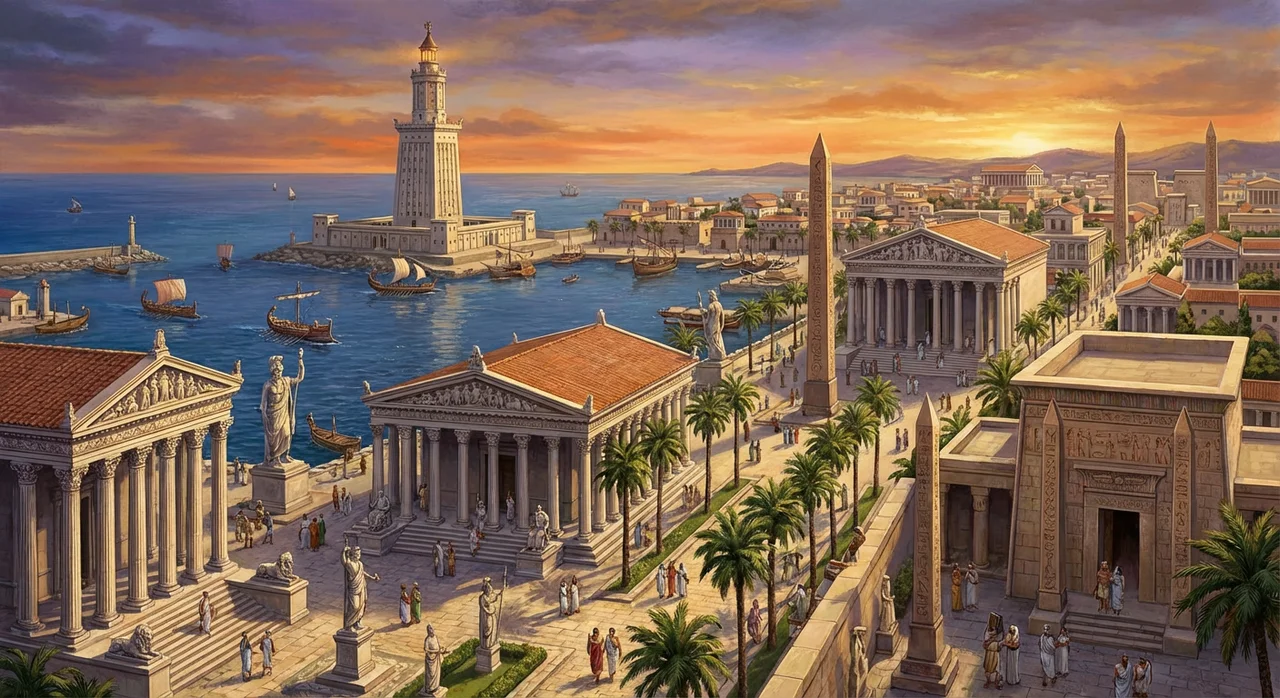
4. Founding Alexandria (April 331 BC): Dinocrates' Urban Masterpiece
In early spring of 331 BC, Alexander sailed down the Canopic branch of the Nile toward the Mediterranean coast to establish a permanent naval and commercial port:
- The Selection of Rhakotis:
• Alexander bypassed the marshy, silted mouths of the Nile Delta, selecting a narrow, limestone isthmus situated between the Mediterranean Sea and the freshwater Lake Mareotis (Lake Mariout);
• Fronted by the natural barrier of Pharos Island, the location offered deep, sheltered double harbors protected from prevailing storms; - The Barley Meal Demarcation:
• According to Plutarch and Arrian, Alexander personally walked the ground, designing the street grid, agora, royal quarter, and temple precincts dedicated to both Greek and Egyptian deities;
• Lacking chalk or limestone powder, the king’s surveyors used ground barley meal from the soldiers' rations to trace the city's perimeter;
• A flock of sea birds suddenly descended and consumed the barley meal; Alexander’s royal seer, Aristander of Telmessos, interpreted this as a divine omen: the new city would grow to feed the entire civilized world; - Dinocrates of Rhodes: Alexander entrusted the architectural execution to the celebrated urban planner Dinocrates, who engineered an expansive Hippodamian grid plan centered around the magnificent Canopic Way, creating what would become the intellectual capital of the ancient world: Alexandria ad Aegyptum.
5. The Epic Desert Pilgrimage to the Oracle of Amun at Siwa Oasis
From Alexandria, Alexander did not return to his army; instead, he initiated one of the most perilous spiritual pilgrimages in ancient biography:
Alexander marched his elite companion escort along the Mediterranean coast to Paraetonium (modern Marsa Matruh), before turning due south into the trackless, waterless dunes of the Libyan Desert toward the isolated oasis of Siwa (Ammonium — واحة سيوة).
- The Miracles in the Desert: Both Arrian and Callisthenes record that the expedition ran out of water and lost its route amid shifting sandstorms:
• The Rain Miracle: Sudden, torrential desert rains fell from the heavens, replenishing the army's water skins;
• The Divine Guides: Ptolemy, son of Lagus, recorded that two talking serpents guided the expedition through the dunes, while Aristobulus maintained that two black ravens flew before the army, calling out whenever the soldiers lost the trail; - Arrival at Aghurmi: After eight days of grueling march, Alexander reached the lush palm groves, freshwater springs, and towering limestone cliff of Aghurmi, home to the internationally revered Oracle Temple of Amun (Zeus-Ammon).
6. The Prophecy of Siwa: "O, Son of Zeus-Ammon" & Cosmic Deification
Entering the inner sanctuary of the temple alone, Alexander consulted the high priest of the Oracle:
- The Sacred Linguistic Greeting:
• Historical legend (recorded by Plutarch) recounts that the elderly Egyptian priest, wishing to welcome Alexander in Greek with "O, pai dion" ("O, my child"), mispronounced the Greek words due to his heavy Egyptian accent as "O, pai Dios" (ὦ παῖ Διός — "O, Son of Zeus!");
• Alexander eagerly seized upon this greeting, interpreting it not as a grammatical slip, but as the direct voice of the god revealing his true biological and cosmic father; - The Secret Inquiries:
• Inside the sanctuary, Alexander asked two questions: whether any of his father Philip II’s murderers had escaped punishment (the priest answered that Philip's murder was avenged, as his real father was immortal), and whether he would conquer the entire Earth (to which the god answered affirmatively);
• Alexander never publicly revealed the exact words spoken in the inner sanctum, writing only to his mother Olympias that he received "secret answers that he would reveal to her alone upon his return"; - The Ram Horns of Ammon: Following Siwa, Alexander permanently integrated the ram horns of Amun-Ra into his official royal iconography. In subsequent Hellenistic coins and sculptures, he was portrayed with curved ram horns sweeping back through his hair, known across the Near East as Dhu al-Qarnayn ("The Two-Horned One").
7. Administrative Organization of Egypt: Balance of Power
Returning to Memphis in April 331 BC, Alexander proved he was an astute administrative architect before marching east to conquer Persia:
- A System of Divided Powers: Wary of appointing a single all-powerful governor who might rebel with Egypt's immense wealth, Alexander deliberately fractured civil, military, and financial power:
• Civil Government: Divided between two native Egyptian governors: Doloaspis governing Upper Egypt and Petisis governing Lower Egypt (when Petisis resigned, Doloaspis governed both);
• Military Command: Entrusted to two Macedonian generals, Peucestas and Balacrus, commanding permanent garrison troops;
• Naval Defense: Entrusted to Polemon, commanding a permanent fleet of thirty triremes stationed at Alexandria;
• Financial Administration: Entrusted to Cleomenes of Naucratis, an unscrupulous financial genius who amassed an enormous royal reserve by monopolizing Egyptian grain exports during Greek famines; - Preservation of Native Nomarchs: Alexander preserved the traditional 42 nomes (provinces) of Egypt, retaining local Egyptian judicial and priestly authorities while placing tax collection under central Hellenistic oversight.
8. Alexander's Departure & Lasting Legacy Across the Nile
In May 331 BC, Alexander marched out of Egypt, crossing the Sinai toward Syria and the plains of Gaugamela, never to see the Nile alive again:
- Temple Restorations Across the Nile:
• Even in his absence, royal funding flowed to native temples;
• At Luxor Temple, the central granite sanctuary was completely rebuilt in Alexander’s name; exquisite relief carvings depict Alexander wearing the Double Crown kneeling before Amun-Ra, receiving the breath of life;
• At Karnak Temple, monumental gateway renovations were inscribed with his cartouches; - The Cultural Shift: Alexander’s six months in Egypt established the foundation for three centuries of the Ptolemaic Dynasty, sparking an unprecedented cultural synthesis where Greek philosophy, science, and trade flourished upon the eternal foundation of Pharaonic civilization.
9. Death in Babylon (323 BC) & The Hijacking of the Imperial Hearse
On June 10, 323 BC, Alexander died in the palace of Nebuchadnezzar II in Babylon at age 32. His death triggered an epic international struggle for his physical body:
For two years, imperial craftsmen constructed a colossal, gold-roofed ceremonial carriage pulled by 64 mules, intended to transport Alexander's embalmed body to Aigai in Macedonia. According to Babylonian oracles, whichever land held Alexander's body would be prosperous and unconquerable. As the funeral cortege crossed Syria, Ptolemy, son of Lagus (satrap of Egypt) marched with an elite military force, intercepted the carriage, and escorted Alexander's golden sarcophagus safely to Egypt!
- Initial Enshrinement at Memphis: Ptolemy initially interred Alexander's body within the sacred temple precinct at Memphis, where he was worshipped as a deified pharaoh for nearly four decades;
- Translation to Alexandria (circa 280 BC): Under Ptolemy II Philadelphus, Alexander’s sarcophagus was moved to Alexandria and enshrined in a magnificent royal mausoleum known as the Soma (السوما — or Sema) in the royal Palaces district.
10. The Lost Soma: The Eternal Mystery of Alexander’s Tomb in Alexandria
For five centuries, Alexander’s tomb in Alexandria was the most visited and venerated monument in the ancient world:
- Imperial Roman Pilgrimages:
• Julius Caesar visited the tomb in 48 BC, paying tearful homage to his idol;
• Augustus (Octavian) visited in 30 BC, placing a golden crown on Alexander’s head and scattering flowers over the body (accidentally breaking a piece of Alexander's nose when leaning forward to kiss the corpse);
• Caligula visited and famously took Alexander's breastplate from the tomb to wear in his own triumphs;
• Caracalla visited in 215 AD, leaving his own imperial purple cloak and rings on the sarcophagus; - The Crystal Sarcophagus: Ptolemy IX Soter II melted down Alexander's original solid-gold inner coffin to pay mercenary debts, replacing it with an identical, transparent sarcophagus of pure rock crystal and glass;
- Disappearance in Late Antiquity:
• Following the riots of Bishop Theophilus (391 AD), earthquakes, tsunamis (365 AD), and Christianization, references to the exact location of the Soma vanished from official records;
• By 400 AD, Saint John Chrysostom famously taunted the pagans of Alexandria: "Where, tell me, is the tomb of Alexander? Show it to me!";
• Today, the location of Alexander's tomb remains one of archaeology's greatest holy grails, speculated to lie beneath the Nabi Daniel Mosque, the Latin Cemetery of Shatby, or submerged in the ancient Eastern Harbor.
11. Master Timeline Matrix of Alexander the Great in Egypt
The following matrix details the chronological itinerary, major events, and lasting monuments of Alexander the Great’s historic campaign in Egypt:
| Date / Era | Location / Site | Historical Action / Event | Significance & Archaeological Legacy |
|---|---|---|---|
| October 332 BC | Pelusium (Tell el-Farama) | Peaceful entry into Egypt; surrender of Satrap Mazaces. | Bloodless transfer of sovereign authority and 800 silver talents. |
| November 332 BC | Memphis (Temple of Ptah) | Coronation as Pharaoh; animal sacrifice to the Apis Bull. | Adopted royal titulary Meryamun Setepenra; won priestly backing. |
| Winter 332/331 BC | Canopic Nile & Rhakotis | Selection of the site for Alexandria; barley meal surveying. | Dinocrates designs the Mediterranean’s greatest Hellenistic capital. |
| February 331 BC | Siwa Oasis (Aghurmi Plateau) | Pilgrimage to the Oracle of Amun; greeted as "Son of Zeus." | Cosmic divine deification; adopted the sacred ram horns of Ammon. |
| April 331 BC | Memphis | Administrative reorganization; division of civil and military power. | Appointed Doloaspis and Cleomenes; preserved 42 nomes. |
| May 331 BC | Sinai / Levant | Departure from Egypt to march toward Mesopotamia and Gaugamela. | Never returned to Egypt alive; left permanent Hellenistic foundations. |
| 321 BC | Syria to Memphis | Ptolemy I intercepts Alexander's funeral cortege. | Enshrines Alexander's golden body at Memphis; secures dynastic legitimacy. |
| ~280 BC | Alexandria (Soma / Sema) | Ptolemy II moves Alexander's body to Alexandria. | The Soma mausoleum becomes the premier pilgrimage shrine of the Roman world. |
12. Private Curated Alexander Expeditions with Ultra Egypt Travel
Walking the ancient Mediterranean foundation stones of Alexandria, standing in the inner granite sanctuary of Alexander at Luxor Temple, journeying across the dunes to the Oracle Temple of Amun at Siwa Oasis, or exploring the Memphis Open-Air Museum with certified academic Egyptologists requires specialized logistical permits, desert expertise, and executive ground comfort.
Operating under Ministry of Tourism License #874 (Class A) and IATA Accreditation #90229930, Ultra Egypt Travel delivers bespoke private historical expeditions retracing the exact steps of Alexander the Great across Egypt:
- The Alexandria Alexander the Great Masterclass: Private chauffeured day expedition exploring the ancient sites of Alexandria—the Roman Amphitheater at Kom El Dikka, the Catacombs of Kom El Shoqafa, Pompey's Pillar (Serapeum), Fort Qaitbay (Pharos Lighthouse foundation), and the modern Bibliotheca Alexandrina;
- The Siwa Oasis Desert Expedition (In the Footsteps of Alexander): Private 4x4 overland safari across the Western Desert from Cairo or Marsa Matruh to Siwa Oasis, exploring the Temple of the Oracle (Aghurmi), the Temple of Umm Ubayd, the Mountain of the Dead (Gabal al-Mawta), and Cleopatra’s Bath;
- The Memphis & Luxor Temple Imperial Tour: Private guided analysis of the coronation temple of Ptah in Memphis and the inner granite sanctuary of Alexander the Great inside Luxor Temple, deciphering his royal Greek-pharaonic cartouches;
- VIP Chauffeured Protocol: Executive climate-controlled Mercedes-Benz vehicles, private 4x4 Land Cruisers for Sahara transit, private airport meet-and-assist, all required antiquities permissions, and 24/7 dedicated operational monitoring from our Cairo headquarters.