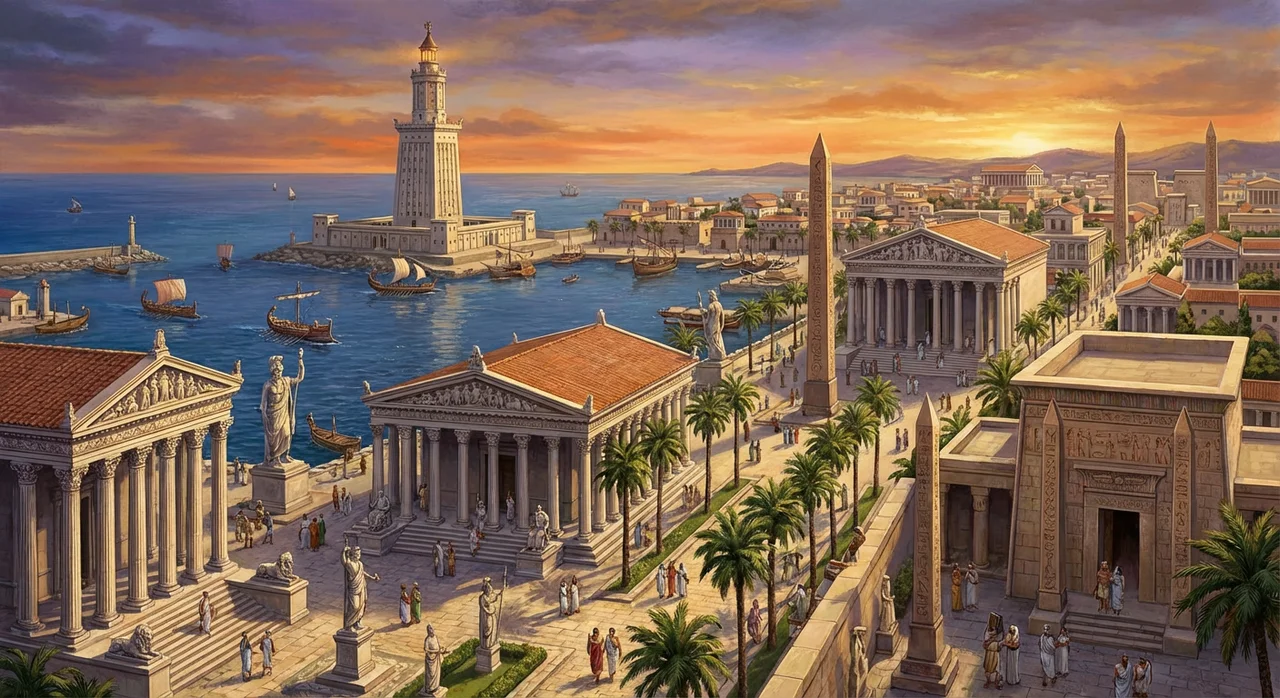
1. Early Life & Dynastic Debt: The Shadow of Ptolemy XII Auletes
Cleopatra was born in Alexandria in early 69 BC into a collapsing dynasty whose survival hung by a thread:
- The Subservience of Auletes: Her father, Ptolemy XII Auletes ("The Flute Player"), had mortgaged Egypt's economic sovereignty to the Roman Republic. To secure official Roman recognition of his throne, Auletes paid colossal bribes totaling 6,000 silver talents to Roman generals Julius Caesar and Pompey the Great;
- Exile and Restoration: When Alexandrian mobs revolted against crippling taxes and drove Auletes into exile in 58 BC, his elder daughter Berenice IV seized power. Auletes secured a Roman invasion army commanded by Aulus Gabinius (featuring a young cavalry officer named Mark Antony) to retake Alexandria in 55 BC, executing Berenice;
- The Witness of Adolescent Cleopatra: As a teenager of fourteen, Cleopatra witnessed firsthand the humiliating weakness of the Ptolemaic monarchy, the danger of Alexandrian street violence, and the cold, terrifying military reality that Rome held the absolute balance of Mediterranean power.
2. Accession & Civil War: The Rift with Ptolemy XIII & Pothinus
In March 51 BC, Ptolemy XII died, naming in his will his 18-year-old daughter Cleopatra VII and her 10-year-old brother Ptolemy XIII as joint rulers:
- Cleopatra Asserts Autonomy: Rejecting traditional subordinate status, Cleopatra initially issued coins bearing her face alone and dropped her brother's name from official state documents, earning the loyalty of the agrarian population by personally inspecting famine-hit grain reserves during severe Nile droughts;
- The Palace Coup of Pothinus: By 49 BC, a regency council headed by the eunuch vizier Pothinus, general Achillas, and the rhetoric tutor Theodotus organized a palace coup against Cleopatra, manipulating the young Ptolemy XIII;
- Exile in Syria: Forced to flee Alexandria, Cleopatra did not surrender. She rode across the Sinai into Syria, assembled an army of Arab and Mediterranean mercenaries, and marched back to the eastern Egyptian frontier fortress of Pelusium in 48 BC to wage civil war against her brother.
3. Intellect & Language: The Pharaoh Who Spoke Egyptian
Ancient historians universally attest that Cleopatra’s true power lay not in physical beauty, but in her brilliant intellect and charismatic statesmanship:
"For her beauty, as we are told, was in itself neither incomparable nor such as to strike those who saw her; but familiarity with her had an irresistible charm, and her form, combined with her persuasive tongue and that character which was present about her every action, was stimulating to the highest degree. Her voice was like an instrument of many strings; she could easily turn her tongue to whatever language she pleased..."
- The Only Ptolemy Speaking Native Egyptian: For 250 years, the Macedonian Greek kings of Egypt lived in Alexandria, communicated exclusively in Greek, and required translators to speak with their native subjects. Cleopatra was the first and only Ptolemaic ruler who learned to speak, read, and write native Egyptian;
- Linguistic Master of the Ancient World: Plutarch recorded that she rarely needed an interpreter, conducting direct diplomatic audiences in nine languages: Greek, Egyptian, Hebrew, Aramaic, Arabic, Syriac, Ethiopian (Ge'ez), Mede, and Parthian;
- Scientific and Economic Acumen: Educated in the Mouseion of Alexandria, she authored treatise manuscripts on cosmetics, toxicology, and weights and measures, managing the kingdom's complex state monopolies and currency reforms with exceptional skill.
4. Julius Caesar & The Alexandrian War: The Carpet Myth vs. Reality
In late September 48 BC, Roman civil war collided violently with Egyptian internal politics:
- The Murder of Pompey the Great: Following his defeat by Julius Caesar at Pharsalus, Roman general Pompey sought sanctuary on the shores of Pelusium. Hoping to win Caesar's favor, Ptolemy XIII’s advisors murdered Pompey as he stepped ashore, presenting his severed head to Caesar when he sailed into Alexandria;
- Caesar's Wrath and Arbitration: Caesar wept in disgust at the dishonorable butchery of his former son-in-law, occupied the royal palaces of Alexandria with two depleted legions (4,000 men), and summoned Cleopatra and Ptolemy XIII to disband their armies and submit to royal arbitration;
- The Secret Infiltration into the Palace (The Bed-Sack Myth):
• Knowing that her brother's guards would murder her if she approached Alexandria openly, Cleopatra sailed at night in a small skiff accompanied by a single Sicilian loyalist, Apollodorus;
• Contrary to Victorian artistic myth depicting her rolled inside an exotic rug, ancient Greek sources (Plutarch) state she concealed herself inside a coarse, leather bed-sack (stromatodes), which Apollodorus carried past Roman sentries directly into Caesar’s private quarters;
• Caesar was captivated by her daring courage, quick wit, and eloquent political strategy; - The Alexandrian War (48–47 BC): Pothinus and Ptolemy XIII mobilized 20,000 Egyptian troops to besiege Caesar and Cleopatra inside the royal palace;
• In desperate street fighting, Caesar burned his fleet to prevent harbor capture (spreading fire to dockside warehouses containing export scrolls);
• Relieved by an allied army from Syria, Caesar crushed the royalist forces at the Battle of the Nile (47 BC); Ptolemy XIII drowned in the Nile under the weight of his golden armor;
• Caesar formally crowned Cleopatra VII as Queen of Egypt alongside her younger 12-year-old brother, Ptolemy XIV.
5. The Birth of Caesarion & Cleopatra in Rome (46–44 BC)
Following their victory, Caesar and Cleopatra embarked on a legendary two-month royal river cruise up the Nile to the First Cataract aboard the colossal royal river palace (Thalamegos):
- The Birth of Caesarion (June 47 BC): Cleopatra gave birth to Caesar's only biological son, named Ptolemy XV Caesarion ("Little Caesar" — قيصرون), consolidating her political claim that Egypt and Rome were destined to be co-ruled by their bloodline;
- Cleopatra's Residence in Rome (46–44 BC):
• In 46 BC, Caesar invited Cleopatra, her court, and young Caesarion to Rome, housing them in his private villa across the Tiber (Horti Caesaris);
• Caesar provoked massive conservative Roman outrage by erecting a gilded bronze statue of Cleopatra inside his newly inaugurated Temple of Venus Genetrix (the divine ancestress of the Julian clan), effectively deifying the foreign Egyptian queen inside the Roman Forum; - The Ides of March (44 BC): When Julius Caesar was assassinated on March 15, 44 BC, Cleopatra’s political hopes in Rome collapsed. Sensing imminent peril, she quietly fled Rome with Caesarion, returning to Alexandria to consolidate domestic control and poisoning her useless brother Ptolemy XIV to elevate Caesarion as co-ruler.
6. The Meeting at Tarsus (41 BC): Mark Antony & The Golden Barge
In the aftermath of the Roman civil war that destroyed Caesar's assassins at Philippi, Mark Antony emerged as master of the eastern Roman provinces:
Antony summoned Cleopatra to Tarsus in modern Turkey to answer charges regarding Egyptian aid during the civil war. Rather than arriving as a supplicant, Cleopatra orchestrated an overwhelming theatrical spectacle:
• Sailing up the Cydnus River in a magnificent golden barge with purple silk sails and silver-plated oars beating time to flutes and harps;
• Cleopatra reclined beneath a gold-embroidered canopy dressed as Aphrodite (Isis), fanned by boys dressed as Cupids, while her maidens were dressed as Nereids and Graces;
• Antony, who fancied himself the living incarnation of Dionysus (Osiris), was utterly captivated by her calculated political and sensual theater.
- The Strategic Pact: Antony promised military protection for Cleopatra and the execution of her treacherous rival sister Arsinoe IV; in return, Cleopatra funded Antony's upcoming imperial campaigns against the Parthian Empire with Egypt's immense gold treasury.
7. The Donations of Alexandria (34 BC): An Imperial Vision of the East
Cleopatra bore Mark Antony three children: twins Alexander Helios (the Sun) and Cleopatra Selene (the Moon) in 40 BC, and Ptolemy Philadelphus in 36 BC. In autumn of 34 BC, following Antony’s campaign in Armenia, the royal couple staged the provocative ceremony known as the Donations of Alexandria:
- The Golden Thrones in the Gymnasium: Before the assembled citizens of Alexandria, Antony and Cleopatra sat upon elevated solid-gold thrones beside their four royal children;
- Proclamation of Caesarion: Antony officially recognized Caesarion as the legitimate biological son of Julius Caesar, proclaiming him "King of Kings" and co-ruler of Egypt;
- Territorial Partition of the East:
• Alexander Helios was named king of Armenia, Media, and unconquered Parthia;
• Cleopatra Selene was granted Cyrenaica and Crete;
• Ptolemy Philadelphus was granted Syria, Phoenicia, and Cilicia; - The Direct Challenge to Rome: By recognizing Caesarion as Caesar's legitimate heir, Antony directly threatened Octavian (Caesar's adopted son in Rome), setting the stage for total civil war.
8. Octavian’s Propaganda War: Roman Smear Campaigns & The Will of Antony
Octavian waged a masterclass in psychological warfare, turning conservative Roman opinion against Cleopatra:
- The Demonization of the Egyptian Queen: Roman poets (Horace, Propertius, Virgil) and politicians systematically painted Cleopatra as an intoxicating Eastern sorceress, a drunken tyrant who had bewitched a noble Roman general into abandoning his homeland, religion, and Roman virtues;
- The Theft of Antony's Will (32 BC): Octavian illegally seized Mark Antony’s private will from the sacred custody of the Vestal Virgins in Rome and read it aloud to the Senate:
• The will confirmed colossal territorial grants to Cleopatra’s children;
• Most scandalously to Roman pride, Antony requested that upon his death, even if he died in Rome, his body should be transported across the Mediterranean to be buried beside Cleopatra in Alexandria; - War Declared on Cleopatra, Not Antony: In a brilliant legal maneuver, Octavian did not declare civil war on fellow Roman Antony; he declared foreign war solely on Queen Cleopatra VII of Egypt, framing the conflict as a patriotic defense of Western Rome against an Oriental despot.
9. The Battle of Actium (31 BC): Naval Tactics, Breakdown & Retreat
On September 2, 31 BC, the combined naval forces of Antony and Cleopatra clashed with Octavian and Admiral Agrippa off the coast of Actium in Greece:
- The Strategic Dilemma: Trapped inside the Gulf of Ambracia, suffering from malaria and food shortages, Antony’s heavy quinqueremes were outnumbered and outmaneuvered by Agrippa’s lighter, agile Liburnian warships;
- The Breakthrough Maneuver:
• Cleopatra commanded the Egyptian royal squadron of sixty warships held in reserve behind the Roman front lines, carrying the royal gold treasury on board;
• When a favorable wind blew southward, Cleopatra hoisted purple sails, punched directly through an opening in the center of the enemy battle line, and sailed toward the open Mediterranean;
• Seeing Cleopatra’s flagship break free, Antony abandoned his flagship, boarded a fast galley, and followed her with a handful of ships, leaving his fleet and legions to surrender; - Historical Revisionism: Hostile Roman historians framed Cleopatra’s action as cowardly desertion; modern naval historians recognize it as a pre-planned tactical breakout to rescue the royal war chest and sovereign leadership when military victory at Actium was already impossible.
10. The Fall of Alexandria & Suicide: The Asp, Poison & Defiance
Returning to Alexandria, Cleopatra fortified the harbor, attempted to drag her fleet across the Isthmus of Suez into the Red Sea, and sent Caesarion toward India with vast treasures:
When Octavian’s legions breached the defenses of Alexandria, Antony received false rumors that Cleopatra had already committed suicide inside her royal mausoleum. In despair, Antony fell upon his own sword. Fatally wounded, he learned she was still alive and had himself hoisted through the upper window of her mausoleum, dying in her arms.
- Capture by Octavian: Octavian captured Cleopatra alive inside her mausoleum, placing her under heavy guard; his primary political ambition was to parade the fabled Queen of Egypt in heavy gold chains through Rome in his official triumphal parade;
- The Defiant Suicide (August 10 or 12, 30 BC):
• Knowing that submission meant public degradation in Rome, the 39-year-old queen prepared her death with surgical precision;
• She sent a sealed suicide letter to Octavian requesting to be buried alongside Antony;
• When Roman guards broke in, they found Cleopatra dead upon her golden royal bed, dressed in divine pharaonic robes and royal diadems, with her loyal handmaidens Iras and Charmion dying at her feet;
• Ancient tradition attributes her death to the bite of an Egyptian cobra (Asp / Uraeus) smuggled in a basket of ripe figs—a sacred act in Egyptian theology, as the cobra represented the solar eye of Ra conferring divine immortality; modern toxicologists also speculate a painless lethal mixture of hemlock, opium, and aconite; - The Execution of Caesarion: Octavian tracked down 17-year-old Caesarion in Upper Egypt, executing him under the advice of philosopher Arius Didymus: "Too many Caesars is not a good thing." Egypt was formally annexed as Rome's personal imperial province.
11. Monuments & Archaeology: Dendera Reliefs & The Quest for the Lost Tomb
Despite deliberate Roman attempts to erase her monuments, Cleopatra VII left an enduring physical and archaeological footprint:
- The Colossal Relief of Dendera:
• On the exterior rear south wall of the Temple of Hathor at Dendera;
• A monumental, 10-meter-high carved relief depicting Cleopatra VII as Pharaoh wearing the horned crown of Isis-Hathor, offering incense alongside her son Ptolemy XV Caesarion before Hathor and Horus;
• The definitive standing monumental proof of her legitimacy as a traditional Egyptian pharaoh; - The Search for the Lost Tomb at Taposiris Magna:
• Since 2005, Dominican archaeologist Dr. Kathleen Martínez has excavated the massive Ptolemaic temple of Taposiris Magna (Abusir), 45 km west of Alexandria;
• Yielded coins bearing Cleopatra’s sharp facial profile, a carved alabaster bust of the queen, a cemetery of Greek-Egyptian nobles buried facing the temple, and a 1,300-meter subterranean rock-cut tunnel carved 13 meters below the desert, suggesting the tomb of Antony and Cleopatra may have been hidden outside Alexandria to evade Roman desecration.
12. Master Chronological Matrix of Cleopatra VII’s Life & Reign
The following matrix details the major chronological milestones, political developments, and international alliances across the lifetime of Cleopatra VII (69–30 BC):
| Date / Year | Age | Historical Action / Event | Political & Historical Significance |
|---|---|---|---|
| Early 69 BC | Birth | Born in Alexandria to King Ptolemy XII Auletes. | Raised in royal palace; educated in languages, science, and statecraft. |
| March 51 BC | 18 | Accession as Queen alongside younger brother Ptolemy XIII. | Issues independent coinage; drops brother’s name; masters Egyptian language. |
| 49 – 48 BC | 20 – 21 | Exiled to Syria by Pothinus; raises an army at Pelusium. | Prepares civil war; Pompey murdered; Julius Caesar lands in Alexandria. |
| October 48 BC | 21 | Secret entry into palace; strategic union with Julius Caesar. | Alexandrian War; Caesar defeats Ptolemy XIII; Cleopatra restored to throne. |
| June 47 BC | 22 | Gives birth to Ptolemy XV Caesarion. | Caesar's only biological son; celebrated at Hermonthis and Dendera. |
| 46 – 44 BC | 23 – 25 | Resides in Caesar's villa in Rome; assassination of Caesar. | Golden statue erected in Temple of Venus; flees Rome following the Ides of March. |
| 41 BC | 28 | The Meeting at Tarsus aboard the Golden Barge. | Allies with Mark Antony; stages herself as Aphrodite-Isis; secures royal borders. |
| 40 & 36 BC | 29 & 33 | Gives birth to twins Alexander Helios & Cleopatra Selene; Ptolemy. | Dynastic children destined to rule client kingdoms across the Near East. |
| Autumn 34 BC | 35 | The Donations of Alexandria held in the Gymnasium. | Caesarion proclaimed "King of Kings"; Octavian declares war in Rome. |
| Sept 2, 31 BC | 38 | The Naval Battle of Actium off the coast of Greece. | Agrippa defeats Antony; Cleopatra breaks through with treasury to Alexandria. |
| August 30 BC | 39 | Death of Mark Antony; suicide of Cleopatra VII in Alexandria. | Defies Octavian's Roman triumph; execution of Caesarion; end of Pharaonic Egypt. |
13. Private Curated Cleopatra Historical Expeditions with Ultra Egypt Travel
Tracing the real history of Cleopatra VII where she lived, ruled, and died—from deciphering her colossal carved pharaonic relief at Dendera to exploring the submerged royal quarters in Alexandria's Eastern Harbor and the enigmatic temple ruins of Taposiris Magna—requires specialized academic guidance, deep historical scholarship, and executive luxury ground support.
Operating under Ministry of Tourism License #874 (Class A) and IATA Accreditation #90229930, Ultra Egypt Travel delivers bespoke private historical expeditions focusing on the life of Queen Cleopatra VII:
- The Dendera Hathor Temple Masterclass (Qena): Private chauffeured expedition from Luxor to inspect the south exterior wall of Dendera Temple, analyzing the monumental carved reliefs of Cleopatra VII and Caesarion, the astronomical ceiling of Nut, and the subterranean crypts with academic Egyptologists;
- The Alexandria Cleopatra & Submerged Antiquities Circuit: Private guided tours exploring Alexandria’s Greco-Roman sites—the Catacombs of Kom El Shoqafa, Pompey’s Pillar, the Roman Amphitheater, and private boat excursions over the submerged Royal Quarter and Antirhodos Island in the Eastern Harbor where Cleopatra's palace once stood;
- Taposiris Magna & The Lost Tomb Archaeological Day Tour: Specialized private overland expedition to the fortress-temple of Taposiris Magna on Lake Mariout, exploring the ongoing archaeological excavations searching for the final resting place of Antony and Cleopatra;
- VIP Chauffeured Protocol: Executive climate-controlled Mercedes-Benz vehicles, private airport meet-and-assist, all required antiquities permissions, and 24/7 dedicated operational monitoring from our Cairo headquarters.