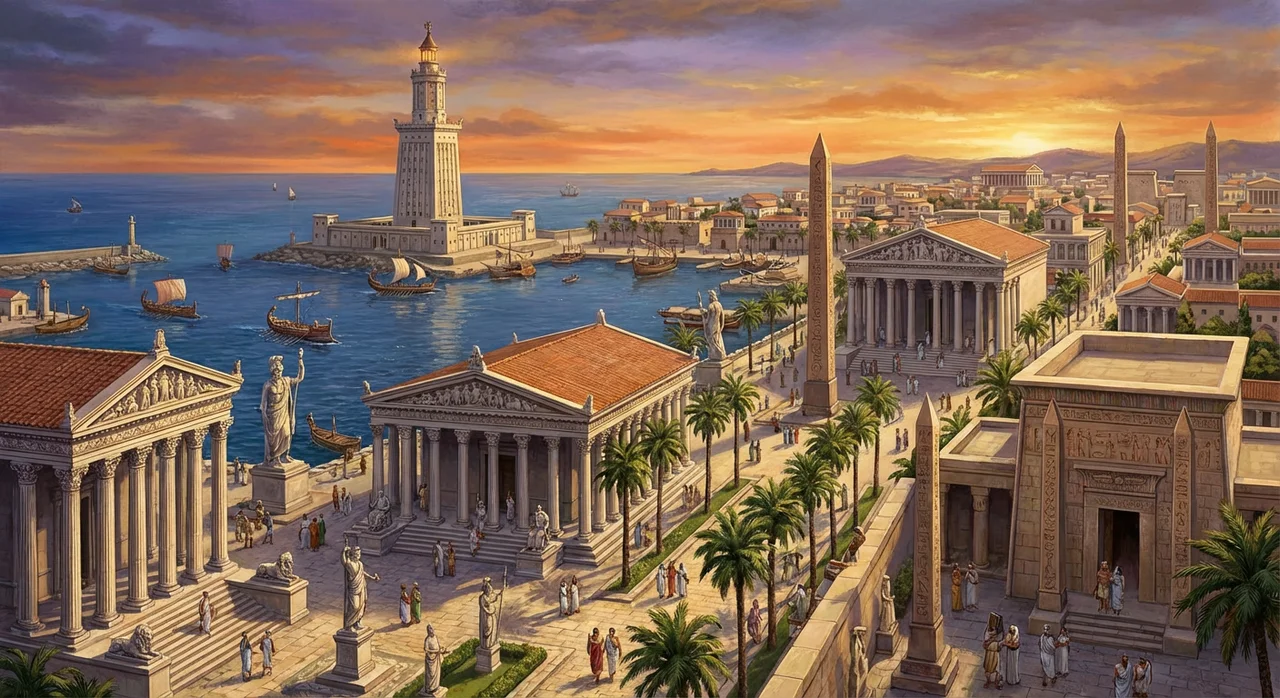
1. The Historical Paradigm: Mediterranean Synthesis & Pharaonic Continuity
The Greco-Roman epoch in Egypt was not an era of colonial erasure, but a profound cultural and institutional synthesis:
- The Dual Monarchy: When Alexander the Great and subsequently the Ptolemaic dynasty assumed control of Egypt, they recognized that governing a civilization with three millennia of established bureaucracy required adopting native Egyptian religious legitimacy. Ptolemaic kings ruled simultaneously in two distinct personas:
• As Hellenistic Greek monarchs (Basileus) speaking Greek in cosmopolitan Alexandria;
• As divine Egyptian Pharaohs (Nesut-Bity) depicted on Upper Egyptian temple walls wearing traditional kilts, double crowns, and offering Ma'at to Horus, Hathor, and Amun; - The Rosetta Stone & Administrative Trilingualism: Official government decrees were issued in three parallel scripts: sacred Hieroglyphs for the priesthood and temples, bureaucratic Demotic for native daily administration, and Greek for the imperial court and military;
- An Economic Juggernaut: The Nile Valley's agricultural surplus transformed Egypt into the wealthiest prize of the ancient Mediterranean—first financing the vast Ptolemaic mercenary armies and fleets, and later sustaining the urban population of the Roman Empire through the annual annona grain fleets.
2. Master Directory of Greco-Roman Sub-Sections
Explore our detailed standalone monographs covering every historical stage, personality, and phase of Egypt's Greco-Roman millennium:
1. Alexander the Great in Egypt →
The Macedonian liberation from Persian rule, coronation as Pharaoh at Memphis, founding of Alexandria, and the sacred pilgrimage to the Oracle of Amun at Siwa Oasis.
Read Full Period Guide →2. Ptolemaic Egypt & The Dynasty →
Three centuries of Macedonian-Greek pharaohs from Ptolemy I Soter: the creation of Alexandria, the cult of Serapis, the Rosetta Stone, and temple building.
Read Full Period Guide →3. Cleopatra VII Philopator →
The life, intellect, statesmanship, and tragic fall of Egypt's last active pharaoh: alliances with Julius Caesar and Mark Antony, the Battle of Actium, and her enduring legacy.
Read Full Period Guide →4. Roman Egypt (Aegyptus) →
Augustus' personal imperial province: the Roman grain fleet, prefects, Eastern Desert porphyry mines, trade routes to India via Berenike, and the Fayum portraits.
Read Full Period Guide →5. Byzantine Egypt →
The Christianization of Egypt: the Patriarchate of Alexandria, birth of desert monasticism (St. Anthony), Council of Chalcedon schism, and the Arab conquest of 641 AD.
Read Full Period Guide →3. Alexander the Great & The Macedonian Foundation (332–305 BC)
In November 332 BC, the 24-year-old Macedonian conqueror Alexander the Great marched his victorious army across the Sinai frontier into Egypt:
- Liberation from Persian Oppression: The Persian satrap Mazaces surrendered Memphis without fighting a single engagement. Having suffered under the harsh reoccupation of Artaxerxes III, the Egyptian population and priesthood hailed Alexander as a divine liberator;
- Coronation at Memphis: Alexander immediately showed deep reverence for Egyptian religious traditions, sacrificing to the sacred Apis Bull in Memphis and undergoing coronation as legitimate King of Upper and Lower Egypt;
- The Sacred Pilgrimage to Siwa Oasis (Amun Oracle): In early 331 BC, Alexander undertook a perilous 500-kilometer desert march across the Western Desert to the Oracle of Amun (Zeus-Ammon) at Siwa Oasis. The high priest of the oracle addressed Alexander as the biological "Son of Amun", conferring supreme divine legitimacy upon his global conquests;
- Founding of Alexandria (April 331 BC): Surveying the Mediterranean coast west of the Delta near the native fishing village of Rhakotis, Alexander personally drafted the grid layout for a new maritime capital, planned by architect Dinocrates of Rhodes, linking the wealth of Egypt directly to the Mediterranean trade network.
4. The Ptolemaic Dynasty (305–30 BC): Hellenistic Golden Age & Syncretism
Following Alexander's premature death in Babylon in 323 BC, his Macedonian general Ptolemy, son of Lagus, secured appointment as satrap of Egypt:
Recognizing the immense political legitimacy carried by Alexander's physical remains, Ptolemy intercepted Alexander's funeral cortege en route to Macedonia in 321 BC, diverting the golden sarcophagus to Memphis and later enshrining it in a monumental royal mausoleum (the Soma) in the heart of Alexandria. In 305 BC, Ptolemy assumed the title of King (Basileus) and Pharaoh, establishing the Ptolemaic Dynasty.
- The Religious Synthesis of Serapis: To bridge the spiritual divide between his Greek ruling elite and the native Egyptian population, Ptolemy I promoted the syncretic composite deity Serapis (سيرابيس)—combining the Egyptian mortuary underworld gods Osiris and Apis (Osirapis) with Greek anthropomorphic attributes of Zeus, Hades, and Dionysus;
- The Ptolemaic Royal System: Fifteen successive male monarchs ruled under the royal name Ptolemy, adopting royal dynastic marriages (often brother-sister marriages imitating Osiris and Isis) to consolidate wealth and prevent court partition.
5. The Intellectual Beacon: The Great Library & Pharos Lighthouse of Alexandria
Under the patronage of the first three Ptolemaic kings, Alexandria became the undisputed intellectual capital of the ancient world:
- The Mouseion & The Great Library of Alexandria (مكتبة الإسكندرية):
• Founded by Ptolemy I and organized by Demetrius of Phalerum circa 295 BC as a dedicated research academy for international scholars;
• Amassed an estimated 500,000 papyrus scrolls, with royal decrees commanding that every ship docking in Alexandria harbor surrender all books on board to be copied;
• Home to history’s greatest scientific breakthroughs: Eratosthenes calculated the circumference of the Earth with 99% accuracy; Euclid codified plane geometry in his Elements; Aristarchus of Samos proposed the first heliocentric model of the solar system; and Herophilos pioneered human anatomical dissection and nervous system mapping; - The Pharos Lighthouse (منارة الإسكندرية):
• Engineered by Sostratus of Cnidus on the island of Pharos circa 280 BC;
• Rising over 100 meters (330 feet) high in three receding tiers of white limestone and granite, crowned by an enormous fire brazier and polished bronze mirror whose beam was visible up to 50 kilometers out to sea; universally ranked among the Seven Wonders of the Ancient World.
6. Monumental Temple Architecture: Edfu, Dendera, Kom Ombo & Philae
Paradoxically, the finest, most complete, and best-preserved ancient Egyptian stone temples standing today are not from the Old or New Kingdoms, but were funded and constructed by the Greek Ptolemaic pharaohs:
- The Temple of Horus at Edfu (معبد إدفو):
• The most complete ancient temple surviving on Earth, built between 237 BC (Ptolemy III) and 57 BC;
• Preserves intact 36-meter-high pylon towers, roofed hypostyle halls, and detailed wall inscriptions detailing the mythological battle between Horus and Seth; - The Temple of Hathor at Dendera (معبد دندرة):
• Renowned for its soaring astronomical ceiling reliefs, intact crypt corridors, Hathor-headed sistrum columns, and the famous carved reliefs of Cleopatra VII and her son Caesarion on the exterior southern wall; - The Dual Temple of Kom Ombo (معبد كوم أمبو):
• Symmetrically balanced along a central axis to honor two rival deities simultaneously: the crocodile god Sobek and the falcon god Haroeris (Horus the Elder); features the world’s oldest carved medical instrument reliefs; - The Temple of Isis at Philae (معبد فيلة):
• Perched on an island at the First Cataract of the Nile; the spiritual heart of the cult of Isis, preserving the world’s very last carved hieroglyphic inscription, dated to August 24, 394 AD (the Graffito of Esmet-Akhom).
7. Cleopatra VII & The Fall of the Ptolemaic Empire (51–30 BC)
The climax of Ptolemaic history was embodied by one of the most brilliant and charismatic statesmen of world history:
Ascending the throne at age 18 in 51 BC, Cleopatra was a brilliant polyglot diplomat fluent in nine languages, and famously the only Ptolemaic monarch who bothered to learn to speak and write the native Egyptian language. Recognizing that Egypt’s survival depended on managing the rising superpower of Rome, she formed strategic romantic and political alliances with Rome's two most powerful men: Julius Caesar and Mark Antony.
- The Alexandrian War & Caesarion: Allied with Julius Caesar in 48–47 BC, winning the civil war against her brother Ptolemy XIII, and bearing Caesar's only biological son, Ptolemy XV Caesarion;
- The Donations of Alexandria & Mark Antony: Unified her fleet and wealth with Mark Antony, declaring Caesarion "King of Kings" and reclaiming former Egyptian territories in Syria, Cyprus, and Cilicia;
- The Battle of Actium (31 BC): The naval defeat of Antony and Cleopatra’s joint fleet off Greece by Octavian;
- The Tragic Suicide (August 30 BC): Rather than being paraded in chains through the streets of Rome in Octavian's triumphal procession, Cleopatra committed suicide in her Alexandrian palace (traditionally via the venomous bite of an Egyptian asp), ending three centuries of Ptolemaic rule and three millennia of pharaonic statehood.
8. Roman Egypt (30 BC – 330 AD): The Imperial Breadbasket & Desert Quarries
Following Cleopatra's death, Octavian (later Emperor Augustus) formally annexed Egypt into the Roman Empire with an unprecedented legal status:
- The Emperor's Private Estate:
• Augustus barred Roman senators from even entering Egypt without his direct personal permission, fearing a rival general could seize Egypt’s grain supply and starve Rome;
• Governed directly by an equestrian prefect (Praefectus Aegypti) backed by three Roman legions; - The Annona (Grain Fleet): Egypt supplied roughly one-third of all grain consumed by the city of Rome (an estimated 150,000 tons annually), carried on giant grain freighters sailing from Alexandria to Ostia and Puteoli;
- Oceanic Red Sea Trade to India:
• Operating through Red Sea ports like Berenike and Myos Hormos, Roman merchants harnessed the Indian Ocean monsoon winds to sail directly to India, importing silk, black pepper, pearls, and frankincense; - Imperial Porphyry & Granite Quarries: Roman engineers established high-altitude desert quarry towns in the Eastern Desert: Mons Porphyrites (the world's sole source of imperial purple porphyry stone reserved for emperors) and Mons Claudianus (granodiorite columns quarried for the Pantheon in Rome).
9. Byzantine Egypt (330–641 AD): Christianization, Monasticism & Theological Schisms
With Emperor Constantine the Great establishing Constantinople as the new Roman capital in 330 AD, Egypt transitioned into its Byzantine Christian phase:
- The Theological Crucible of Alexandria: The Patriarchate of Alexandria became the intellectual capital of Christian theology; Patriarch Athanasius of Alexandria formulated Orthodox Trinitarian doctrine against Arianism at the Council of Nicaea (325 AD);
- The Desert Fathers & Monasticism:
• Egypt gave birth to global Christian monasticism: Saint Anthony the Great pioneered solitary eremitic life in the Eastern Desert, while Saint Pachomius established communal monasticism in Upper Egypt;
• Desert monastic communities flourished in Wadi El-Natrun and Saint Catherine in Sinai; - The Council of Chalcedon Schism (451 AD): The rejection of Chalcedonian Christological definitions by the native Egyptian Church created a permanent rift between the native Coptic Orthodox Church and the Byzantine imperial authorities in Constantinople;
- The Arab Conquest (639–641 AD): In December 639 AD, the Arab-Muslim commander Amr ibn al-Aas marched into Egypt, capturing the Roman fortress of Babylon (Old Cairo) in 641 AD and Alexandria in 642 AD, bringing the Byzantine and Greco-Roman millennium to its historic close.
10. Cultural & Artistic Synthesis: Fayum Mummy Portraits & Serapis Cult
The Greco-Roman Period produced one of the most haunting and beautiful artistic syntheses in human history:
Flourishing between the 1st and 3rd centuries AD in the Faiyum Oasis, wealthy Greek, Roman, and Egyptian citizens maintained the traditional Pharaonic religious custom of mummification, but replaced traditional idealized gold and cartonnage masks with realistic, painted wooden panel portraits.
- Encaustic Wax Mastery: Executed using pigmented hot beeswax (encaustic) or egg tempera on thin cedar and fig wood panels inserted directly over the wrapped face of the mummy;
- Photographic Psychological Realism: Depicting living individuals with wide, expressive eyes, Roman hairstyles, gold laurel wreaths, and Mediterranean jewelry; universally recognized as the direct evolutionary ancestor of Christian Byzantine iconography and Renaissance portrait painting;
- The Catacombs of Kom El Shoqafa (الإسكندرية): A subterranean Roman necropolis in Alexandria blending Pharaonic, Greek, and Roman motifs: Roman soldiers carved as Anubis, Agathodaemon serpents wearing Egyptian double crowns, and Medusa shields carved on limestone crypt walls.
11. Master Greco-Roman Egypt Chronological & Dynastic Matrix
The following matrix synthesizes the complete chronological sequence, major historical phases, primary rulers, and architectural achievements across Egypt's Greco-Roman millennium:
| Historical Phase | Date Span | Imperial Capital | Prominent Rulers | Major Architectural & Civilizational Milestones |
|---|---|---|---|---|
| Macedonian Period | 332 – 305 BC | Alexandria / Memphis | Alexander the Great, Philip Arrhidaeus, Alexander IV | Founding of Alexandria; pilgrimage to Siwa Oasis; coronation at Memphis. |
| Early Ptolemaic | 305 – 221 BC | Alexandria ad Aegyptum | Ptolemy I Soter, Ptolemy II Philadelphus, Ptolemy III Euergetes | Great Library of Alexandria; Pharos Lighthouse; Serapis cult; beginning of Edfu Temple. |
| Middle Ptolemaic | 221 – 80 BC | Alexandria | Ptolemy IV to Ptolemy IX, Ptolemy V (Rosetta Stone) | Rosetta Stone decree (196 BC); construction of Kom Ombo, Philae, and Dendera temples. |
| Late Ptolemaic | 80 – 30 BC | Alexandria | Ptolemy XII Auletes, Cleopatra VII Philopator, Caesarion | Alliances with Caesar and Antony; Battle of Actium; death of Cleopatra; end of Ptolemaic dynasty. |
| Early Roman Empire | 30 BC – 192 AD | Alexandria / Rome | Augustus, Tiberius, Nero, Trajan, Hadrian | Egypt as imperial granary; Red Sea trade to India; Mons Porphyrites; Antinoöpolis founded. |
| Late Roman Empire | 193 – 330 AD | Alexandria / Rome | Septimius Severus, Caracalla, Diocletian | Fayum mummy portraits; Diocletian fortifies borders; Great Persecution of Christians (284 AD). |
| Byzantine Period | 330 – 641 AD | Alexandria / Constantinople | Constantine the Great, Theodosius I, Justinian I, Heraclius | Rise of Christian monasticism (St. Anthony); closure of pagan temples; Arab conquest by Amr ibn al-Aas. |
12. Private Curated Greco-Roman Expeditions with Ultra Egypt Travel
Exploring the Hellenistic and Roman marvels of Egypt—from descending into the subterranean Catacombs of Kom El Shoqafa and standing before Pompey’s Pillar in Alexandria to studying the astronomical ceiling of Dendera and sailing by private boat to the Island of Philae in Aswan—requires specialized academic Egyptologists, verified private site permissions, and executive luxury logistics.
Operating under Ministry of Tourism License #874 (Class A) and IATA Accreditation #90229930, Ultra Egypt Travel delivers bespoke private Greco-Roman historical expeditions:
- The Alexandria Hellenistic Maritime Masterclass: Private chauffeured day or multi-day expeditions from Cairo exploring the Catacombs of Kom El Shoqafa, Pompey's Pillar, the Serapeum, the Roman Amphitheater of Kom El Dikka, the modern Bibliotheca Alexandrina, and Fort Qaitbay (built atop the ruins of the Pharos Lighthouse);
- The Upper Egyptian Ptolemaic Temple Circuit: Private guided explorations of Egypt's best-preserved classical temples: the Temple of Hathor at Dendera, the Temple of Horus at Edfu, the dual sanctuary of Kom Ombo, and the romantic Island of Philae in Aswan;
- The Faiyum Oasis & Roman Heritage Tour: Private 4x4 overland day journeys visiting Karanis (Kom Aushim), Medinet Madi, and the origins of the world-famous Fayum Mummy Portraits;
- VIP Chauffeured Protocol: Executive climate-controlled Mercedes-Benz vehicles, private airport meet-and-assist, all required antiquities permissions, and 24/7 dedicated operational monitoring from our Cairo headquarters.