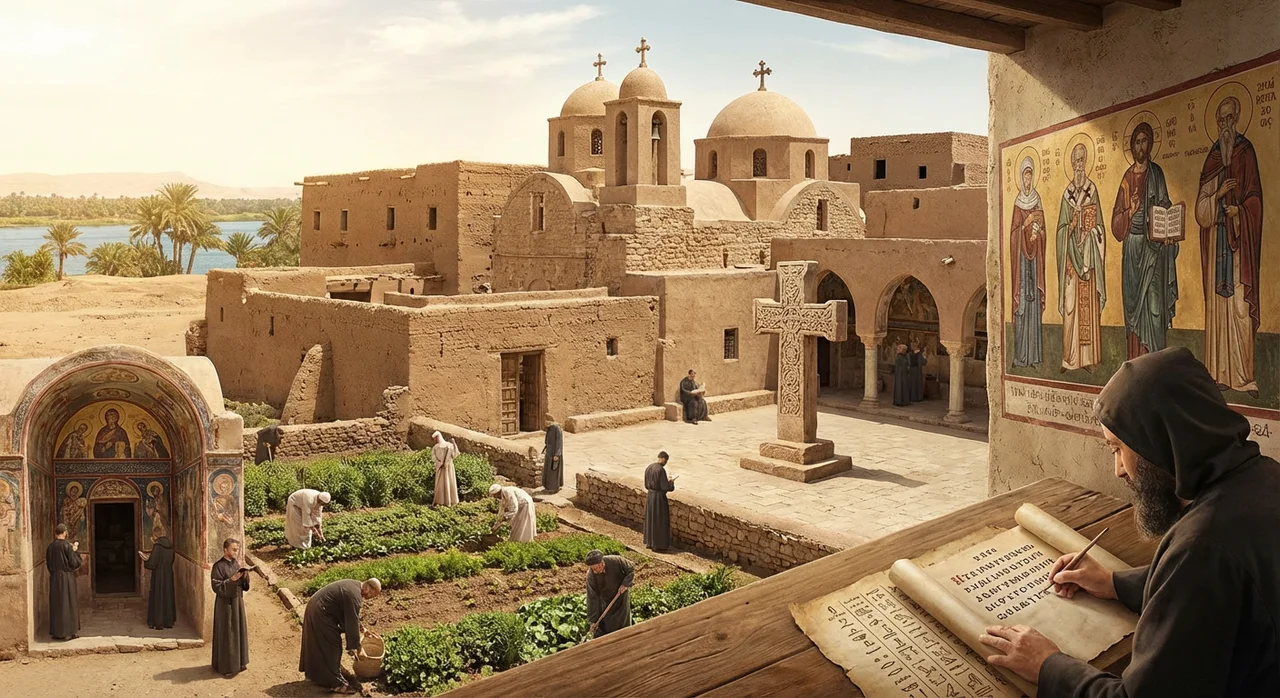
1. The Synthesis of Heritage: From Pharaonic Mastery to Christian Symbolism
When Christianity swept across the Nile Valley between the 1st and 4th centuries AD, it did not destroy Egypt's ancient artistic legacy; instead, native craftsmen channeled three millennia of technical mastery into a new spiritual vocabulary:
- The Baptism of the Ankh (𓋹): The ancient Egyptian hieroglyphic symbol for life (*Ankh*) was seamlessly adopted as the Crux Ansata (the looped cross). To the early Coptic Christian, the symbol no longer merely promised temporal longevity, but represented the eternal life won through Christ's resurrection;
- Isis and Horus to the Virgin and Child: The ubiquitous maternal motif of the goddess Isis nursing the infant Horus on her lap (*Isis Lactans*) directly inspired the tender Christian iconographic depiction of the Virgin Mary breastfeeding the Christ Child (*Maria Lactans / Galaktotrophousa*);
- The Falcon and the Dove: The soaring solar falcon of Horus transformed into the hovering dove of the Holy Spirit, while the lotus flower—symbolizing primeval resurrection from the dark waters of Nun—became a symbol of the incorruptible spiritual renewal of Christian baptism.
2. Coptic Architecture: The Basilica Layout, Khurus & Triple Sanctuaries
Coptic ecclesiastical architecture evolved an ingenious, highly specialized floorplan designed to foster deep contemplative liturgy and communal reverence:
Unlike Roman Catholic churches with open altars or Byzantine churches with monumental central domes, the Coptic church is designed as an ark of salvation (traditionally shaped like a ship sailing eastward toward Christ):
• The Narthex & Three Naves: The congregation gathers in a longitudinal hall divided into three aisles by ancient marble columns, often featuring a distinct second-floor gallery reserved for women;
• The Khurus (الخورس): A transverse room or elevated choir partition separating the nave from the sanctuary, designated exclusively for deacons and cantors chanting the liturgical responses;
• The Triple Sanctuaries (Al-Haykal — الهيكل): Three square, domed altars facing east. The central sanctuary is dedicated to the patron saint of the church, flanked by two side altars for feast days, each housing an unattached cube altar table (*Madhbah*) capped with an consecrated wooden altar board (*Lawh Muqaddas*).
- The Eastern Apses (Sharqiyya / Niches): Directly behind the altar table, the semicircular eastern wall forms a sacred niche painted with Christ the Pantocrator seated on His heavenly throne, surrounded by the four incorporeal living creatures and the twenty-four elders of Revelation;
- The Syntronon: Stepped masonry benches curved inside the central apse where the bishop and his presbyters sat during the initial readings of the Liturgy of the Word.
3. The Iconostasis (حامل الأيقونات): Woodwork, Ivory Inlay & Geometric Stars
The most visually breathtaking architectural feature of any Coptic sanctuary is the monumental wooden partition screen known as the Iconostasis (حامل الأيقونات / الحجاب):
- Intricate Joinery without Nails: Due to Egypt's arid climate, large wooden planks would warp or split. Coptic master carpenters developed a complex technique of assembling thousands of tiny interlocking wooden polygons and crosses that expanded and contracted naturally without glue or nails;
- Inlay of Ivory and Mother-of-Pearl: Solid dark walnut, cedar, and ebony screens were meticulously inlaid with bone, mother-of-pearl, and engraved elephant ivory forming intricate 12- and 16-pointed geometric star patterns (*Arabesque* and *Tashshiq*);
- The Three Sanctuary Doors: The iconostasis is pierced by three curtained wooden doors leading into the altars. The central door (the Royal Door) is flanked by icons of Christ on the right and the Virgin Mary on the left;
- The Upper Icon Tier: The top of the screen is crowned by a continuous horizontal row of icons depicting the Last Supper, the Twelve Apostles, and capped at the summit by the Golgotha Cross flanked by Saint Mary and Saint John the Evangelist.
4. The Coptic Iconographic Canon: Visual Theology, Large Eyes & Spiritual Light
In Coptic theology, an icon is not a decorative painting; it is a "Window into Heaven" written through prayer and fasting according to strict spiritual conventions:
- The Anatomy of Sanctity:
• Enlarged, Wide Eyes: Saints are painted with large, luminous, almond-shaped eyes gazing serenely toward eternity, reflecting internal spiritual illumination and vigilance;
• Small Mouths: Depicted with diminutive, tightly closed lips, symbolizing fasting, silence, and mastery over earthly speech;
• Enlarged Ears: Prominent ears listening intently to the Word of God and the prayers of the faithful;
• No Realistic Shadows: Coptic icons intentionally omit physical shadows and cast light; saints exist in the uncreated, eternal light of the Kingdom of God where darkness has been banished; - Frontal Perspective: Holy figures look straight at the viewer, inviting direct personal communion; evil figures (such as Roman persecutors or Judas Iscariot) are strictly painted in profile with a single visible eye, representing their incomplete, duplicitous nature;
- The 18th-Century Masters: The celebrated icons in Old Cairo churches were painted by master artists like Ibrahim Al-Nasikh and Yuhanna Al-Armani, blending traditional Coptic theology with vibrant Mediterranean folk colors.
5. Coptic Textiles (Al-Qabati): Weaving Techniques, Tapestry & Nilotic Motifs
From the 3rd to the 12th century, Egyptian textile artisans produced woven masterpieces so renowned that medieval Arab chroniclers referred to all luxury linen fabrics as Al-Qabati (أقمشة القباطي):
The Upper Egyptian city of Akhmim (Panopolis) was the undisputed center of the textile industry. Using horizontal and vertical wooden looms, Coptic weavers mastered linen warp threads interlaced with dyed sheep's wool wefts using advanced slit-tapestry techniques.
- The Clavus and Orbiculus: Tunics were decorated with vertical woven bands (*Clavi*) running over the shoulders and circular or square medallion patches (*Orbiculi*) positioned over the knees and chest;
- Nilotic Flora and Fauna: Tapestries were bursting with vibrant life: ducks swimming among blooming water lilies, leaping gazelles, grapevines spilling from amphorae, river fishermen, and equestrian saints holding crosses;
- The Kiswah of the Kaaba: So legendary was the quality of Coptic linen weaving that early Islamic caliphs commissioned the sacred embroidered covering of the Kaaba in Mecca (*Kiswat al-Kaaba*) to be woven annually by Coptic textile artisans in the Nile Delta city of Tennis!
6. Liturgical Music: The Acoustic Survival of Pharaonic Temple Hymns
Coptic liturgical music is universally recognized by ethnomusicologists as the oldest living vocal tradition in the world:
- Oral Transmission across Millennia: Because the ancient Egyptians never invented written musical notation, sacred temple chants were passed down through oral apprenticeship from priest to student. When Egypt converted to Christianity, these acoustic structures were preserved directly within church liturgy;
- Melismatic Complexity: Hymns such as Golgotha (sung on Good Friday) and Pek Ethronos feature astonishing, extended vocal melismas—where a single vowel syllable is carried across dozens of complex rhythmic modulations and quarter-tone intervals, mirroring the solemn lamentations sung for the burial of Osiris in the temples of Abydos;
- The Role of the Cantor (Al-Mu'allim): Leading the deacons from the khurus, the blind master cantor memorizes hundreds of hours of hymns for different feast seasons (Joyful, Fasting, Passion, Annual, and Nativity), maintaining the pristine oral purity of the melodies without deviation.
7. Sacred Metalwork & Liturgical Implements: Cymbals, Triangles & Censers
Coptic worship employs distinct metallic instruments and liturgical vessels forged from cast bronze, silver, and gold:
- The Hand Cymbals (Duff / Def — الدف) & Triangle (Mothalath — المثلث):
• The sole musical instruments permitted during Coptic church services;
• The small cast-brass cymbals provide the driving metallic syncopation, while the steel triangle rings with high-pitched crystalline clarity;
• Together, they regulate the speed and cadence of vocal chanting, continuing the percussive role played by the ancient Egyptian *Sistrum* (*Sesheshet*) in Hathoric temple ceremonies; - The Coptic Censer (Al-Shuria — الشورية):
• A sacred cast-bronze or silver incense burner suspended from three chains;
• Loaded with profound Trinitarian symbolism: the three chains represent the Holy Trinity, the central joining ring represents their divine unity, the charcoal coal represents Christ's humanity, and the glowing fire represents His divinity; - Liturgical Crosses: Handheld blessing crosses cast with intricate openwork floral filigree, held by priests alongside three lighted candles during episcopal blessings.
8. The Coptic Museum in Old Cairo: Marcus Simaika Pasha & World Masterpieces
Nestled within the ancient Roman precinct of Babylon Fortress in Old Cairo stands the Coptic Museum (المتحف القبطي), housing the world's most comprehensive collection of Christian antiquities:
- The Vision of Marcus Simaika Pasha:
• Founded in 1908 and officially inaugurated in 1910 by prominent Coptic nationalist scholar Marcus Simaika Pasha;
• Dedicated to gathering, salvaging, and protecting endangered church woodwork, manuscripts, icons, and stone carvings from disappearing into European private collections;
• Built in exquisite neo-Coptic architectural style, featuring recycled mashrabiya woodwork, intricately carved painted wooden ceilings, and tranquil garden courtyards; - Priceless Masterpieces on Display:
• The Nag Hammadi Codices: 4th-century leather-bound papyrus books of early Christian Gnostic texts;
• The Wooden Altar of Abu Serga: The oldest surviving wooden Christian altar screen in Egypt, carved in the 5th century;
• The Frescoes of Bawit and Saqqara: 6th-century monastery apse paintings depicting Christ in Majesty and the Virgin Mary with the Apostles;
• The Psalm Codex of Mudil: The oldest complete parchment manuscript of the Book of Psalms in Sahidic Coptic, discovered resting beneath the head of a buried young girl in an Upper Egyptian Christian tomb.
9. Living Architectural Jewels of Old Cairo: Hanging Church, Abu Serga & St. Barbara
The walled quarter of Coptic Cairo (مصر القديمة) preserves some of the oldest active Christian monuments in the world:
- The Hanging Church (Al-Muallaqa — الكنيسة المعلقة):
• Dedicated to the Virgin Mary; constructed suspended atop the gatehouse bastions of the Roman Fortress of Babylon;
• Features an extraordinary cedar-wood barrel-vaulted ceiling built in the shape of Noah’s Ark, supported by thirteen ancient marble columns (representing Christ and the Twelve Apostles);
• Houses a magnificent 11th-century carved marble pulpit (*Ambon*) and over 110 priceless historic icons; - Church of Saints Sergius & Bacchus (Abu Serga — كنيسة أبي سرجة):
• Built directly over the sacred 4th-century subterranean stone crypt where the Holy Family lived for three months during their flight into Egypt;
• Ancient sanctuary where Coptic patriarchs were traditionally consecrated before entering their patriarchal seat; - Church of Saint Barbara (كنيسة القديسة بربارة):
• Dating to the late 5th century, celebrated for its monumental wooden basilica proportions and ancient reliquaries containing the relics of Saint Barbara and Saint Juliana; - Church of Saint George (Greek Orthodox Mar Girgis):
• A towering circular rotunda church built directly atop one of the massive round Roman bastion towers of Emperor Trajan.
10. Preserving Intangible Heritage: Language, Monastic Calligraphy & Folk Feasts
Coptic heritage is not a relic preserved in glass museum cases; it is a vibrant, living culture woven into the fabric of Egyptian society:
- The Survival of Coptic Words in Modern Egyptian Arabic:
• Everyday Egyptian colloquial Arabic (*Ammiya*) retains hundreds of ancient Coptic-pharaonic vocabulary words:
• Embaba (from Coptic *Pa-Hapi* — the Nile river crossing);
• Shobra (from Coptic *Jomro* — meaning village or farm);
• Fasikh, Tamiya, Kankeh, and culinary terms rooted directly in Coptic speech; - Sham El-Nessim (شم النسيم): The ancient Egyptian spring harvest feast celebrated by all Egyptians on the Monday following Coptic Easter, continuing the three-thousand-year-old pharaonic festival of *Shemu* with salted fish, green onions, and colored eggs;
- Monastic Scriptoriums & Modern Iconography: Contemporary iconographers, led by the school of the late master Dr. Isaac Fanous, revived the ancient Coptic neo-iconographic style, decorating hundreds of new cathedrals and monasteries across Egypt and five continents worldwide.
11. Master Coptic Heritage & Art Matrix (Medium, Origins & Masterpieces)
The following matrix categorizes the primary artistic media, technical methods, historical origins, and world-renowned masterpieces of Coptic artistic heritage:
| Artistic Medium | Historic Origin Era | Technical Methods & Materials | Signature Motifs & World Masterpieces |
|---|---|---|---|
| Icon Painting | 4th – 18th Century AD | Egg tempera and encaustic wax on gesso-primed cedar panels; gold leaf backgrounds. | Enlarged spiritual eyes; Christ Pantocrator; St. Menas & Christ (Louvre); Ibrahim Al-Nasikh icons. |
| Architectural Woodwork | 5th – 14th Century AD | Mortise and tenon joinery without nails; ivory and mother-of-pearl geometric inlays. | Intricate star iconostases; Altar screen of Abu Serga; Door of Symbols at Deir Al-Surian. |
| Qabati Textiles | 3rd – 10th Century AD | Slit-tapestry weaving on vertical looms; linen warp with dyed wool weft. | Clavus bands; Nilotic river medallions; grapevines; Akhmim tapestries in the Coptic Museum. |
| Liturgical Vocal Music | Pharaonic / 1st Century AD | Oral acoustic transmission; complex melismatic vocal chanting in Bohairic Coptic. | Good Friday Hymn *Golgotha*; hymn *Pek Ethronos*; rhythmic syncopation via bronze cymbals. |
| Architectural Stone Sculpture | 5th – 8th Century AD | Fine low-relief carving on local limestone; acanthus and floral capitals. | Niches of Bawit and Saqqara; friezes of Saint Jeremiah Monastery; shell niche pediments. |
| Manuscript Illumination | 4th – 14th Century AD | Parchment and papyrus codices; black carbon ink; red rubrication; gold leaf miniatures. | Nag Hammadi Codices; Mudil Psalter; bilingual Bohairic-Arabic Gospel manuscripts in Wadi El-Natrun. |
12. Private Curated Coptic Heritage Expeditions with Ultra Egypt Travel
Experiencing the artistic soul of Coptic Egypt—from stepping inside the serene cloisters of Old Cairo's Hanging Church and examining the 5th-century Bawit frescoes in the Coptic Museum to listening to ancient melismatic chants in the monasteries of Wadi El-Natrun—requires deep cultural scholarship, academic Egyptologists, and executive private logistics.
Operating under Ministry of Tourism License #874 (Class A) and IATA Accreditation #90229930, Ultra Egypt Travel delivers bespoke private cultural and historical heritage expeditions:
- The Coptic Museum & Old Cairo Architectural Masterclass: Private guided walking expedition of Coptic Cairo with a dedicated university art historian: exploring the Hanging Church, the crypt of Abu Serga, the Church of Saint Barbara, and a private VIP tour of the Coptic Museum's finest collections;
- The Upper Egyptian Monastic Art Pilgrimage (Sohag): Private chauffeured expedition to Upper Egypt to inspect the fully conserved 5th-century encaustic frescoes of the Red Monastery (Deir el-Ahmar) and the monumental pharaonic-style stone architecture of the White Monastery;
- Wadi El-Natrun Monastic Art & Manuscript Tour: Exclusive access to the ancient libraries and 10th-century ivory Door of Symbols at Deir Al-Surian, exploring early Christian art alongside resident monastic scholars;
- VIP Chauffeured Protocol: Executive climate-controlled Mercedes-Benz fleet, private airport meet-and-assist, all required antiquities permissions, and 24/7 dedicated operational monitoring from our Cairo headquarters.