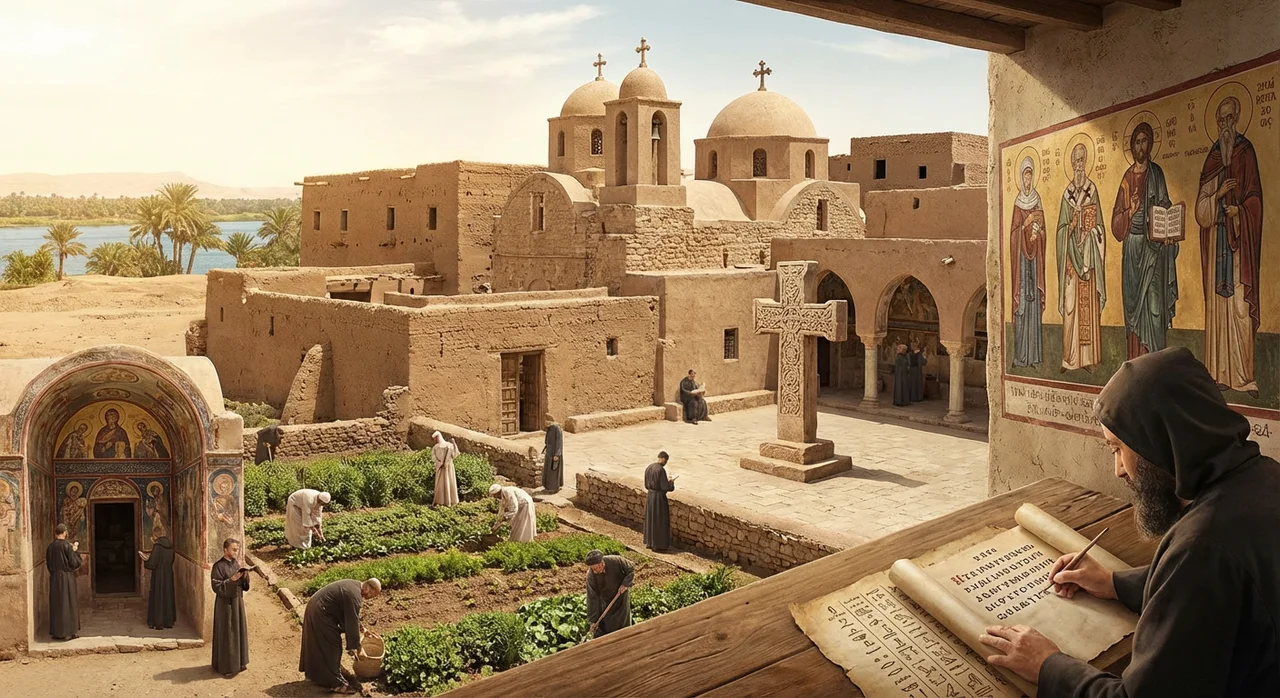
1. The Apostolic Foundation: Saint Mark & The First Patriarchs
The Coptic Orthodox Church traces its spiritual lineage directly to the apostolic college of the New Testament:
- The Apostle of Africa: Saint Mark the Evangelist arrived in Alexandria circa 42–62 AD, preaching the Gospel and establishing the primary apostolic see of the African continent;
- The Miracle of Saint Anianus: Mark’s conversion and ordination of the cobbler Anianus in 62 AD established the local episcopate, ensuring that the pastoral leadership of Egypt remained rooted in native Egyptian soil;
- The Unbroken Succession: Following Mark's martyrdom at Bucolis in 68 AD, Anianus governed the Church for twenty-two years, succeeded by Avilius (83 AD), Kedron (96 AD), and Primus (106 AD), creating an unbroken documentary chain of 118 patriarchs extending to the current Pope of Alexandria.
2. The Papacy of Alexandria: Origin of the Title "Pope" (Papa)
Historical scholarship confirms that the title of "Pope" was used in Alexandria centuries before it was adopted by the Bishops of Rome:
The affectionate Greek title Pappas (meaning "Father") was first formally bestowed upon Saint Heraclas (13th Patriarch of Alexandria, reigned 232–248 AD). A letter from Bishop Dionysius of Alexandria to Philemon in Rome (preserved by Eusebius) refers to Heraclas as "Our blessed Pope, Heraclas." Rome did not officially adopt the title for its bishop until the reign of Pope Siricius in the late 4th century.
- The Official Patriarchal Title: To this day, the official canonical title of the Coptic leader is: "Pope of Alexandria and Patriarch of the See of Saint Mark in all Africa and the Diaspora";
- "Judge of the Universe" (قاضي المسكونة): Conferred upon the Patriarchs of Alexandria by Emperor Theodosius the Great following their decisive leadership in formulating universal Christian doctrine at early ecumenical councils, establishing Alexandria's preeminence alongside Rome, Antioch, Constantinople, and Jerusalem.
3. The Golden Theological Era: Nicaea (325 AD) to Ephesus (431 AD)
Between the 4th and 5th centuries, the theological school and bishops of Alexandria defined the universal doctrinal boundaries of the Christian faith:
- Saint Athanasius I (20th Patriarch — 328–373 AD):
• The "Pillar of the Church" and champion of the Council of Nicaea (325 AD);
• Successfully fought against Arianism to enshrine the term Homoousios (Consubstantial) into the Nicene Creed;
• Endured five imperial exiles totaling seventeen years, surviving assassination attempts in Alexandrian churches;
• Consecrated Saint Frumentius as the first Bishop of Axum in 330 AD, permanently tying the ancient Ethiopian Orthodox Tewahedo Church to the patriarchal authority of Alexandria for over sixteen centuries; - Saint Cyril I (24th Patriarch — 412–444 AD):
• Revered as the "Seal of the Fathers" (عمود الدين);
• Presided over the Council of Ephesus (431 AD), defeating Nestorianism and formulating the doctrine of the hypostatic union: Christ is one united nature out of two (divine and human);
• Enshrined the title Theotokos (Mother of God) for the Virgin Mary, establishing the foundational Christology of the Coptic Church.
4. The Council of Chalcedon (451 AD): The Christological Rupture
In 451 AD, political rivalries between the imperial capital of Constantinople and the ancient theological capital of Alexandria culminated in tragedy:
- The Doctrinal Conflict:
• The Council of Chalcedon endorsed the formula that Christ exists "in two natures" (divine and human) after the union;
• Saint Dioscorus I (25th Patriarch of Alexandria) fiercely resisted this, arguing it divided Christ into two persons (Nestorianism). Dioscorus defended the traditional Cyrillian formula: Mia Physis tou Theou Logou Sesarkomene ("One Incarnate Nature of God the Word"); - The Unjust Deposition: Dioscorus was unjustly deposed on procedural grounds and exiled to the Black Sea island of Gangra, where he died in 454 AD;
- The Birth of the Non-Chalcedonian Family: The native Church of Egypt, supported by the Church of Antioch (Syria), Armenia, and later Ethiopia, rejected the Council of Chalcedon, forming the ancient communion of Oriental Orthodox Churches that remains separate from Eastern Orthodox and Roman Catholic churches to this day.
5. Two Centuries of Shadows: Byzantine Persecution & The Melkite Division
From 451 to 641 AD, Egypt was torn between two competing ecclesiastical authorities:
Byzantine emperors installed imperial Greek military bishops in Alexandria (the Melkites, or "King's Men"), who enforced Chalcedonian orthodoxy with armed legions. The overwhelming majority of native Egyptians refused to recognize them, remaining loyal to their persecuted non-Chalcedonian Coptic Patriarchs, who were forced to govern secretly from desert monasteries.
- The Persecution of Cyrus (Al-Muqawqis): Appointed in 631 AD by Emperor Heraclius as both imperial prefect and Melkite patriarch, Cyrus unleashed a ten-year campaign of terror across Egypt: imprisoning native clergy, burning Coptic churches, and torturing priests;
- The Flight of Patriarch Benjamin I: The 38th Coptic Patriarch, Benjamin I, was warned by an angel of impending imperial violence and fled into the remote wilderness of Upper Egypt, living in monastic hiding for thirteen years while his brother Saint Mena was tortured and drowned in the Nile by Byzantine soldiers.
6. The Islamic Conquest (641 AD): Amr ibn al-Aas & Patriarch Benjamin I
The arrival of the Arab-Muslim armies in 639 AD brought a dramatic end to centuries of Byzantine imperial religious oppression:
- The Fall of Babylon Fortress (April 641 AD): General Amr ibn al-Aas captured the Roman stronghold in Old Cairo, welcoming local Coptic non-resistance;
- The Amnesty of Amr ibn al-Aas: Learning that the legitimate leader of the Egyptian people, Patriarch Benjamin I, was living in hiding in the desert, Amr issued an official decree of imperial safe-conduct:
"In whichever place Benjamin, the Patriarch of the Egyptian Christians, may be, we grant him protection and guarantee of peace from God. Let him come forth securely to administer the affairs of his Church and lead his people in peace."; - The Restoration of Benjamin I (644 AD): Benjamin I returned to Alexandria in triumph after thirteen years of exile; upon meeting him, Amr ibn al-Aas famously remarked: "In all the lands I have conquered, I have never seen a man of God of such holy dignity." Amr restored all confiscated cathedrals and properties to the native Coptic Church under the legal framework of the Dhimmi pact.
7. Relocation of the Patriarchal Seat: From Alexandria to Cairo
For a thousand years, the official residence of the Coptic Pope remained in Alexandria, but political shifts eventually forced a strategic inland relocation:
- The Rise of Al-Fustat and Cairo: Following the founding of Cairo by the Fatimids in 969 AD, Egypt’s political and economic gravity centered around the apex of the Nile Delta;
- Pope Christodoulos (66th Patriarch — 1046–1077 AD): Formally transferred the official seat of the Coptic Papacy from Alexandria to Cairo, establishing the patriarchal headquarters at the iconic Hanging Church (Al-Muallaqa) in Old Cairo;
- Subsequent Patriarchal Residences:
• The Church of Saint Mercurius (Abu Seifein) in Old Cairo;
• The Church of the Virgin Mary in Haret Zuweila (1300–1660 AD);
• The Church of the Virgin Mary in Haret El-Roum (1660–1800 AD);
• Saint Mark's Cathedral in Azbakeya (1800–1968 AD);
• Saint Mark's Coptic Orthodox Cathedral in Abbasiya (Cairo): Dedicated in 1968 by Pope Cyril VI and President Gamal Abdel Nasser, where the relics of Saint Mark rest today.
8. The Arabization of the Church & The Medieval Apologetic Golden Age
Between the 10th and 14th centuries, the Coptic Church navigated a profound linguistic transition:
- Linguistic Shift to Arabic: While Coptic remained the sacred liturgical language, Arabic gradually replaced spoken Coptic as the everyday language of Egyptian society by the 12th century;
- The Medieval Theological Golden Age: Coptic scholars pioneered Christian Arabic apologetics and encyclopedias:
• Sawirus ibn al-Muqaffa (Bishop of Ashmunein — 10th Century): Authored the monumental History of the Patriarchs of Alexandria (تاريخ بطاركة كنيسة الإسكندرية القبطية), the primary historical chronicle of Egyptian medieval history;
• The Awlad al-Assal Brothers (13th Century): Brilliant legal minds who compiled the Nomocanon (المجموع الصفوي), the comprehensive legal canon of Coptic civil, marital, and ecclesiastical jurisprudence; - Bilingual Manuscripts: Scribes in the monasteries of Wadi El-Natrun produced magnificent parallel manuscripts featuring Bohairic Coptic on the right column and Arabic on the left to preserve scriptural literacy.
9. Mamluk & Ottoman Eras: Endurance, Communal Solidarity & Monasteries
During the late medieval and Ottoman periods, the Coptic Church demonstrated extraordinary spiritual endurance amidst social shifts:
- The Role of Coptic Scribes (Mubashirun): Throughout Mamluk and Ottoman rule, the fiscal administration, land measurement, and tax registries of Egypt remained almost exclusively managed by skilled Coptic scribes and accountants (such as the famous 18th-century philanthropist Ibrahim El-Gohary);
- The Monasteries as Spiritual Lifeboats: When urban churches faced closures, the remote desert monasteries of Wadi El-Natrun, the Red Sea, and Upper Egypt preserved the sacred vestments, holy vessels, patristic manuscripts, and liturgical chanting traditions;
- Coptic Communal Cohesion: The Church operated not merely as a house of prayer, but as the central communal, legal, educational, and charitable anchor protecting the identity of the Egyptian Christian population.
10. The 19th & 20th Century Renaissance: Cyril IV to Pope Shenouda III
The modern era witnessed an unprecedented revival in Coptic intellectual, educational, and monastic vitality:
A visionary reformer who established the first modern Coptic printing press, founded Egypt's first private schools for girls, promoted interfaith harmony, and encouraged widespread modern education alongside Muhammad Ali Pasha's national modernization.
- The Sunday School Movement (حركة مدارس الأحد): Founded in the early 20th century by Saint Archdeacon Habib Girgis, revitalizing biblical literacy and youth education across all Egyptian dioceses;
- Pope Cyril VI (116th Patriarch — 1959–1971):
• Revered as a modern miracle-working ascetic monk;
• Re-established the ancient monastery of Saint Menas (Mar Mina) at Maryut;
• Welcomed the official repatriation of the relics of Saint Mark from Venice back to Egypt in 1968;
• Presided over the internationally authenticated Apparitions of the Virgin Mary at Zeitoun (1968); - Pope Shenouda III (117th Patriarch — 1971–2012):
• A charismatic orator, poet, theologian, and author of over a hundred books;
• Spearheaded the global expansion of the Coptic Church, establishing hundreds of dioceses and monasteries across North America, Europe, Australia, and Africa; - Pope Tawadros II (118th Patriarch — 2012–Present): Successfully leading the Church in the 21st century, fostering global ecumenical dialogues, establishing institutional governance reforms, and presiding over the inauguration of the magnificent Cathedral of the Nativity of Christ in Egypt’s New Administrative Capital.
11. Master Patriarchal & Ecumenical Chronology Matrix
The following matrix details the landmark patriarchs, historical epochs, ecumenical councils, and transformative milestones of the Coptic Church across two thousand years:
| Patriarch & Number | Reign Span | Historical Epoch | Ecclesiastical & Theological Milestone |
|---|---|---|---|
| St. Mark the Evangelist (1st) | 42 – 68 AD | Apostolic Era | Founds Church of Alexandria; ordains Anianus; martyred at Bucolis. |
| St. Heraclas (13th) | 232 – 248 AD | Ante-Nicene Era | First Bishop in history officially titled Pope (Papa); dean of Didascalia. |
| St. Peter I (17th) | 300 – 311 AD | Era of the Martyrs | "Seal of the Martyrs"; martyred under Diocletian; establishment of Coptic Calendar. |
| St. Athanasius I (20th) | 328 – 373 AD | Nicene Golden Age | Champion of Nicaea (325 AD); Homoousios; ordains Frumentius for Ethiopia; 5 exiles. |
| St. Cyril I (24th) | 412 – 444 AD | Council of Ephesus | "Pillar of Faith"; defends Theotokos at Ephesus (431 AD); hypostatic union theology. |
| St. Dioscorus I (25th) | 444 – 454 AD | Council of Chalcedon | Rejects Dyophysitism; deposed at Chalcedon (451 AD); exiled to Gangra; Coptic autonomy. |
| St. Benjamin I (38th) | 623 – 662 AD | Arab Conquest | 13 years in desert exile from Byzantine persecution; safe-conduct pact with Amr ibn al-Aas (644 AD). |
| Pope Christodoulos (66th) | 1046 – 1077 AD | Fatimid Cairo Era | Transfers Patriarchal Seat from Alexandria to the Hanging Church in Cairo. |
| Pope Cyril IV (110th) | 1854 – 1861 AD | Modern Reform | "Father of Reform"; modern printing press; first schools for girls in Egypt. |
| Pope Cyril VI (116th) | 1959 – 1971 AD | Contemporary Revival | Ascetic revival; repatriation of St. Mark's relics (1968); Zeitoun apparitions; Abbasiya Cathedral. |
| Pope Shenouda III (117th) | 1971 – 2012 AD | Global Expansion | Sunday school leader; author; worldwide dioceses across America, Europe, and Australia. |
| Pope Tawadros II (118th) | 2012 – Present | 21st Century | Ecumenical unity dialogues; institutional reform; Nativity Cathedral in New Capital. |
12. Private Curated Church History Expeditions with Ultra Egypt Travel
Exploring the sacred two-thousand-year history of the See of Saint Mark—from the subterranean apostolic shrine of Saint Mark in Alexandria and the historic papal thrones of the Hanging Church in Old Cairo to the patristic libraries of Wadi El-Natrun—requires deep ecclesiastical scholarship, certified academic Egyptologists, and executive ground support.
Operating under Ministry of Tourism License #874 (Class A) and IATA Accreditation #90229930, Ultra Egypt Travel delivers bespoke private church history and ecclesiastical pilgrimage expeditions:
- The Alexandrian Apostolic Patriarchate Circuit: Private guided exploration in Alexandria visiting Saint Mark’s Coptic Orthodox Cathedral (site of Saint Mark's head relic and original Bucolis shrine), the Catacombs, and historic early Christian sanctuaries;
- The Old Cairo Papal Seats Masterclass: Private walking tour of the historic papal residences—the Hanging Church (Al-Muallaqa), the Church of Saint Mercurius (Abu Seifein), the ancient crypt of Abu Serga, and the Coptic Museum with university church historians;
- The Wadi El-Natrun Patristic Library Expedition: Exclusive chauffeured desert day journey exploring the ancient 4th-century monastery fortresses: Deir Al-Surian, Deir Amba Bishoy, Deir Abu Makar, and Deir Al-Baramus;
- The Modern Coptic Renaissance Tour: Private guided visits to Saint Mark's Grand Cathedral in Abbasiya (Cairo) and the newly consecrated Cathedral of the Nativity of Christ in the New Administrative Capital;
- VIP Chauffeured Protocol: Executive climate-controlled Mercedes-Benz vehicles, private airport meet-and-assist, all required antiquities permissions, and 24/7 dedicated operational monitoring from our Cairo headquarters.