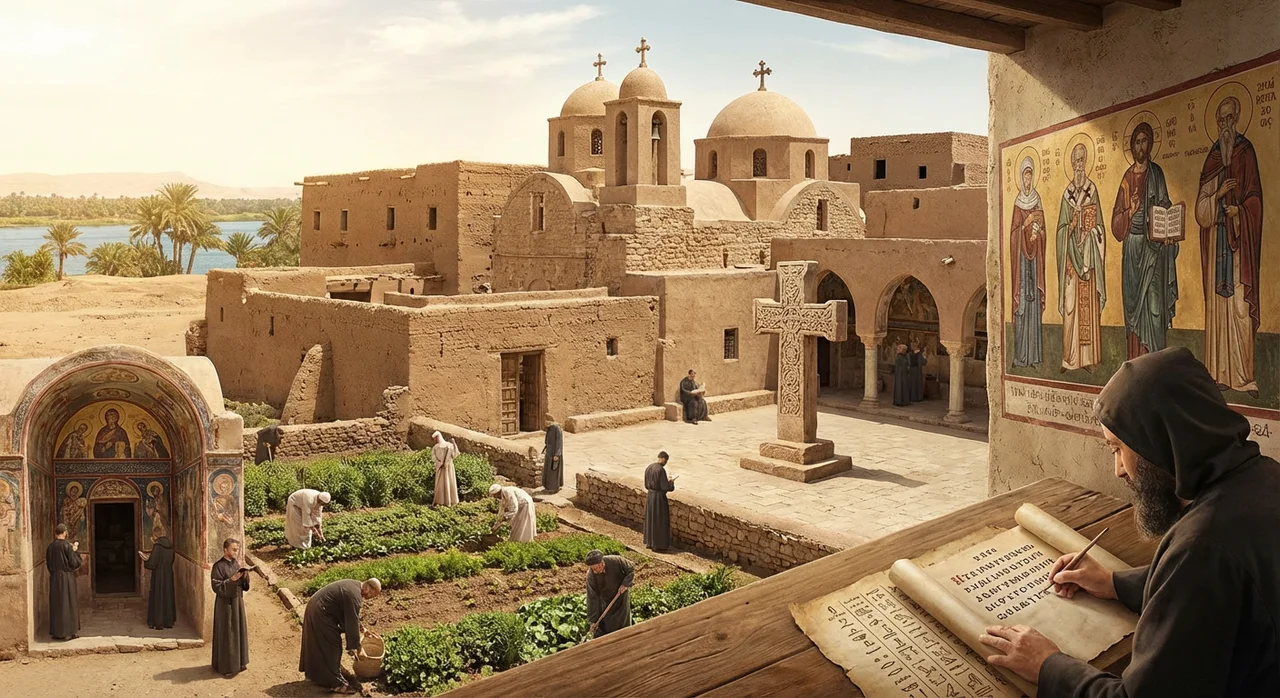
1. Definition & Boundaries: The Emergence of Coptic National Identity
The Coptic Era marks the historic epoch during which the native population of Egypt embraced Christianity while actively preserving their indigenous linguistic, artistic, and social heritage:
- Beyond a Religious Term: In Late Antiquity, Coptic did not merely denote a religious creed; it defined the native Egyptian people (Remenkemi — "The People of the Black Land") as distinct from their foreign Hellenistic and Roman rulers;
- Cultural Self-Determination: While the imperial administrative capitals of Alexandria and Antioch operated in Greek, the rural towns, agricultural estates, and desert valleys of Middle and Upper Egypt created a robust vernacular culture grounded in native Egyptian speech;
- The Historical Span: Beginning with the systemic crisis of the 3rd century and the accession of Emperor Diocletian in 284 AD, the Coptic Era reached its classical zenith in the 5th and 6th centuries, providing the cultural foundation that allowed Egyptian identity to survive through the Middle Ages.
2. Diocletian’s Fire: The Great Persecution & The Anno Martyrum Calendar
The foundational trauma that permanently forged Coptic consciousness was the Great Persecution (303–311 AD) unleashed by Emperor Diocletian:
While the Western Christian world eventually adopted the Gregorian calendar counting from the birth of Christ (Anno Domini), the Coptic Church of Egypt chose to anchor its official calendar not in triumph, but in sacrifice. The Coptic calendar permanently resets its epoch to September 11, 284 AD (1 Tout)—the accession year of Emperor Diocletian—commemorating the estimated 140,000 Egyptian Christians who were martyred for their faith.
- Imperial Decrees of Annihilation: Between 303 and 304 AD, imperial edicts ordered that all Christian scriptures be burned, churches razed to the ground, and every citizen forced to offer incense to pagan Roman gods upon penalty of execution;
- The Egyptian Witness: Eusebius of Caesarea, who personally visited the Nile Valley during the persecution, wrote in awe of the fearlessness of Egyptian martyrs: magistrates grew exhausted from sentencing, while Christian men and women sang hymns while awaiting execution;
- Saint Peter I (Seal of the Martyrs): The 17th Patriarch of Alexandria, martyred in 311 AD; his execution marked the close of the official era of imperial Roman persecutions prior to the Edict of Milan.
3. The Coptic Calendar System: Ancient Agricultural Months & Feast Cycles
The Coptic Calendar is the direct, unadulterated astronomical continuation of the 365-day ancient Egyptian civil calendar:
- The Structure: Exactly twelve months of thirty days each, followed by a short intercalary month of five days (six days in leap years) known as the Nasie (الشهر الصغير / أيام النسيء);
- Direct Pharaonic Month Names: Every month in the Coptic calendar preserves the phonetic name of an ancient pharaonic deity or harvest festival:
• Tout (توت): Named after Thoth, god of wisdom and writing; marks the Coptic New Year (September 11);
• Paopi (بابه): Named after the festival of Opet;
• Hathor (هاتور): Named after Hathor, goddess of beauty and agriculture;
• Koiak (كيهك): Dedicated to the sacred mysteries of Osiris; celebrated today with magnificent Marian vigil praises;
• Tobi (طوبة), Meshir (أمشير), Paremhat (برمهات), Parmouti (برمودة), Pashons (بشنس), Paoni (بؤونة), Epip (أبيب), Mesori (مسرى); - The Rhythm of the Nile: To this day, Egyptian agricultural farmers (both Christian and Muslim) structure their crop planting, plowing, and harvesting around the Coptic agricultural calendar, reciting ancient folk proverbs associated with each Coptic month.
4. Linguistic Transformation: From Hieroglyphs & Demotic to Coptic
The creation of the Coptic alphabet represents one of the most brilliant linguistic achievements in antiquity:
- The Demise of Hieroglyphs: Ancient hieroglyphic and hieratic scripts were exceedingly complex, restricted to a tiny elite caste of pagan temple priests. As temple funding dried up under late Roman rule, knowledge of hieroglyphs rapidly disappeared;
- The New Phonetic Script:
• Scholars and early Christian translators adopted the 24 letters of the standard Greek alphabet;
• To represent seven distinct Egyptian consonant sounds that did not exist in Greek, they extracted seven phonetic signs directly from cursive Demotic script: Ϣ (Shai), ϥ (Fai), ϧ (Khai), ϩ (Hori), ϫ (Janja), ϭ (Chima), and ϯ (Ti); - Democratic Literacy: For the first time in Egyptian history, ordinary citizens could master reading and writing in weeks rather than years of scribal apprenticeship, allowing biblical texts, monastic rules, and legal contracts to circulate freely among commoners.
5. Regional Dialects: Sahidic Classical Literature vs. Bohairic Liturgy
Reflecting the natural geographic diversity of the long Nile Valley, Coptic evolved into distinct literary dialects:
• Sahidic (الصعيدية): The southern dialect of Upper Egypt; celebrated as the classical literary dialect of Coptic, boasting a pure grammatical structure used for translating the Bible, monastic rules, and the homilies of Saint Shenoute;
• Bohairic (البحيرية): The northern dialect of the Nile Delta and Alexandria; preserved in the monasteries of Wadi El-Natrun, it became the official liturgical dialect of the Coptic Church in the 11th century and remains chanted in services today;
• Regional Dialects: Fayumic (Faiyum Oasis), Akhmimic (Akhmim), and Oxyrhynchite (Mesokemic/Middle Egypt).
6. Shenoute of Atripe: The Founding Father of Coptic National Literature
The undisputed giant of Coptic prose, rhetoric, and political leadership was Saint Shenoute the Archimandrite (348–466 AD):
- Abbot of the White Monastery (Deir el-Abyad): Situated near Sohag, Shenoute governed an immense monastic federation housing over 2,200 monks and 1,800 nuns;
- The Coptic Stylist: Shenoute was the first Egyptian author who did not translate from Greek, but composed directly in rich, powerful, and evocative Sahidic Coptic; his surviving sermons, letters, and polemics filled over 4,000 pages of text;
- Social Justice Champion: Shenoute used his monastic power to protect the native Egyptian poor against corrupt Roman tax collectors, predatory landlords, and surviving pagan aristocrats, famously opening the monastery gates to feed and shelter over 20,000 famine-stricken refugees during nomadic Blemmyes raids;
- Council of Ephesus (431 AD): Accompanied Patriarch Cyril of Alexandria to Ephesus, fiercely defending the orthodox Christian doctrine of the Incarnation.
7. Rural Village Life: Papyrological Treasures from Oxyrhynchus & Aphrodito
Thanks to the arid desert rubbish heaps of Middle and Upper Egypt, we possess more intimate documentary evidence about everyday life in the Coptic Era than almost any other ancient society:
- Oxyrhynchus (El-Bahnasa) Papyri: Tens of thousands of papyri written in Greek and Coptic detailing tax receipts, loan agreements, private divorce settlements, medical prescriptions, and private letters between family members;
- The Archives of Dioscorus of Aphrodito (6th Century):
• Discovered in Kom Ishqaw near Sohag;
• Dioscorus was a bilingual Coptic village headman, lawyer, and poet who traveled directly to Constantinople to petition Emperor Justinian for tax relief for his village;
• Preserves intimate village leases, petitions against abusive local governors, and original Coptic poetry; - Village Economic Cooperatives: Towns like Jeme (Medinet Habu) on the Theban West Bank were self-governing Christian communities where potters, weavers, and leatherworkers formed professional guilds, settling legal disputes before local presbyters rather than corrupt imperial judges.
8. Social Resistance: Native Egyptian Copts vs. Byzantine Imperial Hegemony
The 5th and 6th centuries were characterized by deep, simmering sociopolitical resistance between native Egyptians and their Byzantine rulers:
- The Chalcedonian Fault Line (451 AD): When the Council of Chalcedon deposed Alexandrian Patriarch Dioscorus, native Egyptians viewed the decision not merely as a theological disagreement, but as an imperial Byzantine attempt to crush Egyptian cultural autonomy;
- Rejection of the "Melkites": The imperial bishops installed by Constantinople were derided as Melkites ("Royalists" or "King’s Men"); native Egyptians refused to take communion from them, hiding their own Coptic bishops in desert monasteries;
- Tax Protests & Agrarian Strikes: Egyptian farmers regularly engaged in passive economic resistance—hiding grain stores, abandoning land, or taking refuge in desert monasteries to evade Byzantine imperial taxation, creating deep structural alienation between the ruler and the ruled.
9. Funerary Culture in Transition: Shrouds, Stelae & The End of Mummification
During the Coptic Era, mortuary practices underwent a profound theological evolution:
- The Demise of Mummification: Influenced by Saint Anthony, who explicitly forbade the traditional embalming and domestic display of Christian bodies, Copts abandoned artificial organ removal and mummification salts, viewing it as pagan vanity;
- The Sacred Woven Shrouds: The dead were washed in holy water, dressed in their finest embroidered linen tunics (featuring Christian crosses and grapevine roundels), wrapped in multiple layers of woven textiles, and buried directly in the earth facing east;
- Coptic Funerary Stelae:
• Carved from local limestone and sandstone, placed over graves in necropolises like Kom Bulbul (Akhmim) and Terenuthis;
• Decorated with prayer inscriptions in Sahidic Coptic: "Remember, O Lord, Your servant who went to rest in peace...";
• Flanked by architectural pediments, shell niches, orants with raised arms in prayer, and the looped Crux Ansata cross.
10. The Climax: The Eve of the Arab-Muslim Conquest (641 AD)
By the opening of the 7th century, Byzantine administrative authority in Egypt had completely exhausted its legitimacy:
- The Brutality of Cyrus (Al-Muqawqis): Emperor Heraclius appointed Cyrus as both imperial prefect and Chalcedonian patriarch; Cyrus subjected the native Coptic population to ten years of torture, arrests, and persecution, seeking to force acceptance of the Monothelite compromise;
- The Exile of Patriarch Benjamin I: The legitimate 38th Coptic Patriarch, Benjamin I, was hunted by imperial troops, forced to live in hiding in the remote desert monasteries of Upper Egypt for thirteen years;
- The Historic Turning Point (641 AD):
• When Arab general Amr ibn al-Aas captured Babylon Fortress and negotiated the capitulation of Alexandria, the Coptic population welcomed the end of Byzantine imperial rule;
• Amr issued a historic safe-conduct guarantee for Patriarch Benjamin I, who returned to Alexandria in triumph, reclaiming Coptic cathedrals and establishing the legal status of Copts under the Dhimmi pact of Islamic governance.
11. Master Coptic Era Chronological & Cultural Matrix
The following matrix details the major chronological phases, sociopolitical developments, linguistic milestones, and historical achievements of the Coptic Era:
| Date Span / Era | Historic Context | Linguistic & Cultural Action | Prominent Personalities | Major Historical & Archaeological Milestones |
|---|---|---|---|---|
| 284 – 313 AD | Reign of Diocletian | Initial development of Old Coptic and Sahidic script. | St. Peter I, St. Menas, St. Catherine of Alexandria | The Great Persecution; founding of the Calendar of the Martyrs (284 AD); early Abu Mena shrine. |
| 313 – 381 AD | Constantinian Peace | Widespread translation of Old and New Testaments into Coptic. | St. Anthony the Great, St. Pachomius, St. Athanasius | Birth of eremitic and cenobitic monasticism; Council of Nicaea (325 AD); Easter Letter 39 (New Testament Canon). |
| 381 – 451 AD | Golden Patristic Era | Flowering of native Coptic literature; Sahidic becomes national standard. | St. Shenoute the Archimandrite, St. Cyril of Alexandria | White Monastery founded; Council of Ephesus (431 AD); closure of pagan temples; Nag Hammadi Codices cached. |
| 451 – 619 AD | Post-Chalcedonian Division | Coptic becomes the primary language of administrative and legal village records. | St. Dioscorus I, Dioscorus of Aphrodito | Council of Chalcedon schism (451 AD); native Coptic resistance against Byzantine Melkite prefects; Aphrodito papyri. |
| 619 – 641 AD | Persian & Arab Transitions | Preservation of Coptic identity through monastic scribal centers during invasions. | Patriarch Benjamin I, Emperor Heraclius, Amr ibn al-Aas | Sasanian Persian occupation (619–629 AD); fall of Babylon Fortress (641 AD); return of Benjamin I from desert exile. |
12. Private Curated Coptic Era Historical Expeditions with Ultra Egypt Travel
Exploring the authentic archaeology of the Coptic Era—from the monumental carved limestone walls of the White and Red Monasteries in Sohag and the desert ruins of Bawit to the Christian town ruins of Jeme at Medinet Habu and the ancient churches of Old Cairo—requires expert academic historians, specialized monastic clearances, and executive luxury ground logistics.
Operating under Ministry of Tourism License #874 (Class A) and IATA Accreditation #90229930, Ultra Egypt Travel delivers bespoke private historical expeditions focusing on the Coptic Era:
- Sohag Coptic Literary & Monastic Masterclass: Private chauffeured expedition to Upper Egypt visiting the White Monastery (Deir el-Abyad) and Red Monastery (Deir el-Ahmar) in Sohag, exploring the architectural genius of Saint Shenoute and inspecting restored 5th-century Byzantine-Coptic frescoes with university art historians;
- Coptic Museum Manuscript & Papyrus Tour (Cairo): Private guided analysis of the Coptic Museum’s world-class collection—early Sahidic and Bohairic biblical codices, monastic woodwork from Bawit, funerary stelae, and woven Coptic textiles;
- Theban West Bank Christian Heritage Tour (Luxor): Private walking exploration of the Coptic village ruins of Jeme preserved inside the Temple of Medinet Habu, and the early monastic hermitages of the Valley of the Kings and Deir el-Bahari;
- Abu Mena UNESCO Archaeological Pilgrimage: Specialized private day tour from Alexandria to the archaeological ruins of the ancient pilgrimage city of Saint Menas in the Maryut desert;
- VIP Chauffeured Protocol: Executive climate-controlled Mercedes-Benz fleet, private airport meet-and-assist, all required antiquities permissions, and 24/7 dedicated operational monitoring from our Cairo headquarters.