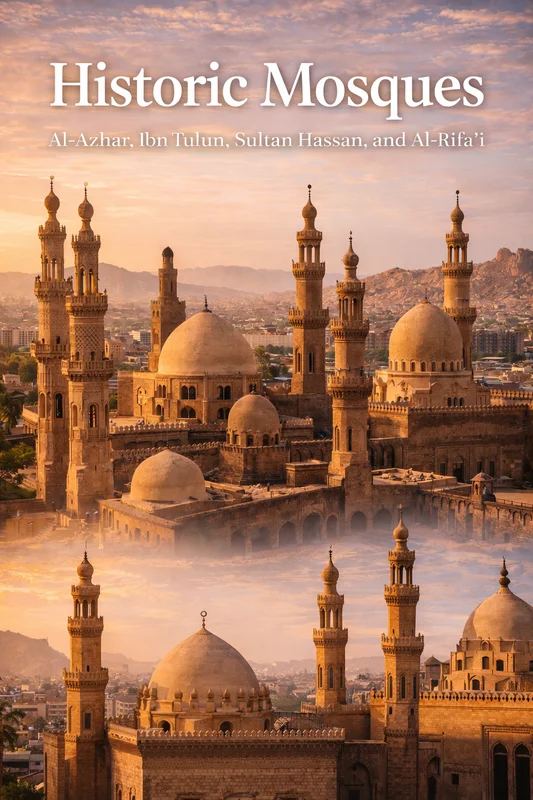
1. Architectural Typologies: Hypostyle, Four-Iwan & Domed Halls
The historic mosques of Egypt represent the structural evolution of Islamic sacred architecture over 1,400 years, classified into three primary structural typologies:
- The Hypostyle Plan (الجامع المعمد): The earliest layout, directly inspired by the Prophet’s Mosque in Medina. Characterized by an open central courtyard (Sahn) surrounded by colonnaded porticos (Riwaqs) where flat timber roofs rest upon rows of marble columns (seen at Amr ibn al-A'as and Al-Azhar);
- The Four-Iwan Plan (التخطيط المتعامد ذو الإيوانات الأربعة): Developed during the Seljuk, Ayyubid, and Mamluk eras. Features a central unroofed court flanked by four monumental vaulted halls (Iwans), traditionally dedicated to teaching the four Sunni schools of jurisprudence (Hanafi, Shafi'i, Maliki, Hanbali), epitomized by Sultan Hassan;
- The Domed Ottoman Plan (الطراز العثماني المركزي): Introduced after 1517 AD, characterized by a monumental central hemispherical dome surrounded by cascading semi-domes and pencil-shaped minarets, creating an open, column-free prayer hall (epitomized by Muhammad Ali Mosque).
2. Mosque of Amr ibn al-A'as: Africa's Foundational Sanctuary (641 AD)
Erected in the newly founded capital of Fustat in the winter of 641–642 AD, the Mosque of Amr ibn al-A'as (جامع عمرو بن العاص) is celebrated across the Islamic world as the first mosque built on the African continent:
The original 7th-century structure was humble—measuring just 29 by 17 meters with mudbrick walls, palm-trunk columns, and thatched palm-frond roofing. Over successive centuries under Umayyad, Abbasid, and Fatimid governors, it expanded into a colossal complex covering over 13,000 square meters, supported by 365 antique marble columns representing the days of the solar year.
- The Qibla Wall: Features deeply recessed marble mihrabs adorned with mother-of-pearl mosaics and gold Quranic inscriptions;
- The Fountain of the Courtyard: A vast open-air marble courtyard centered around a domed ablution fountain, historically shaded by canvas awnings during Friday congregations;
- The Crown of Mosques (Taj al-Jawami): The spiritual and legal nursery where Imam Al-Shafi'i (founder of the Shafi'i legal school) delivered lectures before his death in 820 AD.
3. Mosque of Ahmad ibn Tulun: The 9th-Century Spiral Wonder
Constructed between 876 and 879 AD atop the rocky limestone elevation of Gebel Yashkur, the Mosque of Ahmad ibn Tulun (جامع أحمد بن طولون) is the oldest mosque in Cairo surviving in its original architectural form:
- The Samarran Architectural Vocabulary: Ahmad ibn Tulun, founder of Egypt’s autonomous Tulunid Dynasty, brought architectural concepts from Samarra in Iraq. Built entirely of red fired brick covered in carved gypsum plaster, it dispensed completely with reused classical temple columns;
- Pointed Arches on Sturdy Piers: The prayer arcades rest on massive rectangular brick piers with engaged decorative corner colonnettes, supporting pointed arches that predate European Gothic pointed architecture by three hundred years;
- The Spiral Minaret (Al-Malwiya): The iconic limestone minaret features an exterior helical stone staircase winding counter-clockwise around its square and cylindrical tiers;
- The Quranic Frieze: Over two kilometers of continuous sycamore timber friezes run beneath the ceiling, hand-carved in archaic Kufic script containing one-fifteenth of the entire text of the Quran;
- The Open Ziyada: An empty outer perimeter precinct measuring 19 meters wide that envelopes the mosque on three sides to keep out street noise and dust.
4. Al-Azhar Mosque: A Millennium of Theology & Architecture (970 AD)
Commissioned by Fatimid commander Jawhar al-Siqilli under Caliph Al-Mu'izz li-Din Allah and inaugurated for Friday prayers on 7 Ramadan 361 AH (972 AD), Al-Azhar Mosque (جامع الأزهر) is Egypt's intellectual and spiritual jewel:
- The Architectural Tapestry: Blends five distinct dynasties into a single living sanctuary:
• Fatimid Core: Original stucco keel arches adorned with openwork plaster rosettes and Kufic inscriptions in the prayer hall;
• Mamluk Minarets: Towering minarets added by Sultan Qaitbay (1468 AD) featuring intricate stone arabesques, and Sultan Qansuh al-Ghuri (1510 AD) crowned with a double-headed finial;
• Ottoman Expansion: The grand Gate of the Barbers (Bab al-Muzayyinin) and twin madrasas added by Abd al-Rahman Katkhuda in 1753; - The Mother University of Sunni Islam: Organized into historic student study halls (Riwāqs) representing different Islamic lands (Riwāq of the Syrians, North Africans, Turks, and Sudanese).
5. Mosque of Al-Hakim bi-Amr Allah: Monumental Stone Fortresses
Anchoring the northern boundary of Al-Mu'izz Street immediately adjacent to Bab al-Futuh stands the Mosque of Al-Hakim bi-Amr Allah (جامع الحاكم بأمر الله — 990–1013 AD):
- Monumental Fortified Bastions: Celebrated for its unique exterior corner minarets encased in massive cubical limestone bastions added by Al-Hakim in 1010 AD, resembling military castle gatehouses;
- The Great Open Sahn: A vast rectangular marble courtyard measuring over 100 meters long, flanked by four arcades of pointed brick arches adorned with Kufic stucco inscriptions;
- Historical Utility: Throughout its turbulent history, the mosque served as a prison for Crusaders, a royal stable under Saladin, an arms depot under Napoleon Bonaparte, and a boys' school, before being restored to pristine religious splendor.
6. Al-Aqmar Mosque (1125 AD): The First Sculpted Stone Facade
Situated along Al-Mu'izz Street, the jewel-like Al-Aqmar Mosque (الجامع الأقمر — "The Moonlit Mosque") represents a revolutionary turning point in Islamic architectural history:
Commissioned by Fatimid vizier Al-Ma'mun al-Bata'ihi in 1125 AD, Al-Aqmar was the first mosque in Islamic history designed with an asymmetrical exterior facade aligned to the existing street grid, while its interior was skewed to strictly face the Mecca Qibla orientation.
- The Carved Stone Portal: Features the earliest known use of carved stone stalactite corbeling (Muqarnas), paired with radiating fluted shell medallions and pierced stone sunburst panels bearing the names of Muhammad and Ali;
- Geometric Masonry: The facade is covered in intricate relief carvings resembling suspended Persian prayer carpets and openwork lattice windows.
7. Mosque-Madrasa of Sultan Hassan: Pinnacle of Mamluk Glory
Commissioned in 1356 AD by the young Bahri Mamluk ruler Sultan al-Nasir Hassan and completed in 1363 AD, the Mosque-Madrasa of Sultan Hassan (مسجد ومدرسة السلطان حسن) is widely considered the supreme architectural masterpiece of medieval Islam:
- Staggering Monumentality:
• Covers 8,000 square meters at the base of the Citadel of Saladin;
• Exterior sheer ashlar limestone walls soar 36 meters high, crowned by an ornate 3-meter projecting stalactite cornice;
• The grand portal rises 38 meters, flanked by spiraled pilasters and carved marble panels; - The Four-Iwan Cruciform Plan:
• Centered around a majestic open courtyard paved in polychrome marble with an octagonal domed fountain;
• Four colossal vaulted halls (Iwans) open off the courtyard. The eastern Qibla iwan spans an enormous pointed barrel vault ending in a carved marble mihrab and an ornate bronze chandelier;
• Four independent multi-story college buildings (madrasas) are tucked into the corners, each with its own private courtyard, student dormitories, and library for teaching the four Sunni legal rites; - The Royal Mausoleum: A magnificent 21-meter square chamber covered by a soaring 48-meter wooden dome situated directly behind the Qibla wall, preserving Sultan Hassan's cenotaph and carved marble lecterns;
- Tallest Medieval Minaret: The southern minaret reaches 68 meters, the tallest historic minaret in Cairo.
8. Al-Rifa'i Mosque: The Royal Mausoleum of Egypt & The Last Shah
Standing directly opposite Sultan Hassan across Citadel Square sits the monumental Al-Rifa'i Mosque (مسجد الرفاعي), separated only by a narrow pedestrian lane:
- Commissioned in 1869: Conceived by Khushyar Hanim, mother of Khedive Ismail, and designed by Egyptian architect Hussein Fahmy Pasha to match the scale of Sultan Hassan; completed in 1912;
- Neo-Mamluk Revival Architecture: Built using imported European marble, hand-carved limestone stalactites, gold leaf ceilings, and 44 grand interior columns;
- The Royal Necropolis of the Muhammad Ali Dynasty: Serves as the Westminster Abbey of modern Egypt, housing the ornate marble tombs of:
• Khedive Ismail (builder of modern Cairo);
• Sultan Hussein Kamel and King Fuad I;
• King Farouk, the last reigning King of Egypt (deposed in 1952); - Tomb of the Last Shah of Iran: Contains the quiet, green-marble tomb of Mohammad Reza Pahlavi, who died in exile in Cairo in 1980 and was granted full military honors by President Anwar Sadat.
9. Mosque of Sultan al-Mu'ayyad Shaykh: Minarets over Bab Zuweila
Adjoining the southern Fatimid gate of Bab Zuweila, the Mosque of Sultan al-Mu'ayyad Shaykh (جامع المؤيد شيخ — 1415–1420 AD) was built by a Burji Mamluk sultan fulfilling a vow:
- From Prison to Sanctuary: While imprisoned as an emir in the notorious Khazanat Shamayil prison on this site, Al-Mu'ayyad vowed that if he ever attained power, he would demolish the dungeon and replace it with a magnificent mosque and madrasa;
- Minarets Perched on Roman-Fatimid Towers: The twin ornate Mamluk minarets are daringly constructed directly atop the two semi-circular stone towers of the 11th-century Fatimid gate of Bab Zuweila, dominating the southern skyline of Old Cairo;
- Bronze Doors of Sultan Hassan: Al-Mu'ayyad purchased and installed the colossal bronze-plated entrance doors originally made for the Mosque of Sultan Hassan;
- Marble Marquetry: The prayer hall is renowned for its turquoise and polychrome marble mosaic walls, gilded carved timber ceilings, and stained-glass stucco windows.
10. The Alabaster Mosque of Muhammad Ali: Ottoman Citadel Skyline
Perched upon the highest point of the Citadel of Saladin, the Mosque of Muhammad Ali Pasha (جامع محمد علي) is Cairo’s most recognizable skyline icon:
- Imperial Ottoman Classical Monument: Built between 1830 and 1848 AD by Greek-Armenian architect Yusuf Bushnaq, modeled directly after the monumental Sultan Ahmed (Blue Mosque) in Istanbul;
- The Soaring Dome & Minarets: A vast central dome rising 52 meters high with a diameter of 21 meters, supported by four massive corner piers and semi-domes, flanked by twin pencil-shaped minarets reaching 84 meters;
- Alabaster Cladding: Lower exterior facades and interior walls are clad in translucent, golden-veined Egyptian alabaster quarried from Beni Suef;
- The Clock Tower Gift: The open marble courtyard houses an ornate brass clock tower presented in 1845 by King Louis-Philippe of France in diplomatic exchange for the pharaonic Luxor Obelisk standing in the Place de la Concorde in Paris.
11. Master Historic Mosques Directory & Visitor Logistics Matrix
The following matrix details Egypt’s primary historic congregational mosques, architectural eras, operating parameters, and visiting advice:
| Mosque Name | Location / Sector | Foundation Era | Signature Highlights & Visiting Advice |
|---|---|---|---|
| Amr ibn al-A'as | Fustat (Old Cairo) | 641 AD | Africa's first mosque, expansive colonnades, open Sahn. Modest dress. |
| Ahmad ibn Tulun | Sayyida Zeinab / Saliba | 879 AD | Spiral exterior minaret (climbable), 6.5-acre red brick courtyard. |
| Al-Azhar Mosque | Al-Azhar Street Core | 970 AD | Millennium-old university, Fatimid rosettes, active student circles. |
| Al-Hakim bi-Amr Allah | North Al-Mu'izz Street | 1013 AD | Fortified corner bastions, massive white marble courtyard. |
| Al-Aqmar Mosque | Central Al-Mu'izz Street | 1125 AD | First sculpted stone street facade in Islamic world, stalactites. |
| Sultan Hassan | Citadel Square | 1356–1363 AD | Monumental 4-iwan vaulting, 68m minaret, Mamluk stone pinnacle. |
| Al-Rifa'i Mosque | Opposite Sultan Hassan | 1869–1912 AD | Royal tombs of King Farouk, Khedive Ismail, and the Shah of Iran. |
| Al-Mu'ayyad Shaykh | Bab Zuweila / Al-Mu'izz | 1420 AD | Minarets built atop 11th-century city gate, bronze doors, mosaics. |
| Muhammad Ali Pasha | Citadel of Saladin | 1830–1848 AD | Alabaster-clad walls, 52m Ottoman dome, French clock tower, views. |
12. Private Curated Mosque Architecture Circuits with Ultra Egypt Travel
Studying the complex evolution of Islamic stone vaulting, climbing medieval minarets for panoramic skyline vistas, or touring royal mausoleums requires licensed art historians, respectful protocol coordination, and executive ground transport.
Operating under Ministry of Tourism License #874 (Class A) and IATA Accreditation #90229930, Ultra Egypt Travel delivers bespoke private itineraries across Egypt's landmark mosques:
- The Grand Mosque Architecture Masterclass (Full Day): Private walking and chauffeured circuit exploring Amr ibn al-A'as, Ibn Tulun, Sultan Hassan, Al-Rifa'i, and Muhammad Ali led by licensed Islamic architectural scholars;
- Al-Mu'izz Street Minarets & Facades Tour: Specialized architectural walks analyzing Al-Aqmar's stone carvings, Al-Hakim's bastions, and Al-Mu'ayyad's gates;
- The Citadel Panorama & Royal Tombs Excursion: Private guided access to the royal crypts of Al-Rifa'i and the alabaster interior of Muhammad Ali;
- VIP Chauffeured Protocol: Executive climate-controlled Mercedes-Benz vehicles with professional drivers, shoe-cover provisions, and 24/7 dedicated operations monitoring.