1. Architecture of Marcel Dourgnon's 1902 Palace
The Egyptian Museum in Cairo (المتحف المصري بالتحرير) was the first building in the world custom-designed and constructed specifically to function as a public national archaeological museum.
Following an international design competition held in 1895 that attracted 73 proposals from Europe and Egypt, French architect Marcel Dourgnon was awarded the prestigious commission. Erected in a refined neoclassical Beaux-Arts style, the building features an iconic terracotta-pink facade, towering arched entry portals flanked by classical ionic pilasters, and personifications of Upper and Lower Egypt sculpted in stone above the main gate.
Inaugurated on November 15, 1902, under Khedive Abbas Helmy II and legendary Antiquities Service Director Gaston Maspero, the museum replaced the overcrowded former storage facility at the Giza Palace. Its grand glass skylights and soaring central atrium were engineered to illuminate massive stone sarcophagi and colossi with filtered natural Mediterranean sunlight, an architectural hallmark preserved to this day.
2. The Ground Floor: Chronological Statuary
The layout of the museum's ground floor was conceived by Maspero as a clockwise chronological procession through three millennia of dynastic artistic evolution:
- The Rotunda & Atrium: Upon crossing the security entrance, visitors enter the colossal atrium housing monumental sculptures, including the massive limestone triad of Amenhotep III, Queen Tiye, and their daughters from Medinet Habu, alongside giant granite sarcophagi and pyramidions.
- Archaic & Old Kingdom (Rooms 41–48): Flanking the western side of the ground floor, these galleries exhibit the pristine, solid limestone and diorite sculptures of the Third, Fourth, and Fifth Dynasties, highlighting the geometric perfection of the Pyramid Age.
- Middle Kingdom (Rooms 21–26): Demonstrates the transition into humanized royal portraiture, featuring the somber black granite statues of Senusret III and the fine limestone architectural reliefs of Mentuhotep II from Deir el-Bahari.
- New Kingdom (Rooms 11–15): Celebrates imperial Theban grandeur with dynamic granite colossi of Hatshepsut, Thutmose III, and the dramatic Amarna revolution gallery displaying the avant-garde colossal statues of Akhenaten.
- Late & Greco-Roman Periods (Rooms 49–50): Concludes the ground floor with basalt sarcophagi, bronze votive statues, and Hellenistic statues embodying Greek-Egyptian syncretism.
3. The Narmer Palette: Dawn of Unification
Standing prominently on the ground floor is arguably the most historically foundational archaeological artifact in the world: the Narmer Palette (c. 3100 BC).
Discovered in 1898 by British archaeologists James Quibell and Frederick Green in the temple temple precinct of Nekhen (Hierakonpolis), this 64-centimeter shield-shaped ceremonial slab of dark green siltstone records the unification of Upper and Lower Egypt:
• Obverse Face: King Narmer wears the White Crown (Hedjet) of Upper Egypt, raising a ceremonial mace to smite a Delta chieftain, overseen by the Horus falcon subduing the papyrus marshes.
• Reverse Face: Narmer marches in triumph wearing the Red Crown (Deshret) of Lower Egypt, inspecting decapitated enemy corpses, flanked by mythical long-necked serpopards whose entwined necks form the circular depression for grinding cosmetic eye paint.
The palette establishes the formal visual canon, canonical proportions, and hieroglyphic serekh royal heraldry that would define Egyptian art for the next three thousand years.
4. Old Kingdom Masterpieces: Khafre & Meidum
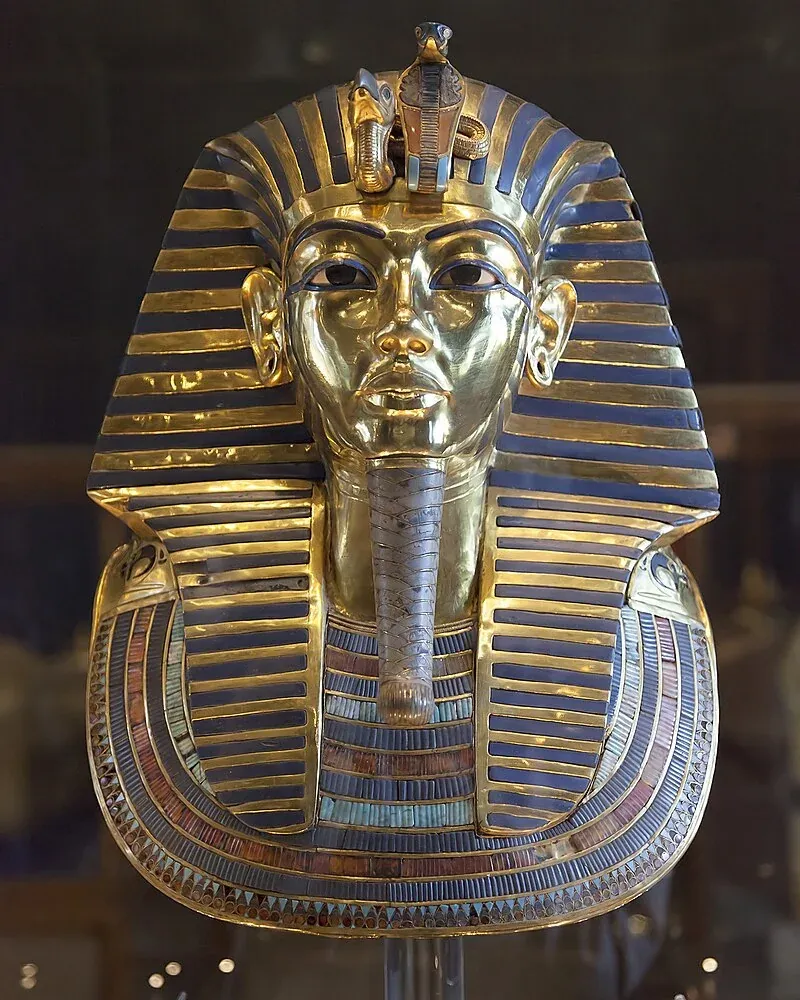
While the gold of Tutankhamun has moved to the Grand Egyptian Museum, the Egyptian Museum in Tahrir remains the undisputed, permanent home of the supreme artistic masterpieces of the Old Kingdom (c. 2686–2181 BC):
- The Diorite Statue of Khafre (Chephren): Carved from an extremely hard block of dark, luminous anorthosite gneiss quarried in the Nubian desert. Depicts the builder of the Second Pyramid seated on a lion-legged throne; behind his head, the divine Horus falcon spreads its wings in protective embrace, visually proclaiming the pharaoh's divine kingship.
- Statue of Rahotep and Nofret: Discovered inside their Fourth Dynasty mastaba at Meidum. Sculpted from fine limestone and adorned with intact, vibrant mineral pigments. Their lifelike inlaid eyes—fashioned from translucent rock crystal, calcite, and bronze eyelids—startle visitors with their realistic presence.
- The Seated Scribe: A painted limestone masterpiece depicting an anonymous Fifth Dynasty bureaucrat seated cross-legged on a woven papyrus mat, reed stylus in hand, displaying intense, intelligent attention in his rock-crystal eyes.
- The Meidum Geese: A 4,500-year-old painted stucco fresco retrieved from the tomb of Nefermaat. Celebrated as the "Mona Lisa of ancient painting," depicting six geese grazing with astonishing naturalistic plumage detail.
- The Copper Statues of Pepi I: Life-sized hammered copper statues of Sixth Dynasty Pharaoh Pepi I and his son Merenre, representing the pinnacle of ancient metal sculpture.
5. Middle & New Kingdom Galleries
Moving into the Middle and New Kingdom galleries reveals the technological, military, and theological developments of Thebes:
- Statue of Mentuhotep II (Bab el-Hosan): Found wrapped in linen in an underground tomb court at Deir el-Bahari. Depicts the unifier of the Middle Kingdom seated in the archaic jubilee Heb-Sed robe, painted pitch-black to symbolize fertility and Osirian resurrection, wearing the Red Crown of the North.
- Hatshepsut Osiride Statues: Rescued from the quarries of Deir el-Bahari after being smashed by Thutmose III, these reassembled painted limestone statues depict the female monarch with ideal facial features and crossed royal flails.
- The Amarna Room: Displays the dramatic artistic rupture of Akhenaten and Nefertiti, featuring the colossal pillars from Karnak with elongated facial features, sculpted limestone heads of Amarna princesses, and painted floor tiles from the royal palace at Akhetaten.
6. First Floor: The Tomb of Yuya and Thuya
On the museum's upper floor, galleries that formerly housed Tutankhamun have been magnificently dedicated to the intact royal tomb of his great-grandparents: Yuya and Thuya (KV46).
Discovered in the Valley of the Kings in 1905 by American archaeologist Theodore Davis and Arthur Weigall, KV46 was the most intact and lavish non-royal tomb ever found in Egypt prior to Tutankhamun:
- Gilded Sarcophagi & Mummy Masks: Exquisite gold-leaf funerary masks with rock-crystal inlays preserving the regal facial likenesses of Queen Tiye’s noble parents.
- State Chariot of Yuya: A fully preserved, lightweight wooden hunting and ceremonial chariot covered in embossed gold foil and tooled leather.
- Palatial Furniture: Intricately carved wooden ceremonial chairs with cedar and ivory inlays presented to the couple by their granddaughter, Princess Sitamun, alongside gilded beds and alabaster ointment vessels.
7. The Royal Gold Treasures of Tanis
While international travelers flock to Tutankhamun, connoisseurs recognize the Treasures of Tanis on Tahrir's first floor as an equally astonishing, precious royal gold collection:
Discovered in 1939–1940 by French Egyptologist Pierre Montet at San el-Hagar in the northeastern Nile Delta, the royal tombs of the 21st and 22nd Dynasties survived antiquity entirely unlooted:
The Tanis galleries also display royal electrum jewelry, heavy gold collars, broad floral collars inlaid with carnelian, and the gold burial masks of Pharaoh Amenemope and General Wendjebauendjed.
8. The Museum Post-GEM: Revitalized Master Plan
Following the transfer of King Tutankhamun's collection to the Grand Egyptian Museum (GEM) and the Royal Mummies to NMEC, the Egyptian Museum in Tahrir has not closed—rather, it has undergone a historic renaissance.
Under an ambitious multi-million-euro consortium funded by the European Union and uniting the Louvre, the British Museum, the Museo Egizio of Turin, the Neues Museum of Berlin, and the Rijksmuseum van Oudheden of Leiden:
- Restoration of 1902 Colors: Layers of modern institutional paint have been stripped away to reveal Marcel Dourgnon's original neoclassical wall colors: soft Egyptian ochre, Pompeian red, and pale olive green.
- State-of-the-Art Lighting: Modern diffused LED lighting tracks have replaced outdated fluorescent tubes, illuminating granite reliefs and statues without glare.
- Reimagined Display Cases: Iconic vintage wooden display cabinets have been fitted with anti-reflective optical glass and modern microclimate control systems.
- Unseen Reserve Treasures: Over 20,000 antiquities previously confined to dark subterranean basement vaults are being rotated onto the upper floor galleries, providing visitors with a far more tranquil, uncrowded curatorial experience.
9. Masterpieces Floor-by-Floor Matrix
The following curatorial matrix details the must-see masterworks on display across the two levels of the Egyptian Museum:
| Floor Level | Masterwork Title | Dynastic Period | Material & Significance |
|---|---|---|---|
| Ground Floor | The Narmer Palette | Dynasty 1 (c. 3100 BC) | Green siltstone; foundational document of the unification of Upper and Lower Egypt. |
| Ground Floor | Diorite Statue of Khafre | Dynasty 4 (c. 2520 BC) | Anorthosite gneiss; builder of Giza's 2nd Pyramid with protective Horus falcon. |
| Ground Floor | Statues of Rahotep & Nofret | Dynasty 4 (c. 2570 BC) | Painted limestone with inlaid rock-crystal eyes; lifelike Old Kingdom royal couple. |
| Ground Floor | The Seated Scribe | Dynasty 5 (c. 2450 BC) | Painted limestone; realistic portrayal of ancient scribal administrative elite. |
| Ground Floor | The Meidum Geese | Dynasty 4 (c. 2575 BC) | Painted plaster fresco; the pinnacle of Old Kingdom naturalistic animal painting. |
| Ground Floor | Statue of Mentuhotep II | Dynasty 11 (c. 2010 BC) | Painted sandstone; pitch-black Osirian Heb-Sed jubilee unifier of Middle Kingdom. |
| First Floor | Gold Mask of Psusennes I (Tanis) | Dynasty 21 (c. 1000 BC) | Solid gold with lapis lazuli; unlooted royal burial mask from San el-Hagar. |
| First Floor | Solid Silver Coffin of Psusennes I | Dynasty 21 (c. 1000 BC) | Solid silver metalwork; extraordinary rarity in a civilization where silver exceeded gold. |
| First Floor | Gilded Chariot of Yuya | Dynasty 18 (c. 1380 BC) | Wood, gold leaf & tooled leather; intact private royal court chariot from KV46. |
10. Visitor Logistics & Fast-Track Ticketing
Navigating the Egyptian Museum in Downtown Cairo is convenient when planned with current ministerial regulations in mind:
- Location: Midan Al-Tahrir, Downtown Cairo. The main pedestrian gate is located directly off the north roundabout of Tahrir Square, facing the Nile Ritz-Carlton.
- Metro Access: Take Cairo Metro Line 1 or Line 2 directly to Sadat Station. Take the "Egyptian Museum" exit to surface immediately in the museum entrance garden.
- Opening Hours: Open daily from 9:00 AM to 5:00 PM. Ticket windows close strictly at 4:15 PM. During Ramadan, opening hours typically run from 9:00 AM to 3:00 PM.
- Cashless Ticketing: The Ministry of Tourism enforces a strict 100% cashless payment policy. Cash banknotes are rejected at all ticket booths. Tickets must be purchased using an international credit or debit card (Visa or Mastercard).
- Cairo Pass Coverage: The Egyptian Museum in Tahrir is included in the official 5-day Cairo Pass ($130 USD).
- Photography Regulations: Non-commercial smartphone photography without flash is completely free and permitted throughout all gallery halls. Professional tripod setups and DSLRs require a dedicated photography permit.
11. Private Guiding with Academic Egyptologists
Because the Egyptian Museum preserves thousands of objects in close proximity, exploring its halls without a scholarly guide can be overwhelming.
Under Ministry License #874 (Class A), Ultra Egypt Travel delivers bespoke private visits led exclusively by university-credentialed Egyptologists:
- Pre-arranged electronic priority entry vouchers bypassing public ticket lines;
- Private, direct translation of Middle Egyptian hieroglyphic stelae and royal cartouches in-situ;
- Curated thematic pathways focusing on Old Kingdom sculpture, Tanis royal gold, and religious evolution; and
- Chauffeured, climate-controlled executive transfers from your hotel, seamlessly combining the Egyptian Museum with Islamic Cairo, Coptic Cairo, or the Citadel.