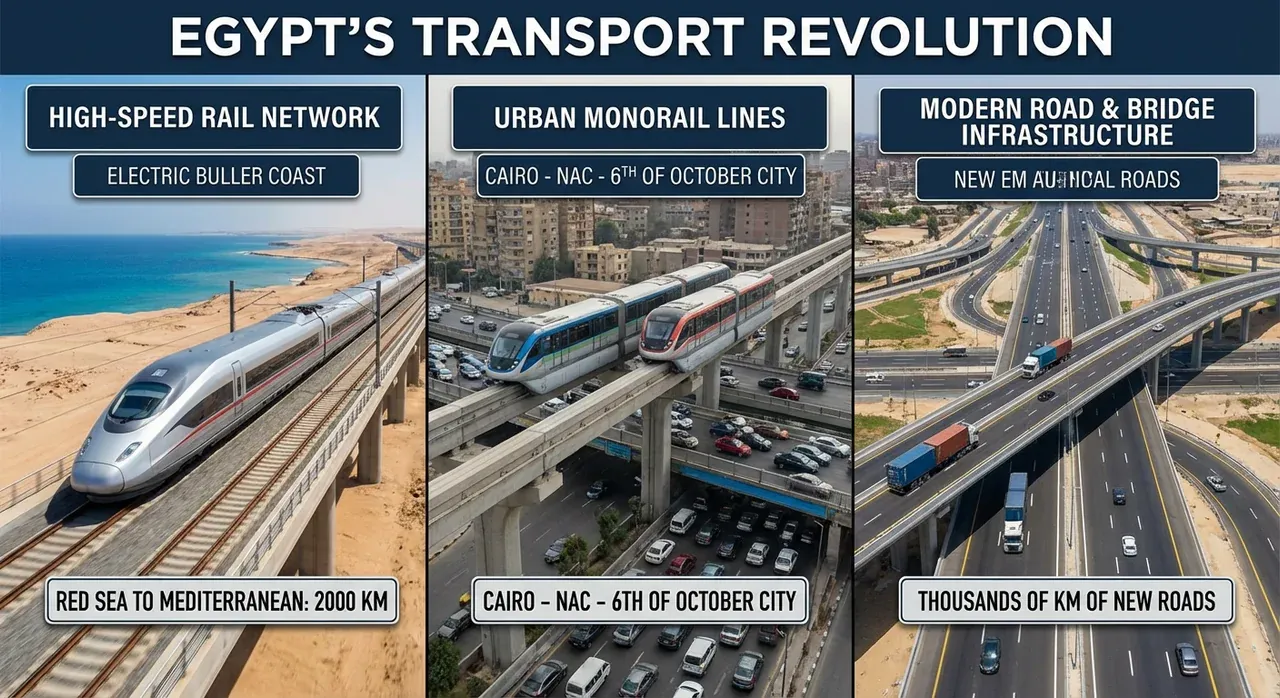
1. The Mobility Transformation: National Master Plan
For over a century, Egypt’s transportation infrastructure was constrained by legacy, diesel-dependent colonial railways and severe urban gridlock across the Greater Cairo metropolitan basin.
Under the directive of the Egyptian Ministry of Transport and the National Authority for Tunnels (NAT), Egypt launched an unprecedented $35-billion national mobility overhaul:
- Multimodal Integration: Constructing interoperable transit interchanges where high-speed trains, urban subways, monorails, electric buses, and suburban light rail meet seamlessly (such as the Adly Mansour Mega-Interchange in eastern Cairo);
- Complete Decarbonization: Transitioning public passenger and freight transit from fossil fuels to clean electrical propulsion powered by Egypt's burgeoning national grid surplus; and
- Spatial Rebalancing: Connecting 4th-generation smart desert metropolises (the New Administrative Capital, New Alamein, and 6th of October City) with ancient river valley populations.
2. Siemens High-Speed Rail (The 2,000 km Electric Network)
In a historic agreement signed with Siemens Mobility alongside Egyptian EPC giants Orascom Construction and The Arab Contractors, Egypt is building the sixth-largest high-speed rail network on earth.
Spanning approximately 2,000 kilometers of fully electrified track, the network operates three distinct lines served by 41 Velaro high-speed trainsets (max speed 250 km/h), 94 Desiro double-decker regional trains (160 km/h), and 41 Vectron freight locomotives (120 km/h):
• Line 1 ("The Green Line" - Suez Canal on Tracks): Spans 660 km from Ain Sokhna on the Red Sea through the New Administrative Capital, southern Cairo, Giza, and Alexandria, terminating at New Alamein and Marsa Matrouh on the Mediterranean coast.
• Line 2 ("The Blue Line" - Nile Valley Express): Spans 1,100 km from 6th of October City running parallel to the Western Desert highway south through Minya, Asyut, Sohag, Qena, Luxor, and Aswan, terminating at Abu Simbel near the Sudanese border.
• Line 3 ("The Red Line" - Upper Egypt Tourist Bridge): Spans 225 km connecting the heritage temples of Luxor and Qena across the Eastern Desert directly to the Red Sea coastal resort ports of Safaga and Hurghada.
This electric network cuts intercity journey times by up to 50%—reducing travel time between Cairo and Luxor to under 4 hours, and between Ain Sokhna and Alexandria to just 120 minutes.
3. The Cairo Monorail: East & West Nile Corridors
To resolve traffic congestion without consuming precious ground-level street space, Egypt engineered the world's longest driverless straddle monorail system:
Totaling 100.3 kilometers across two elevated concrete guideway corridors, the network operates 70 fully automated, driverless Innovia 300 four-car trainsets engineered by Alstom:
- The East Nile Monorail (56.5 km, 22 Stations): Connects Stadium Station on Cairo Metro Line 3 in Nasr City, traversing the 5th Settlement in New Cairo, and terminating deep inside the Governmental District of the New Administrative Capital.
- The West Nile Monorail (43.8 km, 13 Stations): Connects the industrial and residential city of 6th of October across the 26th of July Axis, terminating at the Nile interchange station in Mohandessin (Wadi El Nile), connecting with Cairo Metro Line 3.
Operating at design speeds of 80 km/h, the monorail system silently transports over 45,000 passengers per hour in each direction along elevated, noise-dampened rubber-tired bogies.
4. Cairo Metro Network: Lines 3 & 4 Underground
The Cairo Metro (مترو أنفاق القاهرة), inaugurated in 1987 as the first subterranean rapid transit system in Africa and the Arab world, is experiencing an aggressive generational expansion:
- Line 3 (The Green Transversal Line): Stretching from Adly Mansour in the east to Cairo International Airport, crossing beneath the Nile River through Zamalek and branching west into Kit Kat, Imbaba, and Cairo University. Designed to the highest European accessibility and safety standards, operated by French operator RATP Dev.
- Line 4 ("The Pyramids Metro Line"): Currently under construction in partnership with Japanese JICA financing, Line 4 runs from 6th of October City directly along Al-Haram Street, stopping at the Grand Egyptian Museum (GEM) and the Giza Pyramids Plateau, before crossing beneath the Nile to Old Cairo, Fustat (connecting with NMEC), and New Cairo.
- Line 1 & 2 Comprehensive Rolling Stock Upgrades: Replacing legacy trains with air-conditioned Hyundai Rotem rolling stock, installing modern platform screen doors, and overhauling power substations.
5. Light Rail Transit (LRT): The Capital Express
The Light Rail Transit (LRT - القطار الكهربائي الخفيف) serves as the northern surface passenger spine linking Cairo's eastern suburbs with new satellite cities:
Built in partnership with China Civil Engineering Construction Corporation (CCECC) and AVIC International, the 105-kilometer line originates at the Adly Mansour Mega-Interchange:
6. Egyptian National Railways (ENR) Modernization
In parallel with new high-speed rail lines, Egypt’s historic conventional railway network (Egyptian National Railways - ENR)—established in 1854 as the second-oldest railway system in the world after the United Kingdom—has undergone total modernization:
- Modern Talgo Luxury Trainsets: Six Spanish Talgo luxury passenger trains now operate daily express services between Cairo and Alexandria (in 2 hours) and Cairo and Luxor/Aswan, featuring lightweight articulated aluminum cars, pneumatic suspension, Wi-Fi, and executive seating;
- 1,300+ Transmashholding Passenger Coaches: Modernizing third- and second-class passenger services across rural Upper Egypt and the Delta;
- Electronic Interlocking Signals (EIS): Replacing dangerous mechanical signal boxes with computerized electronic signal cabins engineered by Siemens, Alstom, and Thales across the entire Cairo–Alexandria and Cairo–Aswan mainlines.
7. National Expressway Network & Intelligent Transport (ITS)
Complementing mass transit, the National Road Project (المشروع القومي للطرق) has constructed over 7,000 kilometers of brand-new multi-lane expressways and upgraded 10,000 kilometers of legacy corridors:
- The Rod El Farag Axis & Tahya Misr Suspension Bridge: Certified by Guinness World Records as the widest cable-stayed bridge in the world (67.3 meters wide), featuring 12 traffic lanes and a pedestrian glass walkway over the Nile;
- The Regional Ring Road: A 400-kilometer outer orbital motorway diverting heavy intercity freight traffic around Greater Cairo;
- Intelligent Transportation Systems (ITS): Installing smart fiber-optic camera networks, dynamic electronic toll gates, automated weigh-in-motion sensors, and real-time highway incident detection along the Cairo–Alexandria Desert Road, Ain Sokhna Highway, and coastal expressways.
8. Comprehensive Mass Transit Infrastructure Matrix
The following matrix details Egypt’s primary urban and intercity transit systems, technology providers, and operational milestones:
| Transit System | Network Span (km) | Lead Technology Partner | Core Strategic Route & Purpose |
|---|---|---|---|
| High-Speed Rail (Line 1) | 660 km (250 km/h) | Siemens Mobility / Orascom | Ain Sokhna – New Capital – Giza – Alexandria – New Alamein. |
| High-Speed Rail (Line 2) | 1,100 km (250 km/h) | Siemens Mobility / Arab Contr. | 6th of October – Minya – Asyut – Luxor – Aswan – Abu Simbel. |
| High-Speed Rail (Line 3) | 225 km (250 km/h) | Siemens Mobility / Consortium | Qena – Luxor – Safaga Port – Hurghada Red Sea resort link. |
| East Nile Monorail | 56.5 km (Driverless) | Alstom (Innovia 300) | Nasr City (Line 3 interchange) – New Cairo – New Capital. |
| West Nile Monorail | 43.8 km (Driverless) | Alstom (Innovia 300) | Mohandessin (Line 3 interchange) – 6th of October City. |
| Cairo Metro Line 3 | 41.2 km (Underground) | RATP Dev / Hyundai Rotem | Airport & Adly Mansour – Zamalek – Kit Kat – Cairo Univ. |
| Cairo Metro Line 4 | 42.0 km (Underground) | JICA / Mitsubishi / Taisei | 6th of October – GEM – Giza Pyramids – Fustat (NMEC) – New Cairo. |
| Light Rail Transit (LRT) | 105.0 km (Surface) | CCECC / AVIC International | Adly Mansour – Shorouk – Badr – 10th Ramadan – New Capital. |
9. Green Decarbonization & Sustainable Mobility 2030
Egypt’s transit strategy serves as a core pillar of the nation's National Climate Strategy 2050:
- Abatement of Carbon Emissions: The Siemens high-speed rail network alone will eliminate over 250,000 tons of carbon dioxide emissions annually by shifting passenger and container freight from diesel trucks to electric rail;
- BRT Electric Express on Ring Road: A dedicated 106-kilometer electric Bus Rapid Transit (BRT) lane operating along the center median of the Cairo Ring Road, replacing unorganized diesel minibuses with zero-emission articulated electric buses;
- Green CNG & Electric Taxis: Government subsidies converting over 300,000 civilian taxis and public transport buses to compressed natural gas (CNG) and dual-fuel electric drivetrains across Cairo, Alexandria, and Red Sea cities.
10. Corporate Transport & Executive Fleets with Ultra Egypt Travel
While Egypt’s public mass transit is modernizing at lightning speed, navigating business delegations, VIP archaeological tours, and diplomatic missions requires an experienced private logistics partner.
Operating under Ministry of Tourism License #874 (Class A) and IATA Accreditation #90229930, Ultra Egypt Travel delivers complete executive mobility solutions nationwide:
- Executive Ground Fleet: Modern luxury Mercedes-Benz S-Class, E-Class sedans, armored VIP SUVs, and high-roof executive Toyota HiAce vans driven by professional, English-speaking, security-cleared chauffeurs;
- VIP Airport Meet & Assist: Tarmac fast-track immigration protocols, executive private lounge access, and escort services at Cairo International (CAI), Sphinx (SPX), and Borg El Arab (HBE) airports;
- Site Inspections & Corporate Transfers: Seamless chauffeured connections directly to the New Administrative Capital, the SCZONE in Ain Sokhna, industrial zones, and archaeological complexes without public traffic delays; and
- Intercity Private Rail Bookings: Direct corporate ticketing and VIP escort onto Spanish Talgo first-class express trains connecting Cairo, Alexandria, Luxor, and Aswan.