1. The Turnaround: Deficits to Regional Power Hub
Prior to 2014, Egypt faced an acute structural energy crisis. Daily rolling blackouts, factory shutdowns, and natural gas supply deficits severely crippled economic productivity and daily civilian life, with power generation deficits reaching 6,000 megawatts during summer peaks.
Between 2014 and 2020, the Egyptian state executed a sweeping $30-billion national emergency energy master plan:
- Overhaul of Existing Generation: Upgrading and rehabilitating legacy steam and thermal power stations across the Nile Delta and Cairo;
- The Fast-Track Siemens Agreement: Adding 14,400 megawatts of ultra-efficient combined-cycle gas turbine capacity in a record-breaking 27 months;
- Legislative Modernization: Enacting Renewable Energy Law No. 203 of 2014, introducing feed-in tariffs (FiT), competitive reverse auctions, and private Build-Own-Operate (BOO) frameworks that unlocked billions in international climate finance; and
- Clean Energy Shift: Reorienting national policy under Egypt's Sustainable Energy Strategy 2035, targeting 42% of total electricity generation from renewable sources, recently accelerated toward 2030.
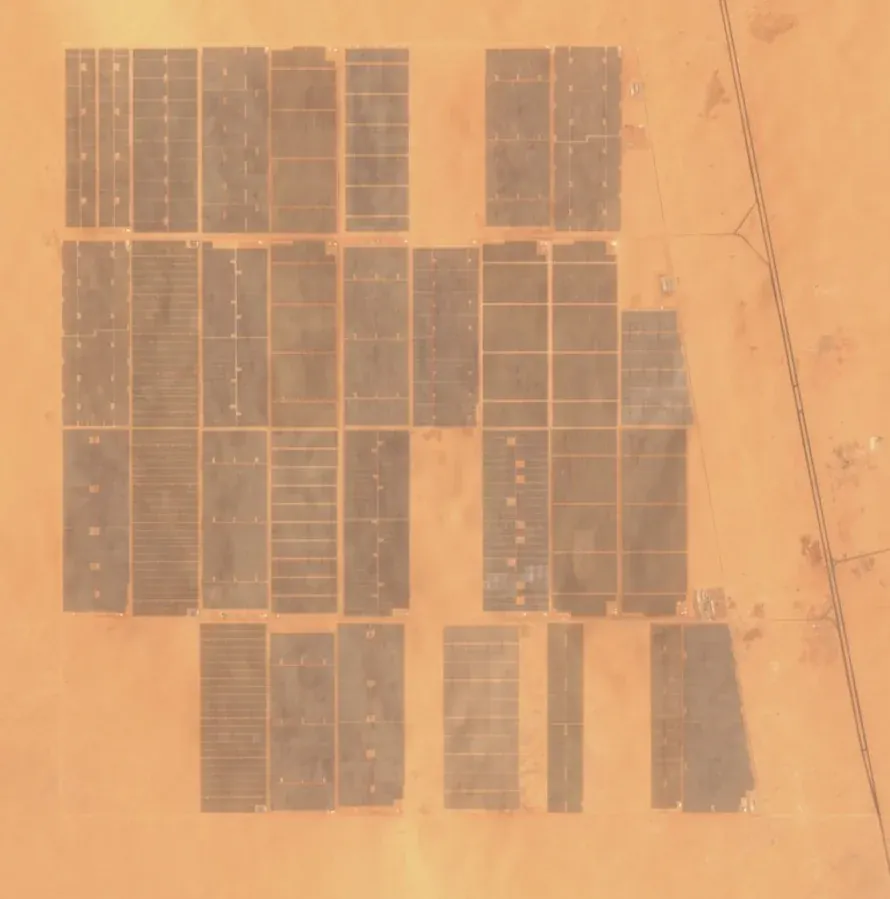
2. Benban Solar Park: Photovoltaic Mega-Capital
Located in the Western Desert near Aswan in Upper Egypt, the Benban Solar Park (مجمع بنبان للطاقة الشمسية) stands as one of the largest single-site photovoltaic installations on planet Earth.
Spanning 37.2 square kilometers of sun-drenched desert terrain, Benban represents an extraordinary achievement in international multilateral project financing and civil engineering:
• Total Capacity: 1,800 Megawatts (1.8 GW), generating approximately 3.8 terawatt-hours (TWh) of clean electricity annually—equivalent to roughly 90% of the electricity produced by the Aswan High Dam.
• Sub-Plants: Composed of 32 individual solar power plants developed by over 30 international consortiums (including Scatec, ACWA Power, Alcazar, and EDF).
• Carbon Abatement: Avoids over 2 million tons of greenhouse gas emissions annually.
• Global Recognition: Winner of the World Bank Group’s Best Project Award in 2019.
The site was selected due to its extraordinary Global Horizontal Irradiance (GHI)—among the highest levels of solar radiation in the world—combined with proximity to the existing national 500 kV high-voltage transmission backbone running parallel to the Nile.
3. Wind Power Corridors: Gulf of Suez & Gabal El Zeit
While Upper Egypt captures the sun, Egypt’s eastern coastline possesses some of the most consistent, high-velocity onshore wind regimes in the world.
The Gulf of Suez wind corridor—stretching between Zafarana, Ras Ghareb, and Gabal El Zeit—benefits from a natural atmospheric thermal funnel between the Red Sea waters and desert mountains:
- Exceptional Wind Metrics: Annual average wind speeds reach 10.5 meters per second at turbine hub height, with an extraordinary capacity factor exceeding 60% (nearly double the global average for onshore wind sites).
- Gabal El Zeit Wind Farm: A 580 MW complex featuring 290 turbines equipped with advanced radar bird-migration monitoring systems that pause spinning blades during seasonal European-African avian flyways.
- Mega-Pipelines in Progress: Over 10,000 MW of additional utility-scale wind capacity is under development with global consortia, including the 10 GW consortium led by Infinity Power, Masdar, and Hassan Allam Utilities, set to be one of the largest onshore wind farms in world history.
4. Natural Gas Wealth: Zohr Field & Mediterranean LNG
In August 2015, Italian energy major Eni discovered the gargantuan Zohr Offshore Gas Field (حقل ظهر) within the Shorouk Concession, approximately 190 kilometers north of Port Said in deep Mediterranean waters:
Holding an estimated 30 trillion cubic feet (TCF) of lean natural gas in place, Zohr represents the single largest natural gas discovery ever made in the Mediterranean Sea:
- Rapid Production Onstream: Brought into commercial production in a world-record 28 months, elevating Egypt’s domestic gas output above 7 billion cubic feet per day (BCFD).
- The Liquefaction Advantage: Egypt is the only country in the Eastern Mediterranean possessing operational coastal liquefied natural gas (LNG) export complexes: the Idku LNG Plant (two trains, 7.2 MTPA) and the Damietta SEGAS LNG Plant (5.0 MTPA).
- The East Mediterranean Gas Forum (EMGF): Headquartered in Cairo, Egypt founded the intergovernmental EMGF alliance (uniting Egypt, Greece, Cyprus, Italy, France, Jordan, and Palestine) to establish Cairo as the central trading and re-export hub for Eastern Mediterranean gas pipeline corridors feeding Europe.
5. Green Hydrogen & Ammonia Corridors (SCZONE)
Positioning itself at the forefront of the global decarbonization race, Egypt has transformed the Suez Canal Economic Zone (SCZONE) at Ain Sokhna into the premier green hydrogen and green ammonia bunkering corridor in Africa:
The state has ratified binding framework agreements totaling over $80 billion USD in projected investment with global developers (including A.P. Moller - Maersk, TotalEnergies, Fortescue, and ACWA Power) to supply zero-emission maritime fuel to the 22,000+ vessels transiting the Suez Canal annually.
6. El Dabaa Nuclear Power Station
On the Mediterranean coast 130 kilometers west of Alexandria in the Matrouh Governorate, Egypt is constructing its first commercial nuclear power facility: the El Dabaa Nuclear Power Plant (محطة الضبعة النووية).
Constructed in partnership with Russian state nuclear corporation Rosatom, the $30-billion complex comprises four Generation III+ VVER-1200 pressurized water reactors:
- Total Baseload Capacity: 4,800 Megawatts (4.8 GW) of steady, zero-carbon baseload electricity operating at capacity factors exceeding 90%;
- Advanced Safety Architecture: Engineered with passive heat removal systems, core catchers, and double-containment concrete domes designed to withstand seismic shocks and external impacts;
- Industrial Desalination Integration: The complex incorporates seawater desalination modules providing millions of cubic meters of fresh water daily to the emerging North Coast smart metropolises.
7. The Siemens Megaproject (14.4 GW Gas Stations)
A cornerstone of Egypt's initial power turnaround was the landmark 2015 agreement with Siemens AG and Egyptian EPC contractors (Elsewedy Electric and Orascom Construction):
The megaproject added 14,400 megawatts of combined-cycle capacity across three mega-power plants:
- Beni Suef Power Plant: Located in Upper Egypt, supplying heavy industrial cement and steel corridors;
- New Administrative Capital Power Plant: Situated in the eastern desert, powering the new smart capital and Suez development belt;
- Burullus Power Plant: Positioned on the northern Mediterranean coast in Kafr El-Sheikh.
Each plant generates 4,800 MW using Siemens H-class gas turbines paired with heat-recovery steam generators, operating at an extraordinary fuel efficiency of over 60.5%—saving Egypt over $1 billion USD annually in natural gas fuel costs.
8. Comprehensive Energy Infrastructure Matrix
The following matrix details Egypt’s primary energy generation assets, technological classifications, and operational capacities:
| Facility / Complex | Energy Type / Fuel | Installed Capacity | Location & Strategic Role |
|---|---|---|---|
| Benban Solar Complex | Photovoltaic (PV) Solar | 1,800 MW (1.8 GW) | Aswan Governorate; 32 utility-scale solar farms across 37 km². |
| Gabal El Zeit Wind Farm | Onshore Wind Turbines | 580 MW | Red Sea Coast; high capacity factor with avian radar protection. |
| Zafarana & Ras Ghareb Wind | Onshore Wind Turbines | 800+ MW | Gulf of Suez; private BOO and state NREA commercial wind parks. |
| Siemens Mega-Plants (3 Sites) | Combined-Cycle Gas (H-Class) | 14,400 MW (3 × 4.8 GW) | Beni Suef, New Capital, Burullus; world-record efficiency. |
| Aswan High Dam Hydro | Hydroelectric Turbines | 2,100 MW | Aswan; 12 Francis turbines generating historic clean base power. |
| Zohr Offshore Gas Field | Offshore Natural Gas | ~2.5 BCFD (30 TCF field) | Deep Mediterranean Shorouk Concession; domestic fuel & LNG feed. |
| Idku & Damietta LNG Plants | Natural Gas Liquefaction | 12.2 MTPA Combined | Mediterranean coast; primary LNG export terminals feeding Europe. |
| El Dabaa Nuclear Station | Nuclear (VVER-1200) | 4,800 MW (Under Const.) | Matrouh North Coast; 4 Generation III+ zero-carbon baseload units. |
9. Tri-Continental Electricity Interconnection
Egypt is actively converting its domestic electricity reserve margin into physical commercial export corridors connecting Africa, Asia, and Europe:
- Egypt–Saudi Arabia HVDC Link (3,000 MW): A $1.8-billion high-voltage direct current (HVDC) transmission link spanning submarine cables across the Gulf of Aqaba, connecting Badr (Egypt) to Medina and Tabuk (Saudi Arabia). The project allows bidirectional power exchange, capitalizing on differing peak consumption hours between Cairo and Riyadh.
- EuroAfrica & GREGY Interconnectors (Europe): Subsea electrical cable projects connecting the Egyptian national grid directly to Greece (GREGY Project - 3,000 MW) and Cyprus, feeding clean Egyptian renewable solar and wind electricity directly into the European Union transmission network.
- Pan-African Interconnections: Operational links connecting Egypt to Jordan (550 MW, expanding to 1,000 MW), Libya (200 MW), and Sudan (80 MW, expanding to 300 MW).
10. Corporate Delegations & Industrial Travel with Ultra Egypt Travel
The scale of Egypt’s renewable and industrial energy complexes attracts thousands of international energy executives, engineering consortiums, institutional investors, and university researchers.
Operating under Ministry of Tourism License #874 (Class A) and IATA Accreditation #90229930, Ultra Egypt Travel delivers specialized corporate travel management:
- Official Technical Delegations: Coordinating ministerial site visit clearances, security protocol, and expert technical liaisons for international consortiums inspecting Benban Solar Park, SCZONE green hydrogen facilities, or Gulf of Suez wind farms;
- Executive Ground Fleet: Modern luxury Mercedes sedans, armored VIP transport, and high-roof executive vans driven by professional security-cleared chauffeurs for long-distance desert transit;
- Aviation & Charter Flights: Instant charter aircraft and scheduled domestic flights connecting Cairo directly to Aswan, Hurghada, Marsa Alam, and Borg El Arab airports; and
- Executive Logistics in Cairo & Upper Egypt: Five-star corporate hospitality, board meeting facilities, and VIP protocol services.