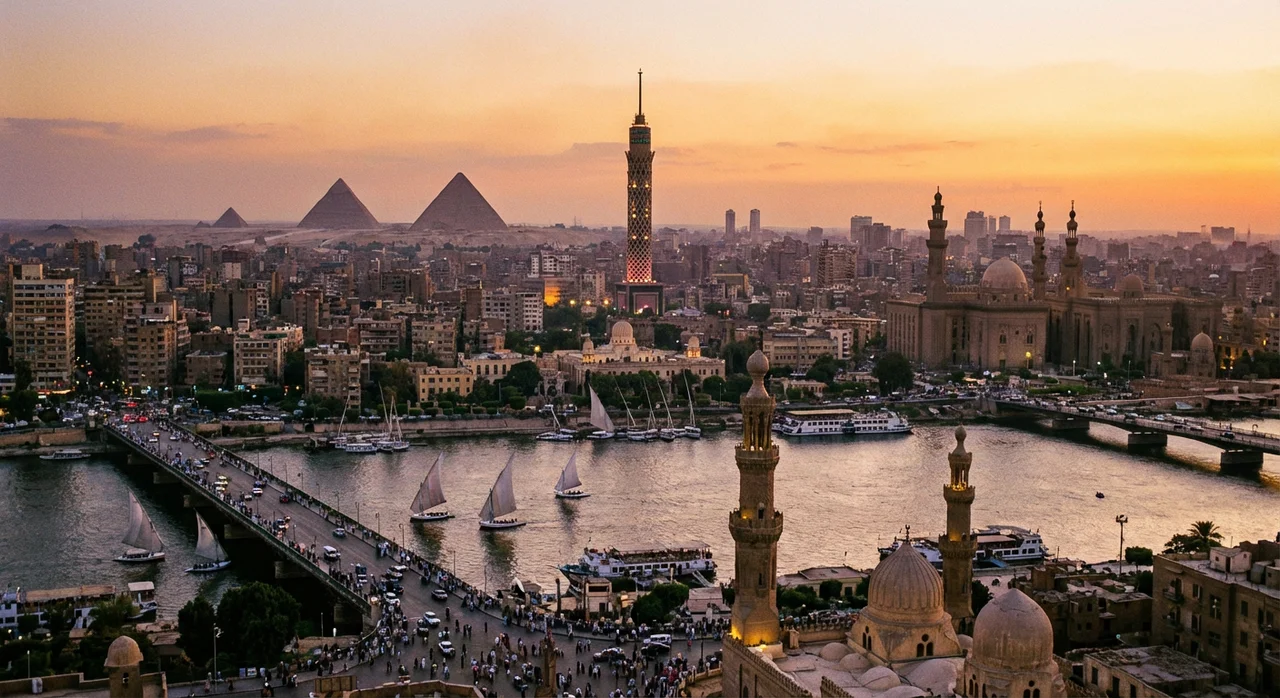
1. The Metropolis: Geography & Urban Evolution
Cairo occupies the strategic apex of the Nile Valley, where the single river corridor splinters into the fan-shaped alluvial branches of the Delta. For over four millennia, the geographic nexus surrounding modern Cairo has served as Egypt’s supreme center of administrative gravity:
- Memphis (c. 3100 BC): The archaic white-walled capital founded by King Menes 20 kilometers south;
- Babylon Fortress (c. 30 BC – 100 AD): The strategic Roman river garrison controlling the canal link to the Red Sea;
- Al-Fustat (641 AD): The first Arab-Islamic capital of Egypt founded by general Amr ibn al-A'as;
- Al-Qahira (969 AD): The walled royal palace-city founded by the Fatimid Caliphate under general Jawhar al-Siqilli, which lent the modern capital its name.
Today, Cairo is Africa and the Middle East’s largest metropolitan giant—a vibrant, 24-hour sensory feast where historic muezzin calls echo against bustling highway flyovers, tranquil residential islands, and leafy colonial avenues.
2. Historic Islamic Cairo: Al-Mu'izz & Khan el-Khalili
Inscribed as a UNESCO World Heritage site in 1979, Historic Islamic Cairo preserves the greatest concentration of medieval Islamic architectural masterworks in the world:
1. Al-Mu'izz li-Din Allah al-Fatimi Street
Often hailed as the world's largest open-air museum of medieval architecture, Al-Mu'izz Street is a pedestrianized 1-kilometer thoroughfare cutting through the historic Fatimid walled city:
- Bab al-Futuh & Bab al-Nasr (1087 AD): Massive fortified northern stone gates engineered with subterranean vaulted galleries, arrow slits, and oil-pouring spouts;
- The Complex of Sultan Qalawun (1284 AD): A Mamluk architectural triumph comprising a hospital (Bimaristan), madrasa, and mausoleum adorned with intricate stucco openwork, marble mosaics, and towering minarets;
- Mosque of Al-Hakim bi-Amr Allah (1013 AD): Famed for its monumental crenelated stone pylons and peaceful central marble courtyard;
- Bayt al-Suhaymi (1648 AD): A pristine Ottoman merchant residence featuring intricate wooden mashrabiya lattice windows, cooling inner courtyard gardens, and a marble fountain.
2. The Khan el-Khalili Labyrinth
Established in 1382 AD by Mamluk Emir Djaharks el-Khalili as a major caravanserai (Wakala) for traveling merchant caravans:
- An intoxicating maze of narrow vaulted stone alleyways alive with scent of frankincense, amber, hand-beaten copper lanterns, silver jewelry, and spice pyramids;
- El Fishawy Cafe (Café of Mirrors): Operating continuously since 1773, where Nobel laureate Naguib Mahfouz drafted masterpieces over fresh mint tea and Turkish coffee.
3. The Citadel of Saladin & Mosque of Muhammad Ali
Commanding Cairo’s eastern skyline from a spur of the Muqattam Hills stands the Citadel of Saladin (Qal'at Salah al-Din), constructed between 1176 and 1183 AD by the Sultan Saladin to fortify the city against Crusader armies:
- The Mosque of Muhammad Ali Pasha (The Alabaster Mosque): Erected between 1830 and 1848 AD in memory of Tusun Pasha. Designed by Turkish architect Yusuf Bushnaq on the classical Ottoman imperial plan of Istanbul's Blue Mosque, featuring soaring 82-meter pencil minarets, cascading lead domes, and interior walls clad in luminous Egyptian alabaster;
- The Mosque of Sultan al-Nasir Muhammad (1318 AD): The royal hypostyle Mamluk mosque of the Citadel, distinguished by its unique green-glazed Persian ceramic tile minaret caps;
- The Great Mosques of Midan al-Qal'a: Nestled directly beneath the Citadel walls:
• Mosque-Madrasa of Sultan Hassan (1356 AD): A pinnacle of early Mamluk monumental architecture, soaring 38 meters high with massive stone iwans;
• Al-Rifa'i Mosque (1912 AD): Royal mausoleum housing the tombs of the Egyptian royal family (including King Farouk) and the last Shah of Iran, Mohammad Reza Pahlavi.
4. Coptic Cairo: Roman Babylon & Early Christianity
Tucked within the partially excavated red-and-white stone ramparts of the Roman Fortress of Babylon in Old Cairo lies the spiritual sanctuary of the Coptic Orthodox Church:
- The Hanging Church (Al-Mu'allaqa - كنيسة المعلقة): Dedicated to the Virgin Mary, built in the 3rd or 4th century atop the southern stone gate towers of the Roman fortress. Accessed via a palm-lined staircase, its wooden timber barrel-vaulted roof was engineered to resemble the hull of Noah’s Ark, decorated with 110 historic icons;
- Church of Saints Sergius and Bacchus (Abu Serga): Built in the 4th century over the subterranean crypt where the Holy Family (Baby Jesus, the Virgin Mary, and Saint Joseph) sought sanctuary during their flight into Egypt to escape King Herod;
- The Ben Ezra Synagogue: Egypt’s oldest Jewish temple, originally a Coptic church sold to the Jewish community in 882 AD. Famed globally for the 1890s discovery of the Cairo Genizah—a hidden cache of over 300,000 medieval Jewish, Arabic, and Aramaic secular and religious manuscripts documenting Mediterranean trade from 870 to 1880 AD;
- The Coptic Museum: Housing the world's most comprehensive collection of Coptic art, stone architectural carvings, textiles, and illuminated vellum manuscripts bridging the pharaonic and Islamic eras.
5. The Grand Museums: Tahrir & NMEC Civilization Museum
Cairo is the custodian of Egypt’s national antiquities collections, split across distinct monumental institutions:
1. The Egyptian Museum in Tahrir Square (EMC)
Inaugurated in 1902 and designed by French architect Marcel Dourgnon in neoclassical rose-colored stone:
- The historic grandmother of archaeological museums worldwide;
- Retains over 120,000 artifacts on display: foundational Old Kingdom masterpieces including the Narmer Palette, the diorite statue of Khafre, the painted limestone statues of Rahotep and Nofret with rock crystal eyes, the Geese of Meidum mural, and the Royal Treasures of Tanis (gold masks and silver sarcophagi of the 21st and 22nd Dynasties).
2. National Museum of Egyptian Civilization (NMEC) in Fustat
Opened in April 2021 following the historic "Pharaohs' Golden Parade":
- The first museum in the Arab world dedicated to the complete, unbroken 7,000-year timeline of Egyptian civilization—from Predynastic tool-making to modern folklore;
- The Royal Mummies Hall: A state-of-the-art subterranean crypt engineered like a royal tomb in the Valley of the Kings, displaying 22 royal mummies (including Seqenenre Taa II, Hatshepsut, Thutmose III, Seti I, and Ramesses II) under specialized nitrogen atmospheric control alongside their personal clinical CT scans.
6. Khedivial Downtown Cairo: 19th-Century Belle Époque
In the 1860s, Khedive Ismail declared his ambition to transform Egypt into "a piece of Europe." Hiring French urban planner Grand Bey and architect Baron Haussmann:
- Paris along the Nile: Wide radial boulevards, neoclassical stone facades, ornate iron balconies, and grand roundabouts centered around Tahrir, Talaat Harb, and Mustafa Kamel squares;
- Passages & Historic Cafés: Bustling bookshops along Sherif Basha Street, historic patisseries (Groppi), and traditional intellectual salons;
- Downtown Revival: Extensive national heritage restoration projects have cleaned and repainted Belle Époque facades, restoring 19th-century pedestrian boulevards to their architectural glory.
7. Nile Island Living: Zamalek, Roda & Sunset Feluccas
The Nile River cuts directly through the heart of Greater Cairo, cradling two historic mid-river islands:
- Zamalek (Gezira Island): Cairo’s leafy, cosmopolitan residential and diplomatic sanctuary. Home to foreign embassies, contemporary art galleries, boutique concept stores, the Cairo Opera House, and the 187-meter Cairo Tower (Borg al-Qahira) with 360-degree views;
- Roda Island: A historic island preserving the 9th-century Roda Nilometer (861 AD) and the extravagant Manial Palace of Prince Mohamed Ali, showcasing an opulent blend of Ottoman, Moorish, and Rococo architecture;
- Sunset Felucca Sailing: Boarding a traditional wooden canvas-sailed felucca from the Garden City or Dokki docks at sunset, gliding silently across the river as the city lights reflect across the water.
8. Culinary Capital: Authentic Egyptian Dining Culture
Cairo is the ultimate gastronomic capital of authentic Egyptian comfort food:
- Koshary (كشري): The beloved national dish: a hearty carb-loaded bowl of brown lentils, macaroni pasta, vermicelli rice, and chickpeas topped with sweet spiced tomato sauce, garlic vinegar (Da'ah), and crispy fried onions;
- Ta'ameya (Egyptian Falafel): Crafted exclusively from crushed dried fava beans (rather than chickpeas) mixed with fresh coriander, leeks, and dill, rolled in sesame seeds and fried to an airy green perfection;
- Molokhia (ملوخية): Fragrant green soup prepared from finely minced jute leaves simmered in rich poultry broth, finished with sizzling fried garlic and ground coriander (Ta'sha);
- Grilled Kebabs & Kofta: Charcoal-grilled skewers of tender lamb and minced spiced kofta served alongside fresh flat baladi bread, tahini, and pickled vegetables.
9. Master Cairo Highlights & Logistics Matrix
The following matrix details Cairo’s primary tourist landmarks, location districts, opening hours, and touring recommendations:
| Landmark / Quarter | City District | Operating Hours | Key Highlights & Curated Advice |
|---|---|---|---|
| Al-Mu'izz Street | Historic Islamic Cairo | 09:00 AM – 10:00 PM (Street 24/7) | Qalawun Complex, Sultan Barquq, evening lantern walks. |
| Khan el-Khalili | El-Gamaleya | 10:00 AM – 11:00 PM | Spices, silver bazaars, El Fishawy mirror cafe tea. |
| Saladin Citadel | Al-Abageyah | 08:30 AM – 04:30 PM | Muhammad Ali Alabaster Mosque, panoramic city rampart view. |
| Coptic Enclave | Old Cairo (Mar Girgis Metro) | 09:00 AM – 04:30 PM | Hanging Church, Abu Serga Holy Family Crypt, Ben Ezra Synagogue. |
| Tahrir Museum | Downtown Cairo | 09:00 AM – 05:00 PM | Narmer Palette, Old Kingdom statues, Yuya and Thuya gold. |
| NMEC Civilization | Fustat | 09:00 AM – 05:00 PM (Fri evening) | Royal Mummies Hall, unbroken 7,000-year Egyptian timeline. |
| Manial Palace | Roda Island | 09:00 AM – 05:00 PM | Ottoman-Rococo state rooms, Islamic botanical garden. |
| Cairo Tower | Zamalek | 09:00 AM – 01:00 AM | 187m observation deck, panoramic skyline, evening dining. |
10. Curated Private Cairo Expeditions with Ultra Egypt Travel
Navigating the sprawling capital of Cairo—from securing private evening openings inside historic Fatimid madrasas to curated scholarly walks through Coptic churches and seamless airport fast-track clearance—demands a reputable licensed local partner.
Headquartered in Cairo under Ministry of Tourism License #874 (Class A) and IATA Accreditation #90229930, Ultra Egypt Travel delivers bespoke capital experiences:
- Scholarly Guided Fieldwork: All cultural excursions are accompanied by university-educated, licensed Egyptologists holding advanced degrees in Islamic, Coptic, and Greco-Roman archaeology;
- Airport Fast-Track & VIP Protocols: Direct meet-and-assist inside Cairo International Airport (CAI), expedited customs entry, luggage handling, and luxury private transfers;
- Executive Mercedes-Benz Fleet: Private, climate-controlled executive transport navigating Cairo’s thoroughfares with seasoned professional drivers;
- Boutique Hotel Partnerships: Priority reservations across Cairo’s luxury properties—from riverside landmarks in Garden City and Zamalek to heritage boutique hotels in Downtown.