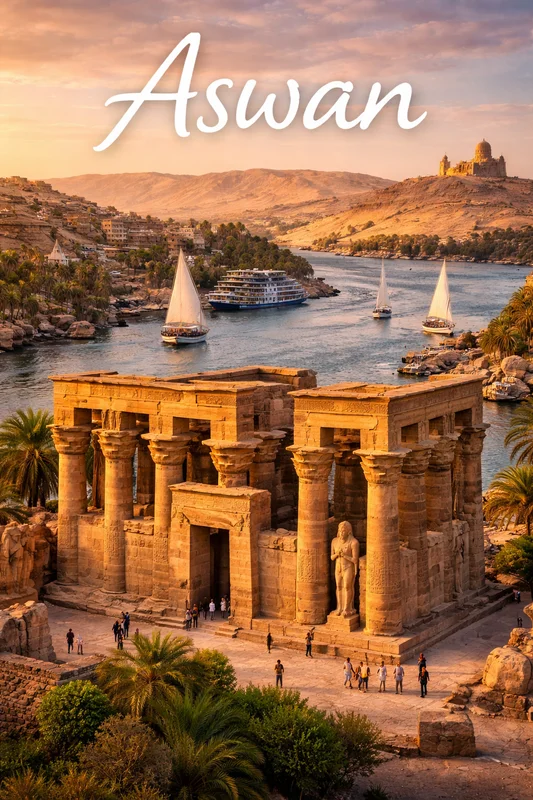
1. The Jewel of the Nile: Southern Frontier & Cataract
From the dawn of Egyptian civilization, Aswan (Swenet) served as the southern military, customs, and commercial border of the Pharaohs' realm:
- The First Cataract: Natural black and pink granite outcroppings jutting out of the riverbed created a natural barrier to navigation, preventing easy river transit further south into Nubia (Kush) and establishing Aswan as the ultimate transshipment hub;
- The Great Trade Emporium: Exotic African commodities arrived here via desert caravan: ebony wood, fragrant frankincense and myrrh, ivory tusks, gold ingots from Nubian mines, ostrich feathers, and panther skins;
- The Pink Granite Matrix: Aswan was Egypt’s prime quarry capital. From its subterranean bedrock came the dense, beautiful pink and red granite utilized to carve royal sarcophagi, temple obelisks, and the lining of the King's Chamber inside the Great Pyramid of Giza.
2. Philae Temple: The Rescued Sanctuary of Isis
Perched like a mirage upon the tranquil waters of Lake Aswan between the Old and High Dams stands the magnificent Temple Complex of Philae (معبد فيلة):
When the British Old Dam and the Soviet-built High Dam flooded original Philae Island, the temple was partially submerged for decades. In a historic engineering feat, UNESCO built an enormous coffer dam around the site, pumped out water, dismantled the entire temple into over 40,000 stone blocks weighing up to 25 tons each, and reassembled it with millimetric precision on higher, artificially reshaped Agilkia Island, 500 meters downriver!
- Sanctuary of the Goddess Isis: Begun under Nectanebo I (30th Dynasty) and expanded by the Ptolemaic monarchs and Roman emperors (Augustus, Tiberius, Trajan), dedicated to the universal mother goddess Isis and her son Horus;
- The Last Bastion of Hieroglyphs: Because of its remote southern location, Philae remained the final operating pagan temple in the Christian world. On August 24, 394 AD, an Egyptian priest named Nesmeterakhem carved the Graffito of Esmet-Akhom into the Gate of Hadrian—the very last dated hieroglyphic inscription in human history;
- Trajan’s Kiosk (كشك تراجان): The iconic riverside pavilion of fourteen slender columns with composite floral capitals, serving as the ceremonial arrival point for the sacred barque of Isis;
- Sound and Light Show: An evocative evening production where visitors arrive by boat under starry desert skies, walking through illuminated colonnades listening to ancient hymns.
3. The Unfinished Obelisk: Ancient Quarry Mechanics
Lying within the ancient northern pink granite quarries of Aswan is the Unfinished Obelisk (المسلة الناقصة), offering the world’s most direct, fascinating window into ancient Egyptian megalithic engineering:
- Astronomical Scale: Commissioned during the 18th Dynasty (believed to be ordered by Queen Hatshepsut). Had it been freed from bedrock, it would have stood 42 meters tall and weighed approximately 1,168 metric tons—nearly double the size of any obelisk successfully raised in antiquity;
- The Fatal Flaw: As quarrymen were carving the perimeter trenches, a catastrophic structural crack developed along a natural internal fault line within the granite, forcing engineers to abandon the monument in situ;
- Thermal & Pounding Mechanics: The site disproves the myth of wooden expansion wedges for hard granite. Instead, workers lit wood fires along the rock face to induce thermal spalling, then knelt in narrow 75-cm trenches pounding the surface with 5-kilogram spherical balls of ultra-hard dolerite, pulverizing the stone dust millimeter by millimeter at a rate of 12 mm depth per hour.
4. Elephantine Island: Nilometer & Khnum Temple
Dividing the Nile in the heart of Aswan sits Elephantine Island (جزيرة إلفنتين — Abu), the archaic pharaonic fortress-city named for the rounded black granite boulders resembling swimming elephants:
- The Sacred Nilometer: A stone staircase descending directly into the river, inscribed with graduated measurement marks in Royal Cubits. By gauging the flood height here every July, priests predicted national agricultural yields months before the flood reached Lower Egypt;
- Temple of Khnum: Dedicated to the ram-headed creator god Khnum, who was believed to mold human beings out of Nile silt on his potter's wheel and control the cavernous subterranean source of the Nile flood at the First Cataract;
- The Elephantine Jewish Colony: Historical home to a celebrated 5th-century BC Jewish military mercenary garrison that maintained its own temple to Yahweh, documented in the famous Elephantine Papyri;
- The Modern Nubian Villages: The northern half of the island preserves the tranquil, authentic Nubian villages of Siou and Koti, connected by narrow mudbrick lanes lined with date palms, mango trees, and painted homes.
5. Living Nubian Culture: Gharb Soheil & Traditions
Aswan is the proud cultural capital of Egypt's indigenous Nubian people (النوبيون), one of Africa's oldest linguistic and ethnic civilizations:
- Traditional Nubian Home Visits: Stepping inside airy courtyards with sandy floors, sipping sweet hibiscus tea (Karkadeh), tasting freshly baked flatbread with sun-dried dates, and observing pet crocodiles kept in ceremonial courtyard tanks as traditional protective talismans;
- Nubian Handicrafts: Woven palm-frond baskets (Kangan), hand-embroidered skullcaps (Taqiya), beaded necklaces, and pure desert spices (cumin, saffron, and natural henna);
- Nubian Language & Music: An unwritten Nilo-Saharan language preserved through oral poetry, accompanied by the hypnotic rhythms of the frame drum (Duff) and traditional Oud melodies.
6. The Aswan High Dam & Lake Nasser Engineering
Constructed between 1960 and 1970 with Soviet engineering assistance, the Aswan High Dam (السد العالي) was modern Egypt’s most transformative mega-project:
- Colossal Scale: A rockfill gravity dam containing 43 million cubic meters of material (seventeen times the volume of the Great Pyramid of Khufu), measuring 3,830 meters long, 980 meters wide at the base, and 111 meters high;
- Taming the Nile: Ended millennia of catastrophic annual flood surges and cyclical devastating droughts, generating hydroelectric energy for industrialization and expanding perennial farming across Egypt;
- Creation of Lake Nasser: Formed one of the world’s largest artificial reservoirs, stretching over 500 kilometers south into Sudan;
- Lotus Tower Monument: Features the soaring 72-meter Soviet-Egyptian Friendship Memorial shaped like a stylized blooming lotus flower, offering panoramic views across the lake and the intake power stations.
7. Kitchener's Island & First Cataract Nature Reserves
Aswan’s natural riverine environment is protected within pristine nature sanctuaries:
- Kitchener's Island / Aswan Botanical Garden (جزيرة النباتات): An entire 17-acre island converted into a lush botanical sanctuary by British Lord Kitchener in the 1890s. Home to hundreds of exotic botanical species collected across five continents: towering Royal Palms, Madagascar travel palms, Indian mahogany, fragrant sandalwood, and flowering bougainvillea;
- Saluga and Ghazal Nature Reserve (محمية سالوجا وغزال): A protected wetland sanctuary spanning small granite islands in the First Cataract, preserving over 135 species of migratory waterbirds (purple swamphens, osprey, kingfishers, and grey herons) and rare Nilotic flora;
- Felucca Cataract Cruising: Drifting silently between monolithic granite boulders, observing the crystal-clear currents of the unpolluted southern Nile.
8. Qubbet el-Hawa: The Rock-Cut Tombs of the Nobles
Carved into the towering golden sand cliff on the West Bank overlooking the northern tip of Elephantine Island lies Qubbet el-Hawa (قبة الهواء — "Dome of the Wind"):
- The Resting Place of Border Princes: Elite rock-cut tomb chapels of the royal governors, caravan commanders, and expedition leaders of the Old and Middle Kingdoms (6th and 12th Dynasties);
- The Autobiography of Harkhuf (Tomb 34): Inscribed on the exterior doorway is the famous autobiographical text of Harkhuf, governor of Upper Egypt under 6th-Dynasty child pharaoh Pepi II. It records his perilous trading expeditions into central Africa, including a personal royal letter from the 8-year-old king begging him to bring back a dancing pygmy "alive, whole, and in good health!";
- Tomb of Sarenput I & II: Featuring Middle Kingdom pillars painted with brilliant agricultural, fishing, and banquet murals;
- Panoramic Sunset Ascent: Climbing the ancient stone staircase at sunset offers Aswan’s finest viewpoint: the shimmering blue Nile below, green island groves, and the domed Sufi tomb of Sheikh Ali Abu el-Hawa crowning the summit.
9. The Nubian Museum: Preserving Nile Heritage
Nestled on a granite ridge overlooking Aswan’s Corniche, the Nubian Museum (متحف النوبة) is an award-winning cultural landmark (recipient of the prestigious Aga Khan Award for Architecture in 2001):
- Design & Landscaping: Designed by Egyptian architect Mahmoud El-Hakim, harmoniously integrated into granite outcrops surrounded by tiered Nubian water channels, native flora, and open-air rock-art installations;
- Comprehensive 7,000-Year Timeline: Documents the prehistoric archaeology of the Nile Valley, the Kingdom of Kerma, Kushite 25th-Dynasty pharaohs, Christian Nubian fresco murals, and the modern 1960s Nubian resettlement;
- Masterpieces on Display:
• The 200,000-year-old Paleolithic quartzite hand axes;
• The colossal statues of the 25th-Dynasty Kushite Pharaoh Taharqa;
• Royal silver horse armor and crowns from Ballana and Qustul;
• Life-sized ethnographic dioramas depicting traditional Nubian weddings, harvest ceremonies, and architecture.
10. Historic Hospitality: Sofitel Legend Old Cataract
No travel portrait of Aswan is complete without the legendary Sofitel Legend Old Cataract Hotel:
- Built in 1899: Founded by Thomas Cook on a pink granite bluff overlooking the First Cataract, designed in an opulent Victorian-Moorish architectural style with keyhole arches, brass lanterns, and high ceilings;
- Agatha Christie's Retreat: Where the famous mystery author stayed for nearly a year writing her classic novel Death on the Nile (her personal suite remains preserved);
- The Legendary Promenade Terrace: Enjoying traditional British afternoon high tea or evening cocktails on the terrace at sunset as white-sailed feluccas glide silently past the granite boulders of Elephantine Island is widely considered the quintessential luxury Egyptian travel ritual.
11. Master Aswan Monuments & Touring Logistics
The following matrix details Aswan’s primary archaeological sites, operating hours, ticket categories, and touring recommendations:
| Monument / Site | Location / Sector | Operating Hours | Signature Highlights & Visiting Advice |
|---|---|---|---|
| Philae Temple Complex | Agilkia Island (Lake Aswan) | 07:00 AM – 04:00 PM (Summer: 05:00 PM) | Temple of Isis, Trajan's Kiosk; accessed via motorboat from Marina. |
| Unfinished Obelisk | Southern Quarries (Town Center) | 07:00 AM – 04:00 PM | 1,168-ton sleeping granite monolith, dolerite ball trench markings. |
| Elephantine Island | Nile River Center (Ferry from Corniche) | 08:00 AM – 05:00 PM | Ancient Nilometer, Khnum temple ruins, Nubian villages (Siou & Koti). |
| Nubian Museum | Aswan Corniche Ridge | 09:00 AM – 01:00 PM / 05:00 PM – 09:00 PM | Statues of Taharqa, prehistoric tools, architectural gardens. |
| Qubbet el-Hawa Tombs | West Bank Cliff | 08:00 AM – 04:00 PM | Autobiography of Harkhuf, Middle Kingdom nomarch tombs, sunset view. |
| Gharb Soheil (Nubian Village) | West Bank (South of Old Dam) | Open 24/7 (Visits: 10 AM – 08 PM) | Painted vaulted homes, Nile motorboat access, spice shopping. |
| Aswan High Dam | 13 km South of Aswan | 08:00 AM – 05:00 PM | Lake Nasser panorama, Lotus Tower friendship monument. |
12. Curated Private Aswan Itineraries with Ultra Egypt Travel
Experiencing the timeless beauty of Aswan—from chartered motorboats gliding to Philae Island to private sunset felucca sailing and luxury Dahabiya departures—demands verified local expertise and seamless executive logistics.
Operating under Ministry of Tourism License #874 (Class A) and IATA Accreditation #90229930, Ultra Egypt Travel organizes world-class Aswan experiences:
- Academic Guided Fieldwork: All archaeological excursions are led by university-educated, licensed Egyptologists fluent in multiple languages with deep expertise in Ptolemaic and Nubian history;
- Private Nile Felucca & Dahabiya Charters: Private boat charters navigating the First Cataract nature reserves with dedicated crew and onboard refreshments;
- Authentic Nubian Community Engagements: Curated visits to private family homes in Gharb Soheil, supporting local artisans with zero commercial pressure;
- Seamless Abu Simbel Overland & Flight Extensions: VIP round-trip transfers across the Western Desert highway to Abu Simbel in luxury climate-controlled Mercedes-Benz vehicles;
- Luxury Historic Stays: Priority suite reservations at the legendary Sofitel Legend Old Cataract Hotel with guaranteed river-view verandas.