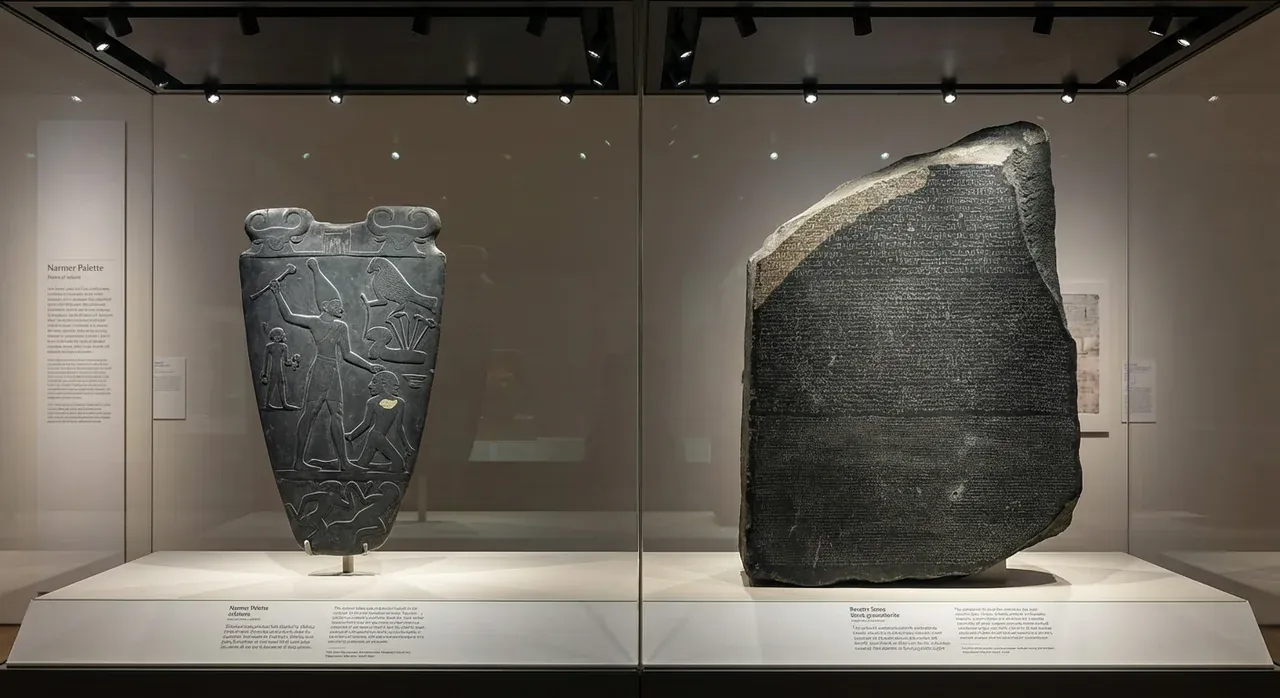
1. The Rosetta Stone (1799): The Linguistic Key to Antiquity
In mid-July 1799, French engineering officer Pierre-François Bouchard was overseeing demolition work to strengthen the defensive fortifications of Fort Julien near the port city of Rashid (Rosetta) in the western Nile Delta when his workers struck a slab of compact dark granodiorite.
Measuring 112.3 cm high and weighing approximately 760 kilograms, the Rosetta Stone (حجر رشيد) bore a priestly decree issued at Memphis in 196 BC under Ptolemy V Epiphanes. The decree was inscribed in three distinct scripts:
- Hieroglyphic (14 lines): The sacred script of the gods, utilized for formal temple decrees;
- Demotic (32 lines): The native cursive script utilized for daily administration and civilian records;
- Ancient Greek (54 lines): The administrative language of the Ptolemaic Greco-Macedonian court.
2. The Royal Mummy Caches: DB320 & KV35
In the late New Kingdom (c. 1070 BC), amid the political collapse of the 20th Dynasty, rampant tomb robbery threatened the sacred remains of Egypt’s greatest pharaohs in the Valley of the Kings. High priests of Amun secretly gathered the desecrated royal bodies, re-wrapped them in fresh linens, inscribed their identities upon the wooden shrouds, and concealed them in two remote subterranean caches:
The Deir el-Bahari Royal Cache (TT320 / DB320 - 1881)
For years, rare royal antiquities appeared mysteriously on the antiquities black market. In 1881, Gaston Maspero, director of the Egyptian Antiquities Service, tracked the source to the Abd el-Rassul family of Qurna. Led to a sheer cliff shaft south of Deir el-Bahari, archaeologist Émile Brugsch descended into an underground gallery and encountered a scene of historical wonder:
- Over 50 royal mummies and coffins stacked haphazardly, including Egypt’s most legendary empire-builders: Seqenenre Tao (displaying battle ax wounds from the Hyksos wars), Ahmose I, Thutmose I, II, and III, Seti I, and Ramesses II ("The Great");
- The mummies were hastily evacuated down the Nile on the government steamer El Menshieh, while villagers lined the riverbanks wailing and firing rifle shots in traditional mourning for their ancient kings.
The Tomb of Amenhotep II (KV35 - 1898)
Seventeen years later, French archaeologist Victor Loret discovered a second royal cache inside the rock-cut tomb of Amenhotep II in the Valley of the Kings. Hidden in side chambers were the mummies of Thutmose IV, Amenhotep III, Merenptah, and the famous "Elder Lady" (Queen Tiye) and "Younger Lady" (confirmed by DNA in 2010 as the biological mother of Tutankhamun).
3. Tutankhamun's Tomb (KV62, 1922): Howard Carter & The Golden Wonder
On November 4, 1922, after six grueling, unsuccessful excavation seasons funded by the 5th Earl of Carnarvon, British archaeologist Howard Carter discovered a sunken rock-cut step hidden beneath the debris of ancient workmen's huts in the Valley of the Kings.
Clearing sixteen steps, Carter and Lord Carnarvon reached a sealed doorway bearing the jackal seal of the royal necropolis. Drilling a small aperture through the plaster, Carter inserted a candle:
Among the unprecedented treasures recovered:
- The Solid Gold Death Mask: Weighing 10.23 kilograms of beaten gold inlaid with lapis lazuli, turquoise, carnelian, and obsidian, capturing the immortal idealized portrait of the young pharaoh;
- The Innermost Gold Coffin: Crafted from 110.4 kilograms of pure solid 22-karat gold;
- The Gilded Shrines & Sarcophagus: Four nested gilded wooden shrines enclosing a red quartzite sarcophagus and three nested anthropoid coffins;
- The Anubis Shrine & Golden Throne: Depicting Queen Ankhesenamun anointing Tutankhamun beneath the rays of the Aten, accompanied by six dismantled royal chariots, gold-sheathed walking sticks, and royal ceremonial daggers forged from extraterrestrial meteoritic iron.
4. The Silver Pharaohs of Tanis (1939–1940)
While Tutankhamun captured the world's imagination, the second intact royal burial in Egyptian history was discovered on the eve of World War II by French Egyptologist Pierre Montet at Tanis (San el-Hagar) in the northeastern Delta:
Excavating within the Great Temple of Amun enclosure in 1939 and 1940, Montet uncovered the undisturbed crypts of 21st and 22nd Dynasty pharaohs:
- The Silver Coffin of Psusennes I: Because silver was significantly rarer and more valuable than gold in ancient Egypt (associated with the bones of the gods, while gold represented their flesh), King Psusennes I was buried inside a magnificent anthropoid coffin hammered from pure silver;
- Solid Gold Funerary Masks: Montet discovered gold masks for Psusennes I and King Amenemope rivaling Tutankhamun's in artistry, accompanied by lapis lazuli collar necklaces, gold toe stalls, and bronze offering tables;
- Overshadowed by World War II: Because Montet made his breakthrough in May 1940, just as Nazi Germany invaded France, the discovery received virtually no international media attention, remaining one of archaeology's greatest overlooked triumphs. Today, the Tanis treasures are displayed in the Egyptian Museum in Tahrir.
5. The Khufu Solar Ship (Giza, 1954)
In May 1954, young Egyptian architect and archaeologist Kamal el-Mallakh was supervising the clearing of sand and construction debris from the southern side of the Great Pyramid of Khufu at Giza when he noticed two parallel rows of massive limestone ceiling slabs hermetically sealed with gypsum mortar:
Chiseling through a 15-ton limestone slab, el-Mallakh smelled the distinct aroma of cedarwood and gazed down into an airtight rectangular rock-cut pit:
In August 2021, the Khufu ship was transported from Giza to its permanent home inside a dedicated, climate-controlled pavilion at the Grand Egyptian Museum (GEM) via an automated remote-controlled smart carrier.
6. Giza Builders' Town: Heit el-Ghurab
For centuries, popular myth claimed that the pyramids were constructed by enslaved laborers or extraterrestrials. In 1990, the discovery of the Pyramid Builders' Cemetery and Town (Heit el-Ghurab) south of the Giza Plateau by Egyptian archaeologist Zahi Hawass and American archaeologist Mark Lehner decisively rewrote human history:
- Skeletal Forensic Evidence: Osteological analysis of hundreds of worker skeletons revealed that they were native Egyptian free citizens. Skeletons showed evidence of healed bone fractures, brain surgeries (trepanation), and spinal strain consistent with heavy stone haulage, proving they received advanced medical care;
- The Royal Cattle Rations: Excavations uncovered massive communal barracks, bakeries producing thousands of conical emmer-wheat loaves, and animal bone dumps revealing that workers consumed prime cuts of beef, sheep, and goat slaughtered daily from delta estates;
- Honorable Burial Next to Kings: Slaves would never have been buried in tombs flanking the royal pyramids with stone false doors, beer jars, and hierarchical titles (such as "Overseer of the Side of the Pyramid").
7. The Valley of the Golden Mummies (1996)
In 1996, in the hyper-arid Bahariya Oasis in the Western Desert (approx. 370 km southwest of Cairo), an antiquities guard’s donkey tripped into an open hole in the desert sand, revealing the edge of a rock-cut tomb facade:
Excavations directed by Zahi Hawass revealed a sprawling Greco-Roman necropolis dating to the 1st and 2nd centuries AD:
- Thousands of Gilded Mummies: Estimated to contain up to 10,000 mummies belonging to wealthy wine merchants and landowners who controlled the trans-Saharan trade routes;
- Elaborate Gilded Cartonnage: The mummies were encased in painted plaster cartonnage masks coated in pure gold leaf, blending traditional Egyptian religious iconography (Anubis, Osiris) with Roman portrait hairstyles and jewelry;
- A dedicated on-site museum in Bawiti displays prime specimens from this remarkable desert necropolis.
8. The Lost Golden City of Luxor (2021)
In September 2020, an Egyptian archaeological mission searching for the mortuary temple of Tutankhamun near Medinet Habu on Luxor's West Bank uncovered mudbrick walls emerging from the sand. Within weeks, the team realized they were excavating an entire urban center:
The city’s astonishing state of preservation earned it comparisons to Pompeii:
- Zigzag mudbrick residential walls standing up to three meters high;
- Fully equipped bakeries with ovens and ceramic storage vessels;
- An administrative quarter secured by single-entry security gates;
- Workshops containing casting molds for amulets, glass-making slag, textile spinning whorls, and dried meat vessels bearing hieratic labels with precise dates (Year 37 of Amenhotep III).
9. Recent Saqqara Discoveries (2018–2024)
Over the past decade, the desert sands of Saqqara have yielded an unprecedented series of discoveries led by Egyptian missions:
- The Tomb of Wahtye (2018): An exceptionally preserved 5th Dynasty royal purification priest’s tomb featuring 55 intact painted rock-cut statues, vivid polychrome reliefs, and untouched burial shafts;
- The Bubasteion Catacombs & Lion Mummies (2019): The discovery of rare mummified lion cubs, cheetahs, and thousands of bronze and wooden cat statues dedicated to the goddess Bastet;
- The 100+ Sealed Coffin Shafts (2020): Uncovering over 100 sealed, vibrantly painted wooden coffins from the 26th Dynasty (Saite Period) stacked deep inside 12-meter-deep vertical shafts, undisturbed since burial;
- Human and Animal Embalming Workshops (2023): Unearthing the first complete mummification workshops in Egypt, featuring stone beds where bodies were eviscerated, measuring cups, and ceramic vessels labeled with the chemical names of natron, resins, and oils.
10. Chronological Discoveries Matrix
The following matrix details Egypt’s most consequential archaeological discoveries in chronological order of their breakthrough:
| Discovery | Year | Primary Discoverer / Mission | Location & Historical Impact |
|---|---|---|---|
| The Rosetta Stone | 1799 | Pierre-François Bouchard | Rashid (Delta); linguistic key that enabled hieroglyphic decipherment. |
| Tomb of Seti I (KV17) | 1817 | Giovanni Battista Belzoni | Valley of the Kings; largest decorated tomb, alabaster sarcophagus. |
| Royal Cache DB320 | 1881 | Gaston Maspero & Brugsch | Deir el-Bahari cliffs; 50+ rescued pharaohs including Ramesses II. |
| Cache of Amenhotep II (KV35) | 1898 | Victor Loret | Valley of the Kings; second royal mummy cache (Amenhotep III, Tiye). |
| Tomb of Tutankhamun (KV62) | 1922 | Howard Carter & Carnarvon | Valley of the Kings; 5,398 intact gold treasures & solid gold coffin. |
| Royal Tombs of Tanis | 1939–1940 | Pierre Montet | San el-Hagar (Delta); intact silver coffin and gold masks of 21st Dynasty. |
| Khufu's Solar Boat | 1954 | Kamal el-Mallakh | Giza Pyramid South Pit; 43m cedarwood vessel reassembled intact. |
| Pyramid Builders' Town | 1990+ | Zahi Hawass & Mark Lehner | Giza Plateau; proved pyramids built by free citizens, not slaves. |
| Valley of Golden Mummies | 1996 | Zahi Hawass / Egyptian Team | Bahariya Oasis; thousands of gilded Greco-Roman cartonnage mummies. |
| Lost Golden City of Luxor | 2020–2021 | Zahi Hawass / Egyptian Mission | West Bank Luxor; intact urban capital of Amenhotep III with standing walls. |
| Embalming Workshops | 2023 | Mostafa Waziri / SCA Mission | Saqqara Necropolis; chemical workshops and stone beds for mummification. |
11. Curated Discovery Itineraries with Ultra Egypt Travel
Experiencing the sites of Egypt’s greatest archaeological discoveries requires an operational travel partner with authorized ministerial credentials, licensed scholarly guides, and exclusive site permissions.
Operating under Ministry of Tourism License #874 (Class A) and IATA Accreditation #90229930, Ultra Egypt Travel creates bespoke discovery itineraries:
- Tutankhamun & The Royal Mummies Odyssey: Private tours connecting the original tomb of Tutankhamun (KV62) in the Valley of the Kings with his 5,000+ treasures at the Grand Egyptian Museum (GEM) and the royal pharaohs in the Royal Mummies Hall at the National Museum of Egyptian Civilization (NMEC);
- Exclusive After-Hours Access: Arranging private permits from the Supreme Council of Antiquities for private, crowd-free access inside the Saqqara Serapeum, the Tomb of Queen Nefertari (QV66), and the Khufu Solar Boat pavilion;
- Scholarly Guided Fieldwork: Expeditions led exclusively by licensed, university-educated Egyptologists holding postgraduate degrees, delivering deep academic rigor on site;
- VIP Ground Fleet & Charters: Executive chauffeured Mercedes-Benz transport across Cairo, Giza, and Luxor, alongside private chartered Nile Dahabiyas and fast domestic flight bookings.