Of all the questions that ancient Egyptian civilization poses to the modern mind, one stands above the rest in sheer audacity: why did a culture expend such extraordinary resources — human labor, material wealth, architectural genius — on the construction of tombs? The answer lies in one of history's most elaborate and tenacious belief systems: the conviction that death was not an ending but a transformation, and that the quality of one's eternal existence depended directly on the quality of one's burial.
Over the course of more than three thousand years, the forms that Egyptian funerary architecture took changed dramatically — driven by shifts in religious belief, political power, technological capability, and bitter practical experience with tomb robbery. From the simplest oval pit dug in hot desert sand to the incomprehensible engineering of the Great Pyramid of Khufu, and then on to the labyrinthine hidden chambers of the Valley of the Kings, the evolution of the Egyptian tomb is one of the most compelling stories in the history of architecture.
In This Article
Why Tombs Mattered: The Theology of Eternal Life
To understand the evolution of Egyptian funerary architecture, one must first understand the cosmology that drove it. The ancient Egyptians conceived of the human being as composed of multiple spiritual elements: the ba (the individual personality or soul, depicted as a human-headed bird), the ka (the life force or double, which needed a physical anchor after death), the akh (the transfigured spirit of the deceased), and the physical body itself. All of these required protection and sustenance after death.
The tomb was simultaneously a physical container for the preserved body, a magical protection for the ka, a ritual space where offerings could be made to sustain the deceased, and a launching point for the journey through the underworld. Its decoration, orientation, contents, and construction method were all freighted with theological meaning. The more elaborate the tomb, the greater the protection it offered — and the more certain the deceased's chances of achieving eternal life in the Field of Reeds, the Egyptian paradise.
This theological imperative explains why Egyptian rulers were willing to mobilize the resources of an entire kingdom in the service of tomb construction. The pyramid was not merely a monument to royal ego — it was a cosmic mechanism, designed to propel the deceased pharaoh into eternal life and thereby ensure the continued order and fertility of Egypt itself. When the pyramid failed at its practical task of protecting the royal body from robbers, Egyptians did not abandon the theology — they redesigned the architecture.
Stage One: Predynastic Pit Graves (c. 4000–3100 BC)
The story begins not with stone and grandeur but with sand and simplicity. In the centuries before the unification of Egypt, the dead were buried in shallow oval pits dug directly into the desert beyond the Nile floodplain. The body was placed in a contracted, foetal position — knees drawn to the chest — and oriented to face west, the direction of the setting sun and the realm of the dead. A few personal possessions — pottery vessels, flint tools, personal ornaments — were placed alongside the body to equip the deceased for the afterlife.
The earliest burials are oval pits dug in the desert edge. Bodies are interred in a contracted position, wrapped in animal hide or linen. The hot, dry desert sand naturally desiccates the body, creating accidental mummies — an experience that may have suggested to Egyptians the possibility of bodily preservation after death.
As social complexity increases, some burials begin to be lined with mud brick or wooden planking to protect the body. Grave goods become more elaborate, including imported prestige items that testify to the deceased's social rank. The pit itself deepens, and some include small side chambers for offerings.
The tombs of the proto-kings at Abydos and Hierakonpolis show the emergence of more complex burial architecture: multi-roomed underground chambers with mud-brick superstructures. Subsidiary burials of retainers surround the royal tomb, suggesting a belief that servants could accompany the ruler into the afterlife.
A crucial and often overlooked consequence of these early desert burials is that the hot, desiccating sand preserved bodies remarkably well — creating naturally mummified corpses that retained recognizable features. This experience of seeing preserved bodies may have been foundational to the Egyptian belief that the physical body could and must be preserved for eternal life. When brick-lined tombs replaced pit graves and bodies began to decompose in enclosed spaces, Egyptians developed artificial mummification to replicate what the desert had done naturally.
Stage Two: The Mastaba (c. 3100–2650 BC)
With the unification of Egypt under the first pharaohs of the 1st Dynasty around 3100 BC, funerary architecture made its first dramatic leap. The mastaba — from the Arabic word for "bench," because of their low, flat-topped shape — became the standard tomb form for royalty and elite officials throughout the Early Dynastic period and into the Old Kingdom.
A mastaba consisted of a rectangular mud-brick or stone superstructure with slightly sloping sides, rising above ground level over a subterranean burial chamber cut into the bedrock. The underground chamber held the coffin and burial goods; the superstructure contained a series of rooms for offerings and ritual. A false door — a carved stone panel symbolically allowing the ka to pass between worlds — provided the interface between the living and the dead. Offering bearers would leave food, drink, and ritual objects at the false door to sustain the deceased eternally.
The royal mastabas at Abydos (where the Early Dynastic kings were buried) and Saqqara (the necropolis of Memphis) grew steadily more elaborate. Their superstructures became increasingly massive, their subterranean chambers more complex, and their grave goods more lavish. It was from this tradition of stacking and extending the mastaba form that the next revolutionary leap — the pyramid — would emerge.

Stage Three: The Step Pyramid & the Birth of the True Pyramid (c. 2650–2560 BC)
The decisive transition from mastaba to pyramid occurred around 2650 BC under Pharaoh Djoser of the 3rd Dynasty, guided by his brilliant architect Imhotep — one of the few non-royal individuals in Egyptian history to be deified after his death. Imhotep's revolutionary concept was elegantly simple: instead of building a single flat mastaba, why not stack a series of progressively smaller mastabas one on top of another, creating a stepped tower reaching toward the sky?
The Step Pyramid of Djoser at Saqqara
The Step Pyramid of Djoser at Saqqara is the world's first large-scale stone monument. Rising to approximately 62 meters in six unequal steps, it was constructed entirely of stone rather than mud brick — a revolutionary choice that reflected both technological ambition and a new conception of permanence. Beneath the pyramid, an elaborate network of tunnels and chambers extended for over five kilometers, housing not only the royal burial but also the burials of members of the royal family and thousands of ritual vessels. The pyramid was surrounded by a vast funerary complex — a symbolic eternal palace of stone — enclosed within a magnificent carved limestone wall.
From Steps to Smooth Sides: The Bent Pyramid and Red Pyramid
The next generation of pharaohs experimented with the step pyramid form, attempting to create a true pyramid with smooth, unbroken sides that would more perfectly represent the primordial mound of creation rising from the waters of chaos. The results were instructive. Pharaoh Sneferu — father of Khufu and the greatest pyramid builder in Egyptian history by volume of stone moved — constructed no fewer than three pyramids as his architects refined the form. The Meidum Pyramid began as a step pyramid and was later converted to a true pyramid, but its outer casing later collapsed. The Bent Pyramid at Dahshur famously changes its angle of incline halfway up, a pragmatic adjustment made when engineers realized the original angle was too steep. Only with the Red Pyramid at Dahshur, also built by Sneferu, was the true pyramid form successfully achieved for the first time.
Djoser's Step Pyramid
c. 2650 BC · Saqqara. The world's first large stone monument. Six-stepped tower, 62m high. Designed by Imhotep. Surrounded by a vast symbolic palace complex in carved limestone.
The Meidum Pyramid
c. 2610 BC · Meidum. Begun as a step pyramid by Huni, converted to a true pyramid by Sneferu. The outer casing later collapsed, leaving a distinctive three-stepped tower emerging from a debris mound.
The Bent Pyramid
c. 2600 BC · Dahshur. Built by Sneferu. Its angle changes from 54° to 43° halfway up — an engineering correction that preserved structural integrity and became a crucial learning step toward the true pyramid.
The Red Pyramid
c. 2590 BC · Dahshur. Sneferu's masterpiece. The world's first successfully completed true smooth-sided pyramid, built at a consistent 43° angle. Its reddish limestone gives it its modern name.
The Great Pyramid
c. 2560 BC · Giza. Built by Khufu. 146.5m original height. 2.3 million stone blocks. The largest and most precisely engineered pyramid ever built, and for 3,800 years the tallest structure on Earth.
The Last True Pyramid
c. 1790 BC · Hawara. The pyramid of Amenemhat III, built at the end of the Middle Kingdom pyramid tradition, marks the final phase of pyramid building before pharaohs abandoned the form entirely for rock-cut tombs.
The pyramid building tradition spread rapidly and reached extraordinary heights of ambition and technical sophistication within just two generations. By the time Sneferu's son Khufu sat on the throne, Egyptian engineers and administrators had accumulated enough knowledge and experience to attempt — and achieve — what remains the most audacious building project in human history.
The Theological Meaning of the Pyramid Form
The pyramid shape was not arbitrary. It almost certainly represented the benben — the primordial mound of creation that rose from the waters of Nun at the beginning of time. It may also have represented the slanting rays of the sun breaking through clouds, a natural phenomenon the Egyptians associated with divine descent. The smooth, polished white limestone casing of the original pyramids would have reflected sunlight with blinding brilliance across the flat desert landscape, visible for dozens of kilometers — making the pyramid not just a tomb but a beacon of royal divinity radiating across the entire kingdom.
Stage Four: The Giza Plateau — The Pinnacle of Pyramid Building (c. 2560–2510 BC)
The three pyramids of Giza — built by Khufu, his son Khafre, and his grandson Menkaure within a span of roughly fifty years — represent the absolute summit of ancient Egyptian architectural achievement and one of the supreme accomplishments of human civilization. No subsequent pyramid ever equaled them in size, precision, or complexity.
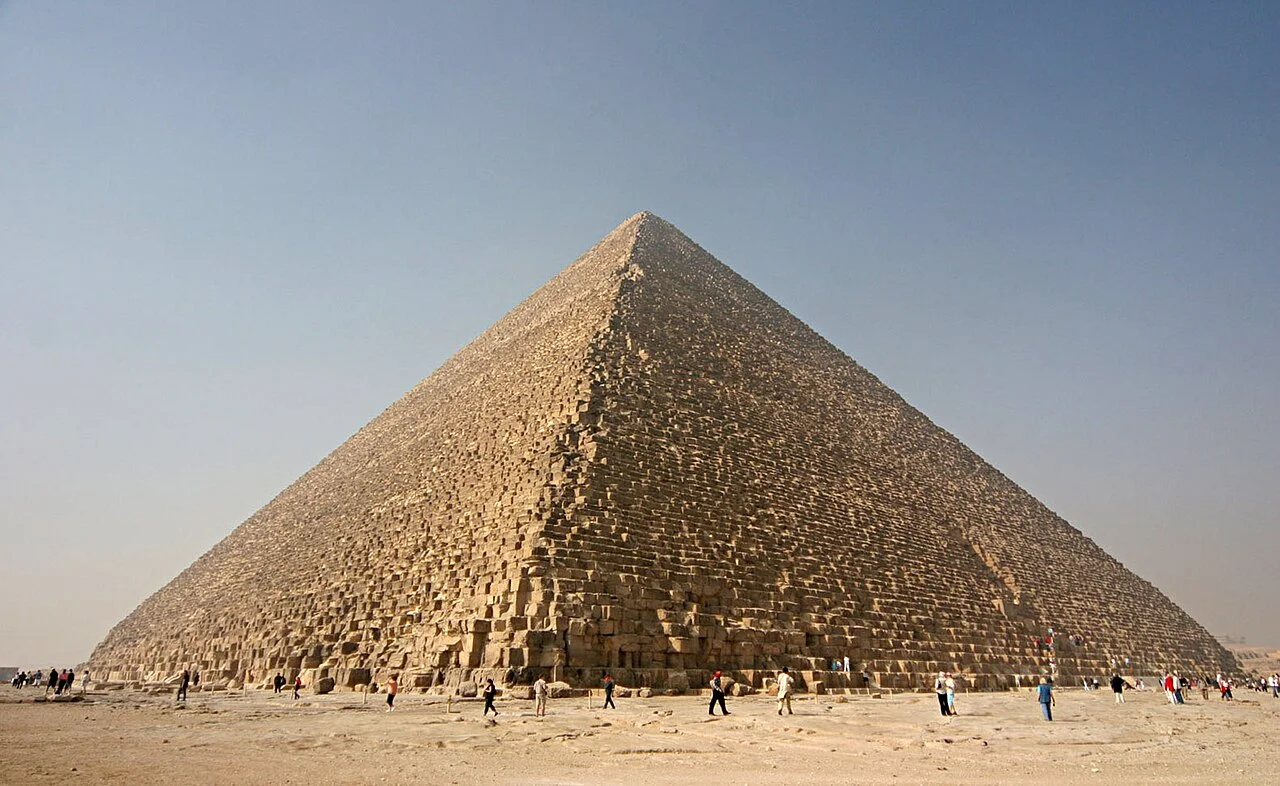
The Great Pyramid of Khufu
The Great Pyramid of Khufu (also known as Cheops), built around 2560 BC, was the tallest man-made structure on Earth for approximately 3,800 years — a record not broken until the construction of Lincoln Cathedral in England around 1311 AD. Originally standing 146.5 meters high and covering 53,000 square meters at its base, it contains an estimated 2.3 million stone blocks weighing on average 2.5 tonnes each. The precision of its construction is staggering: the base is level to within 2.1 centimeters across its entire 230-meter width, and the four sides are oriented to true north, south, east, and west with an accuracy of less than 0.06 degrees.
Inside, the pyramid's interior layout is unique among Egyptian pyramids: it contains three burial chambers, two of which (the so-called Queen's Chamber and King's Chamber) are carved directly into the limestone bedrock and the pyramid's masonry, connected by the dramatic Grand Gallery — a soaring corbelled passage 47 meters long and 8.6 meters high that represents a masterpiece of architectural engineering in its own right. The granite-lined King's Chamber still contains the lidless granite sarcophagus of Khufu, though the king's mummy and all burial goods were long since plundered.
The Giza Complex as Funerary City
The three pyramids were not isolated monuments but the centerpieces of a vast funerary city covering over two square kilometers. Each pyramid was accompanied by a mortuary temple on its east face, connected by a long causeway to a valley temple at the desert edge where the Nile floods reached. Queens' pyramids, mastaba tombs of nobles and officials, workers' villages, and boat pits (containing ritual wooden boats for the pharaoh's journey through the sky) surrounded the main complexes. The Great Sphinx — carved from a natural limestone outcrop — stood guard over Khafre's valley temple and causeway, serving as a colossal divine protector of the entire necropolis.
Why Pyramid Building Declined
After the Old Kingdom pyramids, the form persisted into the Middle Kingdom — pharaohs of the 11th and 12th Dynasties built pyramids at Thebes, Dashur, and the Fayyum — but these were smaller, less precisely engineered, and constructed with rubble cores rather than solid masonry. They degraded far more quickly than their predecessors. By the end of the Middle Kingdom, around 1650 BC, pyramid building was in rapid decline. The reason was partly practical: the pyramids had failed catastrophically at their primary purpose of protecting the royal burial. Every pyramid tomb known to us was robbed in antiquity. The sheer scale of these monuments made them impossible to conceal and irresistible to thieves. A new approach was needed.
Stage Five: Rock-Cut Tombs & the Valley of the Kings (c. 1550–1070 BC)
The New Kingdom pharaohs of the 18th Dynasty — beginning with Thutmose I around 1500 BC — made a radical break with 1,500 years of funerary tradition. Instead of building a conspicuous monument that advertised the presence of a royal burial, they would hide their tombs. The burial chamber would be cut deep into the living rock of a remote, cliff-lined valley in the Theban hills on the west bank of the Nile at Luxor. The mortuary temple — where the funerary cult would be maintained — would be built separately, at the valley entrance, disconnected from the tomb itself to prevent would-be robbers from using it as a landmark.
The Valley of the Kings
The Valley of the Kings (known to the ancient Egyptians as "The Great and Majestic Necropolis of the Millions of Years of the Pharaoh, Life, Strength, Health in the West of Thebes") was used as the royal burial ground for approximately 500 years, from the early 18th Dynasty to the end of the 20th Dynasty. It contains 63 known tombs, ranging from simple single-chamber pits to the enormous multi-corridor complex of Ramesses VI — a labyrinth of decorated corridors, pillared halls, and burial chambers extending over 100 meters into the cliff face and descending more than 50 meters below the valley floor.
The walls of these rock-cut tombs were covered floor to ceiling with painted relief carvings of unprecedented richness and complexity — scenes from the great religious texts of the New Kingdom including the Book of the Dead, the Book of Amduat ("What is in the Underworld"), the Book of Gates, and the Litany of Ra. These were not decorative but functional: they were magical texts designed to guide the pharaoh through the dangers of the underworld and ensure his successful transformation into an akh, a transfigured spirit capable of joining the sun god Re on his eternal circuit across the sky.
The Irony of Secrecy
The strategy of concealment was ultimately no more successful than the strategy of monumentality had been. Within a few centuries of the end of the New Kingdom, virtually every royal tomb in the Valley of the Kings had been robbed — many of them within decades of the original burial. The scale of the problem is documented in extraordinary surviving papyri from the 20th Dynasty that record the trials of tomb robbers caught in the act. The Egyptian authorities responded by consolidating the surviving royal mummies into a small number of hidden caches — the great Discovery of the Deir el-Bahari cache in 1881, in which 40 royal mummies were found stacked together, represents the final desperate measure of a civilization struggling to protect its dead.
Noble Tombs and Private Funerary Architecture
Alongside the royal tradition, a rich parallel tradition of private and noble tomb building evolved throughout Egyptian history. The rock-cut tombs of nobles and officials at sites like Beni Hasan (Middle Kingdom), the Theban necropolis at Sheikh Abd el-Qurna (New Kingdom), and the mastaba fields of Saqqara provide an unparalleled window into daily Egyptian life and funerary belief — their painted walls depicting agriculture, hunting, music, and banqueting with a warmth and immediacy that the grander royal monuments rarely achieve.
Visit These Sites Today
Every major stage of the evolution of Egyptian funerary architecture is accessible to modern visitors in Egypt, with most sites remarkably well preserved and fully open to the public. Below is a practical overview of the key sites corresponding to each phase of this architectural story.
| Predynastic Graves | Hierakonpolis & Abydos. Abydos is easily visited from Luxor and contains royal tombs from Dynasty 0 through Dynasty 2, as well as the magnificent Seti I temple. Hierakonpolis (Kom el-Ahmar) is more remote but accessible on a dedicated Egyptology tour. |
|---|---|
| Mastabas | Saqqara Necropolis, south of Cairo. The mastaba fields of the Old Kingdom nobles surrounding the Step Pyramid are among the finest in Egypt. Many tombs are open to visitors and contain superbly preserved painted reliefs of everyday Old Kingdom life. |
| Step Pyramid | Saqqara. Djoser's Step Pyramid and its surrounding complex have been extensively restored and are open to visitors. The adjacent Imhotep Museum contains extraordinary finds from the necropolis. |
| Bent & Red Pyramids | Dahshur, south of Saqqara. Often overlooked by tourists, Dahshur is one of the most rewarding sites in Egypt — visitors can enter the interior of both the Bent and Red Pyramids, experiencing the sheer scale of these monuments from the inside. |
| Giza Pyramids | Giza Plateau, Cairo. The Great Pyramid, Pyramid of Khafre, Pyramid of Menkaure, and the Great Sphinx. Open daily. Interior visits to the Great Pyramid require a separate ticket, available in limited numbers each day. |
| Valley of the Kings | West Bank, Luxor. Standard tickets cover entry to three tombs; additional tickets required for KV62 (Tutankhamun), KV17 (Seti I), and KV57 (Horemheb). Early morning visits strongly recommended to beat the heat and crowds. |
| Noble Tombs | Theban Necropolis, West Bank Luxor. The tombs of officials like Nakht, Menna, Sennefer, and Rekhmire contain some of the finest painted decoration in Egypt — intimate, colorful, and deeply human. |
| WhatsApp Bookings | Contact Egypt Lover at +201009305802 to book a guided tour covering all phases of tomb evolution across Giza, Saqqara, Dahshur, and Luxor. |
The Stage Cards: Architecture at a Glance
Here is a quick-reference summary of each major phase in the evolution of Egyptian funerary architecture, showing the progression from simplicity to grandeur and back to concealment:
Pit Grave
Simple oval pit in desert sand. Body in contracted position, facing west. Grave goods: pottery, tools, ornaments. Natural desiccation preserves bodies and inspires mummification.
Mastaba
Rectangular flat-topped superstructure of mud brick or stone over subterranean burial chamber. Contains offering chapel, false door. The standard elite tomb form for 500 years.
Step Pyramid
Stacked mastaba forms rising in steps. World's first large stone monuments. Djoser's Step Pyramid at Saqqara (62m) designed by Imhotep is the supreme example.
True Pyramid
Smooth-sided geometric form representing the primordial mound and solar rays. Perfected at Giza. Persists in modified form through the Middle Kingdom before being abandoned.
Rock-Cut Tomb
Hidden chambers carved deep into Theban cliffs. Mortuary temple separated from burial site. Wall-to-wall religious texts guide the pharaoh through the underworld. The Valley of the Kings contains 63 known examples.
Best Experience for First-Time Visitors
If you have limited time, a single day on the Saqqara–Dahshur–Giza circuit gives the most complete understanding of the pyramid tradition. For the rock-cut tomb tradition, a half-day in the Valley of the Kings combined with a visit to the Theban noble tombs provides an unparalleled contrast. Combining both — ideally with a guide who can explain the theological connections — is the gold standard Egypt experience.
Who Will Enjoy This Most
The story of Egyptian tomb evolution appeals to almost everyone. Architecture enthusiasts will be riveted by the engineering challenges and solutions. History lovers will appreciate the sweep of three thousand years of cultural development. Philosophy and religion students will find the theological underpinnings fascinating. And for anyone who has ever wondered what the ancient Egyptians really believed about death, life, and the cosmos, no textbook can substitute for standing at the entrance to a painted royal tomb in the Valley of the Kings and reading the walls.
Frequently Asked Questions
Why did the ancient Egyptians build such elaborate tombs?
What came before the pyramids in ancient Egypt?
Why did pharaohs stop building pyramids?
How many people built the Great Pyramid of Giza?
Can I enter the pyramids and Valley of the Kings tombs?
What is the difference between a mortuary temple and the tomb itself?
Sources & Further Reading
The following academic and institutional sources were consulted in the preparation of this guide. We encourage readers to explore these resources for deeper study of ancient Egyptian funerary architecture.
- The Metropolitan Museum of Art — Egyptian Art: Funerary Architecture
- Encyclopædia Britannica — Pyramid Architecture, Ancient Egypt
- World History Encyclopedia — Egyptian Pyramids: History & Development
- Giza Project, Harvard University — The Giza Plateau Mapping Project
- Theban Mapping Project — Valley of the Kings Complete Survey