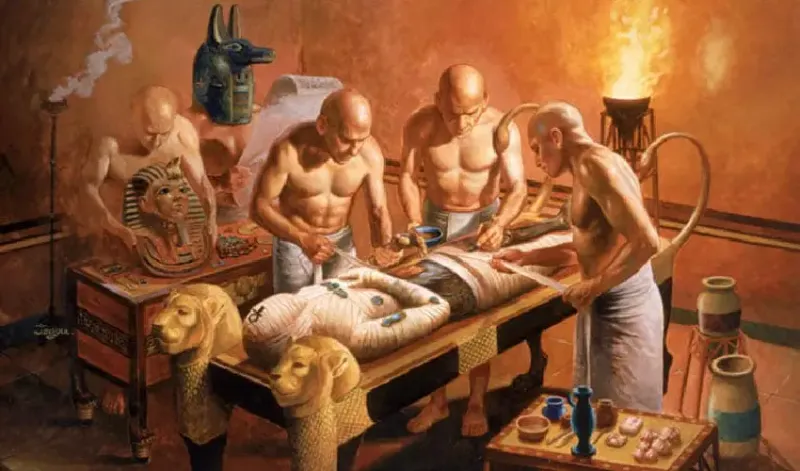
"You shall live again, you shall live again forever; behold, you are young again for ever." – from the Opening of the Mouth Ritual.
To the Ancient Egyptians, death was not the end, but a transition. To survive in the Afterlife (Field of Reeds), the soul (Ka and Ba) needed a physical vessel to return to. Thus, the art of mummification was born.
Mummification was a complex, sacred process that took 70 days to complete. It was performed by embalmers who were often priests of Anubis, the jackal-headed god of embalming. The procedure involved both physical preservation and religious ritual.
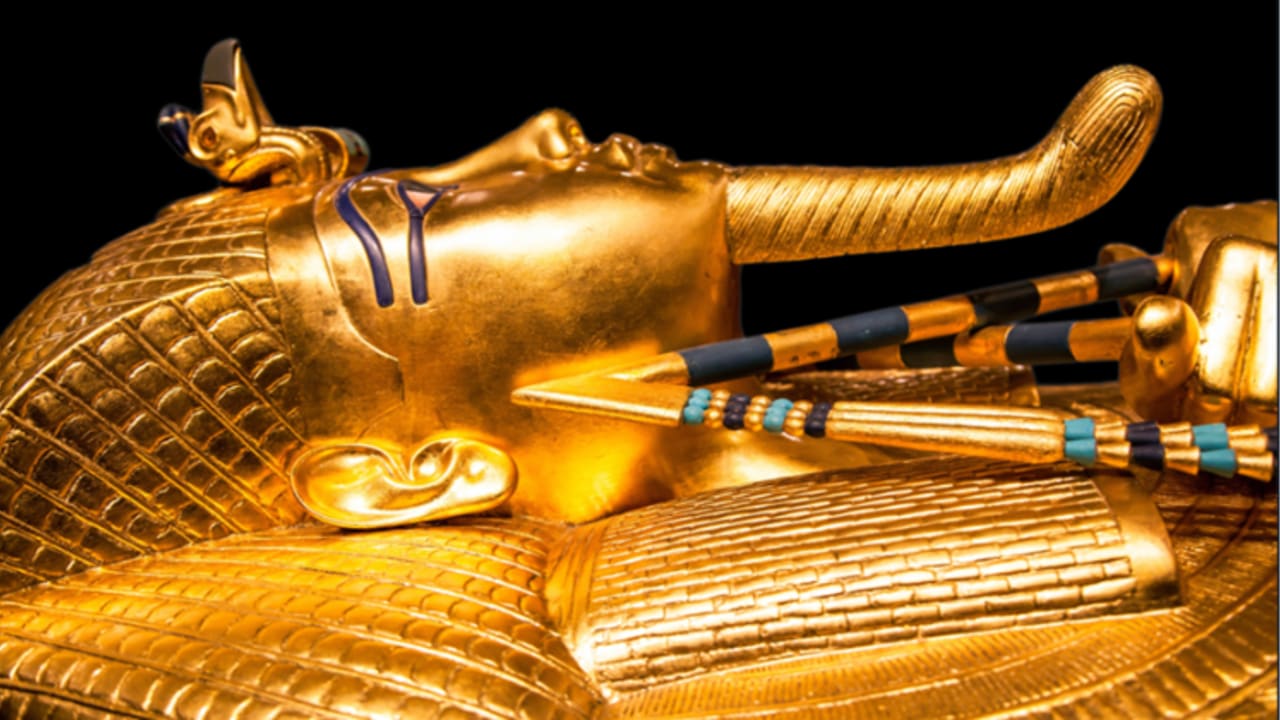
The 70-Day Process
The process was divided into distinct stages, each vital for the preservation of the body.
Step 1: Purification (Ibw)
The body was taken to the Ibw (Place of Purification) near the Nile. It was washed with sacred water and wine made from palm dates to kill bacteria.
Step 2: Removal of the Brain
Using a long bronze hook inserted through the nostrils, the embalmers would liquefy and extract the brain. Unlike other organs, the brain was considered useless (the heart was thought to be the seat of intelligence) and was discarded.
Step 3: Evisceration & Canopic Jars
A small incision was made on the left side of the abdomen. The internal organs—which decompose quickly—were removed. However, the Heart (Ib) was left inside, as it would be weighed against the Feather of Truth (Ma'at) in the Hall of Judgment.
The removed organs were washed, wrapped, and placed in four Canopic Jars, each guarded by one of the Four Sons of Horus:
- Imsety (Human head): Guarded the Liver.
- Hapi (Baboon head): Guarded the Lungs.
- Duamutef (Jackal head): Guarded the Stomach.
- Qebehsenuef (Falcon head): Guarded the Intestines.
Step 4: Dehydration (The Natron)
The body was stuffed and covered with Natron, a natural salt mixture found in dried lake beds (like Wadi El Natrun). The body was left to dry for 40 days. The salt absorbed all moisture, leaving a preserved, leather-like form.
Step 5: Wrapping
After dehydration, the body was washed again and anointed with oils and resins (which give mummies their black appearance). It was then wrapped in hundreds of yards of linen.
Amulets: Between the layers of linen, priests placed magical amulets for protection. The most important was the Heart Scarab, placed over the heart to prevent it from "betraying" the owner during judgment.
The Opening of the Mouth
Before burial, a crucial ceremony called the "Opening of the Mouth" was performed at the tomb entrance. A priest used a ritual adze to touch the mouth, eyes, and ears of the mummy case.
Purpose: To magically restore the senses, allowing the spirit to breathe, eat, drink, and see in the afterlife. Without this, the mummy would be a lifeless shell.
Tools of the Embalmer
-
Obsidian Blade: A ritually sharp stone knife used to make the abdominal incision.
-
Bronze Hook: Used for brain extraction.
-
Resins & Oils: Myrrh, cedar oil, and beeswax were used to seal the body and sweeten the smell.