Definition & Concept
In Ancient Egyptian belief, Eternal Life (Ankh) was not a spiritual abstraction or an escape from the physical world. It was a continuation and perfection of earthly existence. It meant endless renewal, participation in the cosmic order, and the defeat of non-existence.
| Ancient Concept | Ankh (Life), Djet (Eternity of Duration) |
|---|---|
| Goal | To become an Akh (Effective Spirit) |
| Requirement | Preservation of Body & Name |
| Opposite | The Second Death (Oblivion) |
Death is a Transition
The Egyptians believed that death was not an end, but a horizon (Akhet) where the sun sets only to rise again. Just as the sun is reborn every morning and the Nile floods every year, the human soul was designed to cycle through death back into life. This cyclical view made mortality a temporary phase in an eternal journey.
Anatomy of the Soul
Eternal life required the complex interplay of several spiritual components. If any one of these was destroyed, the person ceased to exist.
| Component | Function | Role in Afterlife |
|---|---|---|
| Ka | Life Force | Requires food/offerings to survive. |
| Ba | Personality | Bird-form; travels between tomb and world. |
| Ib | Heart | Seat of intellect and morality; weighed in judgment. |
| Ren | Name | Must be spoken/written to maintain existence. |
| Sheut | Shadow | Protective double; contains the essence. |
Ethics & Ma'at
Eternal life was not guaranteed by magic alone; it had to be earned. Living in accordance with Ma'at (Truth, Justice, Balance) was essential. The universe was built on moral laws, and violating them created heaviness in the heart, which would doom the soul during judgment. Immortality was an ethical achievement.
The Weighing of the Heart
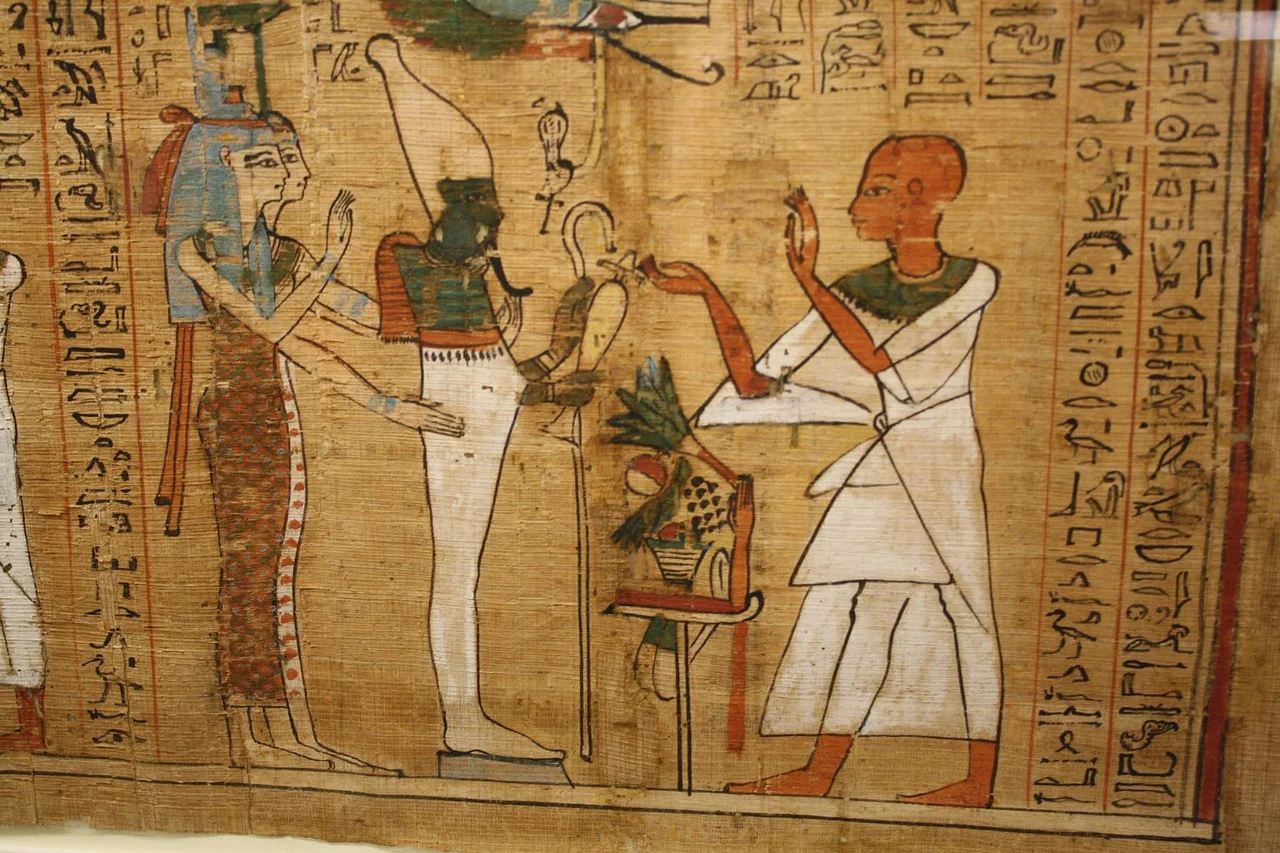
Before entering paradise, every soul faced the Tribunal of Osiris. In the Hall of Two Truths, the heart was weighed against the feather of Ma'at. If balanced, the deceased was declared Maa Kheru ("True of Voice") and admitted to the afterlife. If heavy with sin, it was devoured by Ammit, resulting in total annihilation.
Ritual Necessity
Survival required action from the living. The body had to be preserved through Mummification to serve as an anchor for the soul. The Opening of the Mouth ceremony restored the senses. Daily offerings of bread and beer sustained the Ka. Without these rituals, the spiritual components would disperse and fade.
Field of Reeds (Aaru)
The Egyptian heaven was not a cloud-filled void, but a perfected version of Egypt called the Field of Reeds (Aaru). Here, the crops grew taller, the Nile never dried up, and families were reunited. It was a physical paradise where the dead lived, ate, drank, and even farmed—though the hard labor was done by magical Shabti dolls.
Guidebooks to Eternity
To navigate the dangerous path to this paradise, the Egyptians created guidebooks: the Pyramid Texts (for kings), the Coffin Texts (for nobles), and the Book of the Dead (for everyone). These texts provided the passwords to pass the gates of the underworld and the spells to defeat demons.
Immortality for All
Initially, in the Old Kingdom, only the Pharaoh was assured eternal life with the gods. Over centuries, this privilege extended to nobles and eventually to commoners. By the New Kingdom, anyone who could afford a proper burial and lived a good life could hope to become "an Osiris" and live forever.
Cyclical Time
Eternal life was dynamic, not static. It followed the solar cycle. The dead joined Ra on his boat, dying at sunset and being reborn at dawn. This daily renewal meant that eternity was a constant process of becoming, a perpetual victory over the inertia of death.
Victory Order Chaos
The obsession with eternal life was a defiance of chaos (Isfet). Preserving the body, building stone monuments, and writing names were all acts of establishing Order (Ma'at) against the destructive forces of time and decay. It was a cosmic duty to remember and be remembered.
A Civilization of Life
Contrary to popular belief, the Egyptians were not obsessed with death, but with Life. Their tombs were filled with scenes of parties, hunting, and farming because they loved life so much they wanted it to continue forever. Their entire civilization—art, architecture, law—was an engine designed to produce eternity.
Legacy of Hope
The Egyptian vision of eternal life influenced the Greek, Roman, and Coptic Christian worlds. Concepts like the judgment of the soul, the resurrection of the body, and a paradise for the righteous have deep roots in the soil of the Nile Valley, shaping how humanity views mortality to this day.
Encyclopedia Summary
| Concept | Eternal Life (Ankh) |
|---|---|
| Goal | Transformation into an Akh |
| Requirement | Ma'at (Truth) & Preservation |
| Destination | Field of Reeds & Solar Barque |
| Key Symbol | The Ankh |