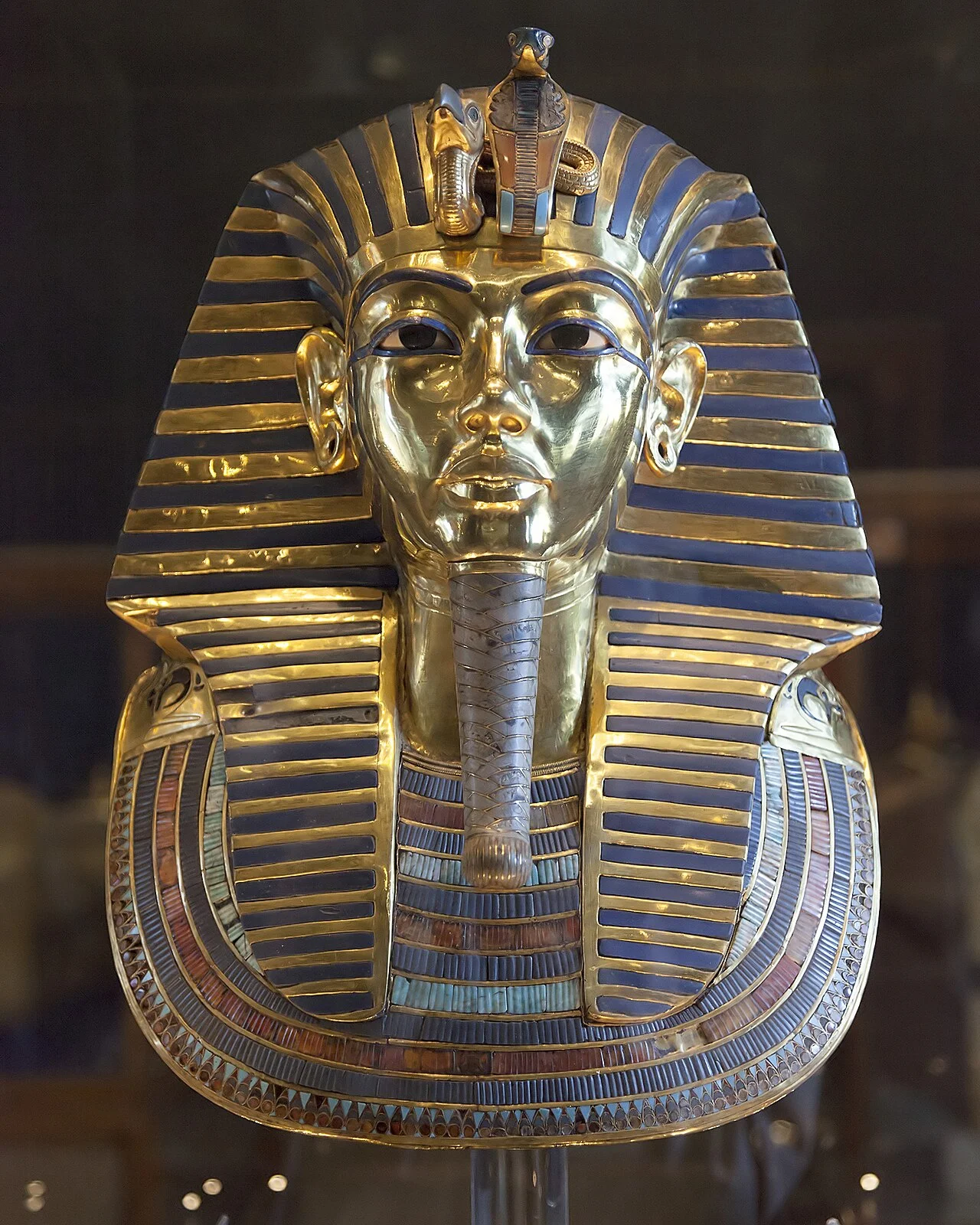
Of all the treasures that have survived from the ancient world, none commands more wonder, reverence, or recognition than the golden funerary mask of Tutankhamun. Fashioned from solid beaten gold, inlaid with lapis lazuli, carnelian, turquoise, and colored glass, and bearing the serene, idealized features of a young pharaoh, this mask has become the defining image of ancient Egypt for billions of people around the world. It is simultaneously a supreme work of art, a profound religious object, and a bridge across three and a half millennia of human history.
Created around 1323 BCE to protect the mummified head of the boy-king Tutankhamun as he journeyed into the afterlife, the mask lay undisturbed for over 3,200 years in the innermost chamber of tomb KV62 in the Valley of the Kings. When British archaeologist Howard Carter and his team finally uncovered it on October 28, 1925, the world reacted with astonishment. Today, the Mask of Tutankhamun is permanently displayed at the Egyptian Museum in Cairo — the single most visited artifact in Egypt, and arguably in the entire world.
Table of Contents
What Is the Mask of Tutankhamun?
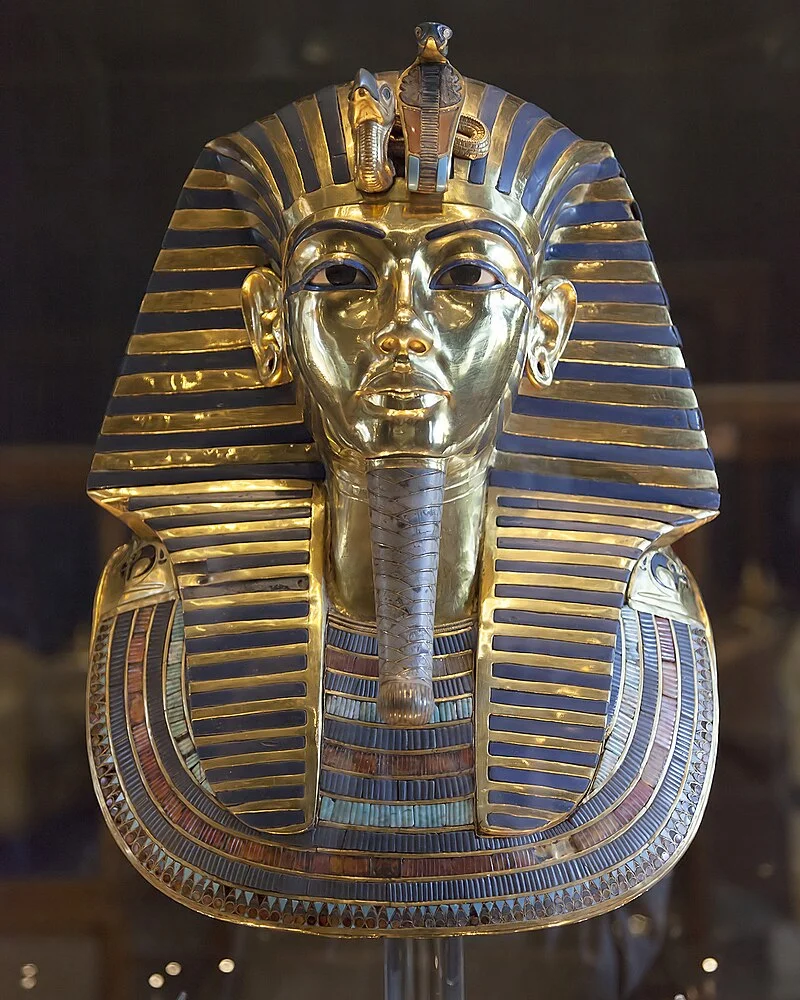
The Mask of Tutankhamun is a funerary death mask — an object placed directly over the head and upper chest of the pharaoh's mummified body inside his innermost coffin. Its purpose was both practical and mystical: it preserved the identity of the deceased so that his spirit (ka) could recognize and return to its body, while simultaneously transforming the pharaoh into Osiris, the god of the dead and the afterlife.
The mask depicts Tutankhamun with the idealized features of a youthful god-king: a smooth, serene face with almond-shaped eyes lined in lapis lazuli and obsidian, a straight nose, and full lips curved in a faint, eternal smile. Atop his head he wears the nemes headdress — the striped royal cloth associated with pharaonic power — with a uraeus cobra and vulture head mounted at the forehead, representing the protective goddesses Wadjet and Nekhbet. A false ceremonial beard of braided gold and blue glass hangs from the chin, linking the king to the divine beard of Osiris.
The mask stands 54 cm tall and 39.3 cm wide, and is constructed from two layers of solid gold beaten to an extraordinary thinness while retaining its rigid form. Its surface is covered in intricate inlaid decoration of astonishing detail and precision, reflecting the peak of ancient Egyptian goldsmithing technique. On the rear of the mask, a hieroglyphic text — a spell from the Book of the Dead — is inscribed in two vertical columns, invoking the protection of various deities over the organs of the king's body.
— Howard Carter, describing his first sight of the mask, 1925
History & Discovery
The story of the Mask of Tutankhamun is inseparable from the story of the pharaoh himself — a young king who died at approximately 18–19 years of age, whose tomb was sealed and largely forgotten, and whose rediscovery in 1922 became the greatest archaeological event of the 20th century.
Tutankhamun is born, likely as the son of the heretic pharaoh Akhenaten and one of his secondary wives. He grows up during the tumultuous Amarna Period, when Akhenaten had abandoned Egypt's traditional polytheism in favor of worshipping a single sun deity, the Aten.
At approximately 8–9 years of age, Tutankhamun ascends to the throne of Egypt following the death of his father (or predecessor) Akhenaten. He reverses his father's religious revolution, restoring the traditional gods — especially Amun — and moving the capital back to Thebes. His original name, Tutankhaten ("Living Image of the Aten"), is changed to Tutankhamun ("Living Image of Amun").
Tutankhamun dies unexpectedly at around 18–19 years of age. The exact cause of his death remains debated — studies suggest a combination of genetic disorders, malaria, and a severe leg fracture. He is hastily buried in a relatively small tomb (KV62) in the Valley of the Kings, and a magnificent array of funerary goods — including the golden mask — is prepared and sealed with him.
Tutankhamun's successors — particularly Horemheb — systematically erase the boy-king's name from monuments, attributing his works to themselves. His tomb entrance is buried under debris from later construction, effectively hiding it from tomb robbers and history alike for over three millennia.
British archaeologist Howard Carter, funded by Lord Carnarvon, discovers the steps leading to Tutankhamun's tomb in the Valley of the Kings. On November 26, Carter and Carnarvon make a small breach in the sealed doorway and peer inside by candlelight. When Carnarvon asks if he can see anything, Carter famously replies: "Yes, wonderful things."
After years of carefully excavating and cataloguing the tomb's outer chambers, Carter's team finally opens the innermost burial chamber and unwraps the royal mummy. The golden mask is found resting perfectly over the head and shoulders of Tutankhamun's mummy inside the innermost of three nested coffins. The innermost coffin itself is solid gold, weighing 110.4 kg.
The discovery of Tutankhamun's tomb and its treasures triggered a worldwide phenomenon — "Tutmania" — that swept through art, fashion, architecture, and popular culture throughout the 1920s and beyond. The mask became the central icon of this cultural obsession, reproduced on magazine covers, posters, and souvenirs around the world. It remains, nearly a century after its discovery, the most recognizable symbol of ancient Egypt on earth.
Materials & Craftsmanship
The physical construction of the Mask of Tutankhamun represents the absolute pinnacle of ancient Egyptian metalworking and decorative art. Every material chosen, every technique employed, and every decorative element included was the result of centuries of accumulated craft knowledge combined with enormous resources available only to the royal court.
The mask is constructed from two layers of solid beaten gold — a high-karat alloy of gold with small amounts of silver and copper — worked into sheets and shaped over a form to create the three-dimensional face and headdress. The total gold weight is 10.23 kilograms, making it not merely a decorative object but a repository of enormous intrinsic wealth. The gold's warm, reddish-yellow color was not accidental: ancient Egyptians associated gold with the eternal, imperishable flesh of the gods, making it the ideal material for a funerary object intended to confer divine status on the deceased king.
The inlaid decoration is executed with breathtaking precision. The striped nemes headdress is inlaid with alternating bands of blue glass designed to mimic lapis lazuli, creating the characteristic royal striped pattern. The broad collar (wesekh) covering the chest is elaborately inlaid with cornelian, lapis lazuli, amazonite, quartz, obsidian, turquoise, and colored glass faience, arranged in multiple registers of intricate floral and geometric patterns. Each individual inlay piece was cut, shaped, and fitted with a precision that rivals modern lapidary work.

The solid gold innermost coffin of Tutankhamun (110.4 kg), inside which the mask was found resting over the royal mummy. Egyptian Museum, Cairo. Photo: Wikimedia Commons (Public Domain)
Symbols & Iconography
Every element of the Mask of Tutankhamun is charged with religious and royal symbolism, reflecting the deeply encoded visual language of ancient Egyptian art. The mask is not simply a portrait — it is a theological statement about the nature of kingship, death, and divine transformation.
The Nemes Headdress
The striped cloth headdress — known as the nemes — was the most common royal headcovering depicted in ancient Egyptian art, worn by pharaohs from the Old Kingdom onward. Its distinctive pattern, rendered here in blue glass and gold, immediately identifies the wearer as a king. The nemes falls in two large flaps over the chest, with a tail gathered at the back, framing the face in a way that emphasizes the serene, frontal gaze of the mask.
The Uraeus and Vulture
At the forehead of the mask, two protective figures are mounted side by side: the rearing cobra (uraeus) of the goddess Wadjet, protector of Lower Egypt, and the vulture head of the goddess Nekhbet, protector of Upper Egypt. Together, they represent the unity of the Two Lands under the pharaoh's rule and serve as divine guardians of the king in death as in life. The uraeus was traditionally worn on the royal brow as a symbol of sovereignty and the power to destroy enemies.
👁️ Eyes of Eternity
The eyes are made from obsidian pupils set in white quartz irises, with black-painted cosmetic lines extending outward. They convey an uncanny sense of living presence and were designed to allow the dead king's spirit to see and engage with the world.
🧔 The Divine Beard
The long, braided false beard — made of gold and blue glass — is a postiche (ceremonial beard) associated specifically with Osiris, the god of the afterlife. By wearing this beard, Tutankhamun is identified as Osiris in death, having undergone divine transformation.
📿 The Broad Collar
The elaborate wesekh collar covering the chest and shoulders is inlaid with cornelian, lapis lazuli, and turquoise in multiple registers. Broad collars were among the most important items of Egyptian royal jewelry and had strong associations with protection and divine authority.
🐍 The Uraeus Cobra
The rearing cobra at the forehead represents Wadjet, divine protector of Lower Egypt and the pharaoh's crown. The uraeus was believed to spit fire at the king's enemies and was the ultimate emblem of royal power and divine protection.
🦅 The Vulture of Nekhbet
Paired with the uraeus, the vulture head of Nekhbet symbolizes Upper Egypt and the protective motherly aspect of divine royalty. Together, the two creatures complete the iconographic statement that this king rules all of Egypt under divine guardianship.
🌟 Gold as Divine Flesh
In ancient Egyptian theology, gold was considered the flesh of the gods — imperishable, solar, and eternal. By crafting the mask from solid gold, the artisans were literally giving the pharaoh the body of a god, ensuring his immortality in the divine realm.
The overall composition of the mask creates a perfect synthesis of the human and the divine: a recognizable human face rendered in idealized, eternal form, clothed in the attributes of royal and divine power, and made from the imperishable substance of the gods themselves. It is one of the most complete expressions of ancient Egyptian royal theology ever created.
Color Symbolism
The colors of the mask are not merely decorative — each hue carries precise religious meaning in the Egyptian symbolic vocabulary. Blue (represented by lapis lazuli and blue glass) was associated with the sky, the primordial waters of creation, and the hair of the gods. Gold stood for the divine sun and eternal life. Red and orange carnelian evoked vitality and the protective power of blood. Green and turquoise symbolized resurrection, fertility, and the rejuvenating power of the Nile's annual flood. Every color choice was a deliberate theological statement woven into the object's visual language.
The Spell of the Book of the Dead
On the back and shoulders of the mask, two vertical columns of finely incised hieroglyphic text contain a protective spell — Spell 151b from the Book of the Dead. This inscription was not merely decorative; it was an active magical text intended to protect and empower specific parts of the pharaoh's body during his journey through the afterlife (the Duat).
What the Spell Says
The spell invokes a series of Egyptian deities to protect each part of the pharaoh's face and body. The text addresses individual organs and facial features, dedicating each to the protection of a specific god or goddess: the forehead is protected by Anubis, the nape of the neck by Thoth, the eyes by Hathor, the lips by Atum, the ears by the children of Horus, and so on. The final lines call upon all the gods of Egypt to safeguard the king and ensure his successful resurrection into eternal life.
The Living Magic of Hieroglyphs
For the ancient Egyptians, written words were not passive records — they were active agents of reality. Carved or written hieroglyphs were believed to live and act, performing their stated purpose in both the physical and divine realms. The inscription on the back of Tutankhamun's mask was therefore a perpetually active spell, continuously working its protective magic throughout eternity. The care taken to inscribe this text on an object of such preciousness reflects the supreme importance of ensuring the king's safe passage to the afterlife.
— Paraphrase of Book of the Dead Spell 151b, inscribed on the back of the Tutankhamun mask
Comparison With Other Royal Masks
While royal funerary masks were used by Egyptian pharaohs for over a thousand years, the Mask of Tutankhamun is exceptional in several respects. Most royal masks were gilded — covered in a thin layer of gold leaf over a base of wood or cartonnage — rather than made from solid gold. The exceptional wealth of Tutankhamun's tomb, combined with the relatively intimate scale of his burial (suggesting the full apparatus of a royal burial was compressed into a smaller space), resulted in objects of extraordinary material richness. Other famous royal masks, such as those of Psusennes I and Amenemope (also in the Egyptian Museum), approach but do not equal the iconic status or material splendor of Tutankhamun's mask.
Legacy & Global Impact
In the century since its discovery, the Mask of Tutankhamun has exerted a cultural influence that extends far beyond the field of Egyptology. It has become one of the most reproduced images in human history, appearing on the covers of magazines, in advertising campaigns, in films, in fashion collections, and in the decorative arts of every country on earth. More than any other artifact, it has shaped the modern world's vision of ancient Egypt.
The mask's discovery in 1922 triggered the "Egyptian Revival" of the Art Deco period, influencing architecture, jewelry design, graphic art, and interior decoration throughout the 1920s and 1930s. The geometric precision of Egyptian motifs — exemplified by the mask's bold lines, striped patterns, and frontal symmetry — blended naturally with the modernist aesthetic of Art Deco, producing a fusion of ancient mystique and contemporary style that swept Europe and America. Buildings, cinemas, department stores, jewelry, and everyday objects were all touched by the influence of Tutankhamun's golden face.
In the realm of popular culture, the mask has appeared in countless films, novels, comic books, video games, and television programs. It functions as an instantly recognizable shorthand for "ancient Egypt" — a visual symbol so deeply embedded in global consciousness that it requires no caption or explanation for audiences from Tokyo to Toronto to Cairo. Few human-made objects have achieved this level of universal recognition, and none from the ancient world comes close.
Visitor Information
The Mask of Tutankhamun is permanently displayed at the Egyptian Museum in Tahrir Square, Cairo — one of the world's great museums and an essential destination for anyone traveling to Egypt. Here is all the practical information you need to plan your visit.
| Location | The Egyptian Museum, Tahrir Square, Cairo 11557, Egypt |
|---|---|
| Gallery | Room 3 (Upper Floor) — Tutankhamun Treasures Gallery |
| Opening Hours | Daily 9:00 AM – 5:00 PM (last entry 4:30 PM) |
| Admission | Approximately 200–300 EGP for general admission; additional tickets required for Tutankhamun gallery and Royal Mummies Hall (fees subject to change — check the museum website before visiting) |
| Getting There | Metro Line 2 to Sadat Station (Tahrir Square); taxi or ride-share to Midan Tahrir; major Cairo hotels offer tour packages including museum visits |
| Best Time to Visit | Weekday mornings (9:00–11:00 AM) for smaller crowds; avoid public holidays and Friday afternoons when the museum is busiest |
| Photography | Photography is permitted in most areas; a photography permit is required (available at the ticket office). No flash photography near the mask |
| Guided Tours | Official English-speaking guides are available for hire at the museum entrance; private tour packages can be arranged in advance through Egyptian tour operators |
| Accessibility | Wheelchair access is available on the ground floor; some upper-floor galleries may have limited accessibility — contact the museum in advance |
| Combined Visit | Pair with a visit to the nearby Grand Egyptian Museum (GEM) in Giza, which now houses additional Tutankhamun treasures and offers a state-of-the-art visitor experience |
Visitor Advice
The Egyptian Museum's Tutankhamun gallery is among the most visited spaces in any museum on earth, and it can become extremely crowded — particularly in the late morning and early afternoon during peak tourist season (October through April). Arriving right at opening time (9:00 AM) gives you the best opportunity to see the mask in relative calm. The mask is displayed in a specially lit glass case that allows you to view the front, sides, and back inscription. Budget at least two to three hours to properly explore the full Tutankhamun collection, which comprises over 5,000 objects spread across multiple rooms.
Who Should Visit
The Mask of Tutankhamun is essential viewing for every visitor to Egypt — regardless of prior interest in history or archaeology. It is one of those rare objects that transcends scholarly context and speaks directly to the human imagination: the idea of a young king, buried in gold, waiting for the world to rediscover him across three thousand years of silence. Families with children will find the mask an especially powerful gateway into Egypt's ancient world, and the Egyptian Museum's vast collection offers hours of discovery for visitors of all ages and interests.
Pairing Your Visit
After viewing the mask at the Egyptian Museum, plan a visit to the Grand Egyptian Museum (GEM) in Giza — one of the largest archaeological museums in the world, opened in recent years, which houses additional Tutankhamun treasures in spectacular modern display settings. Combining both museums with a visit to the Valley of the Kings in Luxor — where Tutankhamun's actual tomb (KV62) can be visited — creates one of the most complete and moving encounters with ancient Egypt possible anywhere in the world. Contact the EgyptLover team for a custom itinerary tailored to your interests.
Frequently Asked Questions
Where is the Mask of Tutankhamun displayed today?
How much does the Mask of Tutankhamun weigh?
Who discovered the Mask of Tutankhamun?
Was the Mask of Tutankhamun ever damaged?
How old was Tutankhamun when he died?
Can I see Tutankhamun's actual tomb in Egypt?
Sources & Further Reading
The following scholarly and institutional sources offer reliable, in-depth information about the Mask of Tutankhamun and the world of the boy-king for readers who wish to explore further.