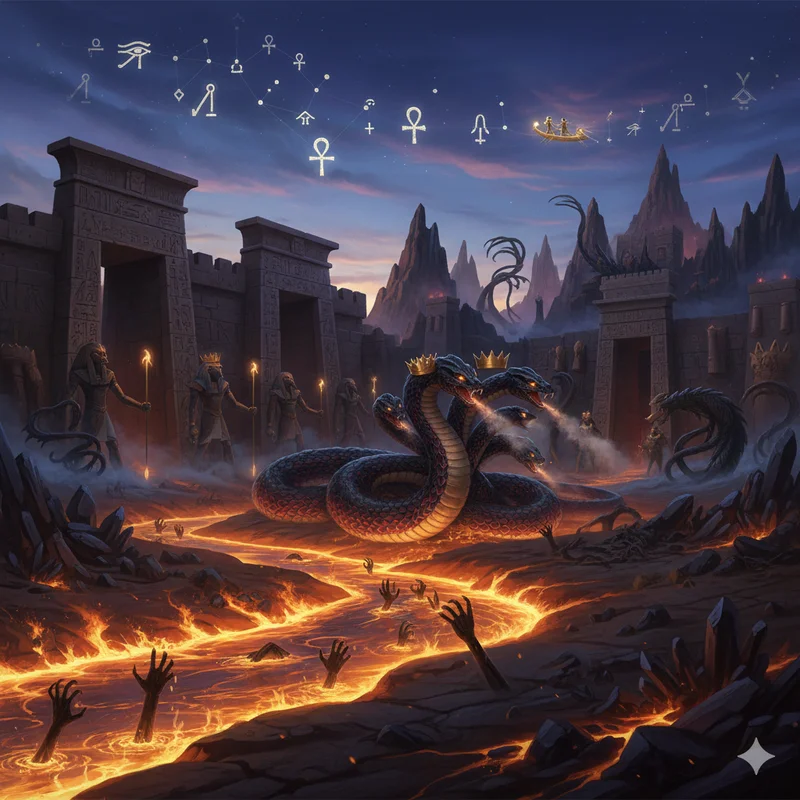
"This is the path of darkness and fire... where the deceased must sail with Ra through the twelve hours of the night, facing demons at every gate, until the dawn of rebirth."
The Duat was the Egyptian realm of the dead. It was not a static heaven or hell, but a dynamic, dangerous landscape located beneath the earth (or in the sky, depending on the cosmology). It was a place of lakes of fire, turquoise trees, iron walls, and monstrous creatures.
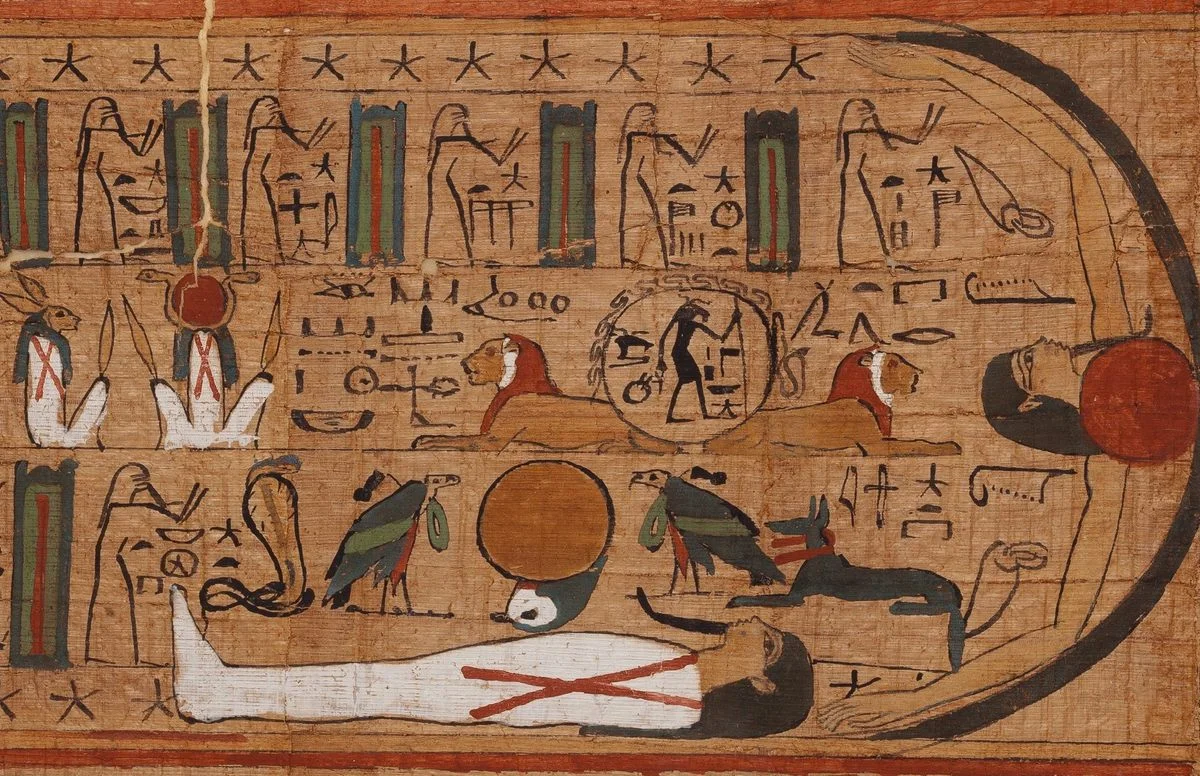
A Landscape of Fire and Darkness
The geography of the Duat was mapped in texts like the Book of Two Ways and the Amduat. It was divided into 12 regions corresponding to the 12 hours of the night.
- The Lakes of Fire: Pits of burning liquid where the souls of the damned (enemies of Ra) were destroyed.
- The Gates (Arits): Massive fortified portals guarding each hour. Each gate was protected by a fearsome deity with a knife. To pass, the deceased had to know the guardian's secret name (e.g., "He who dances in blood").
- The River: A subterranean version of the Nile on which the sun god Ra sailed in his night barque (Mesektet).
The Battle with Apophis
The greatest danger in the Duat was Apophis (Apep), a gigantic serpent of chaos who lived in the 7th Hour. Every night, Apophis tried to swallow the sun boat to stop the dawn and plunge the world into eternal darkness.
The deceased, along with gods like Seth and Mehen, had to help Ra fight off this monster using magic spells and weapons. This battle represented the eternal struggle between Order (Ma'at) and Chaos (Isfet).
Knowledge is Salvation
In the Duat, physical strength was useless. Magic (Heka) and knowledge were the only weapons.
The Book of the Dead served as a "cheat sheet," providing the deceased with the names of every doorkeeper, ferryman, and demon they would encounter. To name a thing in Ancient Egypt was to have power over it. Without this knowledge, the soul would be trapped in the darkness forever.