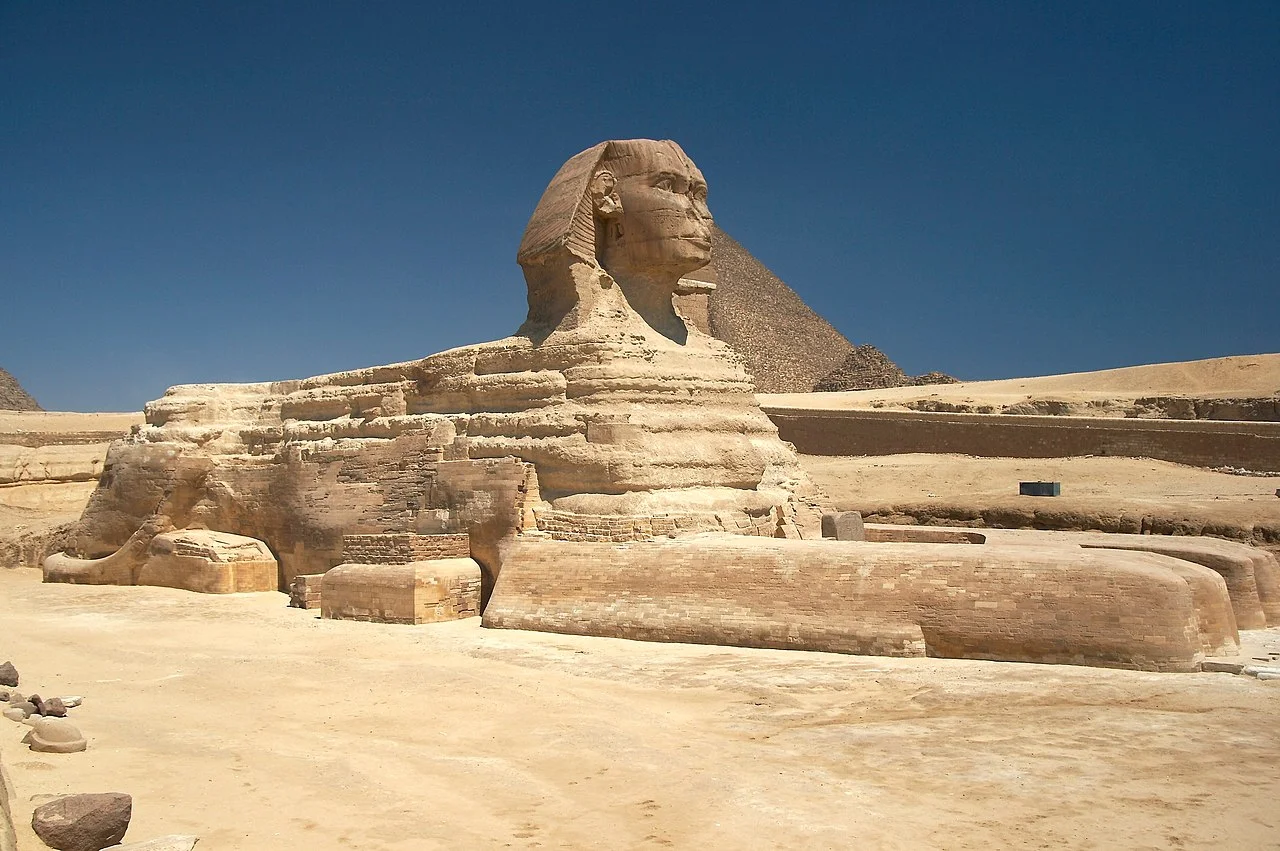
Stand before the Great Sphinx of Giza and look carefully between its outstretched stone paws. There, sheltered by the colossal forearms of one of the ancient world's most iconic monuments, stands a pink granite stele more than three thousand years old — the Dream Stele of Thutmose IV. Carved around 1401 BC on the orders of a newly crowned pharaoh, it tells one of the most compelling stories in all of Egyptian history: how a young prince, exhausted from the hunt, fell asleep in the shadow of the Sphinx and received a divine vision that would change the course of his life — and of Egypt itself.
The story inscribed on the stele is at once deeply personal and powerfully political. It describes the god Harmakhis — the Sphinx in his divine form — speaking directly to the sleeping prince Thutmose, promising him dominion over the Two Lands of Egypt if only the prince would clear away the sand that was slowly burying the great monument. Thutmose, it seems, was not the expected heir to the throne. The dream, and the act of clearing the Sphinx, served as divine legitimation for his kingship. The stele erected to commemorate this bargain has stood between the Sphinx's paws ever since — a monument to a dream, a divine contract, and the enduring power of storytelling in ancient Egyptian culture.
In This Article
What Is the Dream Stele?
The Dream Stele is a large pink granite stele — a standing inscribed slab — erected by the 18th Dynasty pharaoh Thutmose IV (reigned c. 1401–1391 BC) at the very beginning of his reign. It is positioned between the forelegs of the Great Sphinx of Giza, facing east toward the rising sun, and it remains in that location to this day, making it one of the very few ancient Egyptian monuments still standing in its original in-situ position after more than 3,400 years.
The stele's primary purpose was to record and validate the divine vision — the "dream" — that Thutmose claimed to have received while sleeping in the Sphinx's shadow during a hunting expedition. In the dream, the Sphinx god Harmakhis (a solar deity identified with the Sphinx and the rising sun) appeared to the young prince and promised him the double crown of Upper and Lower Egypt if he would excavate the sand that had buried the Sphinx up to its neck. Thutmose carried out the work, became pharaoh, and erected the stele as a permanent record of the divine covenant. The stele thus served simultaneously as a religious dedication, a royal legitimation text, and a record of architectural restoration — a remarkable combination that makes it one of the most historically layered inscriptions in the ancient world.
Historical Timeline
The story of the Dream Stele spans from the Old Kingdom origins of the Great Sphinx to the stele's creation in the New Kingdom — and encompasses the political turbulence that gave the dream narrative its urgent purpose.
The Great Sphinx of Giza is carved during the reign of Pharaoh Khafre (4th Dynasty, Old Kingdom) from a natural limestone outcrop on the Giza Plateau. From its earliest days it is associated with solar worship and royal divinity, facing east toward the rising sun. The area around the Sphinx is called Rosetau — a sacred zone associated with the god Sokar and the underworld.
During the early New Kingdom (18th Dynasty), the Great Sphinx has already been partially buried by wind-blown desert sand several times over the preceding centuries. The site around it has fallen into disrepair and is no longer actively maintained as a cult centre. The Sphinx is known by this period as Harmakhis ("Horus on the Horizon") — a form of the solar god Ra — and is still an object of veneration, but the physical monument is encroached by sand.
Prince Thutmose, a son of Pharaoh Amenhotep II, grows up as one of several royal princes — not necessarily the designated heir. He spends time at Giza on royal hunting expeditions in the desert around the plateau. Ancient texts describe the Giza desert as a royal hunting ground during the 18th Dynasty, where princes rode chariots and hunted gazelle and other game.
During one such hunting excursion, Prince Thutmose rests in the midday heat in the shade of the Sphinx's enormous head — the only part of the monument still visible above the sand. He falls into a deep sleep and experiences the divine vision recorded on the Dream Stele: the god Harmakhis speaks to him, promises him the throne, and asks him to clear the sand from the Sphinx's body. Upon waking, Thutmose undertakes the excavation.
Thutmose ascends to the throne as Thutmose IV, becoming the 8th pharaoh of the 18th Dynasty. The circumstances of his accession — and the fact that the Dream Stele so carefully emphasizes divine selection — have led many historians to suspect that he was not the first in line for succession and used the dream narrative to legitimize a somewhat unexpected rise to power.
Thutmose IV orders the construction and erection of the pink granite Dream Stele between the forelegs of the Great Sphinx, in the niche between its paws where a small chapel had already existed since the Middle Kingdom. The stele is carved with the account of the dream, decorated with images of the pharaoh making offerings to the Sphinx god, and inscribed with hymns of praise to Harmakhis. It has remained in place for over 3,400 years.
The stele has survived remarkably well given its age and outdoor exposure. Its upper portion retains clear images of Thutmose IV kneeling before the Sphinx in acts of worship, and large sections of the hieroglyphic text remain legible. It was first properly recorded and translated by European Egyptologists in the 19th century, and its account of the dream has been a cornerstone of scholarship on New Kingdom royal ideology ever since.
Physical Description of the Stele
The Dream Stele is carved from pink (rose) granite, a harder and more prestigious stone than the limestone of the Sphinx itself — a deliberate choice that signals the royal importance of the inscription and ensures its long-term survival. The stele is approximately 3.6 metres tall and 2 metres wide, making it a substantial monument in its own right, though it is visually dwarfed by the colossal paws of the Sphinx that frame it on either side.
The upper portion of the stele is carved in raised relief and depicts Pharaoh Thutmose IV kneeling before the Sphinx in a posture of worship, offering incense and libations. The Sphinx is shown wearing the royal nemes headdress and the double crown of Egypt, and is identified as Harmakhis-Khepri-Ra-Atum — a composite solar deity combining the aspects of the sun at horizon (Harmakhis), at dawn (Khepri), at noon (Ra), and at dusk (Atum). The royal cartouches of Thutmose IV are clearly visible, confirming his identity and dateable reign.
The main body of the stele is covered in horizontal lines of incised hieroglyphic text recording the dream narrative and the hymns of praise. The lower portion of the text has suffered some damage and erosion over the millennia, but the core account of the divine vision survives intact. The sides of the stele show additional offering scenes. The stele sits on a base and is set into the masonry of the chapel niche between the Sphinx's paws, where it would have formed the focal point of a modest cult chapel used for offerings to Harmakhis during the New Kingdom.
The Text and Its Meaning
The Dream Stele's inscriptions are among the most fascinating royal texts to survive from ancient Egypt, combining formal hymns, narrative storytelling, and political messaging into a single coherent document. The text unfolds in three main parts: an opening hymn praising Harmakhis, the narrative account of the dream itself, and a royal decree recording Thutmose's response to the divine vision.
The Opening Hymn
The stele opens with an elaborate hymn to the sun god in his Sphinx form, addressing Harmakhis as the master of the Giza plateau and the lord of the western desert horizon. The hymn draws on deep traditions of Egyptian solar theology, associating the Sphinx's eastward gaze with the daily journey of the sun across the sky. This section establishes the sacred context for the dream that follows and identifies the Sphinx with a succession of solar deities spanning different moments in the solar cycle.
The Dream Narrative
The central account describes Prince Thutmose resting at midday in the shadow of the Sphinx during a hunting expedition. As he sleeps, the god Harmakhis appears to him in a vision and speaks directly to him, addressing him as "my son" and establishing an immediate bond of divine kinship. The god laments that his body — the Sphinx — is buried in sand and asks the prince to clear it, promising in return to bestow upon Thutmose the throne of Egypt, vast wealth, and long life. The passage is written with considerable literary skill, alternating between the direct speech of the god and narrative description.
Divine Legitimation
The dream narrative serves as proof of divine selection — the god personally chose Thutmose for kingship, bypassing normal succession and conferring divine authority directly.
Harmakhis-Khepri-Ra-Atum
The Sphinx is identified as a composite deity covering all phases of the solar day — a theologically sophisticated equation placing the Giza monument at the centre of Egyptian cosmology.
The Sand as Symbol
The buried Sphinx was not merely a practical problem — sand covering a sacred monument was a form of desecration. Clearing it was an act of royal piety and divine service.
Royal Cartouches
Thutmose's full throne names and epithets are prominently displayed, anchoring the divine narrative to a specific, historically verifiable ruler and reign.
Restoration Text
The stele is also a record of architectural restoration — one of the earliest known accounts of a pharaoh deliberately excavating and restoring a major monument.
Cult Chapel Context
The stele was placed in an existing chapel niche between the Sphinx's paws, transforming the site into an active cult centre dedicated to Harmakhis during Thutmose's reign.
The text's description of the dream itself is notably vivid and personal in tone — unusually so for an official royal inscription, which typically favours formal, impersonal language. Scholars have debated whether the dream was a genuine personal experience subsequently elevated into political narrative, or an entirely literary construction designed from the outset to serve as royal propaganda. Most modern Egyptologists take the view that the two possibilities are not mutually exclusive: the dream may well have been a real experience, but the way it was recorded, shaped, and publicly proclaimed was undeniably driven by the political needs of a new and perhaps unexpectedly installed pharaoh.
The Royal Decree Section
The lower portion of the stele — partially damaged — records Thutmose's response to the divine vision: his undertaking to clear the sand, his restoration of the Sphinx's cult, and the establishment of regular offerings at the Harmakhis chapel. This section functions as a royal decree, giving official force to the acts of piety that the dream demanded. It also records the names of officials involved in the restoration work, providing valuable historical data about the New Kingdom administration of the Giza plateau.
Thutmose IV and the Politics of the Dream
Understanding the Dream Stele fully requires understanding the unusual circumstances of Thutmose IV's rise to power. His father, Amenhotep II, had multiple sons, and ancient sources suggest that Thutmose was not the most senior or expected heir. Several of his older brothers appear in court records but are absent from the historical record after a certain point, suggesting the question of succession was not entirely clear-cut. In this context, the dream narrative reads as more than a pious account of divine favour — it reads as a deliberate political statement.
A Prince Who Needed a Mandate
By claiming that the god Harmakhis had personally selected him for kingship — bypassing the normal human channels of succession — Thutmose IV was invoking the highest possible authority in ancient Egyptian society. The gods did not make mistakes. If Harmakhis had spoken to him in a dream and promised him the throne, then the throne was divinely his, regardless of what human birth order might suggest. The Dream Stele, installed at one of the most sacred and visible sites in all of Egypt, was the permanent, monumental proclamation of this divine endorsement.
The Sphinx Restoration as Act of Kingship
The excavation of the Sphinx was also a powerful royal act in its own right, independent of the dream narrative. To restore a buried sacred monument was an act of profound religious merit — it demonstrated that the new pharaoh was a worthy servant of the gods, capable of and committed to maintaining Egypt's sacred landscape. This kind of restoration piety was a well-established component of New Kingdom royal ideology, and Thutmose IV's work at Giza was among the most dramatic and visible examples of it in the archaeological record.
Legacy of Legitimation Inscriptions
The Dream Stele belongs to a well-documented tradition in ancient Egyptian royal culture of using extraordinary personal experiences — visions, oracles, divine signs — to establish or reinforce royal legitimacy. Other famous examples include the Sphinx oracle that designated Thutmose III's father Thutmose I as pharaoh, and the divine birth narratives of Hatshepsut and Amenhotep III. In each case, the inscription serves to translate a moment of claimed divine contact into permanent, publicly visible, monumentally scaled political authority.
Legacy and Cultural Significance
The Dream Stele of Thutmose IV is significant on multiple levels — as a piece of royal history, as an insight into Egyptian religious belief, as a document of architectural preservation, and as one of the most enduring monuments in the history of human civilization. Its survival in its original location, between the paws of the world's most famous statue, gives it a resonance that few ancient inscriptions can match.
From a purely historical perspective, the stele is invaluable as evidence that the Great Sphinx had already been partially buried by sand at least once — and probably multiple times — well before the New Kingdom. This confirms that the management of desert sand encroachment at Giza was an ongoing challenge throughout ancient Egyptian history, and that the Sphinx's preservation required active royal intervention across many dynasties. Thutmose IV's clearance was followed by similar restorations under later pharaohs, and the struggle against the desert sands continues even today under the care of the Egyptian Ministry of Antiquities.
The Dream Stele also occupies an important place in the history of Egyptology. When Giovanni Battista Caviglia excavated around the Sphinx in 1817 and cleared the sand from between its paws, the stele was one of the most significant objects uncovered. Its full text was first copied and published in the 19th century, and subsequent translations and analyses have become landmarks in the scholarly study of New Kingdom royal ideology. The stele features prominently in virtually every serious academic treatment of the Great Sphinx, of Thutmose IV, and of Egyptian legitimation narratives.
For the general visitor, the Dream Stele adds an entirely new dimension to the experience of standing before the Great Sphinx. The Sphinx is already overwhelming as a physical presence — but knowing that the stele between its paws records a dream, a divine bargain, and a pharaoh's act of devotion made more than three thousand years ago transforms the visit into something closer to a conversation with the ancient world itself.
Visitor Information
The Dream Stele is located at the Giza Plateau archaeological site, between the forelegs of the Great Sphinx of Giza. It is accessible as part of a general visit to the Giza Pyramid Complex.
| Location | Between the paws of the Great Sphinx, Giza Plateau, Giza Governorate, Egypt |
|---|---|
| Site | Giza Pyramid Complex (Al-Ahram, Giza) |
| Opening Hours | Daily 8:00 AM – 5:00 PM (summer until 7:00 PM); check current hours before visiting |
| Admission | Entry fee to the Giza Plateau required; Sphinx area included in standard ticket |
| Material | Pink (rose) granite |
| Dimensions | Approx. 3.6 m tall × 2 m wide |
| Date of Creation | c. 1401 BC, early reign of Thutmose IV (18th Dynasty) |
| Nearest City | Cairo (approx. 15 km northeast of Giza Plateau) |
| GPS Coordinates | 29.9753° N, 31.1376° E |
| Photography | Permitted (no flash required; outdoor natural light) |
Tips for Visitors
To see the Dream Stele properly, walk around to the front of the Great Sphinx and approach from the eastern viewing area. The stele stands in the niche between the Sphinx's outstretched paws and is clearly visible from the front viewing platform. Getting closer — into the Sphinx enclosure itself — may require additional access arrangements depending on current site policies. The stele's text is not easily read by non-specialists in the field, but the carved relief images in the upper section depicting Thutmose IV worshipping the Sphinx are clear and striking even to the untrained eye. Hiring a knowledgeable licensed Egyptologist guide for the Giza Plateau is strongly recommended to bring inscriptions like this one to life.
Who Is It Best For?
The Dream Stele is compelling for any visitor to Giza, but it has particular appeal for those interested in New Kingdom history, the mythology and religion of ancient Egypt, royal biography, and the deep history of the Great Sphinx itself. It provides a human-scale narrative — the story of a young man's dream — set against the overwhelming scale of the Giza monuments, creating a striking contrast that many visitors find deeply moving. Children and younger visitors are often captivated by the dream story, making it a natural entry point for introducing the human drama behind ancient Egypt's monumental architecture.
Pair Your Visit With
The Great Sphinx and Dream Stele are best experienced as part of a full day at the Giza Plateau, which also encompasses the Great Pyramid of Khufu, the Pyramid of Khafre, the Pyramid of Menkaure, and the Valley Temple of Khafre directly adjacent to the Sphinx enclosure. The Egyptian Museum in Cairo (or the newer Grand Egyptian Museum at Giza) houses artefacts associated with Thutmose IV and the 18th Dynasty, including statuary, jewelry, and ceremonial objects that complement the story told by the stele.
Frequently Asked Questions
Where exactly is the Dream Stele located?
What does the Dream Stele say?
Was the dream story real or political propaganda?
Who was Thutmose IV and why is his accession unusual?
How old is the Dream Stele and how has it survived so well?
Can visitors see the Dream Stele up close?
Sources & Further Reading
The following authoritative sources were consulted in the preparation of this article and are recommended for readers wishing to explore the Dream Stele, Thutmose IV, and the Great Sphinx in greater depth.