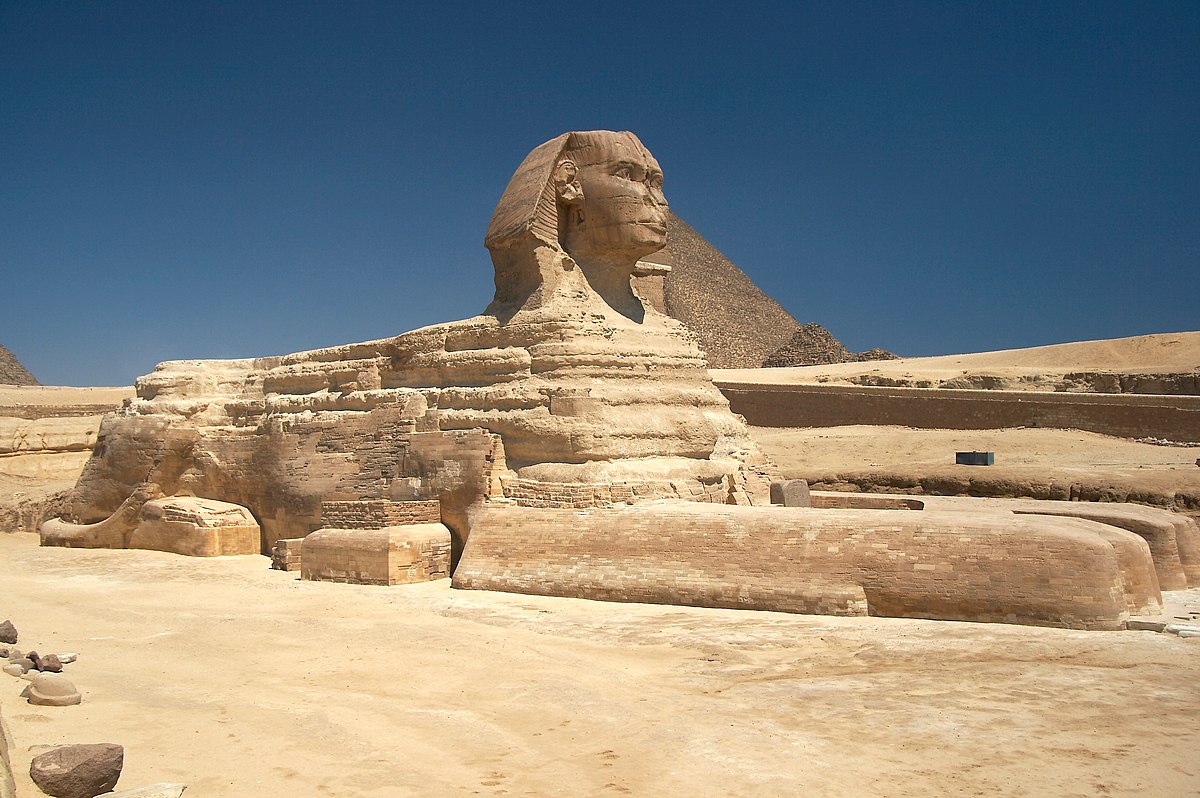
Between the massive forepaws of the Great Sphinx at Giza, a weathered slab of pink granite tells one of ancient Egypt's most captivating stories. The Dream Stele, erected by Pharaoh Thutmose IV around 1401 BC, records a miraculous vision in which the Sphinx itself appeared to a sleeping prince and promised him the throne of Egypt — on one condition.
The narrative inscribed on this stele blends royal propaganda with religious devotion, divine intervention with political legitimacy. It is the only known account of how a pharaoh justified his unexpected rise to power through a divine dream — and it transformed both the sacred status of the Sphinx and our understanding of how New Kingdom rulers constructed their public image for eternity.
Table of Contents
What Is the Dream Stele?
The Dream Stele — also known as the Sphinx Stele — is a large pink granite inscription standing approximately 3.6 metres tall, carved in the shape of a traditional round-topped Egyptian stela. It was erected by the New Kingdom pharaoh Thutmose IV, eighth ruler of the 18th Dynasty, and placed in a specially constructed chapel between the forepaws of the Great Sphinx at Giza around 1401 BC. It has remained in this dramatic setting for over three thousand years.
The stele records a royal dream experienced by Thutmose IV before he became pharaoh. In it, the Sphinx — identified as the solar deity Horemakhet ("Horus on the Horizon") — appeared to the sleeping prince and promised him dominion over all of Egypt if he would undertake one act of devotion: clear the desert sand that had gradually buried the Sphinx up to its neck. Thutmose fulfilled the promise, restored the monument, and memorialised the divine bargain in granite for all eternity.
History & Discovery
The Dream Stele's story unfolds across more than three millennia — from a Giza hunting ground in the New Kingdom to the excavations of modern archaeology. Here are the key events in its extraordinary journey.
Prince Thutmose, son of Amenhotep II, rests in the shadow of the half-buried Sphinx during a hunting expedition on the Giza plateau. In a deep sleep, the Sphinx manifests as the god Horemakhet and speaks directly to the prince, promising him the double crown of Egypt in exchange for clearing the sand that has buried the statue.
Upon his accession to the throne, Thutmose IV orders the massive sand clearance around the Sphinx — a monumental undertaking involving the removal of centuries of accumulated desert debris. Once the Sphinx is restored, he erects the pink granite stele between its paws to commemorate the divine promise and his act of piety.
The Sphinx enclosure becomes an increasingly important cult centre. The Dream Stele functions as a focal point for worship of Horemakhet, and the site attracts royal devotion through subsequent reigns. Later pharaohs, including Ramesses II, add their own images to the stele's base — appropriating its sacred authority for dynastic purposes.
Desert sand once again reclaims the lower body of the Sphinx. The Dream Stele is progressively buried as the Sphinx enclosure fills with sand over the following centuries, rendering the inscription inaccessible. The site remains in this state throughout the medieval period.
Italian explorer Giovanni Battista Caviglia conducts the first modern excavation of the Sphinx area, clearing sand from the chest of the statue and exposing the Dream Stele for the first time in many centuries. He makes the first modern record of the inscription, though his excavation is incomplete and the full text remains partially buried.
French engineer Émile Baraize leads a landmark decade-long excavation that fully exposes the Sphinx, the Sphinx enclosure, and the complete Dream Stele. His systematic clearance allows modern scholars to study and translate the full surviving text for the first time, firmly establishing the stele's content and historical significance.
The Dream Stele's physical journey — from proud royal monument to buried relic to fully excavated ancient text — mirrors the broader story of the Sphinx itself: a monument repeatedly swallowed by the desert and repeatedly restored by those who recognised its power.
The Stele: Form & Inscription
The Dream Stele was carved from pink Aswan granite — the same hard, durable stone used for obelisks and pyramid capstones — sourced from the famous quarries at Aswan in Upper Egypt. At approximately 3.6 metres tall, it dominates the space between the Sphinx's forepaws, set within a small chapel that Thutmose IV constructed specifically to house it. The chapel itself — built from mud brick with stone elements — has largely disappeared, but the stele remains upright in its original position.
The upper portion of the stele features a carved lunette scene — the characteristic curved top section standard in Egyptian stelae. This scene depicts Thutmose IV in the act of offering to the Sphinx-deity Horemakhet, shown in its combined form: a recumbent lion body with a human head wearing the royal nemes headdress and double crown of Egypt. Two cartouches frame the royal figure, identifying the king by his full throne name and personal name. The composition is formal and hieratic, following established conventions for scenes of royal devotion to a deity.
Below the lunette scene, the body of the stele is covered in horizontal lines of hieroglyphic text. Unfortunately, the lower third of the inscription is severely damaged — erosion, weathering, and the mechanical stress of centuries of burial have worn away much of the stone in this area. Approximately thirteen to fourteen lines survive in legible form, with additional fragments below. What remains is sufficient to reconstruct the core narrative of the dream, the divine speech of Horemakhet, and the record of Thutmose's restorative act — though the full conclusion of the text is lost.
The Dream: A Divine Promise
The surviving inscription tells its story with compelling directness. As a young prince, Thutmose was hunting on the Giza plateau — a royal pastime well suited to the open desert south of Memphis. In the midday heat, he sought rest in the shade of the enormous, sand-buried Sphinx and fell into a deep sleep. What followed was no ordinary dream.
The Divine Apparition
In his vision, the Sphinx manifested as the god Horemakhet — a solar deity associated with the rising sun and the liminal moment of dawn, identified in the inscription with Khepri, Ra, and Atum in their daily solar cycle. The god addressed Thutmose not as a subject but as a son, using the intimate paternal language that in Egyptian theology bound the pharaoh directly to the divine. He declared his affection for the prince and expressed his desire to be freed from the "sands of the desert" that covered him, blocking the free passage of his divine power.
The Royal Bargain
The terms of the divine commission were explicit and extraordinary. The Sphinx promised Thutmose "the sovereignty over all the land" and the white crown and the red crown — the dual symbols of rulership over Upper and Lower Egypt respectively. In exchange, Thutmose was to undertake the clearing of the sand and the restoration of the Sphinx to its full glory. This was not a vague divine blessing; it was a negotiated promise with specific obligations on both sides, recorded in permanent form for the eyes of gods and men alike.
Horemakhet — Solar Deity
The Sphinx was identified in the New Kingdom as Horemakhet ("Horus on the Horizon"), a solar god of the rising sun. The Dream Stele places Thutmose's kingship directly within this solar theology.
The Double Crown
The white crown of Upper Egypt and the red crown of Lower Egypt together symbolised complete pharaonic authority. The Sphinx's promise of both crowns was a promise of total, unified kingship.
The Sand Clearance
Sand from the Saharan plateau regularly buried the Sphinx over millennia. Thutmose's clearance was not the first or last — but it is the most famous, permanently recorded in durable pink granite.
Political Legitimacy
Thutmose IV was likely not his father's designated heir. The Dream Stele provided powerful divine justification for his kingship — a theologically sophisticated response to a potentially contested succession.
In Situ Setting
Positioned between the Sphinx's massive forepaws, the stele occupies one of the most dramatically framed positions of any monument in ancient Egypt — and remains there to this day.
Later Royal Additions
Scenes at the base of the stele attributed to Ramesses II show two royal figures in adoration — evidence of how later pharaohs appropriated the monument's sacred authority by adding their own images.
The Dream Stele is unusual in the entire ancient Egyptian record for the intimacy of its narrative. Most royal inscriptions celebrate military victories, territorial conquests, or colossal building projects. The Dream Stele records something altogether more personal — a sleeping prince, a voice from a god, and a bargain struck in the silence of a desert afternoon.
A Recurring Motif in Royal Theology
The motif of a ruler receiving divine instruction through a dream appears across ancient cultures, from the Biblical patriarchs to the kings of Mesopotamia and the oracular dreams of Greek heroes. Within Egypt itself, royal dream narratives are relatively rare in the surviving written record — which makes the Dream Stele one of the most significant and fully developed examples of this literary and theological genre in the entire ancient Egyptian corpus. Its influence can be felt in later New Kingdom royal inscriptions that similarly emphasise direct divine communication as a source of royal authority.
Key Figures & Context
The Dream Stele cannot be fully understood without knowing the people and forces that shaped it. Here are the essential figures in its story.
Thutmose IV (r. c. 1401–1391 BC)
The pharaoh who commissioned the Dream Stele and undertook the restoration of the Sphinx. Thutmose IV was the eighth pharaoh of the 18th Dynasty and son of Amenhotep II. His reign, though relatively short at approximately ten years, was significant for his diplomatic activities — including an early peace treaty with the powerful Mitanni kingdom of northern Syria, sealed by a royal marriage — and for extensive building works at Karnak. He is depicted in surviving statuary as a slender, refined figure wearing a distinctive blue war crown. The Dream Stele remains his most enduring legacy and the monument most closely associated with his name in the modern world.
The Great Sphinx of Giza
The monolithic limestone statue carved from the natural bedrock of the Giza plateau, most likely during the reign of Pharaoh Khafre (c. 2558–2532 BC) of the 4th Dynasty. Standing 20 metres tall and 73 metres long, it is the largest monolithic statue in the world. By the time of Thutmose IV, the Sphinx was already over a thousand years old and had accumulated enormous religious prestige as a manifestation of Horemakhet. Its face — oriented precisely towards the east — aligns with the rising sun at the spring and autumn equinoxes, a solar alignment that reinforced its identification with the solar cycle and the daily rebirth of the sun god Ra.
Horemakhet — Horus on the Horizon
The New Kingdom solar deity with whom the Great Sphinx was identified. Horemakhet ("Horus on the Horizon") represented the solar disc at the precise moment of rising — the liminal threshold between darkness and light, embodying the daily promise of renewal and rebirth. The Sphinx, positioned facing due east on the Giza plateau, was a natural physical embodiment of this theology. In the Dream Stele, Horemakhet speaks with the full authority of the sun god at its most primal — a creative, sovereign force that can bestow or withhold the gift of kingship.
Amenhotep II (r. c. 1427–1401 BC)
Thutmose IV's father and predecessor on the throne. Amenhotep II was one of the most physically powerful and militarily formidable pharaohs of the New Kingdom — celebrated in inscriptions as a champion archer, oarsman, and horseman who personally led campaigns into Syria-Palestine and Nubia. His designation of a crown prince is not definitively established in the surviving record, and several Egyptologists have proposed that Thutmose IV was not the originally intended heir, lending particular political weight to the Dream Stele's narrative of divine election.
Giovanni Battista Caviglia (1770–1845)
The Italian sea captain turned explorer who conducted the first modern scientific excavation of the Sphinx in 1817–1818. Working with local labourers, Caviglia cleared the sand from the chest of the Sphinx and exposed the Dream Stele, making the first modern record of its inscription. Although his excavation methods were rudimentary by today's standards and he lacked the scholarly framework to fully contextualise his findings, his work reintroduced the Dream Stele to European scholarship and directly prompted subsequent, more systematic investigations of the site.
Significance & Legacy
The Dream Stele is one of the most revealing documents of New Kingdom royal ideology. Unlike conventional battle inscriptions or temple dedications, it exposes the theological machinery by which pharaohs constructed and communicated their divine right to rule. The stele demonstrates that in ancient Egypt, legitimacy was not purely a matter of birth — it could be conferred, or confirmed, by direct divine communication. Thutmose IV's use of a dream narrative to justify his kingship is sophisticated political theology, and it succeeded: his dynasty continued unbroken through Amenhotep III and ultimately Amenhotep IV — the revolutionary pharaoh who would become Akhenaten.
The stele also illuminates the extraordinary religious longevity of the Sphinx as a sacred site. By Thutmose IV's time, the statue was already over a millennium old. The fact that it was so profoundly revered that a sitting pharaoh would undertake a massive desert-clearance operation — and memorialise it in the most durable material available — testifies to the enduring spiritual power the Sphinx commanded across the full sweep of ancient Egyptian civilisation, from the Old Kingdom through the New Kingdom and beyond.
Today, the Dream Stele stands in situ at one of the world's most visited archaeological sites, between the same paws of the same Sphinx that inspired it three and a half thousand years ago. Its physical survival — through desert burial, periodic flooding from rising groundwater, and the pressures of mass modern tourism — is remarkable. It remains a living monument in the most literal sense: not an object removed to a museum case, but a permanent inscription in the living rock of the Giza plateau, still doing exactly what Thutmose IV intended it to do.
Visitor Information
The Dream Stele is accessible to all visitors to the Giza Plateau as part of the standard site entry. Standing in front of it — between the Sphinx's enormous forepaws, with the pyramid of Khafre rising behind — is one of the most evocative experiences available anywhere in Egypt.
| Location | Between the forepaws of the Great Sphinx, Giza Plateau, Giza Governorate, Egypt |
|---|---|
| Opening Hours | Daily 8:00 AM – 5:00 PM (winter); 8:00 AM – 7:00 PM (summer). Hours subject to change during Ramadan and public holidays — verify before visiting. |
| Admission | Included with the standard Giza Plateau entry ticket. Separate tickets required for pyramid interiors. International and Egyptian rates differ. |
| Getting There | Approximately 13 km southwest of central Cairo. Accessible by taxi, Uber, or guided tour. Nearest metro station: Giza (Line 2), taxis available from there. |
| Best Time to Visit | Early morning at opening (8:00 AM) for smaller crowds and soft light. October through April offers the most comfortable temperatures for outdoor exploration. |
| Photography | Personal photography of the Sphinx and Dream Stele is permitted from the designated viewing areas. Commercial photography requires a separate permit. |
| Guided Tours | Strongly recommended — a qualified Egyptologist guide provides essential context for the stele's inscription and its meaning within New Kingdom royal theology. |
| Accessibility | The Giza Plateau involves uneven terrain and sandy paths. The Sphinx enclosure area has limited accessibility for mobility-impaired visitors. |
| Nearby Sites | The three Great Pyramids (Khufu, Khafre, Menkaure), the Valley Temple of Khafre, the Solar Boat Museum, and the Grand Egyptian Museum (a short drive away) |
| What to Bring | Water, sun protection (hat and sunscreen), comfortable closed-toe shoes suitable for sandy terrain, and a camera with a zoom lens for inscription details |
Tips for Your Visit
Arrive at the Giza Plateau gates at opening time (8:00 AM) to experience the Sphinx enclosure in relative quiet — the Dream Stele can draw large crowds by mid-morning during the main tourist season. Standing directly before the stele, you can read the surviving hieroglyphic columns at close range and study the carved lunette scene of Thutmose IV offering to Horemakhet. Bring a zoom lens or binoculars to better appreciate the upper carved scene. Allow at least three to four hours for a thorough visit to the full plateau, and consider combining your visit with the interior of the Valley Temple of Khafre — one of the finest surviving examples of Old Kingdom stone architecture in Egypt.
Who Should Visit?
The Dream Stele is unmissable for anyone drawn to the intersection of religion, mythology, and political power in the ancient world. It is equally rewarding for seasoned Egyptologists and first-time visitors to Egypt. Families will find the dream narrative genuinely accessible — it is, at its core, one of the oldest stories of a divine bargain in recorded human history. For those with an interest in ancient writing, the hieroglyphic inscription provides an excellent close-up study of New Kingdom script style and royal titulary in a spectacular natural setting.
Pair Your Visit With
Directly adjacent to the Dream Stele, the Valley Temple of Khafre offers an extraordinary encounter with Old Kingdom granite architecture and the surviving statue of Khafre protected by the hawk-god Horus. The Grand Egyptian Museum (GEM) in Giza, a short drive from the plateau, houses artefacts from across the full sweep of pharaonic history including objects from the 18th Dynasty. In Cairo, the Egyptian Museum on Tahrir Square holds statues, stelae, and funerary objects associated with Thutmose IV's reign and those of the pharaohs who preceded and followed him. Together, these sites paint a comprehensive picture of the New Kingdom world in which the Dream Stele was created.
Frequently Asked Questions
Where is the Dream Stele located?
Who erected the Dream Stele and why?
What does the Dream Stele say?
Was Thutmose IV really not the intended heir to the throne?
What material is the Dream Stele made from?
Can visitors see the Dream Stele today?
Sources & Further Reading
The following authoritative sources were consulted in the preparation of this article.