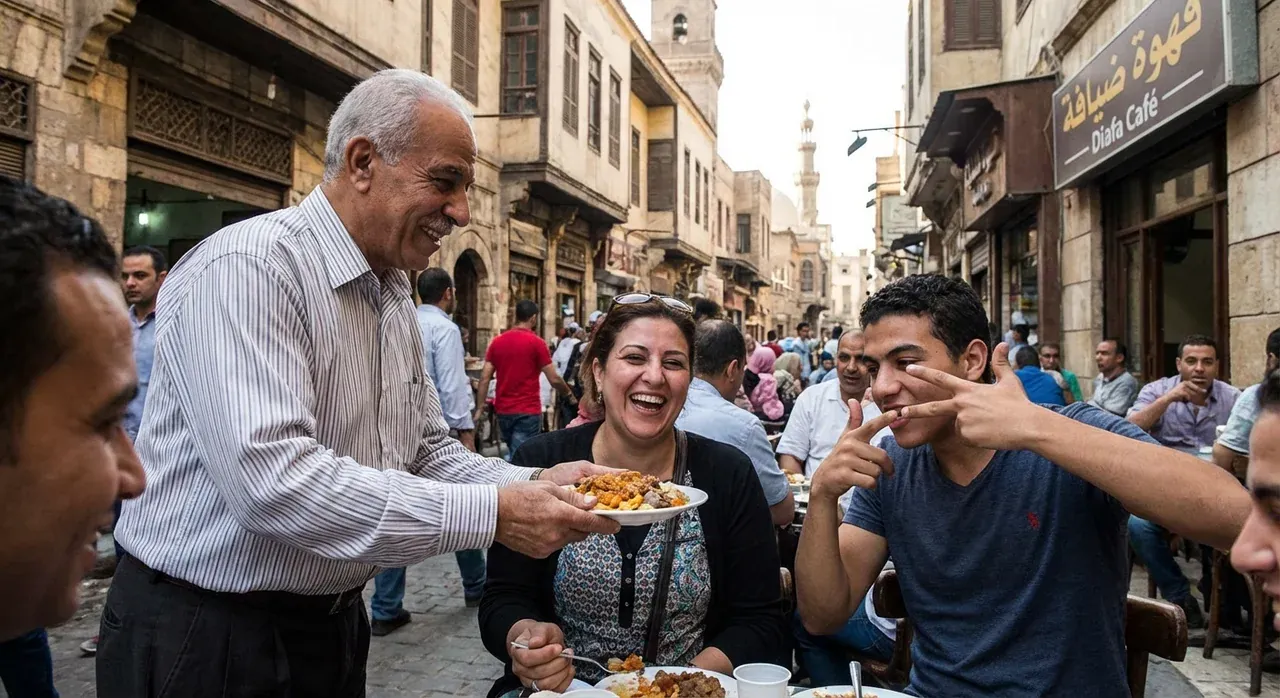
1. The Primacy of the Family & Intergenerational Solidarity
In Egyptian society, the individual does not exist in isolation; the fundamental building block of identity, honor, and security is the extended family (Al-A'ela).
Unlike Western models of nuclear independence, Egyptian social structures remain deeply communal and intergenerational. Grandparents, parents, children, aunts, uncles, and cousins form an interconnected support network that guides daily decision-making, career milestones, and marital unions:
- Reverence for Elders (Birr Al-Walidayn): Respect for elderly parents and grandparents is an inviolable moral and spiritual imperative. Nursing homes are culturally rare; elderly relatives typically reside within the family household, where their counsel is sought for major family decisions and their care is considered a sacred duty;
- Multigenerational Housing: In both urban neighborhoods and agrarian villages, family apartment buildings (where siblings and their families occupy separate floors within the same ancestral property) remain the cultural norm, preserving daily proximity and mutual childcare;
- Marriage as an Alliance of Families: Matrimony in Egypt is seen not simply as a union between two individuals, but as the merging of two family networks. Elaborate engagement rituals, household preparations (Gihaz), and multi-day wedding celebrations involve extensive inter-family coordination and collective financial investment.
2. Cultural & Religious Harmony: Muslim-Coptic Coexistence
Egypt is home to the largest Christian community in the Middle East—the Coptic Orthodox Church—which traces its apostolic lineage to Saint Mark the Evangelist in Alexandria in the 1st century AD.
Rather than living in segregated sectarian silos, Egyptian Muslims (approx. 85–90%) and Coptic Christians (approx. 10–15%) share an identical cultural DNA, dialect, culinary heritage, national pride, and social customs refined over fourteen centuries of shared history:
During religious holidays, neighbors routinely exchange traditional greetings and sweets: Muslims share holiday meat from Eid al-Adha with Christian neighbors, while Copts share festive baked goods (Kahk) during Easter and Christmas, exemplifying spontaneous grassroots harmony.
3. The Ethos of Karam (Sacred Hospitality) & Social Warmth
If there is a universal defining trait of Egyptian society, it is the concept of Karam (الكرم - Generosity and Sacred Hospitality).
In Egyptian culture, welcoming a guest is not an optional courtesy; it is an ancient, almost sacred obligation rooted in Bedouin, agrarian, and Islamic traditions where a guest is considered an honored blessing upon the household:
- The Obligatory Invitation (Al-Wagib): Refusing to offer food, tea, or coffee to a visitor—regardless of the host's financial standing—is considered a profound social failing (Ayb). Even in the humblest rural hamlets, hosts will butcher their finest poultry or prepare lavish feasts for guests;
- The Ritual of "Etfaddal": The ubiquitous Arabic phrase "Etfaddal" (Please, be my guest / Do me the honor) accompanies every interaction, whether offering a seat on public transit, inviting a colleague to share a meal, or a shopkeeper offering mint tea before business discussions;
- Warmth Toward Strangers: International travelers frequently note that asking for directions in Egypt rarely results in a simple point of the finger; it often leads to a local resident walking several blocks with the visitor, introducing them to local shopkeepers, or extending an invitation into their home for mint tea.
4. Shared Seasons: Ramadan, Eid, Christmas & Sham El-Nessim
The rhythms of Egyptian social life are dictated by a vibrant calendar of spiritual festivals, seasonal holidays, and shared cultural celebrations:
The Magic of Egyptian Ramadan
Nowhere in the Islamic world is the holy month of Ramadan celebrated with the unique communal exuberance seen in Egypt. Streets are decorated with colorful geometric paper banners (Zina) and brass stained-glass lanterns (Fanous). Every evening at sunset, communal charity banquets (Mawa'id Al-Rahman) line public sidewalks, offering free, nutritious hot meals to thousands of laborers and passersby, funded by local neighborhood donations.
Sham El-Nessim: The 4,500-Year-Old Spring Rite
Celebrated annually on the Monday immediately following Eastern Christian Coptic Easter, Sham El-Nessim (شم النسيم) is an unbroken cultural holiday inherited directly from ancient pharaonic harvest festivals (the feast of Shemu).
5. Community Solidarity & Grassroots Support (Gam'eya)
In the absence of Western-style commercial credit and institutional social safety nets, Egyptian society developed sophisticated indigenous grassroots financial systems that reflect deep communal trust:
- The "Gam'eya" (الجمعية - Rotating Savings and Credit Association): A traditional informal financial mechanism widely practiced across all social strata. A trusted circle of neighbors, relatives, or coworkers contribute a fixed sum monthly into a shared pool, with one member taking the entire lump sum each month to fund weddings, purchase appliances, or cover medical emergencies, functioning with zero interest rates based purely on communal honor;
- The Neighborhood Watch & Chivalry (Al-Gad'ana): Local residential alleys (Al-Hara) maintain an unspoken code of chivalry where young men (Gada'an) protect the neighborhood, escort elderly neighbors, and resolve disputes through local reconciliation councils (Magalis Urfiyya);
- Institutional Philanthropy (Resala, Orman, Misr El-Kheir): Massive domestic charity foundations powered by millions of volunteer hours and private charitable endowments (Zakat and Sadaqah), financing orphanages, rural water piping, and free cancer hospitals (such as Hospital 57357).
6. Egyptian Humor (Ibn El-Balad & Nukta) as Resilience
Sociologists universally recognize humor (Al-Nukta) as the primary psychological defense mechanism, cultural currency, and intellectual signature of the Egyptian people.
Known historically as Ibn El-Balad (the authentic, street-smart son of the country), Egyptians possess a legendary capacity for quick-witted banter, self-deprecating irony, and political satire:
- The Joke as Social Commentary: Major political events, economic hardships, and global crises are processed across Egypt within minutes through viral jokes and witty memes that circulate through street cafes, taxis, and digital channels;
- The Lightness of Spirit (Dammo Khafeef): Being described as possessing "light blood" (Dammo Khafeef) is the highest compliment an Egyptian can receive, denoting someone who brings joy, laughter, and ease into social gatherings, whereas a dull or pompous individual is critiqued as having "heavy blood" (Dammo Teqeel);
- Conversational Warmth: Conversations with shopkeepers, taxi chauffeurs, and waiters are rarely transactional; they are almost universally punctuated by jokes, theatrical expressions of affection, and shared laughter that instantly breaks interpersonal barriers.
7. Regional Subcultures: Nubians, Bedouins, Sa'idis & Fallahin
While bound together by a unified national identity, Egyptian society encompasses distinct regional subcultures shaped by geography, dialects, and historical lifestyles:
The Sa'idis (Upper Egypt)
Inhabiting the Nile Valley south of Cairo to Aswan, the people of Upper Egypt (Al-Sa'id) are celebrated for intense familial loyalty, traditional codes of honor (Sharaf), chivalry, and stoicism. They maintain traditional attire (the wide linen Galabeya and turban) and historic martial stick-dancing rituals (Tahtib).
The Fallahin (Delta Peasantry)
The agrarian heart of Lower Egypt, the Fallahin represent the direct continuity of ancient Egyptian riverine agriculture, characterized by deep attachment to the black soil of the Delta, communal harvesting traditions, and warm pastoral folklore.
The Nubians (Southern Frontier)
Native to the Nile Valley between Aswan and Sudan, the Nubian people maintain distinct spoken languages (Nobiin and Kenuzi-Dongola), vibrant dome-and-vault whitewashed architecture painted in bright geometric patterns, and deep spiritual veneration for the Nile crocodile as an emblem of resilience.
The Bedouins (Sinai & Western Oases)
The tribal communities of the Sinai Peninsula, the Red Sea mountains, and the Western Desert oases (Siwa, Bahariya) preserve traditional nomadic customary law (Urf), intricate camel-breeding lore, herbal desert medicine, and celebrated oral poetry.
8. Societal Norms & Cultural Demographics Matrix
The following matrix details the primary subcultures, geographic heartlands, cultural characteristics, and signature values across Egyptian society:
| Subcultural Group | Geographic Region | Defining Cultural Signature | Signature Social Values |
|---|---|---|---|
| Cairenes & Urbanites | Greater Cairo / Giza | Fast-paced, cosmopolitan, tech-savvy street cafe culture. | Neighborly solidarity, rapid wit, civic resilience. |
| Sa'idi (Upper Egyptians) | Upper Nile (Beni Suef to Aswan) | Traditional Galabeya, Tahtib stick martial art, tribal lineage. | Fierce familial honor, absolute hospitality, loyalty. |
| Fallahin (Delta Farmers) | Nile Delta (Lower Egypt) | Riverine agriculture, agrarian folk poetry, communal feasts. | Love of the soil, generational patience, generosity. |
| Nubians | Aswan & Lake Nasser | Nubian languages, painted domed architecture, vibrant music. | Artistic pride, communal harmony, gentle hospitality. |
| Sinai & Coastal Bedouins | Sinai Peninsula & Red Sea | Tribal council arbitration (Urf), desert tracking, herbal lore. | Absolute guest protection, desert honor, independence. |
| Alexandrians (Iskandarani) | Mediterranean Coast | Cosmopolitan maritime heritage, distinct dialect cadence. | Mediterranean openness, maritime warmth, relaxed humor. |
9. Women in Contemporary Egyptian Society & Evolution
Egyptian women have historically occupied central roles in family leadership and nation-building—from ancient female pharaohs like Hatshepsut to feminist pioneers like Hoda Sha'arawi in the early 20th century.
In contemporary Egypt, women are driving massive economic, academic, and legislative progress:
- Higher Education Parity: Women now constitute over 54% of all university graduates in Egypt, achieving dominant representation across faculties of Medicine, Dentistry, Pharmacy, Engineering, and Languages;
- Constitutional & Judicial Representation: Under recent constitutional reforms, women hold a guaranteed 25% quota in the Egyptian Parliament and were formally appointed for the first time in history as judges to the State Council and the Public Prosecution;
- The National Council for Women (NCW): Spearheading legal protections against domestic violence, digital harassment, and forced marriage, while financing rural women's financial inclusion through digital microfinance and handicrafts cooperatives;
- The Matriarchal Pillar (Sitt Al-Habayeb): Within the domestic realm, the mother and grandmother remain the revered spiritual emotional center of the household, commanding immense authority over family finances, children's education, and moral direction.
10. Cultural Etiquette & Immersion Guidelines for Travelers
Navigating Egyptian society with cultural respect, emotional intelligence, and etiquette unlocks an unparalleled depth of warmth and friendship from local citizens.
Operating under Ministry License #874 (Class A), Ultra Egypt Travel advises international guests on essential cultural protocols:
- Dress Sensibility: While resort enclaves (Sharm El Sheikh, Hurghada, El Gouna) welcome casual beachwear, modest attire (covering shoulders and knees) is deeply appreciated when visiting historical urban residential districts, markets, and rural townships, and is mandatory (with head coverings for women) when entering active mosques and historic churches;
- Accepting Hospitality: When offered tea or coffee, it is polite to accept with a warm smile. Placing your right hand over your heart while saying "Shukran" (Thank you) is a universal Egyptian gesture of heartfelt gratitude;
- Photography Etiquette: Always ask permission before photographing individuals, especially women and elderly citizens in traditional attire. Respecting personal privacy fosters instant trust and warm interactions;
- The Body Language of Respect: Avoid pointing the soles of your shoes directly at others when seated, use your right hand for eating and handing items, and accord visible deference and polite greetings to elderly individuals in public spaces.