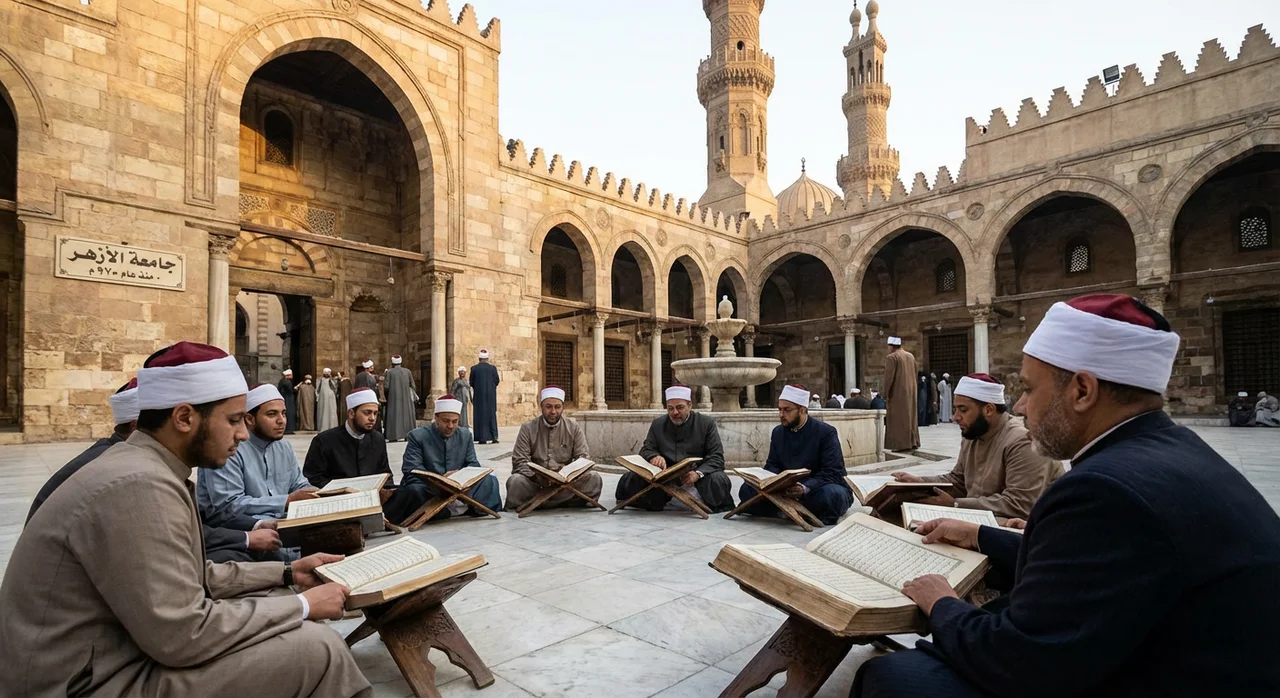
1. Al-Azhar University: A Millennium of Scholasticism
Founded in Cairo in 970 AD by the Fatimid Caliphate alongside the Al-Azhar Mosque, Al-Azhar University (جامعة الأزهر) stands alongside the University of al-Qarawiyyin in Morocco as one of the oldest degree-granting academic institutions in the world.
Throughout the Middle Ages, Al-Azhar served as the intellectual sanctuary where Islamic theology, Arabic philology, astronomy, philosophy, and mathematics were cataloged, debated, and preserved through catastrophic historical disruptions such as the Mongol sack of Baghdad.
In 1961, under President Gamal Abdel Nasser, Al-Azhar underwent a structural modernization that integrated secular professional colleges alongside its traditional theological faculties:
- Dual Academic Architecture: Al-Azhar educates over 450,000 students across faculties of Medicine, Civil Engineering, Agriculture, Pharmacy, and Computer Science, alongside its venerable faculties of Islamic Jurisprudence (Sharia), Theology (Usul al-Din), and Arabic Language;
- Global Scholastic Magnet: The university hosts over 30,000 international scholars from more than 100 countries across Africa, Southeast Asia (Indonesia, Malaysia), Europe, and Central Asia, studying under full academic scholarships;
- Al-Azhar Primary & Secondary Network: Manages an independent parallel national K-12 schooling system educating over 2 million Egyptian pupils, combining the standard national curriculum with religious literacy and classic Arabic scholarship.
2. Secular Higher Education: Cairo University & Public Campuses
The birth of modern secular higher education in the Arab world traces directly to the establishment of the Egyptian University (now Cairo University - جامعة القاهرة) in December 1908.
Spearheaded by Egyptian national intellectuals and royal patrons (notably Princess Fatma Ismail, who donated land in Giza), Cairo University introduced modern scientific inquiry, liberal arts, and European university traditions to the Nile Valley:
- Intellectual Pioneers: Cairo University served as the academic cradle for Nobel laureates Naguib Mahfouz (Literature) and Mohamed ElBaradei (Peace), international jurists, and prime ministers across the Arab world;
- The Public University System: Expanded into a network of 28 comprehensive public universities across all Egyptian governorates:
• Ain Shams University (Cairo): Built on the historic palace grounds of Zaafarana, renowned for its Faculty of Medicine and engineering research;
• Alexandria University: Anchoring Mediterranean scientific, marine biology, and maritime engineering scholarship;
• Assiut, Mansoura, and Zagazig Universities: Regional research powerhouses renowned globally for specialized organ transplantation, nephrology, and agricultural pathology.
3. Educational Reform: Education 2.0 & EKB
To address memorization-based legacy testing and prepare youth for digital knowledge economies, Egypt launched Education 2.0 (Edu 2.0) under the Ministry of Education and Technical Education:
Core components of the K-12 modernization include:
- Curriculum Redesign: Complete transition in kindergarten and primary grades to multidisciplinary, skills-based learning focusing on critical thinking, coding, empathy, and mathematical logic;
- Secondary School Digitization: Distributing over 2.5 million cellular-connected tablet devices to secondary students nationwide, replacing printed textbooks with interactive digital simulations and open-book assessments;
- Reform of the "Thanaweya Amma": Overhauling the high-stakes general secondary examination system by introducing computerized test banks, national automated grading, and questions measuring analytical comprehension rather than rote memory.
4. Private & Non-Profit Universities (AUC, GUC, BUE)
Alongside public universities, Egypt hosts an internationally accredited ecosystem of private and non-profit universities offering Western-style curricula:
- The American University in Cairo (AUC): Founded in 1919 in Tahrir Square and relocated in 2008 to a 260-acre campus in New Cairo. Accredited in the United States by MSCHE, AUC is Egypt's leading liberal arts and scientific research university, housing extensive archival libraries, business incubators, and fine arts centers;
- The German University in Cairo (GUC): Established in 2002 in partnership with the state universities of Ulm and Stuttgart, GUC is the largest transnational German educational institution outside Germany, educating over 12,000 students in engineering, pharmacy, and design;
- The British University in Egypt (BUE): Founded in 2005 in El-Sherouk City under UK university validation agreements (London South Bank University), offering British honors degrees across engineering, political science, and law;
- Modern National Universities (Ahlia Universities): Non-profit public spin-off campuses—such as King Salman International University in Sinai, Galala University, and New Mansoura University—built to reduce pressure on public universities while providing specialized programs in renewable energy, artificial intelligence, and aerospace.
5. Specialized Research Centers: Zewail City & E-JUST
To reverse brain drain and anchor national scientific innovation, Egypt established dedicated postgraduate and research institutions:
- Egypt-Japan University of Science and Technology (E-JUST): Established in New Borg El Arab (Alexandria) through bilateral cooperation between the Egyptian and Japanese governments (JICA). It integrates Japanese engineering laboratory culture (Kenkyushitsu) with practical industrial innovation;
- Nile University (NU): Egypt's first non-profit research university focusing on computer engineering, microelectronics, and technological entrepreneurship;
- The National Research Centre (NRC): Located in Dokki, Cairo, spanning over 4,000 research scientists across medical, chemical, and agricultural laboratories.
6. STEM Boarding Schools for the Gifted
To cultivate elite national talent in mathematics and natural sciences, Egypt partnered with the U.S. Agency for International Development (USAID) to launch a specialized network of STEM Schools for the Gifted (مدارس المتفوقين في العلوم والتكنولوجيا):
Operating over 20 residential high school campuses across Egypt (in 6th of October, Maadi, Alexandria, Kafr El-Sheikh, Luxor, and Assiut):
- Rigorous Merit Admissions: Students must score above 98% on preparatory certificate exams and pass national psychometric assessments in spatial reasoning and scientific aptitude;
- Capstone Problem-Solving Curriculum: Ditching traditional curricula, students work in teams on semester-long engineering projects addressing national developmental challenges—such as water desalination, agricultural pest eradication, renewable energy storage, and urban congestion;
- Global Academic Dominance: Egyptian STEM school graduates routinely win top honors at the Intel/Regeneron International Science and Engineering Fair (ISEF) and earn full scholarships to universities including MIT, Harvard, Stanford, and Oxford.
7. Applied Technology & Dual Vocational Education
Historically, vocational education in Egypt suffered from outdated curricula disconnected from industrial labor market realities.
To bridge this gap, the Ministry of Education introduced Applied Technology Schools (مدارس التكنولوجيا التطبيقية) under a public-private partnership (PPP) model:
- Corporate Partnerships: Schools are jointly managed with industrial corporations (such as Elsewedy Electric, Ghabbour Auto, WE Telecom, Siemens, and Arab Contractors);
- Dual-Track Education: Students split their time between theoretical engineering classrooms and real manufacturing factory floors, receiving competitive student stipends;
- International Certification: Graduates receive dual diplomas certified by international accreditation bodies (from Germany, the UK, and Italy), guaranteeing employment upon graduation in precision mechanics, solar maintenance, fiber-optics, and automated robotics;
- Technological Universities (الجامعات التكنولوجية): The establishment of ten specialized public technological universities (in New Cairo, Beni Suef, Delta, and 6th of October) enabling vocational graduates to pursue Bachelor's and Master's degrees in technology without academic dead-ends.
8. International Branch Campuses (IBCs) in the New Capital
Under Law No. 162 of 2018, Egypt established an international higher education district within the New Administrative Capital, inviting foreign universities to open physical branch campuses:
Operational branch campuses in the New Capital include:
- The Knowledge Hub Universities (TKH): Hosting Coventry University (UK) and NOVA University Lisbon (Portugal);
- European Universities in Egypt (EUE): Hosting the University of London (with academic direction from LSE, King's College, and UCL) and the University of Central Lancashire (UCLan);
- Universities of Canada in Egypt (UofCanada): Hosting the University of Prince Edward Island (UPEI) and Toronto Metropolitan University (formerly Ryerson);
- German International University (GIU): An applied sciences university founded in the New Capital in partnership with German partner universities.
9. Comprehensive Academic Institutions Matrix
The following matrix details Egypt's prominent higher education institutions, foundation dates, specializations, and global character:
| Academic Institution | Foundation Year | Institutional Model | Core Scholastic Excellence & Recognition |
|---|---|---|---|
| Al-Azhar University | 970 AD | Historic Public / Religious | Oldest Islamic scholastic hub; 30,000+ international students from 100+ countries. |
| Cairo University | 1908 | Comprehensive State Public | Premier secular university in MENA; Nobel alumni; medicine, engineering & law. |
| American University in Cairo (AUC) | 1919 | Private US-Accredited | Liberal arts, business (AACSB), Middle East studies, New Cairo smart campus. |
| Ain Shams University | 1950 | Comprehensive State Public | Historic Zaafarana Palace; specialized medical, pediatric, and engineering hubs. |
| German University in Cairo (GUC) | 2002 | Private Transnational | Engineering, pharmacy, mechatronics; largest German campus outside Germany. |
| Zewail City of Science | 2011 | Special Research Institute | National renaissance project; nanotechnology, biomedical engineering & physics. |
| E-JUST (Alexandria) | 2010 | Bilateral State Research | Japanese laboratory model; applied robotics, mechatronics, material science. |
| New Capital IBCs | 2018+ | International Branch Hub | Law 162/2018 hosting Coventry, University of London, UPEI, and GIU. |
10. Academic Delegations & Educational Travel Services with Ultra Egypt Travel
Egypt’s deep academic heritage and ongoing higher education transformation make it a premier destination for university study-abroad programs, faculty research delegations, and academic conferences.
Operating under Ministry of Tourism License #874 (Class A) and IATA Accreditation #90229930, Ultra Egypt Travel delivers specialized educational travel management:
- Academic Study-Abroad Programs: Designing tailored educational itineraries for international universities (departments of History, Archaeology, Anthropology, Middle East Studies, Architecture, and Civil Engineering);
- Official University Permissions & Site Access: Securing specialized academic permits from the Ministry of Tourism and Antiquities for off-limits archaeological excavations, closed tombs in Luxor and Saqqara, and university library archives;
- Scholarly Lecturers & Academic Guides: Providing university groups with licensed Egyptologists holding Master's and PhD degrees from Cairo and Helwan universities, capable of conducting academic field lectures;
- Conference & Symposium Logistics: Full ground management for international academic symposiums, university faculty exchanges, and student group accommodations across Cairo, Alexandria, Luxor, and Aswan.