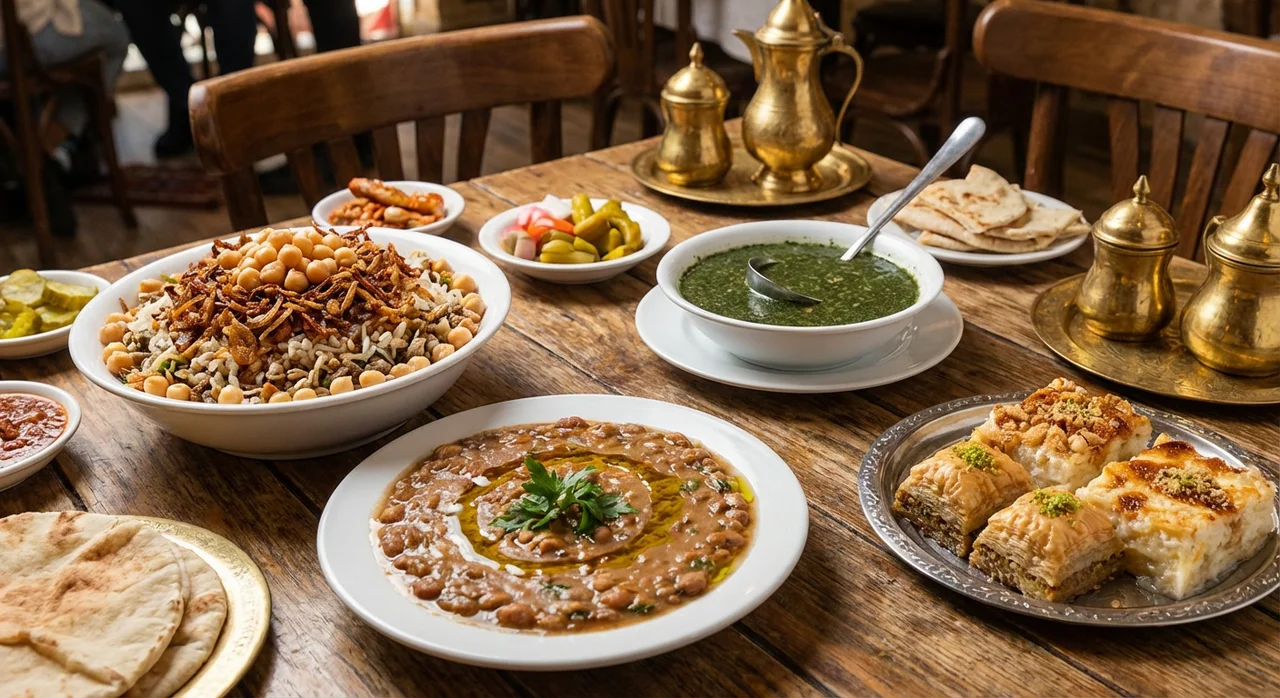
1. "Bread and Salt" (Aish wa Malh): The Moral Compact of Food
In Egyptian civilization, sharing food is an inviolable ethical covenant. When two individuals share a meal, they are said to have entered into "Aish wa Malh" (بيننا عيش وملح — "Between us is Bread and Salt"):
- The Sacred Covenant: To break bread with someone creates a lifelong moral duty of non-aggression, mutual protection, and honesty. To betray a person after sharing bread and salt with them is considered one of the gravest social transgressions (Khayanet al-Aish wal-Malh);
- The Cultural Root of Karam (الكرَم): Egyptian hospitality is not performative; it is a spiritual obligation. When visitors enter an Egyptian home or commercial workshop, they are instantly offered refreshments. The universal phrase "Nawwart Masr" ("You have brought light to Egypt") is accompanied by immediate offerings of hot mint tea, Turkish coffee, or seasonal fresh juices.
2. The Tabliya Tradition: Communal Round Table Gastronomy
In traditional rural villages across the Nile Delta and Upper Egypt, as well as historic working-class urban quarters, family meals are anchored around the Tabliya (الطبلية):
A low, circular wooden table resting just 30 to 40 centimeters above the floor. Family members and honored guests sit cross-legged on woven floor mats or cushions around its perimeter. Because the table is round, there is no "head" of the table; every diner sits at an equal distance from the central serving platters, creating intimacy, shared conversation, and collective dining.
- Center-Out Sharing: Main dishes—such as clay tagines, large platters of rice with roasted lamb, or bowls of Molokhia—are placed in the direct center. Diners eat from the section of the communal platter immediately in front of them rather than reaching across others;
- Modern Dining Evolution: In contemporary urban Cairo and Alexandria homes, European-style high dining tables are common, yet the practice of placing communal bowls and shared platters in the center remains universal.
3. Aish Baladi Etiquette: Reverence & "Cat's Ears" (Wedn al-Qitta)
Nowhere is Egyptian food symbolism more evident than in the handling of bread. As explored throughout Egyptian cuisine, bread is called Aish (Life):
- The Folding Technique ("Cat's Ears" — ودن القطة):
• Rather than using metal forks and knives, diners tear off a palm-sized quarter of warm Aish Baladi;
• The piece of bread is folded between the thumb, index, and middle finger to form a small, triangular scoop resembling a cat's ear;
• This edible scoop is used to pinch chunks of meat, scoop up Ful Mudammas, or mop up viscous Molokhia soup cleanly without fingers touching the food; - Reverence for Bread:
• Bread is never thrown casually into trash bins. If a crust falls to the floor, an Egyptian will gently pick it up, press it to their lips, touch it to their forehead in a gesture of grateful reverence (Bouset al-Ne'ma), and place it on an elevated ledge for birds;
• Never cut Aish Baladi with a knife at a home table; tearing it by hand reflects brotherhood and warmth.
4. Hand Etiquette: The Right-Hand Rule & Cleanliness Rituals
Centuries of hygienic and religious tradition govern physical movement at the Egyptian table:
- The Absolute Primacy of the Right Hand:
• Diners must always eat, tear bread, take food from shared platters, and accept beverages using the right hand;
• In Arab and Islamic tradition, the left hand is reserved for personal bodily hygiene and is considered culturally unclean for eating or passing food;
• If you are left-handed, polite hosts will understand when explained in advance, but making an effort to use the right hand for passing shared items is deeply appreciated; - Pre-Meal Handwashing: In traditional homes and rural banquets, a host or young family member will circulate before the meal carrying a brass pitcher (Ibreeq), basin (Tasht), soap, and a clean towel for every guest to wash their hands at the table;
- Bismillah & Alhamdulillah: Meals traditionally commence with the blessing "Bismillah" ("In the name of God") and conclude with "Alhamdulillah" ("Praise be to God").
5. Navigating an Egyptian 'Ozouma: Banquets & Insistent Seconds
Being invited to an Egyptian family banquet—known as an 'Ozouma (عزومة)—is an extraordinary cultural experience requiring knowledge of specific social choreography:
Egyptian hosts consider it their sacred duty to ensure guests eat until completely stuffed. The host will repeatedly swear oaths (Yihlef bil-Talaq or W'Allahi) insisting you take more pigeon, another serving of Mahshi, or extra lamb shank. This is not pushiness; it is genuine affection and fear that a guest might remain hungry.
- The Protocol of Polite Refusal:
• If you genuinely cannot eat another bite, polite custom requires you to praise the cooking enthusiastically ("Tislam Eideki" — "Bless your hands" to the cook);
• Refuse gently two or three times before taking a token final forkful;
• Always leave a tiny, polite morsel of food on your plate at the conclusion of the meal. A completely clean, scraped plate can signal to a traditional host that they failed to provide enough food! - Guest Gifts: Never arrive at an Egyptian home empty-handed. The proper gift is a box of high-quality oriental pastries (Baklava, Basbousa, Konafa) or fresh seasonal fruits (mangoes in summer, oranges in winter) from a reputable patisserie.
6. The Rituals of Tea & Coffee: The Welcoming Sip to Parting Cup
In Egypt, beverages bookend every social interaction with rhythmic formality:
- Wagib al-Diyyafa (The Welcome Offering): Upon arrival, guests are seated and immediately offered a choice of drink. Never decline this initial beverage outright, as doing so rejects the host's hospitality. Accepting a simple cup of water or tea honors the home;
- The Post-Meal Shay (Tea Ritual):
• Immediately following lunch or dinner, hot sweet black tea (Shay Koshary) is served in small clear glass tumblers, heavily infused with fresh mint leaves (Na'na);
• The tea aids digestion and signals the transition to relaxed post-meal conversation; - Ahwa Etiquette:
• When Turkish-style Egyptian coffee (Ahwa) is prepared, hosts will always ask your sugar level in advance: Sada (black, zero sugar), Ariha (slight sweetness), Mazboot (medium, 1 spoon), or Ziyada (sweet dessert style);
• The coffee is poured slowly into small cups to preserve the thick, golden foam crown (Wesh). A coffee served without a rich foam crown is considered a social faux pas by traditional hosts.
7. Ramadan Feasting: Iftar Cannons & Mawa'id al-Rahman Street Tables
During the Islamic holy month of Ramadan, Egypt transforms into the world's most vibrant communal dining landscape:
- The Midfa' al-Iftar (The Sunset Cannon): For centuries, Cairo's historic artillery cannon at the Citadel of Saladin fired at sunset, signaling the end of the dawn-to-dusk fast across the city;
- Breaking the Fast: Families break the fast with a sip of water, dried dates soaked in milk, and chilled glasses of Amar al-Din (apricot nectar) or hibiscus Karkadeh before performing sunset prayers and gathering for the grand family feast;
- Mawa'id al-Rahman (Tables of Mercy — موائد الرحمن):
• Long communal banquet tables set up across city sidewalks, alleys, and mosque squares, sponsored by local philanthropists, merchants, and neighborhood families;
• Hundreds of thousands of free, hot meals (roast chicken, beef stew, rice, salad, bread, and sweets) are served every sunset to passersby, laborers, travelers, and the poor alike, embodying the pinnacle of Egyptian communal generosity.
8. Street Food Manners: Eating at Carts, Koshary Counters & Juice Bars
Navigating Egypt's dynamic street food landscape has its own unwritten etiquette:
- Standing at the Ful Cart (Ettiket al-Arabiya):
• Morning workers cluster shoulder-to-shoulder around wooden fava-bean carts;
• Diners eat standing up, tearing bread and dipping into small metal bowls while the cart master (El-Usta) refills plates;
• Personal space is condensed; politely squeeze in, greet fellow diners with "Sabah al-Kheir" (Good morning), and eat with your right hand; - Koshary Parlor Customs:
• Koshary halls are fast-paced, multi-story urban institutions;
• You order by bowl size (Small, Medium, Large); the metal bowl arrives scalding hot;
• Customers customize their own bowl at the table using stainless-steel cruets of Da'ah (garlic-vinegar dressing) and Shattah (fiery chili oil);
• Clanking your spoon rapidly against the bottom of the bowl is the universal Cairo signal that you have thoroughly mixed all five layers; - Asab (Sugarcane) Stalls: Drink freshly pressed sugarcane juice on the spot standing at the marble counter while it remains frothy green; sugarcane juice oxidizes and turns brown within twenty minutes if left standing.
9. Tipping (Baksheesh) Protocol in Restaurants & Cafes
Tipping in Egypt—known as Baksheesh (بقشيش)—is not an exceptional luxury; it is an organic, expected mechanism of wealth distribution and appreciation for personal service:
- Sit-Down Restaurants:
• Bills in formal Egyptian restaurants typically include a 12% service charge plus 14% VAT;
• However, the 12% service charge goes directly to the restaurant establishment, not to the individual waiter;
• Standard etiquette is to leave an additional 10% to 12% cash tip directly on the table for your server; - Traditional Cafes (Ahwas): Leaving 10 to 20 EGP in cash for the tea-maker or water attendant is customary;
- Street Food Stalls: Rounding up the bill to the nearest note or leaving 5 to 10 EGP in the tip box reflects courteous dining manners.
10. Dietary Accommodations: Vegetarian, Vegan, Halal & Coptic Fasting
Egypt is one of the easiest destinations in the world for travelers with diverse dietary restrictions:
- Naturally Vegan Capital of the Middle East:
• Because of Egypt's agricultural roots and Coptic Christian fasting traditions, national staples—including Koshary, Ful Mudammas, Ta'ameya, Besarah, and Lentil Soup—are 100% plant-based and vegan by default;
• The Arabic phrase for vegan/fasting food is Siyami (صيامي), understood instantly across every restaurant in the country; - Coptic Christian Fasting (Sawm): Coptic Christians fast from animal products (meat, poultry, dairy, and eggs) for more than 210 days per year, meaning that vegan food is widely prepared and culturally understood nationwide;
- Strictly Halal: All meat and poultry served in mainstream Egyptian restaurants is prepared according to Islamic Halal standards, free of pork products and alcohol marinades;
- Gluten Sensitivity: While bread is ubiquitous, gluten-free travelers can enjoy grilled meats (Kebab and Kofta), roasted pigeons, white rice with vermicelli-free broth, Molokhia, and fresh salads (Salata Baladi).
11. Master Dining Etiquette, Customs & Social Gestures Matrix
The following matrix summarizes essential dining etiquette rules, cultural meanings, and proper traveler responses:
| Social Custom / Situation | Cultural Meaning | Proper Traveler Response & Etiquette |
|---|---|---|
| Offering Food ("Etfaddal") | Sincere hospitality; sharing blessing | Smile and reply "Shukran, Bil-Hana wash-Shifa" (May it bring health). |
| Using the Right Hand | Sacred purity and dining hygiene | Always tear bread, scoop food, and accept tea with the right hand. |
| Insistent Seconds ('Ozouma) | Host's fear of guest under-eating | Gently decline twice; accept small token portion with compliments. |
| Dropping Bread on Floor | Aish is holy blessing (Ne'ma) | Pick it up, touch to lips and forehead, place on clean high ledge. |
| Leaving Last Bite on Plate | Proof that host provided abundance | Leave a tiny morsel on your plate to signal total satisfaction. |
| Complementing the Cook | Deep gratitude for domestic labor | Say "Tislam Eideki" (to a female cook) or "Akla Hayla" (Great food). |
| Paying the Bill in Company | Honor of hosting (Mousharafa) | Guests are rarely allowed to pay. Offer politely once, then accept hospitality. |
12. Private Curated Culinary Encounters with Ultra Egypt Travel
Experiencing the genuine warmth of an authentic Egyptian home banquet, decoding the culinary rituals of medieval street carts, or sharing tea with local families requires authentic cultural bridges, linguistic fluency, and executive ground comfort.
Operating under Ministry of Tourism License #874 (Class A) and IATA Accreditation #90229930, Ultra Egypt Travel delivers bespoke private culinary immersion journeys:
- Authentic Home Dining Experiences: Private multi-course dinner invitations arranged with welcoming Egyptian families in Cairo, Upper Egypt, and Nubian villages, experiencing authentic 'Ozouma hospitality firsthand;
- The Cairo Street Food Safari (Half-Day): Private walking circuit through Historic Cairo tasting the finest local Koshary, Ta'ameya, Hawawshi, and freshly pressed juices guided by licensed culinary historians;
- Ramadan Night Culture Excursions: Exclusive evening tours during the holy month experiencing the firing of the Citadel Iftar cannon, lantern-lit alleys, and midnight Sahoor feasts;
- VIP Chauffeured Protocol: Executive climate-controlled Mercedes-Benz vehicles with professional drivers, door-to-door concierge care, and 24/7 dedicated operational monitoring.