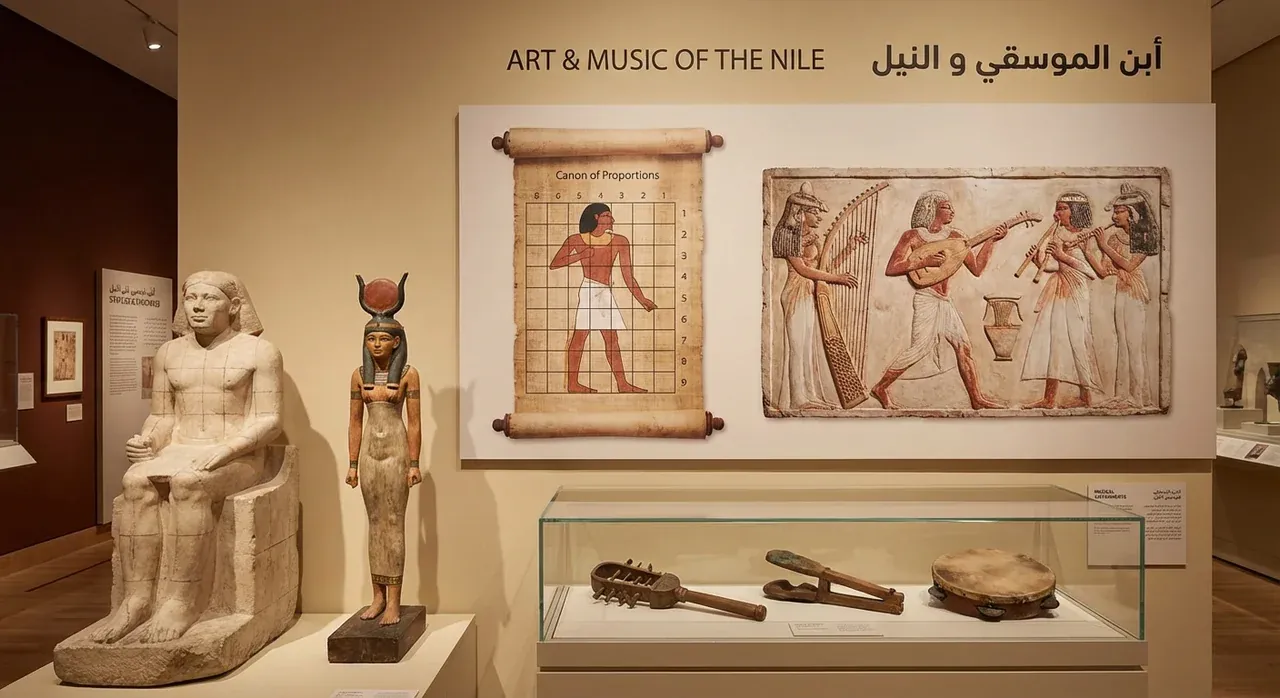
1. Historical Foundations: Pharaonic Harps to Islamic Theory
Music in the Nile Valley boasts an unbroken evolutionary lineage spanning more than five thousand years, documented in temple inscriptions, tomb reliefs, and medieval philosophical treatises:
- Pharaonic Temple Liturgies: Ancient tomb walls in Saqqara and Thebes depict elaborate musical ensembles comprising arched floor harps, double clarinets (Arghul), sistra (Sekhem), and bronze cymbals played by priestesses of Hathor to maintain cosmic balance (Ma'at);
- Cheironomy (The Ancient Conductor's Hand): Wall paintings at Giza reveal that pharaonic musicians used complex manual hand gestures (cheironomy) to indicate melodic pitch and rhythmic tempo to instrumentalists thousands of years before Western notation;
- The Medieval Islamic Synthesis: In medieval Cairo, scholars like Al-Farabi (author of Kitab al-Musiqa al-Kabir) and Ibn Sina harmonized ancient Greek acoustic mathematics (Pythagorean ratios) with native Egyptian and Mesopotamian lutherie, laying the formal theoretical foundations for the Arabic modal system.
2. The Classical Arabic Takht: The Quintet of Chamber Sound
From the late 19th century through the 1930s, urban Egyptian art music was performed by an intimate, highly virtuosic chamber ensemble known as the Takht (التخت العربي — "The Platform"):
The traditional Takht eschewed large orchestras and conductors. Comprising only four to five instrumental virtuosos surrounding a lead vocalist (Mutrib), the musicians sat cross-legged on an elevated carpeted platform. Each musician was both an accompanist and an improvising soloist, weaving spontaneous microtonal ornamentations around a shared melodic framework in real-time response to the singer's vocal inspiration.
- The Wasla Suite (الوصلة الغنائية): The classical performance format, comprising a unified cycle of instrumental preludes (Bashraf and Sama'i), metric solo improvisations (Taqsim), vocal poems (Qasida), and rhythmic choral refrains (Muwashshah), all set within a single primary Maqam family;
- Acoustic Purity: Performed completely unplugged without modern electronic amplification, relying on the natural acoustic resonance of vaulted stone chambers and open palace courtyards.
3. The Master Instruments: Oud, Qanun, Nay & Percussion
The acoustic voice of Egypt is defined by four core instruments and a disciplined family of rhythmic drums:
- The Oud (العود — The King of Arabic Instruments):
• A pear-shaped, deep-backed chordophone with a short, fretless neck and eleven strings grouped into five double courses plus a single bass string;
• The fretless neck allows complete microtonal freedom to slide between quarter-tones with rich vibrato;
• Plucked with an eagle feather quill or flexible plastic plectrum (Risha), producing a warm, resonant, woody acoustic tone; - The Qanun (القانون — The Law of Sound):
• A trapezoidal wooden soundbox strung with 78 nylon or gut strings grouped in courses of three;
• Resting flat on the musician's lap, plucked with two horn or tortoise-shell plectra attached to the index fingers;
• Equipped with miniature brass levers (Mandals) beneath each string course, flipped with the left hand during performance to alter the pitch by microscopic microtonal intervals; - The Nay (الناي — The Breath of the Reeds):
• An open-ended, end-blown flute crafted from hollowed wild giant cane (Arundo donax) with nine joints and seven finger holes;
• Played using an oblique mouth technique where the lip covers part of the tube's rim;
• Produces a breathy, soulful, meditative timbre capable of expressing profound sorrow and spiritual yearning; - The Riq (الرق — Classical Tambourine):
• A small wooden frame drum covered with translucent fish skin or goatskin, fitted with five double rows of heavy brass jingles;
• In the hands of a master percussionist, it produces both deep bass strikes (Dum), high-pitched rim clicks (Tak), and shimmering metallic cascades, functioning as the rhythmic anchor of the Takht; - The Darbuka / Tabla (الدربوكة / الطبلة):
• A goblet-shaped clay or cast aluminum hand drum played horizontally across the lap, delivering the driving, syncopated rhythms of popular and folk music.
4. The Modal Matrix: Understanding Maqamat & Quarter-Tones
Unlike Western music, which is built on equal temperament, major/minor scales, and vertical harmonic chords, Arabic music is strictly melodic and modal, organized around the system of Maqamat (المقامات — singular: Maqam):
- The 24-Tone Octave & Quarter-Tones: The Arabic octave is divided into twenty-four quarter-tones rather than the twelve half-steps of the Western piano keyboard. These microtonal intervals (neutral thirds, half-flats, and half-sharps) give Egyptian melodies their characteristic emotional nuance;
- Jins (The Building Blocks): Every Maqam is constructed by joining two smaller three-, four-, or five-note melodic phrases called Ajnas (singular: Jins);
- The Primary Maqam Families:
• Maqam Rast: The foundational, noble mode of dignity and balance, featuring half-flat third and seventh degrees;
• Maqam Bayati: The warm, beloved soul of Egyptian folk music, expressing humility, nostalgia, and tenderness;
• Maqam Hijaz: A dramatic, mystical mode featuring an augmented second interval, evoking desert landscapes and sacred call-to-prayer melodies;
• Maqam Saba: The mode of profound sorrow, grief, and spiritual lamentation, defined by an intensely contracted minor third;
• Maqam Nahawand & Ajam: Closer to Western minor and major scales, conveying romantic longing and triumphant majesty.
5. The Aesthetics of Tarab: Ecstasy in Shared Listening
The supreme objective of classical Egyptian performance is the cultivation of Tarab (الطرب):
Tarab is an untranslatable Arabic aesthetic concept describing a shared state of emotional transcendence, catharsis, and musical ecstasy. It is not a passive listening experience; it is an active reciprocal dialogue between performer and listener (Al-Sammi'a). When a vocalist delivers an unexpected microtonal modulation or stretches a poetic syllable with soulful ornament, listeners audibly sigh, cry out phrases of praise ("Ya Salam!", "Allah!"), and plead for repetition, inspiring the singer to explore even deeper melodic variations.
- Al-Sammi'a (The Connoisseurs): An educated, culturally sophisticated audience whose acute appreciation of modal nuances acts as a co-creator of the live musical performance;
- The Freedom of Improvisation (Taqsim & Layali): Solo improvisations where musicians explore the microtones of a Maqam without a strict meter, guided entirely by breath and emotion.
6. The 20th-Century Cairo Renaissance: Umm Kulthum & Masters
Between 1920 and 1970, Egypt commanded unprecedented cultural hegemony over the Arab world through its recording studios, radio broadcasting, and musical cinema:
- Sayed Darwish (1892–1923 — Father of Modern Popular Music): Revolutionary composer who liberated Egyptian music from Ottoman court elitism, giving voice to everyday working-class citizens (builders, porters, water-carriers) through patriotic theater anthems, including Egypt's national anthem Bilady, Bilady;
- Umm Kulthum (1898–1975 — Kawkab al-Sharq / "Planet of the East"):
• The most influential cultural figure in modern Arab history;
• Born in a rural Delta village, trained in Quranic recitation, she developed extraordinary vocal power, microtonal control, and diction;
• On the first Thursday of every month, her live radio concerts emptied the streets of cities from Casablanca to Baghdad for four decades;
• Performances of single songs (such as Enta Omri, Al-Atlal, and Fakarouni) lasted over two hours, driven by endless improvised variations; - Mohammed Abdel Wahab (1902–1991): The master innovator who introduced Western instruments (violins, cello, double bass, electric guitar, and accordion) into Arabic modal orchestration while preserving melodic authenticity;
- Abdel Halim Hafez (1929–1977 — Al-Andaleeb al-Asmar / "The Dark Nightingale"): The romantic idol of Egyptian youth whose modern cinematic songs captured the political optimism and personal romance of the post-1952 republican era.
7. Regional Folk Traditions: Sa'idi Mizmar, Nubian Tamboor & Simsimiyya
Beyond urban classical music, Egypt's diverse geographic regions preserve distinct indigenous acoustic traditions:
- Upper Egypt (Al-Sa'eed — الموسيقى الصعيدية):
• Driven by the thunderous double-headed Tabl Baladi bass drum and the wailing, double-reed Mizmar shawm;
• The musicians utilize circular breathing to sustain uninterrupted, high-energy melodies accompanying wedding processions, harvest festivals, and Tahtib stick-fighting matches;
• The Rebab (two-string spike fiddle) provides acoustic accompaniment for traditional bards reciting the multi-generational epic poem Sirat Bani Hilal; - Nubian River Rhythms (Aswan & Lake Nasser):
• Centered around the Tamboor (five-string bowl lyre) and large Tar frame drums;
• Characterized by rolling syncopated polyrhythms, syncopated handclaps (Keff), and choral call-and-response singing in Kenuzi and Fedicca dialects celebrating Nile floods, date harvests, and ancestral villages;
• Popularized internationally by master musicians Hamza El Din and Ali Hassan Kuban; - The Simsimiyya of the Suez Canal Zone (Port Said & Ismailia):
• A bright, five-string acoustic bowl lyre whose metallic plucked melodies became the musical voice of fishermen, boatmen, and popular resistance fighters during 20th-century conflicts.
8. Urban Evolution: Baladi Accordion, Shaabi & Mahraganat
Throughout the late 20th and early 21st centuries, working-class urban neighborhoods continuously reinvented Egyptian music:
- The Quarter-Tone Accordion & Raqs Baladi: In the 1960s, Egyptian master accordionists physically modified European piano accordions by filing down internal metal reeds to produce authentic Arabic quarter-tones, creating the earthy, wailing soundscape of Cairo's popular quarters;
- Shaabi Music (الموسيقى الشعبية — 1970s–1990s): Pioneered by working-class legend Ahmed Adawiya, blending street slang, sarcastic social commentary, and relentless dance rhythms, challenging conservative classical broadcasting norms;
- Mahraganat (Electro-Shaabi — أغاني المهرجانات): Emerging from Cairo's peripheral working-class districts (Salam City, Imbaba) in the late 2000s, combining aggressive electronic synthesizer beats, autotuned street poetry, and hip-hop basslines, representing the voice of contemporary Egyptian urban youth.
9. Mohammed Ali Street: The Historic Quarter of Lute Makers
Stretching between the Citadel of Saladin and Ataba Square in central Cairo, Mohammed Ali Street (شارع محمد علي) is the historic boulevard of Egyptian lutherie and theatrical arts:
- Commissioned in 1845: Designed by Khedive Ismail as a grand Haussmann-inspired boulevard, it evolved by the early 20th century into Cairo’s primary entertainment district, housing theaters, instrument workshops, and bandmaster agencies;
- Generational Master Luthers (Al-Alatiyya):
• Workshops crafting custom hand-made Ouds, Qanuns, and Riqs;
• Master builders bend strips of mahogany, walnut, rosewood, and maple over hot iron pipes to construct the ribbed bowl of the Oud (Al-Qas'a), fitting soundboards cut from fine spruce or Canadian cedar;
• Famous lutherie houses like Beit Al-Oud where international musicians travel to purchase instruments tested and voiced by ear; - Percussion Ateliers: Shops fitting cast aluminum and glazed clay Darbukas with natural fish skin and tuning synthetic drum heads for professional recording artists.
10. Live Concert Venues: Cairo Opera House, Makan & Beit El-Sehemi
Travelers seeking authentic acoustic and orchestral musical encounters can experience live performances across historic Cairo:
- Cairo Opera House (دار الأوبرا المصرية — Gezira Island, Zamalek):
• The premier state performing arts complex, inaugurated in 1988;
• Regularly hosts the National Arab Music Ensemble and the Heritage Ensemble for Arabic Music, performing complete orchestral reconstructions of classical Wasla suites and Umm Kulthum masterpieces; - Makan Egyptian Center for Culture and Arts (Downtown Cairo):
• An intimate acoustic venue dedicated to preserving vanishing folk music traditions;
• Weekly live performances by the Mazaher Zar ritual ensemble, Upper Egyptian Gypsies (El-Warsha), and classic Nile Delta folk bards; - Beit El-Sehemi (Darb al-Asfar, Al-Mu'izz Street):
• A 17th-century Ottoman merchant palace hosting weekly acoustic concerts of classical Arab Takht music and traditional shadow puppetry (Aragoz) in open marble courtyards; - Arabic Music Institute (Ramses Street): A neoclassical 1914 palace dedicated to master Oud recitals, housing a public museum of antique historical musical instruments.
11. Master Egyptian Musical Traditions & Instruments Matrix
The following matrix details Egypt’s primary musical instruments, their acoustic families, regional roots, and distinctive roles:
| Instrument | Classification | Origins & Regional Core | Acoustic Role & Timbral Character |
|---|---|---|---|
| The Oud (العود) | Fretless Plucked Lute | Classical Pan-Arab / Cairo | Microtonal melodic foundation; warm, deep, resonant woody timbre. |
| The Qanun (القانون) | 78-String Plucked Zither | Abbasid Court / Classical Takht | Microtonal lever precision (Mandals); bright, rapid harmonic cascading. |
| The Nay (الناي) | End-blown Cane Flute | Pharaonic / Sufi Liturgies | Breathy, meditative, spiritually mournful timbre across 3 octaves. |
| The Riq (الرق) | Frame Drum with Brass Jingles | Classical Takht Ensemble | Rhythmic master clock; syncopated bass strikes and metallic cascades. |
| Mizmar & Tabl Baladi | Double-Reed Shawm & Bass Drum | Upper Egypt (Al-Sa'eed) | Continuous circular-breathing horn and booming drum for Tahtib. |
| The Simsimiyya (السمسمية) | 5-String Bowl Lyre | Suez Canal Zone (Port Said/Suez) | Crisp, plucking maritime melodies celebrating folk resistance. |
| The Rebab (الربابة) | Two-String Spike Fiddle | Rural Nile Delta & Upper Egypt | Horsehair bow on coconut shell; accompanies epic folk bard poetry. |
12. Private Curated Musical Masterclasses with Ultra Egypt Travel
Navigating the lutherie workshops of Mohammed Ali Street, meeting master Oud builders in their private ateliers, or attending private acoustic Takht performances inside 17th-century Ottoman courtyards requires seasoned academic connections and executive comfort.
Operating under Ministry of Tourism License #874 (Class A) and IATA Accreditation #90229930, Ultra Egypt Travel delivers bespoke private music itineraries:
- The Cairo Musical Heritage Walking Tour (Half-Day): Private walking circuit connecting the instrument workshops of Mohammed Ali Street, the Arabic Music Institute, and the Umm Kulthum Museum at Manasterly Palace led by certified ethnomusicologists;
- Private Instrument Sourcing & Lutherie Consultations: Accompanied visits to Cairo’s master Oud makers to select, inspect, and custom-voice concert-grade instruments with export packaging;
- Exclusive Palace Acoustic Concerts: Private classical Takht chamber concerts arranged inside the historic marble courtyards of Bayt al-Suhaymi or Bayt al-Kritliyya;
- VIP Cairo Opera House Bookings: Priority box-seat reservations for seasonal performances by the National Arab Music Ensemble with private executive hotel transfers;
- VIP Chauffeured Protocol: Executive climate-controlled Mercedes-Benz vehicles with professional drivers, door-to-door concierge care, and 24/7 dedicated operational monitoring.