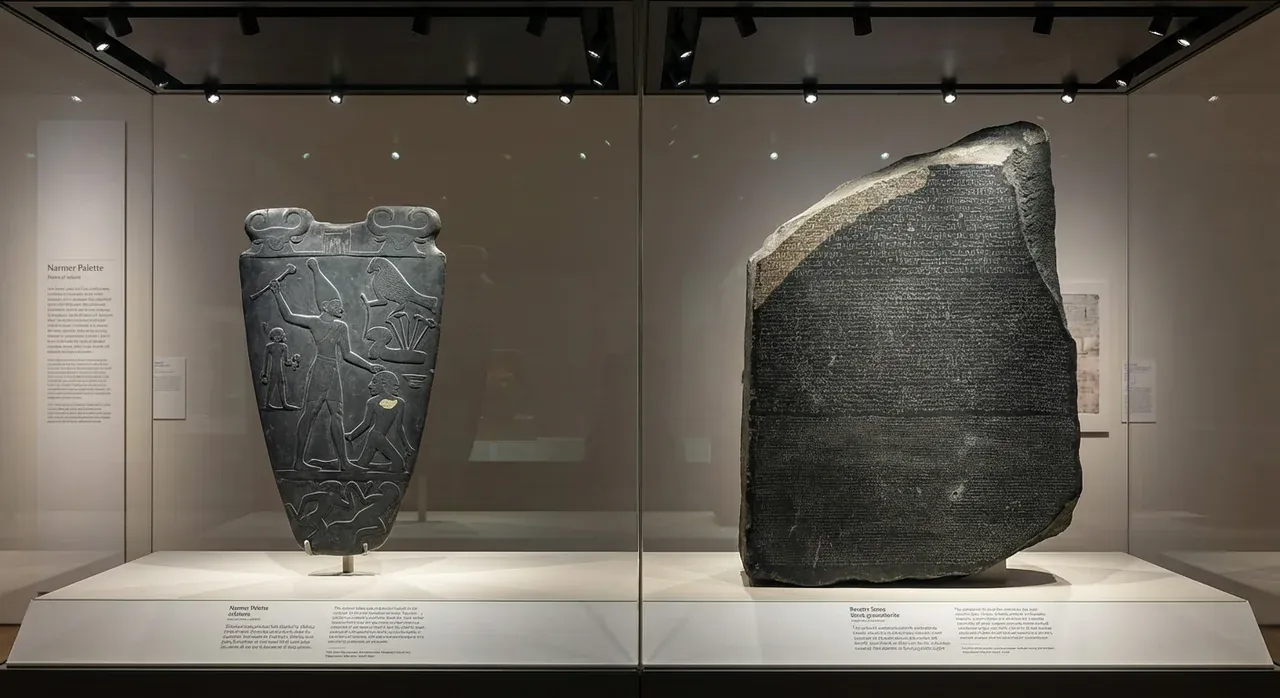
1. The Sacred Function: The Physical Vessel (Ka Statue)
In the modern Western tradition, sculpture is evaluated primarily as an aesthetic exercise—an expression of artistic vanity, proportion, and visual pleasure. In ancient Egypt, the concept of "art for art's sake" did not exist. There was not even a specific word in the ancient Egyptian language for "art"; the sculptor was designated as San-ankh (س-عنخ), literally translating to "He who makes alive" or "The Vivifier".
Every Egyptian statue fulfilled an active, vital metaphysical function:
- The Somatic Anchor for the Ka: If the physical mummified body of the deceased suffered decay, destruction, or tomb plundering, the spiritual double—the Ka (كا)—would be left wandering without a somatic home, resulting in the second, permanent death of the soul. The stone statue served as an eternal, indestructible substitute body;
- The Temple Dwelling of the Gods: Cult statues positioned inside the dark innermost shrines (the Naos) of temples were not viewed as idols. They were temporary physical dwelling places into which the transcendent cosmic essence of the deity descended when summoned by daily morning hymns, incense, and offerings;
- Frontality & Immortality: Egyptian statues are strictly frontal, designed to gaze straight ahead into eternity. They do not engage in twisting, dynamic, or asymmetrical movement. The figure stands or sits locked in timeless stability, impervious to mortality and age.
2. The Canon of Proportions: The 18-Square Grid System
Ancient Egyptian sculpture was governed by an unbending mathematical discipline known as the Canon of Proportions (قانون النسب). Rather than sculpting freehand from living models, Egyptian workshops utilized a standardized proportional grid system snapped onto rectangular stone blocks using string dipped in red pigment:
A standing human figure was divided horizontally into exactly 18 equal square units from the soles of the feet to the hairline (with the crown of the head and headdress sitting above the 18th line):
• Line 1: The base of the foot / ground line.
• Line 6: The base of the knee cap.
• Line 10: The lower edge of the buttocks / groin.
• Line 12: The small of the back / navel.
• Line 16: The juncture of the shoulders and neck.
• Line 18: The hairline / forehead.
This grid ensured that whether a statue was carved as a 15-centimeter bronze votive or a 20-meter sandstone colossus, its somatic ratios remained identical. During the 26th Dynasty (Saite Period), the grid was recalibrated to 21 squares, measuring to the eye level to accommodate slender, elongated archaic revivals.
3. Lithic Geology: Diorite, Greywacke, Quartzite & Wood
The choice of material for an Egyptian statue was dictated not by convenience, but by deep cosmological and mineralogical symbolism:
- Anorthosite Gneiss / Diorite (Gebel el-Asr): Mined in the hyper-arid desert northwest of Abu Simbel. A luminous, deep greenish-black crystalline stone that glows with an ethereal blue translucency when struck by sunlight. Chosen exclusively for Old Kingdom royal statues (such as Khafre Enthroned) to symbolize celestial solar illumination and eternal permanence;
- Greywacke (Wadi Hammamat Schist): Mined along the ancient caravan route between Coptos and the Red Sea. A dense, dark green-grey stone capable of taking a mirror-like polish with razor-sharp edges. Its deep green color symbolized Wadj—the green of fresh Nile vegetation, rebirth, and resurrection (celebrated in the Menkaure Triads);
- Red Quartzite (Gebel el-Ahmar): Mined near modern Heliopolis (Cairo). A dense, iron-rich silicified sandstone glowing with fiery red, orange, and purple hues. Explicitly associated with the sun god Ra and the radiant heat of the solar disc (used for the Colossi of Memnon and Hatshepsut’s sarcophagi);
- Fine Tura Limestone: Soft, easily carved, and brilliant white. Often coated with gesso plaster and painted in vibrant mineral pigments: reddish-brown for men (reflecting an active outdoor life under the sun) and pale yellowish-ochre for elite women (reflecting protected, indoor domestic prestige);
- Wood (Native Acacia, Sycamore & Imported Cedar): Carved in separate anatomical pieces (torso, head, arms, legs) joined by mortise-and-tenon wooden pegs, allowing for dynamic postures like the outstretched walking staff of Kaaper (Sheikh el-Balad).
4. The Opening of the Mouth Ritual (Wepet-Er)
Carving a statue out of stone or wood was only the physical half of creation. Before a statue could serve as an operative vessel for the soul, it had to undergo a sacred consecration ceremony known as the Opening of the Mouth (طقس فتح الفم - Wepet-Er):
Conducted by the Sem-priest wearing a leopard skin upon the day of burial outside the tomb entrance or in the House of Gold (the sculptor's workshop):
- The priest wielded specialized magical instruments, including the Pesh-kef (a bifurcated obsidian blade mimicking a ceremonial flint) and the Netjerti adze forged of meteoric iron;
- The priest systematically touched the eyes, nose, mouth, and ears of the stone statue;
- Through these physical touches accompanied by continuous recitations of magical spells, the inanimate stone was ritually infused with life: its spiritual eyes were opened to see offerings, its mouth opened to speak and consume meat and wine, and its nostrils opened to breathe the breath of life (Ankh).
5. Royal Colossi: Memnon, Abu Simbel & Ramesses II
When Egyptian pharaohs expanded their empires into the Levant and Nubia during the New Kingdom, stone statuary expanded to colossal, awe-inspiring scales:
1. The Colossi of Memnon (Luxor West Bank)
Two towering megalithic enthroned portraits of Pharaoh Amenhotep III guarding the lost pylon entrance of his mortuary temple at Kom el-Hettan:
- Carved from single blocks of quartzite sandstone quarried at Gebel el-Ahmar near Cairo and dragged 675 kilometers overland to Thebes;
- Each statue stands 18 meters (60 feet) high atop a stone plinth, weighing an estimated 720 metric tons each;
- Following an earthquake in 27 BC, the northern colossus developed acoustic cracks: at dawn, thermal evaporation caused the stone to vibrate and emit an eerie musical whistle, which Roman travelers attributed to the mythical Greek hero Memnon greeting his mother Eos, the dawn.
2. The Rock-Cut Colossi of Abu Simbel
Carved directly from the living sandstone cliffs of Lower Nubia by Ramesses II:
- Four seated colossi standing 20 meters (66 feet) high, wearing the double Pschent crown, flanked by small figures of Queen Nefertari and royal children reaching only to the king's knees;
- A terrifying visual projection of divine pharaonic authority designed to humble Nubian river travelers entering Egyptian sovereign waters.
3. The Colossus of Ramesses II at Memphis (Mit Rahina)
Discovered in 1820 by Giovanni Battista Caviglia near the Temple of Ptah: a fallen 10-meter-long red limestone colossus lying horizontally inside a dedicated museum pavilion, celebrated for the crisp, gem-like precision of its carved chest musculature, royal dagger, and cartouches.
6. Masterpieces of Royal Portraiture (Khafre to Amarna)
Across 3,000 years, royal statuary navigated between eternal divine idealism and raw psychological realism:
- Khafre Enthroned (Cairo Museum / GEM - 4th Dynasty): Discovered in the pit of the Giza Valley Temple. Carved in glowing greenish-black anorthosite gneiss. Behind the pharaoh's nemes headdress perches the Horus falcon, wrapping its protective wings around the back of the king's neck. The message is absolute: the king and the god Horus are one indivisible entity;
- The Menkaure Triads (4th Dynasty): Carved in greywacke from the Giza Valley Temple, portraying King Menkaure flanked by the goddess Hathor and regional district deities (nomes), displaying smooth, sensual modeling and supreme anatomical harmony;
- Senusret III & Amenemhat III (12th Dynasty): Middle Kingdom portraiture abandoned Old Kingdom youthful perfection. Sculptors carved kings with deeply lined, furrowed brows, heavy lidded eyes, drooping mouths, and prominent ears—depicting a weary, brooding shepherd-king burdened by the weighty governance of the state;
- The Amarna Revolution (Akhenaten - 18th Dynasty): Breaking completely with classical tradition, sculptors at Amarna depicted Pharaoh Akhenaten with elongated facial features, full drooping lips, a thin neck, protruding belly, and wide feminine hips, symbolizing the sun god Aten as the sole genderless source of all fertility;
- The Bust of Nefertiti (Berlin - 18th Dynasty): Discovered in 1912 by Ludwig Borchardt in the workshop of master sculptor Thutmose at Amarna. Crafted from limestone coated in sculpted stucco layers, preserving delicate bone structure, realistic cosmetic kohl eye-lining, and her tall blue cap crown.
7. Elite Private Sculpture: Scribes & Realism
While kings were usually depicted with idealized youthful physiques, non-royal elite private sculpture embraced vivid, affectionate realism:
Discovered at Saqqara in 1850 by Auguste Mariette (5th Dynasty). Portrayed cross-legged in white linen upon the ground, holding an unrolled papyrus scroll in his left hand, ready to write. The sculptor rendered his aging body with complete biological honesty: soft flesh rolls across the abdomen, prominent collarbones, and piercing, lifelike eyes crafted from magnesite, rock crystal, and copper that seem to follow the viewer across the gallery.
- Rahotep & Nofret (4th Dynasty, Meidum): Discovered in 1871 in their mastaba. Two painted limestone seated statues so perfectly preserved that excavators fled in terror upon opening the dark tomb chamber, believing them to be living apparitions. Princess Nofret wears a heavy black wig over her natural hair and a sheer white gown; Prince Rahotep sports a rare mustache;
- Kaaper ("Sheikh el-Balad" - 5th Dynasty): Carved from native sycamore fig wood. Depicts an overweight, middle-aged court official holding a wooden walking staff. When local workers unearthed the statue at Saqqara, they were so struck by its resemblance to their local village mayor that they immediately nicknamed it Sheikh el-Balad.
8. The Block Statue (Hetep): Epigraphic Architecture
During the Middle Kingdom (12th Dynasty) and expanding dramatically through the New Kingdom and Late Period, Egyptian sculptors invented a unique, purely functional genre: the Block Statue (تمثال الكتلة - Hetep):
- Anatomy of the Form: The subject is depicted squatting on the ground with their knees drawn tightly against their chest, completely enveloped in an ankle-length mantle. Only the head, and occasionally the hands resting upon the knees, emerge from the cubical stone block;
- Structural Durability: The compact, monolithic cube eliminated vulnerable protruding limbs, preventing arms or noses from snapping during temple transport or centuries of exposure;
- An Architectural Canvas for Inscriptions: The broad, flat front and side planes of the cubic block provided vast, pristine surfaces for scribes to carve lengthy hieroglyphic biographical texts, genealogical lineages, and offering appeals to temple priests (such as the famous statue of architect Senenmut holding Princess Neferure).
9. Comprehensive Ancient Egyptian Statuary Matrix
The following matrix details the most celebrated stone and wooden sculptures of ancient Egypt, their historical eras, materials, and artistic breakthroughs:
| Statue Masterpiece | Period / Dynasty | Material Lithology | Current Location & Significance |
|---|---|---|---|
| Khafre Enthroned | Old Kingdom (4th Dynasty) | Anorthosite Gneiss (Diorite) | Egyptian Museum, Cairo; divine union with Horus falcon wings. |
| Menkaure Triads | Old Kingdom (4th Dynasty) | Greywacke (Schist) | GEM / MFA Boston; Menkaure with Hathor and district nome deities. |
| Rahotep & Nofret | Old Kingdom (4th Dynasty) | Painted Limestone | Egyptian Museum, Cairo; lifelike inlaid crystal eyes and vibrant skin tones. |
| The Seated Scribe | Old Kingdom (5th Dynasty) | Painted Limestone & Crystal | Louvre Museum, Paris; realistic rolls of flesh, intellectual alertness. |
| Kaaper (Sheikh el-Balad) | Old Kingdom (5th Dynasty) | Sycamore Fig Wood | Egyptian Museum, Cairo; wooden portraiture, inlaid copper-framed eyes. |
| Senusret III Portrait | Middle Kingdom (12th Dynasty) | Black Granite / Quartzite | MET / GEM; psychological realism, weary introspective ruler. |
| Colossi of Memnon | New Kingdom (18th Dynasty) | Silicified Quartzite | Thebes West Bank; 18m tall, 720-ton twin enthroned portraits. |
| Bust of Nefertiti | New Kingdom (18th Dynasty) | Limestone & Stucco | Neues Museum, Berlin; Thutmose workshop model, iconic feminine elegance. |
| Ramesses II Colossus | New Kingdom (19th Dynasty) | Silicified Limestone | Mit Rahina (Memphis); 10m fallen colossus with exquisite relief carving. |
| Block Statue of Senenmut | New Kingdom (18th Dynasty) | Black Granite | Egyptian Museum, Cairo; cubic block protecting Princess Neferure. |
10. Museum Inspections & Curated Access with Ultra Egypt Travel
Standing before the luminous green diorite of Khafre or looking directly into the crystal eyes of the Seated Scribe is an intellectual encounter with antiquity that requires curatorial depth and seamless logistical care.
Operating under Ministry of Tourism License #874 (Class A) and IATA Accreditation #90229930, Ultra Egypt Travel delivers specialized sculpture and museum study expeditions:
- Grand Egyptian Museum (GEM) Curated Galleries: Private explorations of the grand staircase colossi, the royal statuary halls, and the complete 5,398-piece Tutankhamun assemblage led by academic Egyptologists;
- The National Museum of Egyptian Civilization (NMEC): Private guided visits through the central chronological halls tracing Egyptian sculptural technique from Predynastic ivory to the Greco-Roman period;
- Exclusive After-Hours Museum & Temple Access: Securing official Supreme Council of Antiquities permits for private, crowd-free access inside the Egyptian Museum in Tahrir Square, the Luxor Museum of Ancient Art, and the Mit Rahina Colossus Pavilion;
- VIP Protocol Fleet: Executive chauffeured Mercedes-Benz sedans and high-roof executive vans providing effortless transit between Cairo, Saqqara, Dahshur, and Luxor.