Chronological & Historical Context
King Djet ruled during the Early Dynastic Period, a time when the foundations of pharaonic civilization were being laid. As the fourth ruler of the First Dynasty, he inherited a unified Egypt and worked to consolidate the institutions established by his predecessors.
- Reign: Approximately 2980 – 2970 BC (circa 10 years).
- Dynasty: 1st Dynasty, fourth pharaoh.
- Significance: Known for his beautiful funerary stela, one of the finest examples of early Dynastic art.
- Predecessor: King Djer (his father).
- Successor: King Den (his son), with Queen Merneith possibly ruling as regent.
Name, Titles, and Identity
🔹 Horus Name: Hor-Djet
The king's Horus name is composed of two elements: 𓅃 (Hr) — the Horus falcon, representing kingship, and 𓆓𓏏 (ḏt) — meaning "serpent" or "cobra."
➡️ Interpretation: "Serpent of Horus" or "Horus Cobra," symbolizing the king's divine protection and his association with the serpent goddess WaDjet, the patron of Lower Egypt.
🔹 Alternative Names and Variants
- Hor-WaDjet: A rarely attested variant meaning "Reinvigorated serpent of Horus."
- WaDjet / Wadj / Zet / Uadji: Variant spellings found in different historical sources.
- Greek Sources: Possibly identified as the pharaoh Uenephes or Atothis in Manetho's king list.
- Prenomen: Nisut-Bity-Itu — "King of Upper and Lower Egypt, the buzzard has come."
- Abydos King List: Recorded as Ita ("The vulture has come").
- Turin King List: Listed as ...tjuj ("The buzzard has come").
Egypt Before Djet
By the time Djet ascended the throne, Egypt had already been unified by his grandfather (or great-grandfather) Narmer. The First Dynasty was in its formative phase, and the early kings were establishing the protocols and traditions of the pharaonic state.
- Predecessors: Narmer (founder), Hor-Aha, and Djer had already laid the groundwork for a centralized state.
- State of the Realm: Egypt was still consolidating its borders and establishing administrative structures. The concept of divine kingship was being refined.
- Royal Cults: The practice of building elaborate funerary monuments and stelae at Abydos had become an established tradition.
Reign & Consolidation
Djet's reign, though relatively short, was a period of consolidation. He focused on strengthening the administrative framework and reinforcing the ideological foundations of kingship.
- Continuity: He maintained the established order, continuing the work of his predecessors.
- Religious Patronage: Djet honored the gods and maintained the royal cults, particularly those associated with Horus and the serpent goddess WaDjet.
- Administration: He likely expanded the network of officials and scribes required to manage the growing state.
The Abydos Stela of Djet

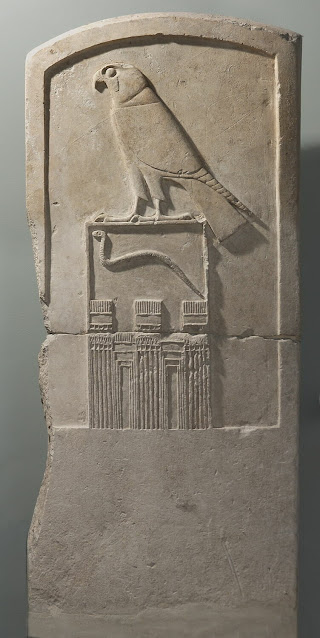
The Funerary Stela of King Djet — Musée du Louvre, Paris (E 11007)
Discovered in Djet's tomb at Abydos in 1898, this limestone stela is considered one of the finest examples of early Dynastic art. It is sometimes called the "Stela of the Serpent King."
▶️ Description & Symbolism
- Material: Limestone with raised relief carving (bas-relief saillant).
- Dimensions: 143 cm high × 65.5 cm wide × 25 cm thick.
- Decoration: The Horus falcon stands atop a serekh (the rectangular royal name frame).
- Inside the serekh, Djet's Horus name (Ḥr-ḏt) is inscribed.
- The falcon's wings are spread protectively over the serekh, emphasizing divine kingship.
▶️ Discovery & Location
- Discovery: Found in Djet's tomb (Tomb Z) at Umm el-Qa'ab, Abydos, in 1898.
- Excavator: Émile Clément Amélineau.
- Acquisition: Purchased at public auction and acquired by the Louvre in 1904.
- Current Location: Musée du Louvre, Paris (inventory number E 11007).
- The BBC has described it as "perhaps the finest" of the First Dynasty royal stelae.
✔ A masterpiece of early Egyptian art and a testament to Djet's enduring legacy.
Family and Royal Lineage
Djet's family connections are partially known from archaeological evidence, providing insight into the dynastic succession of the First Dynasty.
- Father: Likely his predecessor, King Djer.
- Mother: Possibly Herneith or Nakhtneith (both attested as royal women of the period).
- Chief Consort: Queen Merneith, who may have ruled as pharaoh in her own right after his death.
- Other Wives: Possibly Ahaneith.
- Son: King Den, who succeeded him to the throne.
- Grandson: King Anedjib, who ruled later in the dynasty.
Other Attestations
Beyond his famous stela, Djet is attested through a variety of sources that help piece together his reign:
- Tomb Z at Abydos: His burial tomb and its associated cult enclosure.
- Seal Impressions: Found in mastaba V at Giza, bearing his name.
- Inscriptions: From tomb 3504 at Saqqara, possibly belonging to the high official Sekhemka, who served under Djet.
- Copper Tools: From subsidiary tomb 387 of Djet's enclosure, now in the Petrie Museum.
- Limestone Stelae: From subsidiary graves around his tomb complex, each marked with smaller stelae.
- Stela of Niseret: A stela of a woman named Niseret from the royal cemetery at Abydos, possibly a relative or official.
Governance & Administration
Djet inherited a state that was still in the process of defining its administrative structures. His reign contributed to the evolution of the Egyptian bureaucracy.
- Centralized Rule: The king was the supreme authority, with power delegated to officials and nomarchs.
- Royal Estates: The crown controlled vast agricultural estates that supported the court and funded building projects.
- Taxation & Tribute: A system of taxation and tribute collection was maintained to supply the royal treasury.
- Record Keeping: The use of seal impressions and labels suggests a sophisticated system of record keeping.
Religion & Ideology
Djet's reign was deeply rooted in religious ideology. The king was seen as the living embodiment of Horus, the falcon god, and the protector of the land.
- Horus Cult: Djet's Horus name emphasizes his divine status as the "Serpent of Horus."
- WaDjet: The serpent goddess of Lower Egypt, whose name is reflected in one of Djet's variants, suggesting her importance in his reign.
- Funerary Cult: The elaborate stelae and tombs at Abydos reflect the importance of the royal funerary cult and the king's journey to the afterlife.
- Ma'at: The concept of cosmic order (Ma'at) was central to kingship. Djet, like all pharaohs, was responsible for maintaining order and justice.
Key Artifacts of Djet
Several significant artifacts from Djet's reign have survived, offering glimpses into the material culture and artistic achievements of the First Dynasty:
- The Abydos Stela (Louvre E 11007): The centerpiece of Djet's legacy, a masterpiece of early royal sculpture.
- Limestone Stelae from Subsidiary Graves: Smaller stelae marking the graves of retainers buried around Djet's tomb.
- Seal Impressions: Clay seals bearing Djet's name, found at various sites including Giza and Saqqara.
- Copper Tools and Vessels: From tomb deposits, now housed in various museums.
- Ivory Labels: Fragments of inscribed labels that record events during his reign.
Tomb & Burial: Tomb Z at Abydos
Djet was buried at Umm el-Qa'ab in Abydos, the royal cemetery of the First Dynasty kings. His tomb is designated Tomb Z.
- Location: Umm el-Qa'ab, Abydos (cemetery of the First Dynasty kings).
- Structure: A brick-lined burial chamber in the desert, typical of the period.
- Features: An offering place flanked by stelae bearing the king's name.
- Subsidiary Burials: The tomb was surrounded by subsidiary graves of retainers, each marked with smaller stelae — a practice reflecting the king's status and the belief in the afterlife.
Art in the Age of Djet
Djet's reign represents a high point in early Dynastic art. The Abydos stela demonstrates the artistic conventions that would endure for millennia:
- Raised Relief: The stela features bas-relief saillant (raised relief), a technique that emphasizes the figures and hieroglyphs.
- Symbolic Composition: The Horus falcon atop the serekh establishes the king's divine status.
- Hieratic Scale: The falcon is depicted larger than other elements to emphasize its importance.
- Artistic Quality: The stela is noted for its "extraordinary quality" and is considered a masterpiece of early Egyptian sculpture.
Legacy & Historical Significance
Though Djet's reign was relatively brief, his legacy endures through the magnificent stela that bears his name. He represents a crucial link in the chain of early Egyptian kingship, bridging the reigns of the great unifier Narmer and the more extensively documented King Den.
- Artistic Legacy: His stela remains one of the most iconic artifacts of the First Dynasty.
- Dynastic Continuity: He ensured the smooth succession of the royal line, passing the throne to his son Den.
- Religious Tradition: His association with the serpent goddess WaDjet reinforced the religious ideology of kingship.
- Historical Record: The stela provides invaluable evidence for the study of early Egyptian writing, art, and royal ideology.
📌 Comprehensive Summary
👑 Name: Djet (Hor-Djet — Serpent of Horus)
🕰️ Era: Early Dynastic Period (c. 2980 – 2970 BC)
🏛️ Dynasty: 1st Dynasty, 4th Pharaoh
🪨 Greatest Legacy: The magnificent Abydos Stela (Louvre E 11007)
👪 Family: Father Djer → Queen Merneith → Son Den
⚰️ Burial: Tomb Z at Umm el-Qa'ab, Abydos