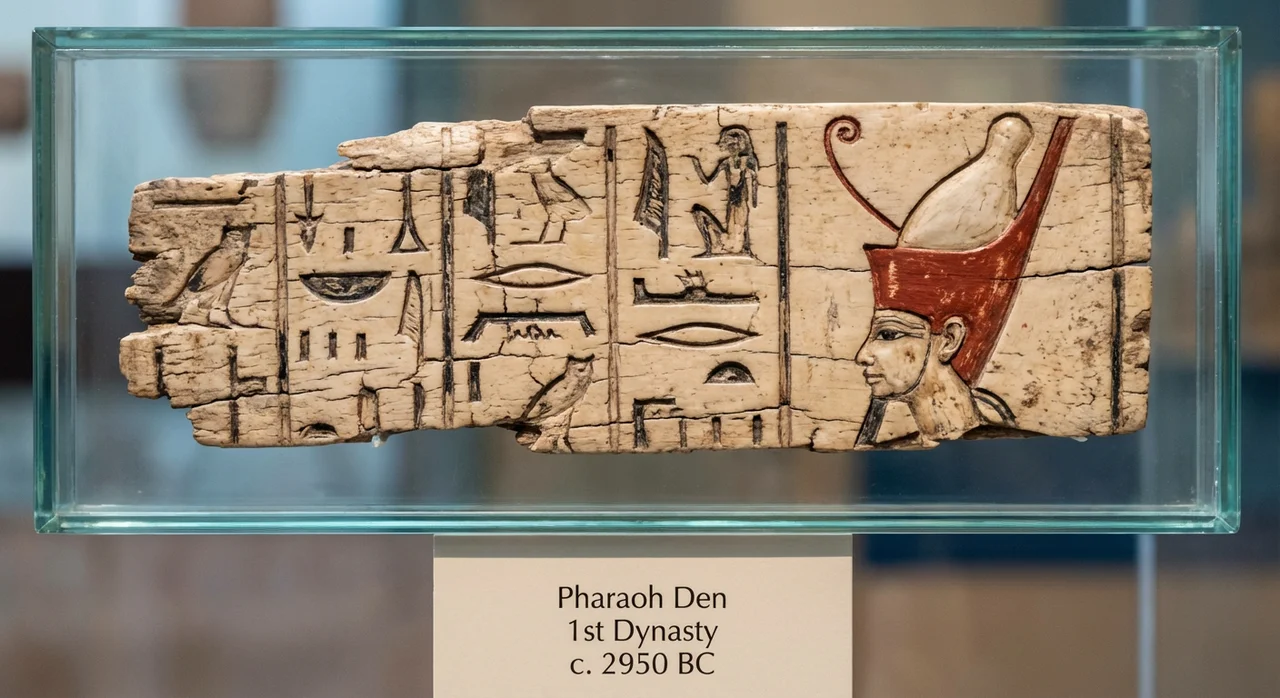
King Den
The king who defined the blueprint of Pharaonic power.
(Hor-Den, "Horus Who Strikes")
🕰️ Reign
c. 2950 BCE
🏆 Title
First "nsw-bity"
🏛️ Innovation
Stairway Tomb
👑 Regency
Queen Merneith
The First "King of Upper and Lower Egypt"
While his predecessors ruled a unified territory, Den's reign marks a major ideological leap. He was the **first ruler to be documented using the title "nsw-bity"**, which translates to "King of Upper and Lower Egypt."
A GolDen Age of Innovation
Den's long and prosperous reign is considered one of the high points of the First Dynasty, marked by significant advances in architecture, administration, and art. Later Egyptians looked back on his era as a golDen age.
- Mature Administration: Seal impressions from his reign reveal a complex and well-organized bureaucracy with specialized officials for taxation, agriculture, and resource management.
- Military Strength: His Horus name, "Horus Who Strikes," is backed by eviDence from ivory labels depicting successful military campaigns to protect Egypt's borders and trade routes, particularly in the east (Sinai).
- Artistic Development: Artifacts from his reign, especially the detailed narrative scenes on ivory labels, show a new level of artistic sophistication and the beginnings of recorded history.
The MacGregor Label: The Smiter of the East
One of the most famous artifacts from the First Dynasty is the MacGregor Label, an ivory tag found in Den's tomb. It depicts the king in the classic "smiting the enemy" pose, a motif that would be used by every subsequent pharaoh to symbolize order conquering chaos.
The Regency of Queen Merneith
Den ascended to the throne as a child. For the early part of his reign, his mother, the powerful Queen Merneith, ruled on his behalf as regent.
Merneith's influence was so immense that she was granted her own royal tomb at Abydos (Tomb Y), built on a scale that rivaled the tombs of the kings themselves. This indicates that she was not just a queen consort, but a ruler in her own right. She is the first female ruler of Egypt known by name.
The Heb-Sed Festival: A Long Reign
Archaeological eviDence, including stone vessels and labels, confirms that King Den celebrated a Heb-Sed (Jubilee) festival. This ritual was traditionally held after a king had ruled for 30 years to rejuvenate his power and reaffirm his divine right to rule.
The fact that Den celebrated this festival suggests his reign was exceptionally long, likely exceeding 40 years. Scenes from his time show him running the ritual race around the boundary markers, proving his physical fitness to continue leading Egypt.
Tomb T: A New Standard in Royal Burials
Den's tomb at Abydos (Tomb T) was a marvel of its time and set a new standard for royal funerary architecture.
- The First Royal Stairway: His tomb was the first to feature a grand entrance stairway, allowing the entire structure to be completed before the king's death. This innovation was adopted by all subsequent pharaohs, including in the pyramids.
- Use of Granite: The burial chamber itself featured a floor paved with red and black granite from Aswan. This is one of the earliest examples of massive stone blocks being transported and used in a monumental construction project.
- Retainer Burials: The tomb was surrounded by the subsidiary graves of over 130 retainers, sacrificed to accompany their king into the afterlife, reinforcing the immense divine authority he commanded.
Legacy of a Great King
Den's reign was a pivotal moment. He didn't just rule Egypt; he defined what it meant to be its king. His administrative systems, royal titles, and architectural innovations became the bedrock of Pharaonic civilization.
His legacy is defined by:
- Formalizing Dual Kingship: Establishing the "nsw-bity" title that all future pharaohs would adopt.
- Architectural Blueprint: Introducing the stairway tomb design and the large-scale use of stone in royal monuments.
- Creating a GolDen Age: His stable and prosperous reign was remembered for millennia as a period of great achievement and a model for future kings.