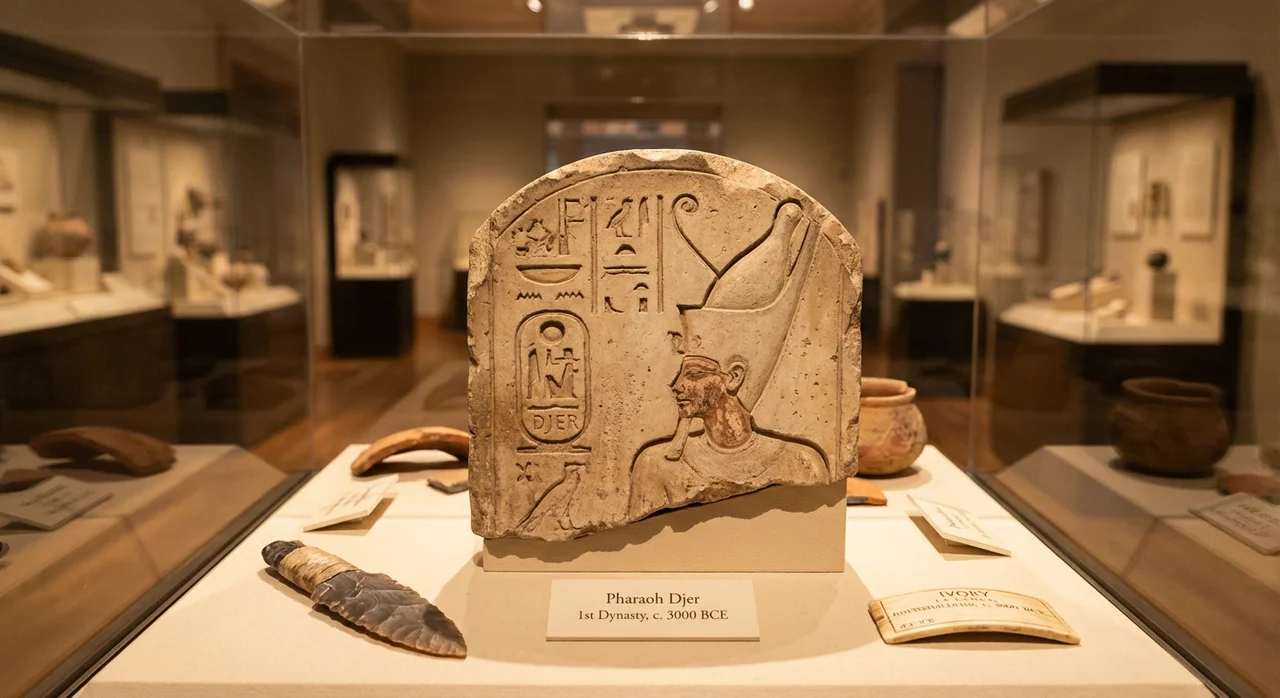
Identity & Names
Djer is one of the best-attested kings of the First Dynasty, with his name appearing on numerous artifacts from Abydos, Saqqara, and even outside of Egypt.
- Horus Name: Ḥr-Ḏr (Hor-Djer), meaning "Horus the Strong" or "Horus Who Endures," reflecting the stability and longevity of his reign.
- Greek Tradition: He is possibly the king remembered as Uenephes in the later king-lists of Manetho.
- Family: He was the son and successor of Hor-Aha. His mother is often identified as Khenthap.
Chronology & Historical Importance
Djer's long reign (estimated at over 40 years) was a period of peace, stability, and significant economic growth. Following the unification by Narmer and consolidation by Hor-Aha, Djer's era was focused on building Egypt's wealth and international influence.
- Reign: Approximately 3000 BCE.
- Dynasty: First Dynasty, Early Dynastic Period.
- Key Contribution: His reign marks the transformation of Egypt into a major regional economic power through the establishment of long-distance trade.
Trade Expansion & Foreign Relations
Under Djer, Egypt's foreign contact expanded significantly, moving from tentative contact to established trade networks that brought immense wealth into the kingdom.
- Trade with the Levant: Egyptian pottery and artifacts from Djer's reign have been found in southern Canaan (modern-day Israel and Palestine). In return, Egypt imported valuable timber (like cedar), olive oil, and other luxury goods.
- Expeditions to Sinai: Inscriptions record expeditions to the Sinai Peninsula to secure valuable resources like copper and turquoise, essential for crafting tools, jewelry, and ceremonial objects.
- Influence in Nubia: A rock inscription near Wadi Halfa (far south in Nubia) bears the name of Djer, proving Egyptian expeditions reached deep into Africa to control trade routes for gold and exotic goods.
King Djer the Physician
The historian Manetho, writing thousands of years later, attributes a surprising skill to King Djer (whom he calls Athothis). He states that the king was a physician and that books on anatomy were written by him.
Tomb, Burial, and Royal Jewelry
Djer's tomb at Umm el-Qaab, Abydos (Tomb O) is a powerful statement of his wealth and authority. It is one of the most significant tombs of the First Dynasty.
- The Tomb of Osiris: Thousands of years later, in the Middle Kingdom, Egyptians believed Djer's tomb was the actual burial place of the god Osiris. It became one of the most sacred pilgrimage sites in all of Egypt.
- Mass Retainer Sacrifice: Surrounding his tomb are the graves of over 300 courtiers and servants who were sacrificed to serve the king in the afterlife. This is the largest-known retainer sacrifice in Egyptian history.
The Jewelry of Djer
During the excavation of his tomb by Flinders Petrie, a mummified arm was discovered hidden in a wall crevice, likely belonging to a queen or a member of the royal family. On this arm were found four exquisite bracelets made of gold, turquoise, lapis lazuli, and amethyst.
Queen Herneith
Herneith was a prominent queen during the reign of Djer, possibly his wife. Her tomb at Saqqara (S3507) is significant for its size and architectural complexity, suggesting she held high status, perhaps even ruling as a regent or partner.
Her name honors the goddess Neith, a warlike deity from the Delta, indicating the continued importance of political alliances between Upper and Lower Egypt.
Legacy & Historical Significance
Djer is remembered not as a conqueror, but as an empire-builder in the economic sense. He laid the material foundations for the future glory of Egypt.
His reign is significant for:
- Economic Foundation: Establishing the trade networks that would fuel Egypt's economy for millennia.
- Strengthening the State: Using the profits of trade to fund a more complex administration and grander royal projects.
- Cultural Influence: The artifacts from his reign, especially the jewelry, show a marked increase in artistic sophistication and craftsmanship.