At a glance
New Alamein City is one of Egypt's most ambitious infrastructure projects of the 21st century. Located along a pristine 48-kilometre stretch of the Mediterranean North Coast in Matrouh Governorate — approximately 240 kilometres west of Cairo and 130 kilometres west of Alexandria — it was officially inaugurated by President Abdel Fattah el-Sisi on 1 March 2018. Spanning roughly 48,000 feddans (around 200 square kilometres), the city is designed to be a true fourth-generation urban centre, blending technology, sustainability, and cultural richness into a seamless living environment.
What sets New Alamein apart from Egypt's seasonal coastal resorts is its ambition to function year-round. Unlike the private gated compounds that dominate the North Coast and open only in summer, New Alamein is conceived as an open-access city serving residents, students, professionals, and international tourists in every season. The project is spearheaded by Egypt's New Urban Communities Authority (NUCA) in partnership with City Edge Developments, with a combined investment projected to exceed $183 billion upon full completion.
Fourth-Generation City Standard: New Alamein City is classified as a "fourth-generation" city in Egypt's urban development framework — meaning it integrates smart infrastructure, sustainable energy systems, expansive green spaces, and mixed-use zoning to support a self-sufficient metropolitan lifestyle from day one.
Table of contents
1) Vision & Origins
The idea of transforming the Egyptian North Coast from a seasonal summer playground into a sustainable urban corridor had been discussed for decades, but New Alamein City as we know it today was born from Egypt's sweeping national development programme launched after 2014. The site chosen — between the historic El Alamein battlefield and Marina el-Alamein — was deliberately selected for its proximity to Alexandria (about 130 km to the east) and the international airport at El Alamein, ensuring the new city would benefit from existing transport links from the very beginning.
President el-Sisi laid the first stone in 2018, and construction began across multiple simultaneous phases. Unlike many speculative urban projects, New Alamein progressed with visible momentum: within the first three years, residential towers, the grand El Masa Mosque, a large shopping mall, hotel blocks, and the beginnings of university campuses were completed or well underway. By 2022, the city was offering habitable residential units and operational commercial facilities — cementing its credibility as a genuine urban endeavour rather than an unrealised vision drawn on a master plan.

Why "Fourth Generation"?
Egypt classifies its new cities in generations. First-generation cities (1970s–80s) relieved Cairo's pressure. Second and third generations addressed industrial and satellite needs. Fourth-generation cities like New Alamein and the New Administrative Capital are designed to be fully integrated smart cities — with fibre-optic infrastructure, automated transport networks, renewable energy grids, and data-driven municipal services built in from the outset.
2) Master Plan & Districts
New Alamein is divided into three primary districts: the Tourist District, the Residential District, and the Heritage (Historical) District. The Tourist District occupies the beachfront and features a 14-kilometre Mediterranean promenade lined with hotels, restaurants, leisure facilities, and residential towers with direct sea views. Behind it, a lagoon with canal waterways adds another dimension to the resort landscape, echoing the aesthetic of planned coastal cities across the Gulf. The city stretches roughly 48 kilometres along the Alexandria–Matrouh International Road, between Wadi El-Natroun and El-Dabaa.
The Residential District lies south of the main highway, offering a broad spectrum of housing typologies — from premium waterfront towers to social housing complexes designed to accommodate a wide demographic. This mixed-income approach is central to the city's year-round ambition, ensuring it does not replicate the exclusivity of Egypt's private North Coast compounds. The first residential phase spans 8,000 acres and is designed to house up to 400,000 residents.
The Heritage City District
Covering approximately one square kilometre adjacent to the El Alamein cemeteries, the Heritage District includes an opera house, a cinema complex, a theatre, a dedicated WWII museum, and educational institutions. It is designed as a bridge between New Alamein's modern metropolitan ambitions and the profound historical memory embedded in this stretch of North African desert.
3) Skyscrapers, Towers & Real Estate
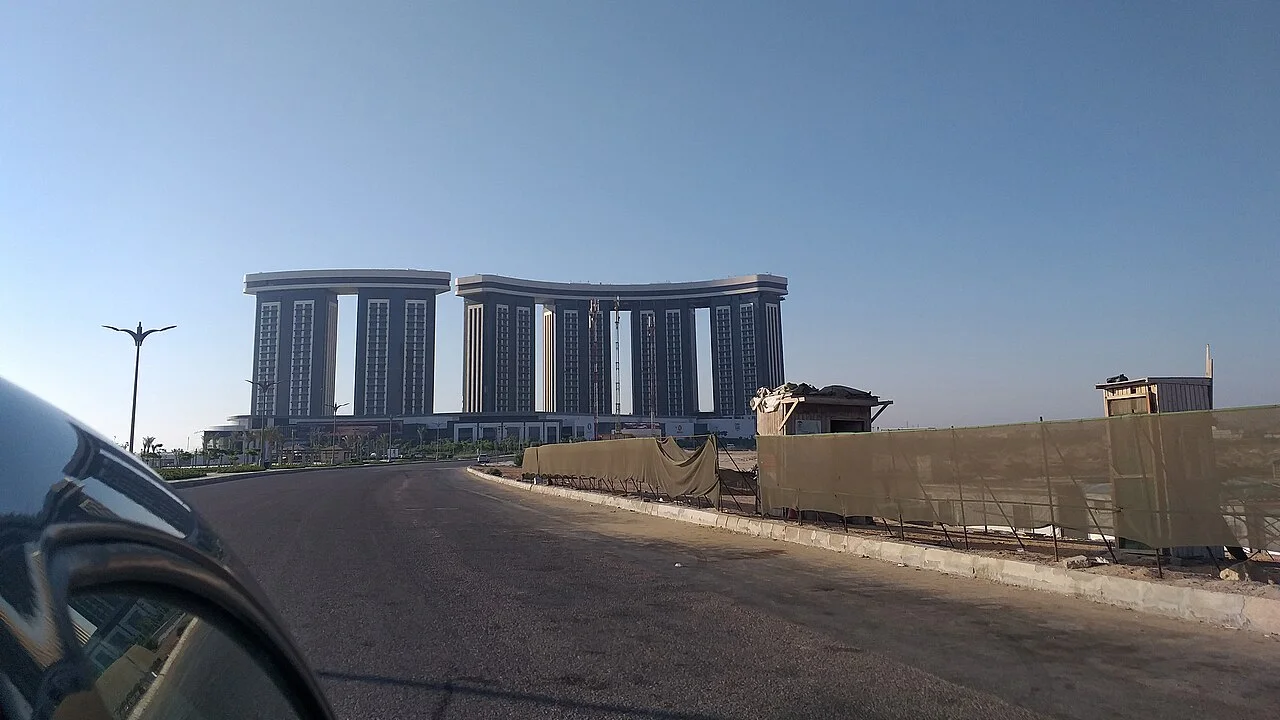
The skyline of New Alamein is already dramatic for a city so young. The North Edge Towers project — a series of soaring residential skyscrapers along the waterfront — is among the most visually striking elements of the first phase. Alongside it, "The Gate" development anchors the promenade with a distinctive architectural statement. City Edge Developments, a joint venture between NUCA and the Housing and Development Bank established in 2017, has been the primary delivery vehicle for the city's largest and most visible assets.
Key Projects & Milestones
| Project | Status / Detail |
|---|---|
| North Edge Towers | Coastal skyscraper cluster, Phase 1 underway |
| The Gate Project | Landmark waterfront development |
| El Masa Mosque | Operational — major city landmark |
| New Alamein Mall | Operational — retail, restaurants & cinema |
| Hotel Rooms (target) | 30,000 across ~30 licensed developers |
| High-Speed Rail | Planned — Ain Sokhna to Marsa Matruh line |
A City Open to All
One of the most deliberate departures from North Coast norms is New Alamein's public access policy. The city's beaches, promenades, and public spaces are not sealed behind private resort gates — they are open to any visitor. This philosophy aligns with the government's goal of repositioning the North Coast as a national and international tourist destination, rather than a seasonal enclave accessible only to Egypt's wealthiest families.
Phase II and Beyond
Phase II of the New Alamein megaproject adds ten more coastal towers and significant expansions of the hotel zone and residential areas. A planned high-speed rail connection running from Ain Sokhna to Marsa Matruh — passing through New Alamein at a projected speed of 250 km/h — will eventually link the city to both Cairo and the Red Sea coast in a single corridor, fundamentally altering the travel landscape of Egypt's northern and western regions.
4) Universities & Education Hub
A central pillar of New Alamein's vision is education. Three universities are planned as part of the city's academic district, with Alamein International University (AIU) already operational since 2020. AIU operates on a purpose-built campus inspired by international academic models, offering programmes across business, engineering, computer science, pharmacy, and the arts. The presence of a functioning university has already begun attracting a year-round population of students and faculty — exactly the demographic New Alamein needs to avoid becoming a ghost city in the winter months.
Plans for additional universities and vocational training institutes reflect Egypt's broader "education city" concept — the idea that clustering academic institutions in a purpose-built environment generates research synergies, entrepreneurial ecosystems, and a sustained young population. For New Alamein, the universities are not merely amenities; they are the engines of permanence that will distinguish it from every seasonal North Coast resort that came before it.
Alamein International University (AIU)
Founded in 2020 under the supervision of Egypt's Ministry of Higher Education, AIU is one of the first fully operational institutions in New Alamein City. Its campus features modern lecture halls, student residences, sports facilities, and research centres. Enrolment has grown steadily each academic year, and the university's year-round academic calendar has been instrumental in establishing a permanent community in the still-developing city. Full campus maps are available at aiu.edu.eg.
5) WWII Heritage: Cemeteries & Military Museum
The land on which New Alamein City is rising is steeped in one of World War II's most pivotal chapters. The Battles of El Alamein — fought in 1942 between Allied and Axis forces across the surrounding desert — marked the decisive turning point of the North African campaign. Three major cemeteries lie within or immediately adjacent to the new city, honouring the dead of three nations, and the El Alamein Military Museum stands as one of the most significant WWII museums on the African continent.
The museum contains an extensive collection of tanks, artillery pieces, armoured vehicles, weapons, maps, uniforms, and personal effects from both the Allied and Axis sides of the conflict. Entry is straightforward and the museum is staffed by guides who contextualise the battle's strategic significance. For many international visitors — particularly from the United Kingdom, Australia, New Zealand, Germany, Italy, and South Africa — a visit to El Alamein remains a solemn and deeply personal pilgrimage.
Three Cemeteries, Three Nations
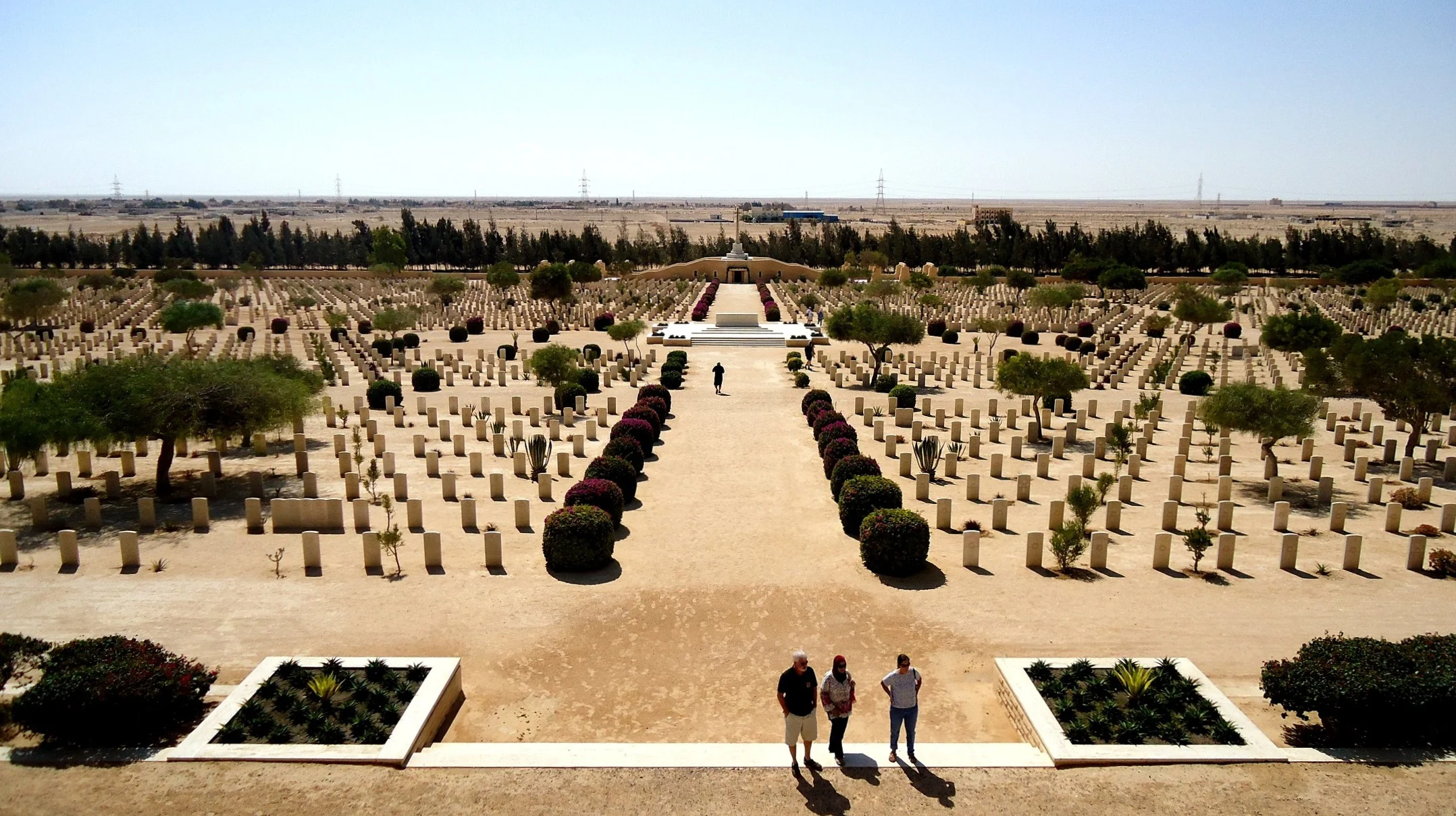
- Commonwealth War Cemetery: Contains 7,240 graves, primarily British, Australian, New Zealand, Indian, and South African soldiers. Inaugurated in 1954 and designed by Hubert Worthington, it is open to visitors daily during daylight hours. The Alamein Memorial within the cemetery commemorates 11,866 Commonwealth forces members with no known grave.
- German War Cemetery: A fortress-like mausoleum structure set on a ridge between the Allied and Italian cemeteries, containing the names of approximately 4,200 German soldiers of the Afrika Korps. Sombre and austere in design, it was completed in 1959.
- Italian Military Memorial (Sacrario): A white marble tower on Tel el-Eisa (Hill of Jesus), designed by Paolo Caccia Dominioni — who himself fought at El Alamein — honouring over 4,600 Italian dead and commemorating the tens of thousands whose remains were never recovered. The largest of the three national memorials at El Alamein.
6) Tourism, Beaches & Cultural Facilities
Beyond its skyscrapers and cemeteries, New Alamein is positioning itself as a Mediterranean leisure destination capable of rivalling European coastal cities. The North Coast climate — warm and dry from May through October and mild throughout winter — makes it genuinely viable for year-round tourism in a way that Upper Egypt's extreme summer heat never permits. The 14-kilometre seafront promenade anchors the waterfront experience and is designed for strolling, cycling, and outdoor dining, with the turquoise Mediterranean always in view.
Cultural infrastructure is being built in parallel with the residential and commercial boom: a Roman Theatre for open-air performances, dedicated studio complexes, an opera hall, and a cinema complex are all either completed or in active construction. The "City of Culture and Arts" district aims to attract festivals, international concerts, film productions, and major exhibitions drawing visitors from Alexandria, Cairo, and beyond. As of 2024, several international hotel chains have established a presence in New Alamein, joining Egyptian operators in building what the government projects will eventually total 30,000 hotel rooms at full capacity.
7) Getting There & Visiting Tips
Getting There
- By Car: Approximately 240 km west of Cairo along the Alexandria–Matrouh International Road. The drive from Alexandria takes about 1.5 hours under normal traffic conditions.
- By Air: El Alamein International Airport handles limited scheduled flights; expansion is planned as the city grows. Cairo International Airport remains the primary international gateway.
- By Rail (future): A high-speed rail line from Ain Sokhna to Marsa Matruh via New Alamein is in active development, projected to operate at 250 km/h with 21 stations.
Best Time to Visit
- Spring (March–May): Ideal weather — warm, clear skies, uncrowded beaches. Perfect for both heritage visits and coastal exploration.
- Summer (June–August): Peak season with busiest beaches; accommodation fills quickly. Book well in advance if visiting during Egyptian school holidays.
- Autumn & Winter (Sept–Feb): Excellent for city exploration, the war cemeteries, and the military museum. The mild Mediterranean winter is far more comfortable than Cairo or Upper Egypt.
A Perfect Day in New Alamein
- Morning (8 AM) — Visit the El Alamein War Cemeteries and Military Museum while the air is cool and before tour groups arrive. Allow at least two hours to do the Commonwealth Cemetery and museum justice.
- Midday (12 PM) — Explore the North Edge Towers promenade and have lunch at one of the beachfront restaurants overlooking the Mediterranean. The Italian Memorial (Sacrario) is a worthwhile nearby stop.
- Afternoon (3 PM) — Walk the city's open public promenades, visit El Masa Mosque, and end the day with sunset views from the coastal waterfront as the towers light up against the evening sky.
Last updated: April 2026. Entry prices and opening hours are subject to change; verify with local authorities or your tour operator before visiting. The war cemeteries are managed by the Commonwealth War Graves Commission (CWGC) and are free to enter.
8) Sources & Further Reading
The following are reputable starting points used to compile the information on this page.
- Egyptian Presidency. New El-Alamein City Project. The Arab Republic of Egypt Presidency, 2018. — Official government overview of the city's masterplan, phases, and objectives.
- State Information Service (SIS) Egypt. New Alamein City. SIS Egypt, 2022. — Detailed government progress report covering infrastructure, education, and investment milestones.
- Gamal, H. New Alamein: A Thriving Integrated City Beckoning Investors. Invest Gate, 2023. — Investment analysis and real estate development status report.
- Commonwealth War Graves Commission (CWGC). El Alamein War Cemetery. CWGC, ongoing. — Authoritative records on the Commonwealth Cemetery, its history, and visiting information.
Hero image and city photographs: Wikimedia Commons, CC BY-SA (New_Alamein_1.jpg, New_Alamein_2.jpg). War Cemetery photograph: Wikimedia Commons (ElAlameinCommonwealthWarCemetery.jpg). Italian Memorial photograph: Wikimedia Commons (Sacrario_Italiano_El_Alamein.jpg). All images used under open licence with attribution.