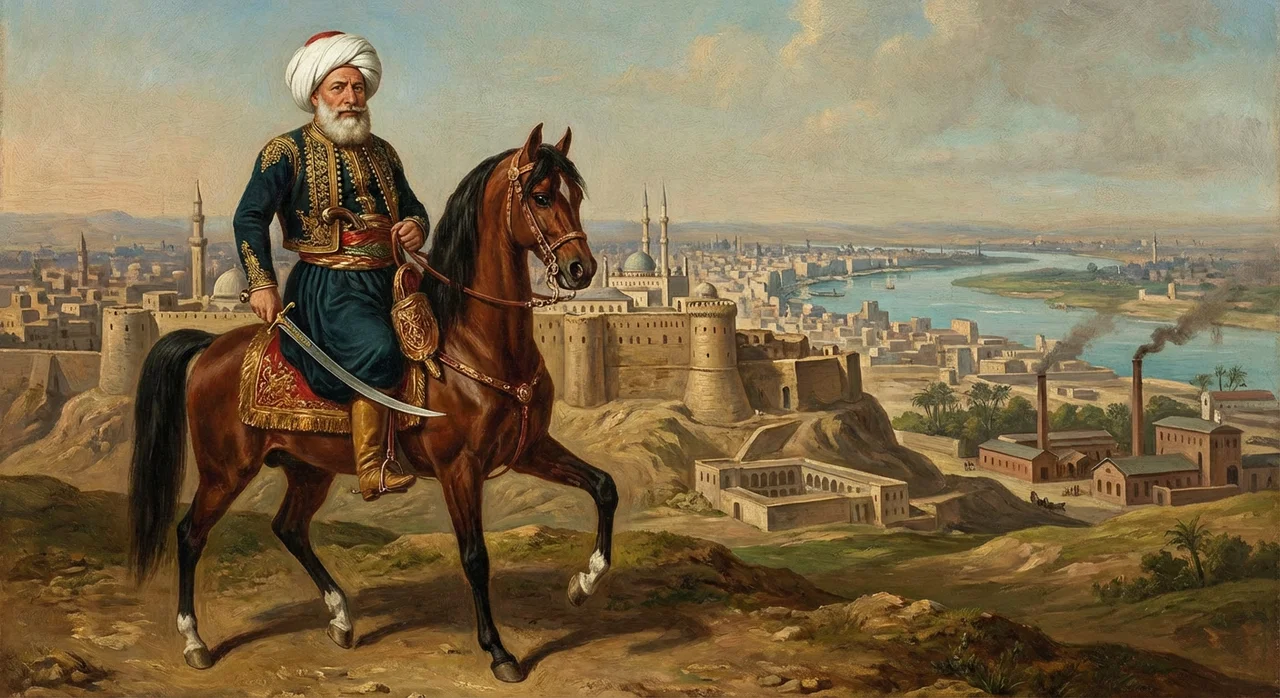
1. The construction of the Suez Canal and the legendary global opening (1869 AD)
The project to build the Suez Canal began with a concession granted by the Egyptian governor Muhammad Said Pasha to his friend, the French engineer Ferdinand de Lesseps, in 1854 AD. The excavations lasted ten full years (1859-1869 AD) with the effort and dedication of more than a million Egyptian farmers and workers, who were exposed to the harshest climatic and sanitary conditions and thousands of whom died as martyrs.
On November 17, 1869 AD, Khedive Ismail held the largest inauguration ceremony of the 19th century. He invited the kings and emperors of the world, especially the Empress Eugenie of France, the Emperor of Austria, and the Crown Prince of Prussia. The Mediterranean Sea and the Red Sea were connected and the three canal cities of Port Said, Ismailia and Port Tawfiq (Suez) were inaugurated.
2. Planning of the Khedive Cairo: the Paris of the East and the Architectural Renaissance
The Khedive Ismail wanted to make Cairo a capital comparable in beauty and organization to Paris and the capitals of Europe, so he sought the help of French engineer Haussmann and Italian engineer Pietro Avocani to plan what is now known as Khedive Cairo:
- Streets and squares: construction of wide and straight streets such as Qasr al-Nil Street, Sharif Street and Ismailia Square (now Tahrir Square);
- Qasr El Nil Bridge: Construction of the first iron bridge connecting Cairo with the west bank of the Nile and decorated with the famous bronze lion statues.
- Khedive Opera: built in wood in 1869 AD. C., it was the first opera in Africa and the East. The international composer Verdi was commissioned to compose the famous opera Aida.
- Abdeen Palace: Construction of a luxurious government headquarters in the heart of the capital as an alternative to the historic Al Jabal Palace.
3. Cultural Renaissance and major intellectual institutions
The Khedive era saw the founding of the greatest scientific institutions that shaped the spirit of the nation:
- The Egyptian House of Books (Khedival Bookstore): was founded in 1870 AD. on the initiative of Ali Mubarak to preserve Arabic heritage and manuscripts.
- Egyptian Geographical Society (1875 AD): Documentation of geographical explorations and Africa;
- Dar Al Uloom School (1872 AD): Train teachers of Arabic language and modern sciences.
- Education for Girls (Al-Siyoufiya School, 1873 AD): The first government school for the education of girls in Egypt and the East, thanks to the efforts of Chesham Afat Hanem.
- The Egyptian Museum: Organization of pharaonic antiquities and their transportation from Boulaq to Giza Palace in preparation for the construction of the Tahrir Museum.
4. Financial crisis, debt funds and foreign intervention
These gigantic development projects were accompanied by wasteful spending and foreign loans on unfair terms imposed by European banks at exorbitant usurious interest rates. When cotton prices fell after the end of the American Civil War, the government defaulted:
- Sale of shares in the Suez Canal (1875 AD): Ismail was forced to sell the Egyptian stake in the canal (176,000 shares) to the British government led by Disraeli at a low price.
- Debt Funds and Bilateral Control: England and France introduced strict financial controls on Egypt's revenues and appointed two European ministers to the Egyptian government.
- Isolation of Khedive Ismail (1879 AD): When Ismail attempted to respond to the national movement and dismiss the two European ministers, Britain and France pressured the Ottoman Sultan Abdul Hamid II to issue a decree dismissing him and appointing his son Muhammad Tawfiq.
5. A guide to Khedive palaces and buildings that can be visited today.
The Khedive era left an urban legacy and lavish royal palaces comparable to Versailles and Buckingham Palaces, and visitors to Cairo can explore them as part of Ultra Egypt Tourism Company's architectural heritage programs:
| Palace/historical place | History of construction and architecture | The most important collectibles and architectural pieces on display | Visiting and permission policies |
|---|---|---|---|
| Abdeen Palace Museum Complex | 1863-1873 AD (French architect Léon Rousseau) | The Khedival Reception Halls, the Museum of Royal Arms, the Museum of Silversmithing and the Hall of the Golden Throne | Open every day in the Abdeen district; It is recommended to book a tour accompanied by an Ultra Egypt cultural guide. |
| Gezira Palace (Marriott Hotel Zamalek) | 1869 AD (Karl von Diebitsch and Julius Franz) | It was built to receive Empress Eugenia at the Canal Gala. It includes classical rooms, lush gardens and rare antiques. | Available for a visit and a classic tea in the lobby of the historic Zamalek palace. |
| Royal Vehicle Museum in Bulaq | The era of Khedive Ismail (the authority of the stirrup) | Gilded royal carriages, including the Kusha carriage of the Khedive and the carriage of Empress Eugenie | A newly equipped museum shows the history of official processions and royal costumes. |
| Downtown and Khedivial area of Cairo | Plan of French engineer Osman and commander Ali Mubarak | Paris architecture, Immobilia and Shawarbi buildings, Qasr al-Nil bridge with statues of the four lions | Morning architectural walking tours to explore Art Deco details. |
6. References and historical documents to study the Khedive era.
For researchers and students of modern history, documentation of the Khedive era is based on important archival sources and reference works:
- New conciliatory plans: Ali Pasha Mubarak Encyclopedia (20 parts), documenting the geography, history and structure of Egypt during the era of Ismail and Tawfiq;
- House of National Archives in Cairo: Contains the records of the Sunni Council, the decree on the accession of Ismail, documents from the Suez Canal negotiations and the correspondence of De Lesseps.
- Records of the Egyptian Geographical Society: Founded in 1875 AD, includes maps and manuscripts exploring the sources of the Nile and the Khedival expeditions in Africa.
Geographic, ecological and tourist infrastructure characteristics.
This destination has a unique strategic location that combines historical richness and attractive environmental diversity, making it an essential pillar on Egypt's developed tourism map. In recent years, ambitious infrastructure development projects have been carried out in the region, including the modernization of the road network, the development of airports and ports and the provision of hotel facilities compatible with international environmental sustainability standards approved by the Ministry of Tourism and Antiquities.
In this destination, cultural experiences are combined with leisure activities and eco-adventure tourism, where visitors can explore archaeological monuments and picturesque nature reserves and interact with local cultural heritage and authentic traditional industries that express the identity and ancient history of the community.
Safety, quality and recognized standards for tourism operations
This new version of the Ultra Egypt Travel program, the Certification and Security Policy in accordance with 874 (Standard) and the IATA Policy (IATA). 90229930) applies the highest standards of safety and comfort for its clients, starting with the fleet of modern tourist vehicles.
Guidelines for planning and adjusting the visiting program
To make the most of it, it's a good idea to book tours and activities in advance, especially during peak season (October to April), and reserve enough time for each activity to avoid burnout. Additionally, by coordinating with tourism consultants, it is possible to design tailored programs that include special VIP access and integrated logistical arrangements.
Academic and official sources and references.
This encyclopedic content has been prepared and verified based on the latest archaeological records and field reports from official organizations and accredited international references:
- Egyptian Ministry of Tourism and Antiquities: statistical data and geographic and service maps for approved tourist destinations, Cairo.
- Egypt Tourism Activation Authority (ETA): Complete guide to cultural, environmental and recreational tourism in Egypt.
- Central Agency for Statistics and Public Mobilization (CAPMAS): Geographic and statistical atlas of the governorates and urban centers of Egypt.
- Egyptian Chamber of Travel and Tourism Companies and Agencies (ETAA): Regulations for the organization of excursions, day trips and approved tourist transport services.
- Ultra Egypt Travel: Records of local tourism operations and quality standards for luxury travel (Ministry of Tourism License 874, Class A).
Are you planning a detailed expedition into the history and civilization of Egypt?
Our consultants at Ultra Egypt Travel (License No. 874 (Class A)) offer specialized tourism programs covering Egypt's most important attractions and museums, accompanied by archaeological guides and academic historians.