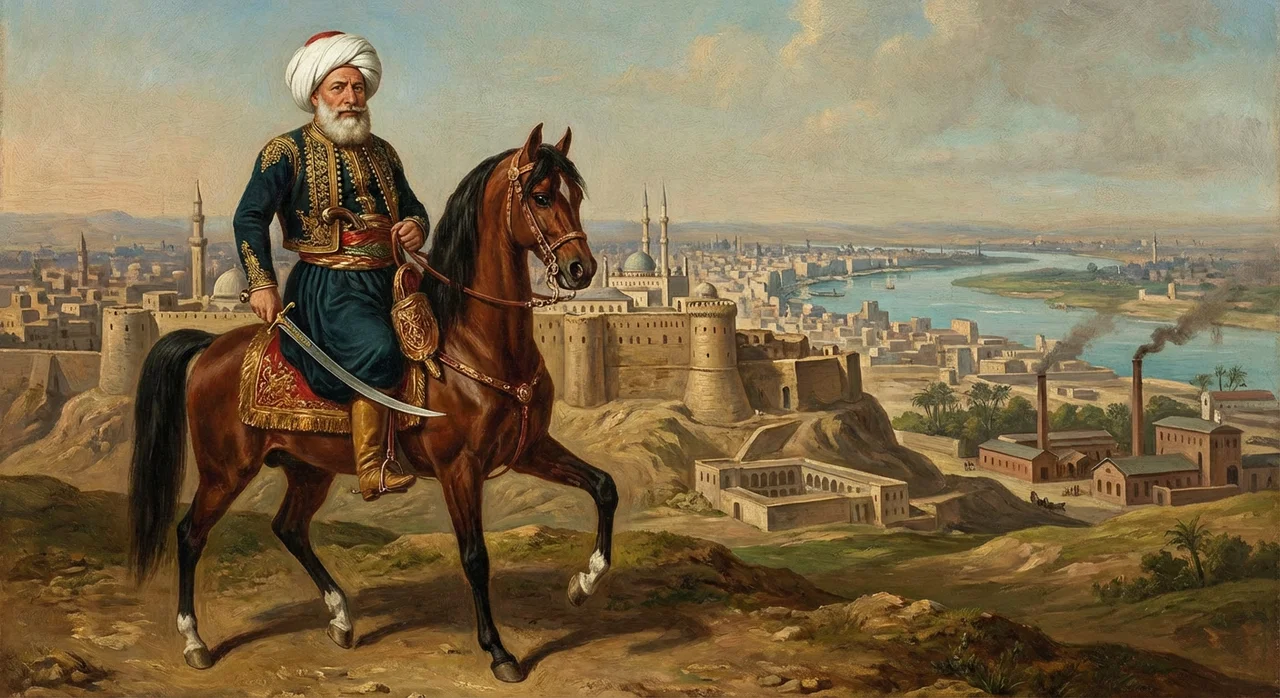
1. The Urabi Revolution and the historical position of Abdeen (1881-1882 AD)
Khedive Tawfiq's pro-foreign policies and War Minister Othman Rifqi's persecution of Egyptian officers brought the national army to a boil. Al-Bakbashi Ahmed Orabi led the Egyptian officers' movement:
- Abdeen Rally (September 9, 1881 AD): Orabi led the army and people to Abdeen Palace Square and presented the demands of the nation: dismissal of Riyadh Pasha's ministry, formation of a European-style parliament, and increase of the army to 18,000 soldiers;
- Immortal Word of Orabi: When Khedive Tawfiq said: "You have no right to all these requests, and I have inherited the kingship of this land from my fathers and grandfathers, and you are nothing but slaves to our benevolence," Orabi decisively replied: "God created us free and not as an inheritance or property. By God, except for whom there is no God, from now on we will neither inherit nor be enslaved."
- The Khedive responded to the demands and the ministry of Sharif Pasha was formed and the basic provisions of the constitution were drafted.
2. The bombardment of Alexandria, the battle of Tel el-Kebir and the occupation of Cairo
Britain saw the Urabi Revolution as a threat to its interests and the Suez Canal. In June 1882 AD, violent incidents occurred in Alexandria to justify military intervention:
- Bombardment of Alexandria (11 July 1882 AD): British naval guns bombarded and destroyed the fortifications of Alexandria, and the army led by Orabi held on to Kafr al-Dawwar and repelled landing attempts.
- De Lesseps' Betrayal: De Lesseps deceived Orabi and promised neutrality of the Suez Canal and prevented the entry of warships, but allowed the British fleet to cross the canal and land in Ismailia.
- Battle of Tell El-Kebir (September 13, 1882 AD): In a surprise attack at dawn, aided by the betrayal of some Bedouins and advisors, the Egyptian army was defeated and British forces entered Cairo on September 14, 1882 AD, occupying the mountain castle. Orabi and his companions were exiled to the island of Ceylon (Sri Lanka).
3. The reign of Lord Cromer and the Denshway incident (1906 AD)
Britain established a system of “covert protection”; The Khedive remained a name, while real power was in the hands of the British commissioner Evelyn Baring (Lord Cromer) for a quarter of a century (1883-1907 AD). Cromer dedicated the Egyptian economy to the textile mills of Lancashire, Britain, neglecting industrial and higher education.
4. The struggle of Mustafa Kamel and Muhammad Farid and the awakening of national consciousness
The national movement was greatly revitalized in the early 20th century thanks to the efforts of young national figures:
- Former writer (1874-1908): "The king's father was the king's son." He founded the Al-Liwaa newspaper in 1900 AD. C., published complaints about the occupation in Paris and London, founded the National Party in 1907 AD. C. and called for the establishment of the Egyptian National University.
- Leader Muhammad Farid (1868-1919 AD): He continued the struggle after the death of Mustafa Kamel and spent all his wealth on the national cause. He founded the first workers' union in Egypt (1909 AD) and popular night schools to educate workers and peasants free of charge until he died in poverty in his German exile.
5. Leaders of the National Movement: Mustafa Kamel, Muhammad Farid and the Dinshaway tragedy
Egyptian youth and intellectuals waged a civil and diplomatic struggle that shook the foundations of the British Empire in international forums:
- Leader Mustafa Kamel and Al-Liwaa newspaper: founded the National Party, issued his famous saying: “If I were not Egyptian, I would like to be Egyptian” and took the Egyptian cause to the capitals of Europe and France.
- The Denshaway Incident (1906 AD): The British occupation executed innocent peasants in the village of Denshaway in Menoufia, and Mustafa Kamel took advantage of this in a major international press campaign that forced the British government to dismiss British commissioner Lord Cromer.
- Leader Mohamed Farid: He spent his entire fortune supporting unions and night schools for the people, and continued the fight in exile in Europe until his death in defense of Egypt's total independence and the constitution.
6. Architectural evidence of colonial-era battles in Cairo and the Canal
Find out what you get from your browser:
- Abdeen Square in Cairo: Witness the historic stance of leader Ahmed Orabi in front of the Khedive Tawfiq on September 9, 1881 AD. and his statement: “God created us free and did not create us as inheritance or property.”
- Dinshaway Tombs and Museum in Menoufia – a building documenting the events of the tragedy, colonial-era gallows and statues of stalwart farmers.
- Landmarks of the canal cities (Port Said, Ismailia, Suez): evidence of the former British base camps of Fayed and the epics of the Egyptian guerrillas in the Tell El-Kebir field.
Geographic, ecological and tourist infrastructure characteristics.
This destination has a unique strategic location that combines historical richness and attractive environmental diversity, making it an essential pillar on Egypt's developed tourism map. In recent years, ambitious infrastructure development projects have been carried out in the region, including the modernization of the road network, the development of airports and ports and the provision of hotel facilities compatible with international environmental sustainability standards approved by the Ministry of Tourism and Antiquities.
In this destination, cultural experiences are combined with leisure activities and eco-adventure tourism, where visitors can explore archaeological monuments and picturesque nature reserves and interact with local cultural heritage and authentic traditional industries that express the identity and ancient history of the community.
Safety, quality and recognized standards for tourism operations
Ultra Egypt Travel, under Ministry of Tourism License No. 874 (Class A) and IATA membership (IATA 90229930), is committed to applying the highest standards of safety and comfort for its clients, starting with the fleet of modern tourist vehicles equipped with tracking and navigation systems, to the permanent accompaniment of field support teams and 24-hour concierges to ensure an exceptional and smooth travel experience.
Guidelines for planning and adjusting the visiting program
To make the most of it, it's a good idea to book tours and activities in advance, especially during peak season (October to April), and reserve enough time for each activity to avoid burnout. Additionally, by coordinating with tourism consultants, it is possible to design tailored programs that include special VIP access and integrated logistical arrangements.
Academic and official sources and references.
This encyclopedic content has been prepared and verified based on the latest archaeological records and field reports from official organizations and accredited international references:
- Egyptian Ministry of Tourism and Antiquities: statistical data and geographic and service maps for approved tourist destinations, Cairo.
- Egypt Tourism Activation Authority (ETA): Complete guide to cultural, environmental and recreational tourism in Egypt.
- Central Agency for Statistics and Public Mobilization (CAPMAS): Geographic and statistical atlas of the governorates and urban centers of Egypt.
- Egyptian Chamber of Travel and Tourism Companies and Agencies (ETAA): Regulations for the organization of excursions, day trips and approved tourist transport services.
- Ultra Egypt Travel: Records of local tourism operations and luxury travel quality standards (Ministry of Tourism License 874, Class A).
Are you planning a detailed expedition into the history and civilization of Egypt?
Our consultants at Ultra Egypt Travel (License No. 874 (Class A)) offer specialized tourism programs covering Egypt's most important attractions and museums, accompanied by archaeological guides and academic historians.