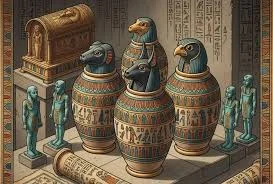
"I am Imsety... I am Hapi... I am Duamutef... I am Qebehsenuef. We have come to be your protection."
During mummification, the internal organs—which decompose rapidly—were removed from the body to ensure its preservation. These vital organs were not discarded but were washed, wrapped, and stored in sacred vessels known as Canopic Jars.
The jars were typically made of limestone, alabaster, or pottery. Initially, they had simple flat lids, but from the New Kingdom onwards, they featured lids shaped as the heads of the Four Sons of Horus, the divine guardians entrusted with protecting the organs until the deceased was reborn in the Afterlife.
The Four Guardians
Each jar was specific to an organ, a deity, a cardinal direction, and a protective goddess.
Imsety
- Form: Human Head
- Organ: The Liver
- Direction: South
- Protective Goddess: Isis
- Significance: The liver was associated with emotion and will.
Hapi
- Form: Baboon Head
- Organ: The Lungs
- Direction: North
- Protective Goddess: Nephthys
- Significance: The baboon represented the dawn and breath of life.
Duamutef
- Form: Jackal Head
- Organ: The Stomach
- Direction: East
- Protective Goddess: Neith
- Significance: The stomach represents digestion and sustenance.
Qebehsenuef
- Form: Falcon Head
- Organ: The Intestines
- Direction: West
- Protective Goddess: Serqet
- Significance: Intestines were linked to purification.
The Importance of Extraction
The Ancient Egyptians understood that decomposition starts from the inside out. Organs with high moisture content and bacteria (like the stomach and intestines) had to be removed to allow the body to be successfully dehydrated by natron.
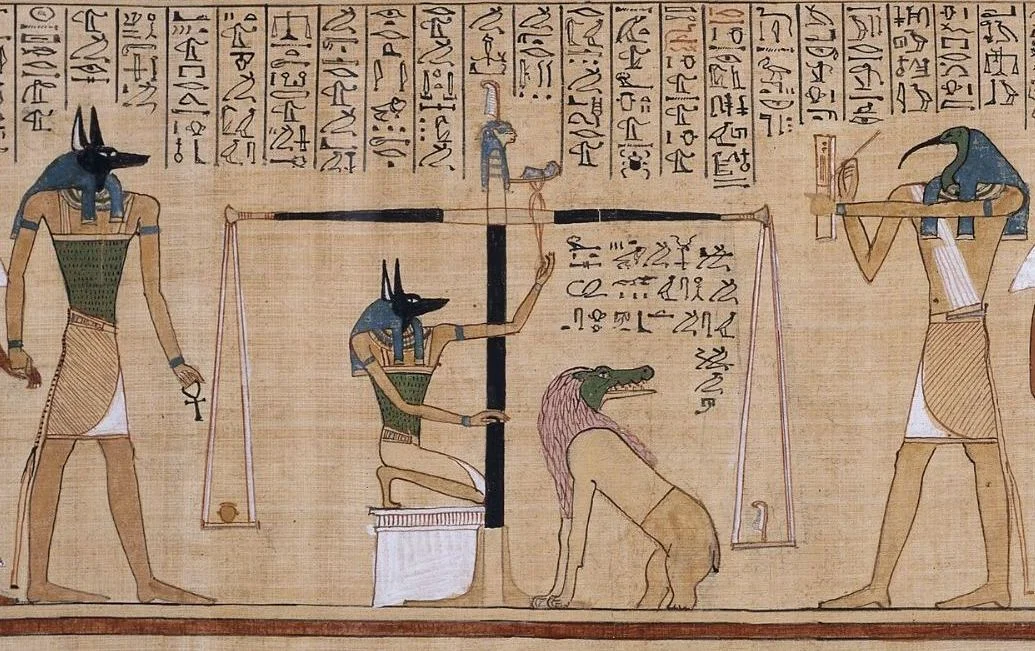
However, the Heart (Ib) was never placed in a jar. It was left in the chest cavity because it was believed to be the seat of intelligence and the soul, needed for the final judgment in the Hall of Truth.
Evolution of the Jars
Old Kingdom: Simple stone jars with flat lids.
Middle Kingdom: Lids began to be shaped as human heads (often resembling the deceased).
New Kingdom (18th Dynasty): The classic animal-headed forms of the Four Sons of Horus appeared.
Third Intermediate Period: Mummification techniques improved so organs were wrapped and returned to the body cavity. Dummy jars (solid, with no cavity) were still placed in tombs for symbolic protection.