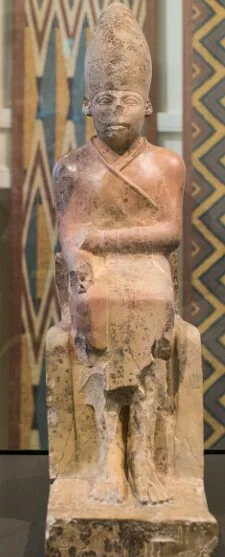
Chronological & Historical Context
King Peribsen ruled during a period of deep religious and political turmoil in Egypt's Second Dynasty. He succeeded a period of dynastic confusion following Nynetjer's long reign and stands out as the only Egyptian king before the 19th Dynasty who placed the Seth-animal rather than the Horus falcon atop his royal serekh.
- Reign: Approximately 2780 – 2760 BC (circa 17–20 years).
- Dynasty: 2nd Dynasty.
- Significance: Radical break with tradition – replaced Horus with Seth on his royal name, reflecting a deep religious schism.
- Predecessor: Uncertain (likely Senedj or a period of division following Nynetjer).
- Successor: Khasekhemwy (who reunified Egypt and honored both Horus and Seth).
Name, Titles, and Identity
🔹 Seth Name (Instead of Horus): Seth-Peribsen
The king's name is composed of the Seth-animal and the word Peribsen, meaning "He who comes forth by the will of Seth" or "The hope/desire of Seth."
➡️ Interpretation: "The one who is revealed through Seth" or "The chosen of Seth."
🔹 Alternative Names and Variants
- Perabsen, Perybsen: Variant spellings.
- Nebty Name: Nebty-Peribsen — "The Two Ladies are the hope/desire."
- Abydos King List: Appears as Peribsen (preserving his Seth-identity).
- Saqqara King List: Omits him entirely — a deliberate act of damnatio memoriae by the Memphite priesthood.
- Turin King List: Damaged, but a fragment may preserve part of his name.
- Manetho: Uncertain; possibly recorded as Sethenes or omitted.
Egypt Before Peribsen
The period before Peribsen was marked by the long reign of Nynetjer, who had formally divided Egypt's administration into Upper and Lower Egyptian bureaucracies. After Nynetjer's death, the succession became uncertain.
- Predecessors: Hotepsekhemwy, Raneb, and Nynetjer.
- State of the Realm: Egypt was a mature centralized state, but the dual administration may have encouraged regional autonomy.
- Religious Landscape: The cult of Horus was dominant in the north (Memphis), while Seth had strong cult centers in the south (especially at Nubt/Naqada).
- Dynastic Crisis: The transition after Nynetjer was unclear, with multiple shadowy kings (Senedj, Sekhemib-Perenmaat) appearing in the records.
Reign & Major Events
Peribsen's reign was marked by political division and religious tension. He likely ruled primarily over Upper Egypt (the south) from Abydos.
⚔️ Political Division
- Divided Kingdom: Peribsen probably controlled Upper Egypt, while a rival Horus-king (possibly Sekhemib-Perenmaat) ruled Lower Egypt.
- Southern Base: His tomb at Abydos and the concentration of his artifacts in the south indicate his power base was in Upper Egypt.
- Possible Civil War: The Horus-Seth conflict may have been an actual civil war between the Two Lands.
🛕 Religious Revolution
- Breaking Tradition: For over 200 years, every king had placed the Horus falcon on his serekh. Peribsen abandoned this entirely.
- Seth's Meaning: Seth was the god of chaos, storms, and foreign lands, but also a powerful protective deity. By choosing Seth, Peribsen made a radical theological claim.
- Deliberate Provocation: He may have intentionally provoked the Horus-worshippers to assert his dominance.
The Seth-Horus Conflict: Religious Revolution or Political Statement?
This is the defining and most extraordinary aspect of Peribsen's reign—a break with tradition that would not be repeated for over a thousand years.
⚡ The Sethian Choice
- Royal Tradition Broken: For over 200 years, every Egyptian king had placed the Horus falcon on his serekh. Peribsen replaced Horus with the Seth-animal.
- Seth's Character: Seth was the traditional rival of Horus. In mythology, they fought for control of Egypt. By choosing Seth, Peribsen was aligning himself with the "other" divine power.
- Religious Schism: A genuine religious movement in Upper Egypt may have elevated Seth above Horus, and Peribsen was its champion.
🏛️ Political Interpretation
- Southern Rebellion: Peribsen may have been a southern king who rejected the northern (Memphite) Horus-cult as a way of asserting independence.
- Regional Tradition: Seth had strong cult centers in Upper Egypt (especially at Nubt/Naqada). Peribsen may have been a local ruler who continued his local traditions.
- Rival King Sekhemib: Some scholars believe Peribsen ruled concurrently with a Horus-king named Sekhemib-Perenmaat, meaning Egypt was split into two kingdoms.
Family and Royal Lineage
Peribsen's family background is almost completely unknown due to the fragmentary nature of the period:
- Predecessor: Uncertain. He likely followed Senedj or Nynetjer (or may have been a contemporary rival to Sekhemib-Perenmaat).
- Relationship to Predecessors: Unknown. He may have been a usurper, a regional ruler from Upper Egypt who seized power, or a legitimate heir who deliberately broke with tradition.
- Successor: Khasekhemwy, the final king of the Second Dynasty, who reunified Egypt and incorporated both Horus and Seth into his royal name.
- Consort/Wives: None are known. No queen burials or inscriptions naming a wife of Peribsen have been identified.
- Children: None are attested. If he had any, they were likely superseded by Khasekhemwy.
Other Attestations
Despite his controversial status, Peribsen left behind a significant archaeological footprint:
- Tomb P at Abydos: His tomb at Umm el-Qa'ab marks a return to the Abydos royal cemetery, confirming his identification with Upper Egypt.
- Tomb Stelae: Two large stelae were found in his tomb, both bearing his serekh with the Seth-animal. One is now in the British Museum, the other in the Louvre.
- Stone Vessels: Many stone vessels inscribed with his name have been found at Abydos and Saqqara (possibly as loot or later deposits).
- Seal Impressions: Clay seal impressions with his name have been found at Elephantine (in the deep south), indicating his control over Upper Egypt.
- Ivory Labels: Several year-labels have been recovered, recording festivals and administrative events.
Governance & Administration
Peribsen's administration was likely limited to Upper Egypt, though he maintained the bureaucratic structures of his predecessors:
- Regional Control: His artifacts are concentrated in the south, suggesting he did not control Lower Egypt.
- Administrative Continuity: He used the same bureaucratic titles and record-keeping practices as earlier kings.
- Taxation & Tribute: Year-labels record cattle counts and other administrative events, indicating a functioning system.
- Royal Estates: He controlled agricultural estates in Upper Egypt to support his court.
Religion & Ideology
Peribsen's religious policies were the defining feature of his reign, reflecting a radical departure from tradition:
- Seth Worship: By placing the Seth-animal on his serekh, he elevated Seth above Horus in his own royal ideology.
- Nebty Title: He used the Nebty name "Peribsen" ("The Two Ladies are the hope/desire"), maintaining the traditional connection to Nekhbet and Wadjet.
- Southern Focus: His return to Abydos for burial and his concentration of artifacts in the south suggest a deliberate rejection of the northern (Memphite) religious establishment.
- Religious Schism: His reign is the clearest evidence of a major religious conflict between the followers of Horus and Seth.
Key Artifacts of Peribsen
Several significant artifacts from Peribsen's reign have survived, providing insight into his rule and the Horus-Seth conflict:
- British Museum Stela: A limestone stela from his tomb bearing the Seth-animal serekh.
- Louvre Stela: A second stela from his tomb, also bearing the Seth-animal.
- Stone Vessels: Many inscribed with his name, some re-carved from earlier kings.
- Seal Impressions: Found at Elephantine and Abydos, confirming his control over Upper Egypt.
- Ivory Labels: Commemorative plaques recording year-events of his reign.
Tomb & Burial: Tomb P at Abydos
Peribsen's tomb is one of the most important of the Second Dynasty, marking a return to the ancestral royal cemetery at Abydos.
📐 Architecture
- Location: Umm el-Qa'ab, Abydos – Tomb P.
- Dimensions: Approximately 19 × 18 meters – a substantial structure.
- Structure: A brick-lined pit with a wooden-roofed burial chamber, with storage chambers for funerary goods.
- No Subsidiary Burials: Unlike the First Dynasty kings, Peribsen's tomb had no subsidiary graves of retainers—the practice had been abandoned.
🏺 Findings & Significance
- Stelae: Two limestone stelae at the entrance, both prominently displaying the Seth-animal.
- Stone Vessels: Many fine vessels, some re-inscribed with his name.
- Seals & Ivory: Seal impressions and ivory objects recovered from the tomb.
- Robbery: The tomb was robbed in antiquity but still yielded important artifacts.
- Significance: Tomb P confirms Peribsen's identification with Upper Egypt and the ancestral royal traditions of Abydos.
Art in the Age of Peribsen
The art of Peribsen's reign reflects the religious conflict of the period, with the Seth-animal replacing the Horus falcon in royal iconography:
- Relief Carving: The tomb stelae feature fine raised relief work, with the Seth-animal clearly depicted.
- Iconography: The Seth-animal (a composite creature with a curved snout, erect ears, and a forked tail) replaces the Horus falcon on the serekh.
- Inscriptions: Well-executed hieroglyphs, though the name itself is a radical departure from tradition.
- Craftsmanship: Stone vessels and seals reflect a continued high level of craftsmanship despite the political turmoil.
Legacy & Damnatio Memoriae
Peribsen's legacy is complex, controversial, yet historically crucial. His reign forced his successors to address the religious split directly.
- Religious Revolutionary: He was the only king before the Ramesside period to entirely replace Horus with Seth. His reign demonstrates that early Egyptian religion was not monolithic.
- Evidence of Dynastic Crisis: His reign provides the clearest evidence that the Second Dynasty was a period of instability, regional conflict, and possibly civil war.
- Omission from Saqqara List: The Saqqara King List completely omits Peribsen—a deliberate act of damnatio memoriae by the northern priesthood, who refused to acknowledge a Seth-worshipping king as a legitimate ancestor.
- Inclusion in Abydos List: The Abydos King List includes Peribsen, revealing a north-south division in historical memory that mirrored the original political split.
- Khasekhemwy's Compromise: Peribsen's successor, Khasekhemwy, famously reunified Egypt and placed both Horus and Seth side-by-side on his serekh—a brilliant political and religious compromise that symbolized the reunification of the Two Lands.
📌 Comprehensive Summary
👑 Name: Peribsen (Seth-Peribsen — He who comes forth by the will of Seth)
🕰️ Era: Early Dynastic Period (c. 2780 – 2760 BC)
🏛️ Dynasty: 2nd Dynasty
⚡ Greatest Legacy: Replaced Horus with Seth on his royal serekh – the first and only king before the New Kingdom to do so
👪 Family: Predecessor uncertain → Successor Khasekhemwy (reunifier)
⚰️ Burial: Tomb P, Umm el-Qa'ab, Abydos