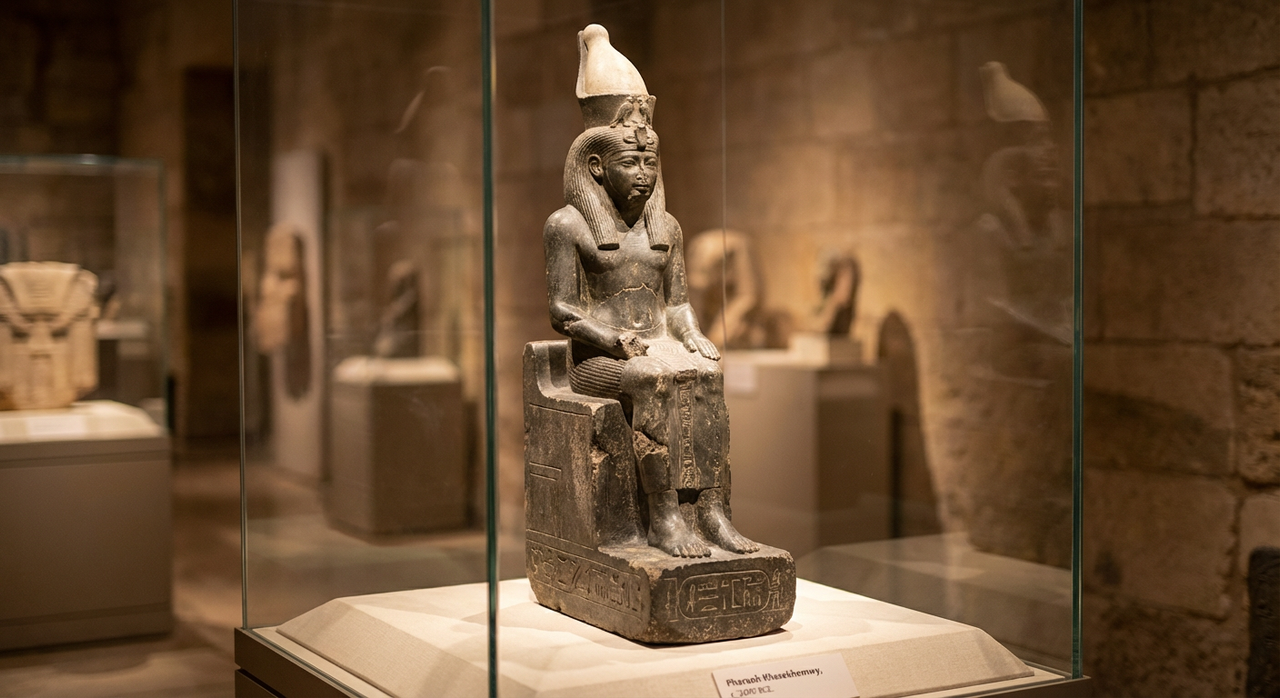
Khasekhemwy
The unifier who ended a civil war and fathered an age of pyramids.
(Hor-Khasekhemwy)
Civil War and Reunification
Khasekhemwy ascended the throne at a time of intense internal conflict. The Second Dynasty appears to have been plagued by a civil war between the north and south, possibly symbolized by the divine struggle between the gods Horus (of the south) and Seth (of the north).
Inscriptions on statues he dedicated at Hierakonpolis record a brutal victory over northern rebels, listing over 47,000 casualties. After crushing the rebellion, he did something remarkable: instead of punishing his enemies, he sought to heal the nation.
The Bridge to the Old Kingdom
Khasekhemwy is one of the most pivotal figures in Egyptian history because he stands at the crossroads of two great eras. He is the last king of the Early Dynastic Period and the direct father of the king who would launch the Old Kingdom.
- Dynastic Link: His wife, Queen Nimaathap, is referred to in later texts as the "Mother of the King's Children," and their son was none other than Djoser, the builder of the first pyramid.
- Era of Stability: By ending the civil war and reunifying the country, Khasekhemwy created the peace and prosperity necessary for his son to launch the massive state projects that would define the Pyramid Age.
- Final King of an Era: His death and burial at Abydos mark the definitive end of the Early Dynastic Period. With his son Djoser, a new era of monumental stone architecture would begin.
Architectural Pioneer
Khasekhemwy's building projects were the direct inspiration for the pyramids. He experimented with monumental construction on a scale never before seen.
- Shunet el-Zebib: At Abydos, he built a massive mudbrick funerary enclosure with walls over 10 meters high. This structure is the world's oldest-surviving mudbrick building of its size and served as a direct model for the enclosure wall of Djoser's Step Pyramid complex.
- Tomb V at Abydos: His tomb was revolutionary. It was the first to have a burial chamber built entirely of dressed limestone blocks, a huge leap in technology from the mudbrick and wood of his predecessors.
- Early Stone Construction: The use of limestone in his tomb demonstrated that Egyptian builders had mastered the quarrying, transportation, and construction of stone on a large scale. It was the final step needed before the construction of a full pyramid was possible.
Legacy: The Father of the Pyramid Age
While Djoser and his architect Imhotep are famous for building the first pyramid, their achievement would have been impossible without the foundation laid by Khasekhemwy.