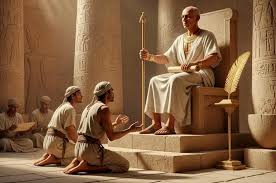
"The Vizierate is not sweet; it is bitter as gall... He is the one who must not make distinctions between the high and the low... He is the copper shield that protects the gold of the King." – The Installation of the Vizier (Text from the Tomb of Rekhmire).
The Pharaoh was the divine head of state, but the man who actually ran Egypt was the Vizier (Tjaty). He was the Prime Minister, the Chief Justice, and the Head of the Treasury all rolled into one. In many periods, the country was so vast that two viziers were appointed: one for Upper Egypt (in Thebes) and one for Lower Egypt (in Memphis).
The Weight of Office
The Vizier reported directly to the Pharaoh every morning. His responsibilities were immense, covering every aspect of civil life.
Treasury & Taxation
The Vizier oversaw the collection of taxes (grain, cattle, linen) from all the Nomes (provinces). He managed the state granaries, ensuring the country had enough food to survive droughts and pay its workers.
High Justice
As the supreme judge, he presided over the High Court. He wore a pendant of the goddess Ma'at (Truth) around his neck, symbolizing his duty to judge fairly without bias or corruption.
Builder of Monuments
No pyramid, temple, or canal could be built without the Vizier. He was the supreme coordinator of the workforce.
- Royal Projects: He organized the conscription of labor (corvée) during the flood season to build the King's tomb.
- Logistics: He managed the transport of materials, ensuring that stone from Aswan and gold from Nubia reached the construction sites on time.
Giants of Administration
Some Viziers became so powerful and respected that they overshadowed the Kings they served.
-
Imhotep: Vizier to Djoser. He was the architect of the first pyramid (Step Pyramid) and a physician. He was later deified as a god of wisdom.
-
Ptahhotep: Famous for writing the "Maxims of Ptahhotep," a book of wisdom on how to be a good official and a moral person.
-
Rekhmire: Vizier to Thutmose III. His tomb in Luxor contains the most detailed text describing the duties and installation of a Vizier.