The Valley Temple of Menkaure stands at the eastern foot of the Giza Plateau, marking the lower end of the ceremonial causeway that connects it to the third — and smallest — of the three great Giza pyramids. Built for the 4th Dynasty pharaoh Menkaure (reigned c. 2532–2503 BCE), this lower temple was the first station in the elaborate funerary journey of the king, where his mortal remains were received from the Nile Valley before being carried up to the mortuary temple for final rites. Although it never reached the full grandeur its builder intended, the temple has yielded some of the most breathtaking royal sculptures ever discovered in Egypt.
Unlike the polished granite temples of Khafre immediately to the north, Menkaure's valley temple presents a striking contrast: a lower body of fine Aswan granite casing and a superstructure hastily completed in mudbrick and white-plastered limestone following the king's unexpected death. This unfinished state, rather than diminishing the monument, offers modern scholars an invaluable cross-section of ancient Egyptian royal building practices — and it is the contents of its buried courts, not its walls, that have secured its fame.
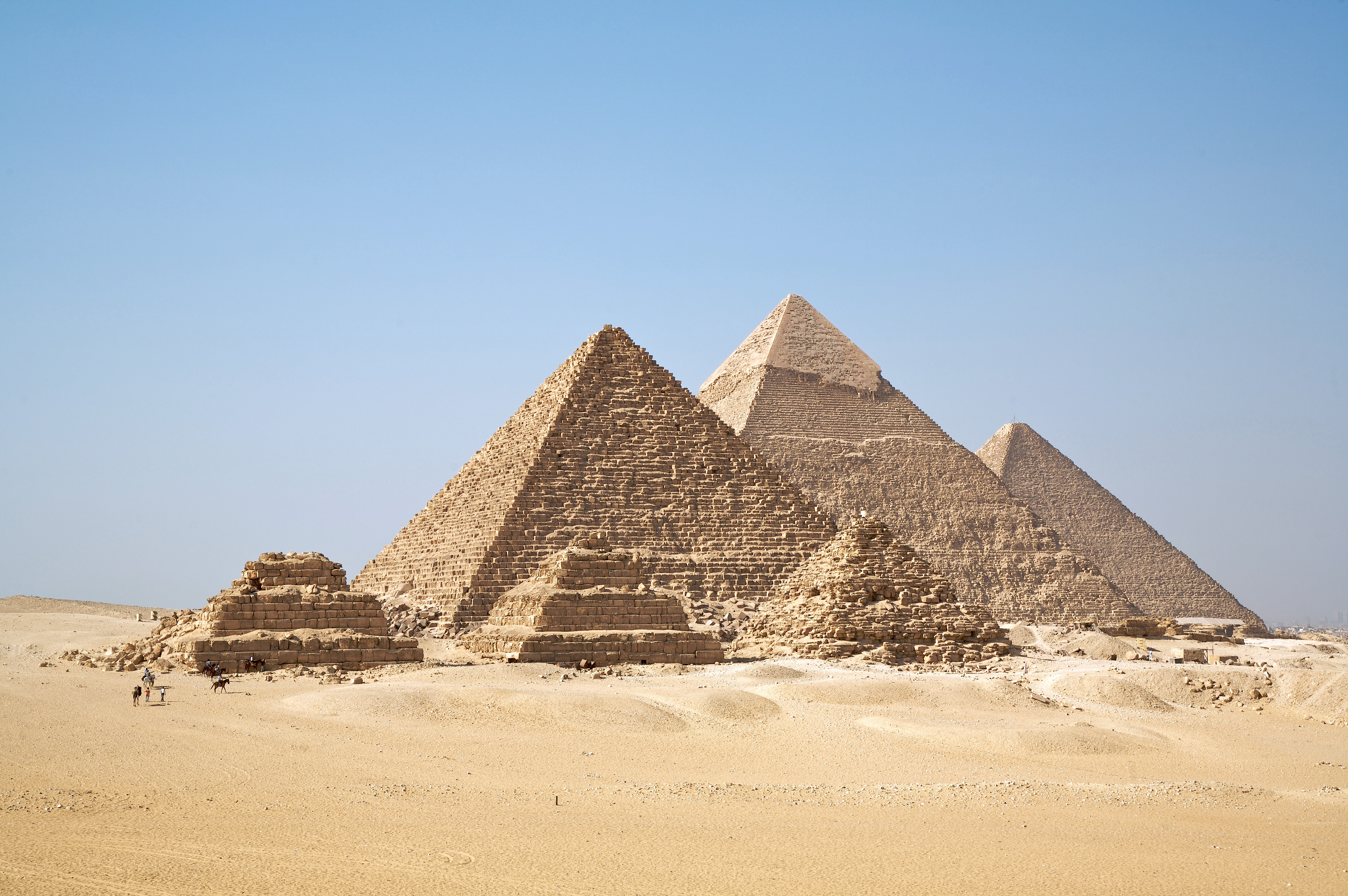
Table of Contents
Overview of the Valley Temple
Valley temples — also called lower temples — were the gateway structures of Egyptian royal funerary complexes. They sat at the cultivation's edge, accessible from the Nile via a quay and a short canal. The royal body arrived here, was purified and processed, and then carried along an enclosed causeway to the mortuary temple against the pyramid's face. In the case of Menkaure's complex, this ritual pathway ran roughly 608 metres from the valley temple to the pyramid's base, and the valley temple itself covered an area of approximately 45 × 45 metres.
The Menkaure valley temple differs from Khafre's well-preserved alabaster-and-granite precursor in one fundamental way: it was never finished. A rectangular podium of large granite blocks forms the base, but the walls above that level were hurriedly erected in mudbrick and covered in white lime plaster — an emergency completion measure ordered by Shepseskaf, Menkaure's successor, who was himself facing a short reign and limited resources. Despite this compromise, the underground storage chambers and statue niches were fully appointed and sealed with some of the finest sculptures ancient Egypt ever produced.
Historical Background
The construction of Menkaure's funerary complex unfolded against the backdrop of the 4th Dynasty's extraordinary building programme — the same century that had already produced the Great Pyramid of Khufu and the Pyramid of Khafre. Menkaure, whose Horus name was Kakhet, appears to have begun his pyramid and associated temples relatively early in his reign, yet his complex was manifestly smaller and less elaborately finished than those of his predecessors, perhaps reflecting a shift in royal ideology away from colossal construction toward refined artistic quality.
Menkaure ascends the throne as the sixth ruler of the 4th Dynasty. Construction of his pyramid complex, including the valley temple, likely begins early in his reign.
Menkaure dies before the funerary complex is complete. The lower courses of the valley temple's walls had been cased in granite, but the superstructure remained unfinished.
Shepseskaf, Menkaure's son and successor, completes the valley temple using mudbrick construction plastered with white lime, and seals the statue deposits within the temple's storerooms.
The valley temple falls out of active funerary use as the Middle Kingdom shifts royal burial traditions to Thebes. The structure gradually silts over and is forgotten under the desert sands.
George Andrew Reisner of the Harvard–Boston expedition excavates the entire Menkaure pyramid complex, including the valley temple. In 1908 he discovers the celebrated triad statues still sealed in their storage chambers.
Reisner publishes Mycerinus: The Temples of the Third Pyramid at Giza, providing the definitive scholarly account of the valley temple and its finds, a reference that remains authoritative to this day.
Reisner's discovery remains one of the great moments in Egyptological history. Working through layers of wind-blown sand and debris in the temple's storerooms, his team found intact deposits of greywacke sculpture that had been placed there — apparently never used in formal worship — when Shepseskaf sealed the building. The finds transformed scholarly understanding of Old Kingdom royal ideology and the purpose of valley temple statue programmes.
Architecture and Construction
The valley temple of Menkaure was built on a roughly square plan with its main axis running east–west, oriented to face the rising sun and the Nile to the east. The lower exterior walls were encased in finely dressed granite blocks quarried at Aswan and shipped north by river — the same deep-red Aswan granite used for the lower courses of the pyramid itself and for the interior casing of the mortuary temple. This granite socle reaches to a height of approximately two to three metres and still survives in substantial sections today.
Above this granite base, where Menkaure's builders intended to continue with stone, Shepseskaf's architects instead laid courses of large mudbrick, which were then coated inside and out with thick white plaster. The plaster was carefully finished and scored to simulate stone block joints, creating a visual impression of an all-stone building for anyone standing at a distance. The interior layout comprised an entrance vestibule opening into a courtyard, flanked by storage magazines and statue niches arranged along the side walls, with a sanctuary at the rear. The plan closely mirrors Khafre's valley temple, though with less elaborate detailing and no surviving alabaster flooring.
The causeway connecting the valley temple to the mortuary temple was also left partially unfinished: only its lower stone courses were laid before mudbrick fill and plaster took over. The mortuary temple, similarly, was an emergency completion by Shepseskaf, this time in small limestone blocks plastered over. Together, these works paint a coherent picture of a royal succession under pressure — the new king determined to provide a complete funerary apparatus for his father while simultaneously beginning his own monuments at South Saqqara.
Key Features and Interior Spaces
Although the valley temple's architecture is partially ruined, several interior spaces can be identified from Reisner's excavation records and the surviving masonry.
The Entrance Vestibule
The eastern façade originally featured a portico or gateway giving access to a transverse vestibule. This entry hall would have been the threshold crossed by the king's funerary cortège and, later, by priests attending the regular offering cult. Traces of granite threshold blocks and column bases suggest a colonnaded forecourt of modest dimensions.
The Central Court and Storage Magazines
Behind the vestibule, a rectangular court — perhaps open to the sky or covered with a wooden roof — formed the functional heart of the temple. Along its flanking walls were narrow storerooms (magazines) cut into the mudbrick structure. It was precisely in these sealed magazines that Reisner found the extraordinary triad statues, standing or lying where they had been placed by Shepseskaf's priests, apparently never displayed in the temple's public areas.
Granite Socle
The lower exterior walls retain substantial sections of their original Aswan granite casing, offering a vivid contrast to the mudbrick superstructure above.
Sealed Magazine Chambers
The side storerooms were deliberately sealed after the statue deposits were placed inside, preserving them intact for nearly 4,500 years until Reisner's excavation.
Causeway Junction
The western wall of the temple connects directly to the causeway ramp, allowing visitors to trace the ancient processional route toward the pyramid.
Plaster-Scored Walls
The mudbrick upper walls were finished with incised plaster mimicking ashlar stonework — an unusual technique rarely seen in royal funerary contexts.
Statue Niche System
Reisner identified a series of niches intended to house the royal cult statues, which in some cases still bore traces of paint and inscription.
Granite Threshold Blocks
Several large polished granite threshold and jamb blocks remain in situ, indicating the high quality originally planned for doorways and transitional spaces.
The sanctuary at the western end of the temple, directly aligned with the causeway, served as the most sacred area — the place where offerings were presented and where the king's divine presence was most strongly invoked. Its walls bore painted relief decoration, fragmentary traces of which were recorded by Reisner's team before they deteriorated further on exposure to air.
The Quay and Canal Approach
To the east of the temple, Reisner identified the remains of a mudbrick-and-stone quay that had once projected into a natural basin or man-made canal connecting the complex to the Nile floodplain. This quay functioned as the harbour where barques carrying the royal mummy and officiating priests would have moored before proceeding to the temple entrance. Its remains are now largely buried beneath the modern suburb of Nazlet El-Semman.
The Royal Triad Statues — Masterpieces of Old Kingdom Sculpture
The valley temple of Menkaure is best known not for its walls but for its sculptures. Among the most spectacular finds in the history of Egyptology, the royal triads discovered by Reisner in 1908 represent the absolute pinnacle of 4th Dynasty sculptural achievement. Carved from greywacke (a fine-grained dark-grey schist quarried in the Wadi Hammamat in the Eastern Desert), these three-figure groups combine technical mastery with a deeply codified royal iconography.
The Composition of the Triads
Each triad shows the same fundamental arrangement: Pharaoh Menkaure stands centrally, wearing either the White Crown of Upper Egypt or the Double Crown, dressed in the traditional shendyt kilt. To his right stands the goddess Hathor, mistress of the sky and patroness of the royal house, identified by her characteristic headdress of cow's horns and a solar disc. To his left stands a personification of one of Egypt's administrative nomes (provinces), each identified by the nome's emblem balanced on the figure's head. The implication is clear: the king stands as the divine intermediary between the cosmic realm of Hathor and the earthly realm of his territorial dominions.
Number and Condition
Reisner recovered four complete triads and the lower portion of a fifth, fragmentary example. Three of the complete triads are now housed in the Egyptian Museum in Cairo (ground floor, Room 47), where they remain among the most admired objects in the entire collection. One triad was shipped to the Museum of Fine Arts in Boston, where it was the centrepiece of the Harvard–Boston expedition's share of the finds; tragically, the ship carrying it sank in the Mediterranean, and the statue was never recovered from the seabed. A greywacke dyad depicting Menkaure with a queen — probably Khamerernebty II — was also found in the same complex and is now in Boston MFA.
The Alabaster Statue of Menkaure
In addition to the greywacke sculpture, Reisner found a magnificent alabaster statue of Menkaure in the valley temple context — a seated figure of unusually large scale, its white translucent surface lending the king an ethereal, luminous quality entirely distinct from the dark authority of the triads. This statue is also in Cairo's Egyptian Museum and is considered one of the finest examples of alabaster royal portraiture from any period of Egyptian history.
Artistic Legacy
The Menkaure triads set a template for royal group sculpture that Egyptian artists would return to for over two millennia. The principle of the king as the apex of a divine triad — flanked by deities who validate his rule — became a standard formula for temple statuary throughout the New Kingdom and beyond. The crisp rendering of musculature, the perfect proportional system, and the subtle individualisation of each figure's face (Menkaure's portrait features are consistent across the triads) make these works a touchstone of world art history as well as Egyptology.
Archaeological and Historical Significance
The valley temple of Menkaure occupies a uniquely important position in the archaeology of ancient Egypt for several overlapping reasons. First, the unfinished state of the building provides direct evidence of the sequence of construction operations in a royal funerary complex — the order in which granite casing was delivered and set, the manner in which mudbrick was substituted for stone when time ran out, and the finishing procedures applied to make the building ritually functional even if architecturally incomplete. No other site offers this level of transparency into royal building logistics.
Second, the sealed statue deposits in the storage magazines have allowed scholars to reconstruct the intended statue programme for the entire complex with unusual precision. Because the figures were deposited unused — perhaps intended for installation in niches that were never properly prepared — they retain their original polished surfaces, traces of paint, and in some cases hieroglyphic inscriptions naming the nomes they represent. This provides irreplaceable evidence for Old Kingdom administrative geography and its theological expression in royal art.
Third, the temple's excavation by Reisner between 1905 and 1927 was itself a landmark in the development of scientific Egyptology. Reisner introduced rigorous stratigraphic recording, detailed field photography, and systematic object cataloguing to the Giza excavations — methods that set a standard for the discipline and that his published reports exemplify even by modern criteria. His two-volume Mycerinus (1931) and the subsequent publication series remain primary references.
Planning Your Visit
The Valley Temple of Menkaure is included within the general admission to the Giza Plateau and is accessible from the main visitor circuits around the pyramid field. Here is key practical information for planning your visit:
| Location | Eastern base of the Giza Plateau, Giza Governorate (approx. 12 km southwest of Cairo city centre) |
|---|---|
| Included In | General Giza Plateau admission ticket (additional ticket required for pyramid interiors) |
| Opening Hours | Daily 08:00 – 17:00 (summer); 08:00 – 16:00 (winter). Hours may vary on public holidays. |
| Entrance Fee | General plateau ticket: approx. EGP 220 for foreigners (subject to change). Check the official Egyptian Tourism Authority website for current rates. |
| Access | Reachable by taxi, Uber, or organised tour from Cairo or Giza. The temple sits in the southernmost section of the plateau, a 10–15-minute walk from the Sphinx. |
| Nearest Landmark | Great Sphinx of Giza (~500 m north); Khafre Valley Temple (~300 m north) |
| Photography | Permitted on the plateau without additional fee. A camera ticket may be required for internal areas. |
| Best Time to Visit | October to April (cooler temperatures). Arrive at opening time to avoid midday crowds. |
| Statues on Display | The Menkaure triads are displayed at the Egyptian Museum, Tahrir Square, Cairo (Room 47, Ground Floor) |
| Guided Tours | Licensed guides available at the plateau entrance; private tour operators in Cairo offer specialist archaeology tours |
Visitor Advice
The valley temple of Menkaure is far less crowded than the Sphinx enclosure and Khafre's valley temple, making it an ideal stop for those willing to walk the extra few hundred metres south. Bring water, sun protection, and sturdy footwear — the sand around the southern pyramid complex is deeper and less well-maintained underfoot than the central plateau area. Early morning light dramatically illuminates the surviving granite blocks and rewards photographers.
Who Is This Site For?
The Menkaure valley temple is especially rewarding for archaeology enthusiasts, students of ancient Egyptian art, and anyone who has already seen the triads at the Egyptian Museum and wishes to visit the context from which they came. General tourists may find the remains modest compared to the dramatic visual impact of the Sphinx precinct, but the site's intimacy and relative quiet give it a contemplative quality that the busier northern monuments cannot match.
Pairing with Other Sites
Combine your visit with the adjacent Menkaure mortuary temple (at the pyramid's base), the Khafre valley temple, the Great Sphinx enclosure, and the Solar Boat Museum near the Great Pyramid. For the statues themselves, plan a separate visit to the Egyptian Museum in Cairo, where the triads and other Menkaure sculpture are displayed together in one of the museum's finest rooms.
Frequently Asked Questions
Where is the Valley Temple of Menkaure located?
Why was the temple left unfinished?
What are the Menkaure triads and where can I see them?
What material were the triad statues carved from?
Who excavated the Valley Temple of Menkaure?
Can I visit the Valley Temple of Menkaure independently?
Further Reading & Sources
The following scholarly resources provide authoritative information on the Valley Temple of Menkaure and its discoveries:
- Reisner, G.A. (1931). Mycerinus: The Temples of the Third Pyramid at Giza. Harvard University Press. (Available via Internet Archive)
- The Metropolitan Museum of Art — Heilbrunn Timeline: The Giza Pyramid Complex
- Museum of Fine Arts, Boston — Old Kingdom Egyptian Collection (includes Menkaure dyad)
- Giza Project at Harvard University — Digital archive of Reisner's Giza excavation records and photographs
- Wikipedia — Valley Temple of Menkaure (with references to peer-reviewed literature)