Identification
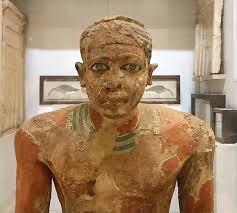
The Fragmentary Head of King Unas is a subtle yet powerful testament to the end of the Fifth Dynasty. While small in size, it represents the intellectual transformation of kingship, belonging to the ruler who introduced the Pyramid Texts to the world.
| Object | Fragmentary head of King Unas |
|---|---|
| Date | Late Fifth Dynasty (c. 2375–2345 BCE) |
| Material | Limestone |
| Original Location | Pyramid complex of Unas, Saqqara |
| Current Location | Egyptian Museum, Cairo |
Historical Importance
This fragmentary head is important because it belongs to Unas, the first king to inscribe Pyramid Texts inside his tomb. It marks the ideological transition from the Fifth to the Sixth Dynasty, where the monumentality of stone began to be replaced by the immortality of the written word.
King Unas
Unas was the last king of the Fifth Dynasty and the builder of the Unas Pyramid at Saqqara. Although he ruled during a period of declining royal resources, he left an indelible mark by introducing the earliest large body of religious writing. Under Unas, ideas became eternal.
Discovery
Found in the pyramid complex at Saqqara, this artwork is preserved only as a fragmentary head. It was identified through stylistic analysis and its archaeological context. Despite its small remains, it carries vast meaning for understanding the royal image of the time.
Original Context
The head originally belonged to a full royal statue placed in the mortuary temple or offering areas of Unas's complex. It was integrated into the royal cult, serving as a focal point for rituals. While the body is lost, the idea of the king survives.
Function of the Statue
The statue functioned as a vessel for the royal Ka and a cult image receiving offerings. Uniquely, it served as a visual counterpart to the Pyramid Texts inscribed nearby; image and word worked together to ensure the king's ascension.
Description of the Head
The fragment shows idealized facial features with a calm, composed expression. The smooth limestone carving conveys a sense of restraint and dignity, characteristic of the refined but simplified style of the late Old Kingdom.
Artistic Style
The head reflects Late Fifth Dynasty simplification. There is a reduced emphasis on muscular modeling and increased abstraction. Art becomes more intellectual, prioritizing the symbolic essence of kingship over physical power.
Facial Features
Visible features include almond-shaped eyes, a straight nose, and a firm mouth. The expression projects authority without grandeur, a quiet confidence suited to a king who relied on magical spells rather than colossal stones.
Material and Technique
Carved from limestone and originally painted, the statue displays modest craftsmanship compared to the hard-stone masterpieces of earlier dynasties. In this era, the meaning of the object began to outweigh the material value of the stone itself.
Religious Meaning
Unas’ reign introduced ascension spells carved in stone, offering direct access to the afterlife through text. This established a new relationship between the king and the gods, where the afterlife was written into existence.
Funerary Beliefs
This statue reflects the integration of image and inscription. It signifies a reliance on ritual knowledge and marks the transition toward Sixth Dynasty funerary practice, where the king ascends by the power of the spell.
Artistic Context
Compared to the administrative focus of Djedkare's art, Unas's sculpture shows a more theological focus. There is reduced sculptural ambition, suggesting that the mind and the word were beginning to replace the monument.
Archaeological Significance
The fragmentary head helps scholars understand the artistic decline of the Late Old Kingdom and the shift toward textual immortality. It is a key transitional artifact for studying the relationship between sculpture and writing.
Condition
Though fragmentary, the head is stable. Surface wear is visible, but it has been carefully conserved. Its survival against the odds allows us to connect the face of the king with the revolutionary texts he left behind.
Comparison: Evolution of Focus
| Period | Emphasis | Result |
|---|---|---|
| Fourth Dynasty | Divine Form | Monumental Statues |
| Fifth Dynasty | Solar Ideology | Sun Temples |
| Unas (End of 5th) | Textual Immortality | Pyramid Texts |
A revolution in belief.
Educational Value
This artifact is used to teach the origins of the Pyramid Texts, the transition in royal ideology, and Late Old Kingdom art. It is essential for understanding the intellectual history of Egyptian religion.
Simplified Summary
The Fragmentary Head of Unas represents a king whose true monument was not stone, but sacred words carved for eternity. Small in size but monumental in meaning, it marks the moment Egyptian kingship became a matter of the mind.