Identification
The Statue of King Shepseskaf is a rare and fragmentary example of royal sculpture from the very end of the Fourth Dynasty. It represents a transitional phase in Egyptian art, marking the shift away from the monumental traditions of the Giza pyramid age.
| Object | Statue of King Shepseskaf |
|---|---|
| Date | Late Fourth Dynasty (c. 2503–2498 BCE) |
| Material | Limestone (likely; fragmentary) |
| Original Location | Mortuary complex at South Saqqara |
| Current Location | Egyptian Museum, Cairo (fragments attributed) |
Historical Importance
The statue of Shepseskaf is historically significant because it represents the end of the Giza pyramid tradition. It reflects a distinct shift away from monumentality and marks a transitional phase in royal art and ideology, closing the great Fourth Dynasty sculptural tradition.
King Shepseskaf
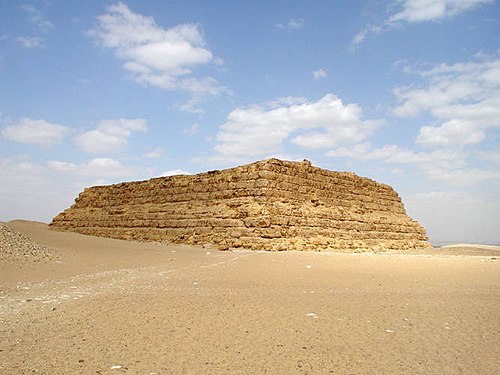
Shepseskaf was the last king of the Fourth Dynasty and possibly the son of Menkaure. He broke with tradition by building his tomb, the Mastabat el-Fara’un, at South Saqqara instead of a pyramid at Giza. He ruled briefly during a time of political change, and his reign signals a transformation in royal priorities.
Discovery
Surviving statues of Shepseskaf are fragmentary. Fragments attributed to him were discovered at his mortuary complex in South Saqqara. Identification is often based on inscriptions and stylistic analysis, making the reconstruction of his statuary a scholarly endeavor.
Original Context
The statue likely stood in the king's mortuary temple, located in ritual and offering spaces connected to the royal cult. While the ideology was changing, the traditional placement of cult statues remained a core part of funerary practice.
Function of the Statue
The statue functioned as a cult image of the king and a vessel for his Ka. It served as a focus for mortuary offerings, ensuring continuity for the king's spirit despite the changes in the political landscape.
Description
Due to the fragmentation, descriptions are based on reconstructions. The statue likely depicted the king in a traditional seated royal pose, wearing standard regalia with a formal, frontal posture. Despite the architectural shift, the imagery remained conservative.
Artistic Style
The statue likely displayed typical Old Kingdom frontality but with less refinement than the works of Menkaure. There is a slight stiffness and simplification of forms, which art historians often interpret as signs of decline or transition in the royal workshops.
Facial Features
Fragments suggest the face was idealized but with reduced subtle modeling compared to predecessors. The expression appears calm but less expressive, indicating that the artistic confidence of the earlier Fourth Dynasty was beginning to wane.
Material and Technique
The statue was likely carved in limestone. There is a notable decrease in the use of hard stones (like diorite or greywacke) compared to earlier kings, suggesting a shift towards a more practical rather than monumental approach to resources.
Religious Meaning
In Egyptian belief, statues continued to house the Ka and ensure offerings and remembrance. Despite political shifts, the core religious function of the statue in maintaining the royal cult practice remained constant.
Funerary Beliefs
Shepseskaf’s statue fits into traditional mortuary cult systems but reflects a reduced monumental expression. It points towards a more modest vision of the royal afterlife, signaling change without a complete rupture in belief.
Artistic Context
Compared to Menkaure, Shepseskaf’s art shows less emotional warmth and a return to more conservative forms. There is a reduced sculptural ambition, which can be seen as a retreat from the innovations of the previous reign.
Archaeological Significance
The statue helps scholars understand the end of the Fourth Dynasty and the decline of large-scale royal sculpture. It serves as a historical bridge to the Fifth Dynasty, where solar ideology would take precedence.
Condition
The statue survives only in fragments, and attribution remains a subject of debate. However, these fragments are carefully studied and conserved, providing meaningful data despite their incomplete state.
Comparison: The End of an Era
| King | Style | Legacy |
|---|---|---|
| Khafre | Divine Perfection | Peak of Monumentality |
| Menkaure | Humanized Divinity | Artistic Refinement |
| Shepseskaf | Conservative Tradition | Transitional / Decline |
An era closes.
Educational Value
This statue is used to teach dynastic transitions, artistic decline and change, and shifts in royal ideology. It is important for establishing the chronology of Old Kingdom art.
Simplified Summary
The Statue of Shepseskaf represents the quiet closing of the great age of Fourth Dynasty royal sculpture. It stands at the threshold of a new era, marking the end of the monumental Giza tradition.