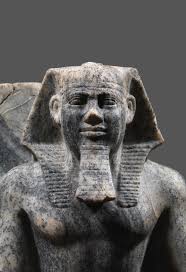
Identification
The Statue of King Sahure represents the mature phase of Fifth Dynasty sculpture. Found in his mortuary complex at Abusir, it reflects the established solar-centered ideology that came to define this period of Egyptian history.
| Object | Statue of King Sahure |
|---|---|
| Date | Fifth Dynasty (c. 2487–2475 BCE) |
| Material | Limestone (traces of paint), Granite |
| Original Location | Pyramid complex at Abusir |
| Current Location | Egyptian Museum, Cairo (fragments); other collections |
Historical Importance
This statue is historically significant as it represents the mature phase of Fifth Dynasty royal sculpture. It reflects the close connection between kingship and the solar cult, where royal imagery becomes part of a broader ideological system. It also coincides with a time when royal art began to show increased narrative and political complexity.
King Sahure
Sahure was the second king of the Fifth Dynasty and the son of Userkaf. He built his pyramid at Abusir, establishing it as the royal necropolis for the dynasty. His reign is renowned for extensive trade, diplomacy, and military activity, reflecting an outward-looking kingship that brought exotic goods and influences into Egypt.
Discovery
Statues of Sahure survive mostly in fragments found during excavations at Abusir, notably by Ludwig Borchardt in the early 20th century. These fragments were identified through inscriptions and stylistic features, allowing scholars to reconstruct the artistic program of his temple.
Original Context
Sahure’s statues originally stood in the courts and processional corridors of his mortuary temple, and possibly in his Sun Temple. They were integrated into the daily rituals of the royal cult, surrounded by elaborate reliefs depicting the king's achievements.
Function of the Statue
The statue functioned as a cult image for receiving offerings and a vessel for the Ka. It allowed the king to participate eternally in both solar and mortuary rituals, ensuring that he remained an active force in the cosmos even after death.
Description
Based on surviving remains, Sahure was depicted seated on a throne or standing, wearing the nemes headdress or a royal crown. He is shown in a formal frontal pose, possibly holding royal insignia like the flail or mace. The form is traditional, but the solar meaning is paramount.
Artistic Style
The statue is smaller in scale than the colossal works of the Fourth Dynasty. It shows more standardized proportions and reduced emphasis on muscular modeling. The focus shifts towards increased symbolic clarity, where ideology takes precedence over sheer monumentality.
Facial Features
Fragments indicate a calm, idealized expression with smooth facial planes. There is less individualization than in earlier periods; the royal identity is symbolic rather than a realistic portrait. The face projects the serenity of a ruler in perfect harmony with the gods.
Material and Technique
The statues were predominantly carved from limestone, often with traces of red and black paint remaining. The use of limestone allowed for efficient carving and the application of color, which played a larger role in bringing the image to life compared to the hard-stone statues of Giza.
Religious Meaning
In Fifth Dynasty belief, the king acts as the mediator between Ra and humanity. Solar rebirth defines the royal afterlife. Statues supported the continuous cycle of rituals, where art served theology to ensure the daily rising of the sun and the stability of the world.
Funerary Beliefs
Sahure’s statues ensured his eternal participation in mortuary rites. They facilitated solar regeneration after death and the receipt of continued offerings. The afterlife was viewed as cyclical, mirroring the daily journey of the sun across the sky.
Artistic Context
Compared to the earlier works of Userkaf, Sahure's art shows more refined carving and greater compositional confidence. The solar symbolism is clearer, marking the maturity of Fifth Dynasty art style at Abusir.
Archaeological Significance
The statue helps scholars understand the output of the Abusir sculptural workshops and the integration of relief and sculpture. It is part of a larger visual program that includes the famous relief scenes of naval expeditions and tribute bearers found in his temple.
- The Palermo Stone: A fragment of Royal Annals from this period records Sahure's donations to temples and trade expeditions to Punt and Lebanon, providing context to the wealth supporting this art.
- Temple Reliefs: Sahure's complex is famous for its extensive and high-quality reliefs showing the king hunting, defeating enemies, and launching naval fleets, complementing the static power of his statues.
Condition
The statuary is mostly fragmentary, though some heads and torsos have been preserved. These pieces have been carefully studied and conserved, allowing experts to reconstruct the ideology and appearance of the king despite the damage of millennia.
Comparison: Fourth vs. Fifth Dynasty
| Aspect | Fourth Dynasty (Giza) | Fifth Dynasty (Abusir) |
|---|---|---|
| Scale | Monumental / Colossal | Smaller / Human-scale |
| Material | Hard Stone (Diorite/Schist) | Limestone / Painted |
| Focus | Divine King | Ritual & Solar Servant |
A conceptual shift from absolute power to ritual devotion.
Educational Value
This statue is used to teach the concepts of solar kingship, the characteristics of Fifth Dynasty art, and royal cult practices. It is essential for understanding the cultural and religious changes that occurred in the Old Kingdom.
Simplified Summary
The Statue of Sahure represents a refined, ritual-focused image of kingship shaped by the solar religion of the Fifth Dynasty. Power is expressed not through massive scale, but through devotion and the king's role as the son of the sun.