Identification
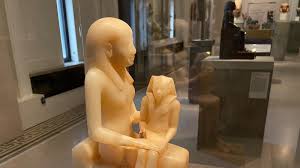
The Group Statue of Pepi II and Queen Ankhesenpepi II is a unique and politically explicit sculpture from the Sixth Dynasty. Carved from alabaster, it depicts the child king Pepi II seated on the lap of his mother, the queen regent, emphasizing her role in maintaining the legitimacy of his reign.
| Object | Group statue of King Pepi II and Queen Ankhesenpepi II |
|---|---|
| Date | Sixth Dynasty (c. 2278–2184 BCE) |
| Material | Alabaster (calcite) |
| Original Location | Mortuary complex of Pepi II, Saqqara |
| Current Location | Egyptian Museum, Cairo |
Historical Importance
This statue is historically important because it is unique in Egyptian royal sculpture. It emphasizes the queen mother’s pivotal role in securing royal legitimacy and reflects the political reality during the minority reign of a child king. No earlier royal statue states the dependence of the king on his mother so clearly.
King Pepi II
Pepi II ascended to the throne at the tender age of about six. He went on to rule for nearly a century, but in his early years, he was entirely dependent on regents and powerful court officials. This statue is a rare acknowledgment in art of this initial dependence and the vulnerability of the child king.
Queen Ankhesenpepi II
Ankhesenpepi II was a formidable figure: the wife of Pepi I and the mother of Pepi II. She likely acted as regent during her son's minority, holding exceptional titles and authority. In this statue, she is presented as the literal and metaphorical foundation of her son's legitimacy.
Discovery
The statue was discovered in the mortuary complex at Saqqara. It was found in relatively good condition, with inscriptions identifying the royal figures. As a rare survival of a group statue made of alabaster, it provides valuable insight into the artistic production of the late Old Kingdom.
Original Context
The statue likely stood in the mortuary temple, in a cultic or ritual space where it would be visible to priests and high officials. It served as a public statement of succession, reassuring the court that despite the king's youth, the royal line was secure under the queen's protection.
Description
The composition depicts Queen Ankhesenpepi II seated on a throne with the young King Pepi II sitting on her lap, oriented at a right angle to her. Both figures are frontally posed. The king is literally supported by his mother, visually reinforcing the political message.
Artistic Style
The sculpture displays calm, restrained forms typical of the period. The smooth surfaces of the alabaster are polished to a high sheen. The formal symmetry and the elegance of the carving serve the ideological purpose of presenting a stable and orderly succession.
Facial Features
The queen is shown with mature dignity, her face serene and protective. The king is depicted as youthful and idealized, with the proportions of a child but the regalia of a pharaoh. There is minimal individualization; the roles they play are symbolic rather than portrait-like.
Material and Technique
Carved from alabaster (calcite), a stone prized for its translucency and beauty, the statue represents high prestige. The workmanship is delicate but precise, utilizing the material's properties to enhance the divine aura of the royal pair.
Religious Meaning
In Egyptian belief, queens possessed protective, maternal power similar to the goddess Isis. The king’s rebirth was seen as paralleling childbirth. Here, the mother acts as the guardian of the divine king, merging political necessity with religious mythology.
Funerary Beliefs
The statue ensured the eternal recognition of maternal legitimacy and the protection of the king’s Ka. It guaranteed the continuity of the royal cult by establishing the queen mother as an eternally present figure in the king's afterlife.
Artistic Context
Compared to earlier royal group statues (like the triads of Menkaure), this work is more intimate and politically explicit. It is an ideologically innovative piece that uses a new sculptural message to address the specific challenges of Pepi II's succession.
Archaeological Significance
The statue helps scholars understand female power in the Old Kingdom, regency practices, and how the state handled succession crises. It stands as one of the clearest and most direct political artworks of ancient Egypt.
Condition
The statue is well preserved, with only minor damage. It has been carefully conserved, allowing us to appreciate it as a rare complete group statue from this period, offering a direct window into the royal court of the Sixth Dynasty.
Comparison: Group Statues
| Group | Subjects | Meaning |
|---|---|---|
| Menkaure & Queen | Adult King & Wife | Dynastic harmony & partnership |
| Pepi II & Mother | Child King & Mother | Legitimacy & Regency |
Different political messages for different needs.
Educational Value
This statue is used to teach gender and power dynamics, royal succession, and Late Old Kingdom politics. It is an essential artifact for interpreting the role of women in the pharaonic state.
Simplified Summary
The Group Statue of Pepi II and Ankhesenpepi II represents a moment when royal power openly depended on motherhood, carved permanently into stone. It is one of the most honest and politically significant sculptures of ancient Egypt.