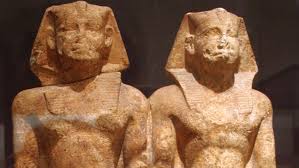
Identification
The Standing Statues of King Nyuserre Ini represent the mature artistic style of the Fifth Dynasty. Discovered in his Sun Temple at Abu Ghurab, these limestone figures are key examples of royal sculpture designed specifically for solar ritual contexts.
| Object | Standing statues of King Nyuserre Ini |
|---|---|
| Date | Fifth Dynasty (c. 2445–2421 BCE) |
| Material | Limestone |
| Original Location | Sun Temple of Nyuserre (Shesepu-ib-Ra), Abu Ghurab |
| Current Locations | Egyptian Museum, Cairo; site collections |
Historical Importance
The standing statues of Nyuserre Ini are historically significant because they represent the fully mature artistic style of the Fifth Dynasty. They are closely associated with solar temple ritual rather than just the mortuary cult, showing confidence, balance, and standardization in royal imagery. They mark the artistic high point of solar kingship.
King Nyuserre Ini
Nyuserre Ini was the son of Neferirkare Kakai and one of the longest-reigning kings of the Fifth Dynasty. He is famous for building the most complete Sun Temple of the dynasty at Abu Ghurab. Known as a restorer and consolidator, he also completed the monuments of his predecessors.
Discovery
The statues were discovered during excavations at Abu Ghurab, found in and around the Sun Temple. Although many are preserved only in fragments, some are nearly complete, providing a strong archaeological context for understanding their placement and function.
Original Context
Originally, these statues stood in the open courtyards of the Sun Temple, along ritual pathways, and near offering altars. Unlike statues hidden in serdabs, these figures interacted directly with the sunlight, playing an active role in the solar cult's daily liturgy.
Function of the Statue
The standing statues functioned as cult images participating in solar rituals. They represented the king worshipping Ra and served as vessels for the royal Ka. In this context, the king eternally faces the sun, maintaining the cosmic cycle.
Description
Nyuserre is depicted standing upright with his left leg advanced in the traditional striding pose. His arms are held close to his body, and he wears royal regalia, likely the nemes headdress or a crown. The canonical standing pose is here perfected and standardized.
Artistic Style
The statues display balanced proportions and clear, simplified forms. The posture is calm and controlled, executed with confidence. There is no sign of hesitation or experimentation; instead, the art reflects a mature style that has found its ideal expression.
Facial Features
Surviving heads show an idealized facial structure with smooth transitions between features. The expression is calm and distant. The king is presented as a timeless figure rather than an individual, embodying the eternal office of kingship.
Material and Technique
The statues were carved in limestone, a material suitable for the open-air settings of the Sun Temple. They were originally painted to enhance their lifelike appearance. The workmanship is efficient but skilled, showing how art was adapted to the specific needs of the ritual environment.
Religious Meaning
In Fifth Dynasty theology, the king is the Son of Ra, and his primary role is to maintain cosmic order through ritual. The Sun Temple replaces the pyramid as the dominant symbol of this relationship, and the statue becomes an integral part of daily solar worship.
Funerary Beliefs
Nyuserre’s statues reflect solar rebirth ideology. They signify the king’s eternal cycle with the sun, integrating life, death, and daylight. The afterlife is viewed not as a static state, but as continuous solar continuity.
Artistic Context
Compared to the unfinished works of Neferefre, Nyuserre's statues are fully finished and confident. Their carefully planned placement and execution indicate a mature workshop organization and a return to stability after a period of disruption.
Archaeological Significance
The statues help scholars understand ritual practices within Sun Temples and the use of open-air sculpture. They provide insight into Fifth Dynasty workshop methods and stand as key evidence for the artistic output of the solar cult.
Condition
While mostly fragmentary, some torsos and heads are well preserved. There is evidence of surface erosion due to long-term exposure to the elements in the open courts, but the fragments remain highly informative about the period's style.
Comparison: The Fifth Dynasty Journey
| King | Sculptural Character | Significance |
|---|---|---|
| Userkaf | Experimental | Start of Solar Shift |
| Neferirkare | Formalized | Standardization |
| Neferefre | Interrupted | Political Disruption |
| Nyuserre | Mature & Complete | Culmination of Style |
The culmination of the dynasty's artistic evolution.
Educational Value
These statues are used to teach the function of Sun Temples, the characteristics of mature Fifth Dynasty style, and the relationship between architecture and sculpture. They are essential for understanding the concept of solar kingship.
Simplified Summary
The Standing Statues of Nyuserre Ini represent the fully realized vision of Fifth Dynasty kingship—calm, ritual-focused, and eternally aligned with the sun god Ra. They are the final, confident statement of solar royal art.