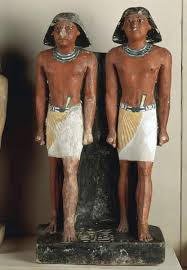
Identification
The Statue of King Neferirkare Kakai is a significant work from the mid-Fifth Dynasty. It belongs to a reign that formalized the full five-part royal titulary, reflecting the consolidation of solar kingship ideology and the further standardization of royal sculpture.
| Object | Statue of King Neferirkare Kakai |
|---|---|
| Date | Fifth Dynasty (c. 2475–2455 BCE) |
| Material | Limestone (traces of paint); Granite fragments |
| Original Location | Pyramid complex at Abusir |
| Current Location | Egyptian Museum, Cairo (fragments); other collections |
Historical Importance
The statue of Neferirkare is historically pivotal because it dates to the era when the five-part royal titulary was fully formalized. It reflects the consolidation of solar kingship ideology where royal identity became fully codified, and shows a move towards greater standardization in royal representation.
King Neferirkare Kakai
Neferirkare Kakai was the third king of the Fifth Dynasty and the builder of the largest pyramid at Abusir. He was the first king to consistently use the full five royal names, a practice that shaped pharaonic tradition for millennia. His reign is noted for strengthening the priestly and administrative systems of the state.
Discovery
Statues of Neferirkare survive primarily as fragments found during excavations at Abusir. These pieces have been identified by inscriptions and stylistic analysis. Although fragmentary, they are well-attested and provide crucial evidence for the artistic production of the royal workshops.
Original Context
Neferirkare’s statues originally stood in the courts, offering chapels, and processional spaces of his mortuary temple. They functioned within the daily solar rituals that were central to the religious life of the Fifth Dynasty necropolis.
Function of the Statue
The statue functioned as a cult image for receiving offerings and a vessel for the Ka. It was a symbol of royal legitimacy, ensuring that the king existed eternally through the rituals performed by the priesthood.
Description
Based on surviving remains, Neferirkare was depicted seated or standing, wearing traditional royal regalia. He is shown in a frontal, formal pose where canonical representation dominates over individual expression, emphasizing the timeless nature of his office.
Artistic Style
The statue shows a further reduction in monumentality compared to the Fourth Dynasty. The proportions are highly standardized, with less emphasis on anatomical realism. Forms are clear and symbolic, designed to serve the prevailing religious ideology.
Facial Features
Fragments indicate a calm, idealized expression with smooth facial planes. There is minimal individuality; the king is presented as an eternal type rather than a specific personality, aligning with the concept of the pharaoh as a divine constant.
Material and Technique
The statues were primarily carved from limestone, with occasional use of granite for key pieces. Traces of pigment found on fragments suggest that color was used to enhance symbolic clarity and bring the images to life.
Religious Meaning
In Fifth Dynasty belief, the king’s afterlife is solar; rebirth occurs in the company of the sun god. Statues were essential to maintain the ritual cycles that ensured this rebirth, reflecting a view of eternity as cyclical and renewable.
Funerary Beliefs
Neferirkare’s statues ensured continuous mortuary offerings and solar regeneration. They preserved the royal Ka, allowing the afterlife to be ritualized and the king to remain a potent force in the cosmos.
Artistic Context
Compared to Sahure, Neferirkare's art shows a more formalized style with less narrative emphasis. There is greater administrative symbolism, reflecting a period where ideology became increasingly systematized and bureaucratic.
Archaeological Significance
The statue helps scholars understand the output of the Abusir sculptural workshops and the development of the royal titulary in art. It illustrates the integration of sculpture and administration, showing how art reflected the growing bureaucracy of the state.
Condition
The statues survive mainly in fragments, with some heads and torsos identified. These remains are actively studied to understand their original context. The fragmentation reflects centuries of reuse and decay at the Abusir site.
Comparison: The Fifth Dynasty Progression
| King | Style | Key Characteristic |
|---|---|---|
| Userkaf | Transitional | Shift to Solar Ideology |
| Sahure | Refined | Narrative Complexity |
| Neferirkare | Formalized | Codified Identity |
A clear progression toward standardization.
Educational Value
This statue is used to teach the royal titulary, solar theology, and artistic standardization. It is a key object for understanding state ideology and the administrative structure of the Old Kingdom.
Simplified Summary
The Statue of Neferirkare represents the moment when royal identity became fully codified under solar kingship. It embodies order, ritual, and theology, reflecting the systematized world of the Fifth Dynasty.