Identification
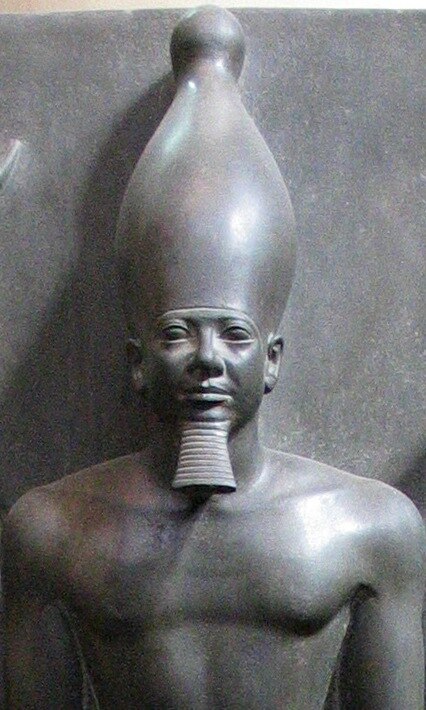
The Triad Statues of King Menkaure are among the most famous sculptures of the Old Kingdom. These groups depict the king in the company of the goddess Hathor and a personification of an Egyptian province (Nome), representing a new relational form of royal imagery.
| Object | Triad statues of King Menkaure |
|---|---|
| Date | Fourth Dynasty (c. 2532–2503 BCE) |
| Material | Greywacke (schist) |
| Original Location | Valley Temple of Menkaure, Giza |
| Current Locations | Egyptian Museum (Cairo); Museum of Fine Arts, Boston |
Historical Importance
The triads of Menkaure are historically significant because they represent a shift from the isolation of earlier royal statues to connection. They show the king interacting with gods and provinces, introducing greater warmth and humanity into royal sculpture.
King Menkaure
Menkaure was the son of Khafre and the builder of the Third Pyramid at Giza. Ruling during the late Fourth Dynasty, he is remembered in tradition as a just and approachable king. His artistic image reflects this benevolent authority, contrasting with the stern power of his predecessors.
Discovery (1908–1910)
The triads were discovered between 1908 and 1910 by the American archaeologist George Reisner. They were found in fragments within the Valley Temple of Menkaure. This find remains one of the greatest sculptural discoveries ever made at the Giza Plateau.
Original Context
These statues were originally placed in the Valley Temple, likely along processional routes or in ritual spaces designed for offerings. They were part of an extensive cult program that visually mapped the king's authority over the different regions of Egypt.
Function of the Triads
The triads functioned as cult statues for ritual worship. They were manifestations of the king’s relationship with the gods and symbols of his authority over the unified land of Egypt. The king stands at the center of order, supported by divine and geographic powers.
Description
Each triad shares a standard composition: King Menkaure stands in the center, flanked by the goddess Hathor on one side and a female personification of a Nome (province) on the other. Together, the three figures represent a complete cosmic order.
Pose and Gesture
Menkaure stands confidently with one leg slightly advanced in the striding pose. Hathor often holds the king's hand or embraces him, while the Nome goddess stands calmly. The gestures imply subtle intimacy and balance, distinct from earlier solitary statues.
Artistic Style
The triads exhibit harmonious proportions and soft modeling of the bodies, moving towards greater naturalism. The expressions are calm and serene. In these works, royal art becomes more human, shedding some of the rigid abstraction of the early Old Kingdom.
Facial Features
Menkaure has a youthful, idealized face with high cheekbones and a slight smile. Hathor appears serene and maternal, wearing her cow-horn headdress. The Nome goddess varies slightly by region, but all figures share a family resemblance where identity and symbolism merge.
Material and Technique
The statues are carved from Greywacke (also known as schist), a hard, dark stone chosen for its durability. The surfaces are highly polished to a smooth, skin-like finish, demonstrating exceptional craftsmanship and the desire for eternity.
Religious Meaning
In Egyptian belief, Hathor was a goddess of rebirth, music, and protection. The Nome deities were the spiritual embodiments of the provinces. By standing with them, the king acted as the mediator between god and country, maintaining the sacred balance of Ma'at.
Funerary Beliefs
The triads ensured eternal royal cult worship and continued offerings from every province of Egypt. They guaranteed the king’s presence in the afterlife and his perpetual regeneration through the goddess Hathor.
Artistic Innovation
Compared to earlier statues like those of Khafre, the triads show less rigid frontality and more interaction between figures. The physical contact and shared space introduce emotional warmth, creating a new sculptural language for the dynasty.
Condition
Some triads are remarkably complete, while others are fragmentary. Overall, their preservation is excellent due to the hardness of the stone and their burial in the temple sands. They remain among the best examples of Old Kingdom sculpture.
Archaeological Significance
The triads provide unique insight into provincial administration and religious geography in the Old Kingdom. They reveal how the central government viewed the provinces and used art as a form of political theology to unify the state.
Comparison: Khafre vs. Menkaure
| Feature | Khafre | Menkaure |
|---|---|---|
| Concept | Isolated divine king | King in relationship |
| Pose | Absolute stillness | Subtle movement |
| Aura | God-like distance | Humanized divinity |
A gentle evolution toward a more approachable kingship.
Educational Value
These statues are used to teach royal ideology, the intersection of art and politics, and symbolism in sculpture. They are core material for any Egyptology curriculum, illustrating the sophisticated theology of the Pyramid Age.
Simplified Summary
The Triads of Menkaure are a powerful image of kingship supported by gods and the land of Egypt. Blending divine authority with human presence, they stand as some of the most beautiful and significant sculptures of the Old Kingdom.