Identification
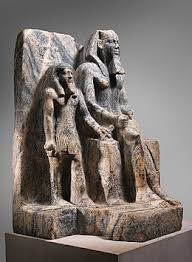
The Seated Statue of King Menkaure represents the traditional pose of royal authority at the end of the Fourth Dynasty. Unlike his famous standing triads or dyad, this figure depicts the king seated on a throne, balancing tradition with the artistic refinement of his era.
| Object | Seated statue of King Menkaure |
|---|---|
| Date | Fourth Dynasty (c. 2532–2503 BCE) |
| Material | Greywacke (schist) |
| Original Location | Valley Temple of Menkaure, Giza |
| Current Location | Egyptian Museum, Cairo (fragmentary) |
Historical Importance
This statue is historically significant as it completes the range of Menkaure’s royal imagery. While his other statues emphasize movement and relationships, this seated figure represents a softer, more humanized version of kingship, balancing the traditional iconography of the throne with the innovation of the period.
King Menkaure
Menkaure was the builder of the Third Pyramid at Giza and the son of Khafre. He ruled during a period of artistic refinement and is known for cultivating a more personal royal image. His seated statues reflect a calm authority that contrasts with the sheer monumental scale of his predecessors.
Discovery
Fragments of seated statues were found during the early 20th-century excavations by George Reisner in the Valley Temple. Although less complete than the famous triads, these discoveries were vital for understanding the full sculptural program of the temple complex.
Original Context
The statue originally stood in the Valley Temple, likely placed along ritual and offering routes among other cult statues. It was part of a carefully orchestrated sculptural ensemble designed to facilitate the worship of the king in his various aspects.
Function of the Statue
The seated statue functioned as a cult image for receiving offerings and a vessel for the Ka. It served as a focus for mortuary rituals, ensuring that the king sat eternally to receive worship and sustenance from the priesthood.
Description
Menkaure is depicted seated on a simple block throne, wearing a royal headdress (likely the Nemes). His hands rest on his thighs in the traditional pose of authority. The posture is upright and symmetrical, conveying a sense of calm and immovability.
Artistic Style
The statue exhibits strong frontality and balanced proportions. However, the modeling is softer than in the statues of Khafre, with reduced rigidity in the musculature. It projects a gentler royal presence, characteristic of Menkaure’s reign.
Facial Features
Surviving fragments suggest a youthful, idealized face with a calm expression. The transitions between features are smooth, avoiding sharp lines. Menkaure appears approachable yet divine, embodying the benevolent ruler.
Throne Symbolism
The throne likely featured symbols of the unification of Egypt, such as the Sema-Tawy motif with stylized lotus and papyrus plants. Even in a more relaxed artistic style, the political message of unity remained central to royal iconography.
Material and Technique
Like his other famous statues, this work was carved from Greywacke. The surfaces were finely polished to a high sheen, demonstrating high technical skill. The durability of the stone combined with the elegance of the carving created an image meant to last forever.
Religious Meaning
In Egyptian belief, the seated king is the recipient of offerings. The Ka resides within the statue to partake of the food and drink presented by priests. The image ensures eternal worship; stillness equates to eternity.
Funerary Beliefs
The statue ensured continuous mortuary cult activity. It guaranteed eternal nourishment and the survival of the royal spirit. As a necessary element of afterlife theology, it anchored the king's presence in the temple forever.
Artistic Context
Compared to the statue of Khafre, Menkaure's seated image is less rigid and displays more human warmth. The posture is slightly more relaxed, reflecting a stylistic shift towards naturalism that occurred in the later Fourth Dynasty.
Condition
The seated statues of Menkaure survive mainly in fragments. However, some heads and torsos have been identified and carefully conserved. Through scholarship, these fragments have been reconstructed to reveal the original majesty of the works.
Archaeological Significance
The statue helps scholars understand the variety in royal representation and late Fourth Dynasty aesthetics. Even as fragments, they provide crucial data on the organization of the Valley Temple and the scale of the king's statuary program.
Educational Value
This statue is used to teach seated royal statue types and canonical poses. It is important for comparative study, allowing students to trace the evolution of royal art from the sternness of the early pyramid age to the refinement of Menkaure's time.
Comparison: Menkaure's Statuary
| Type | Key Elements | Meaning |
|---|---|---|
| Triads | King, Goddess, Nome | King, Gods, and Land |
| Dyad | King and Queen | Dynastic Unity |
| Seated | King on Throne | Eternal Rulership |
A complete ideological program.
Simplified Summary
The Seated Statue of Menkaure is a calm and timeless image of kingship. Quiet, refined, and eternal, it expresses stability and continuity at the end of the great Giza pyramid age.