Identification
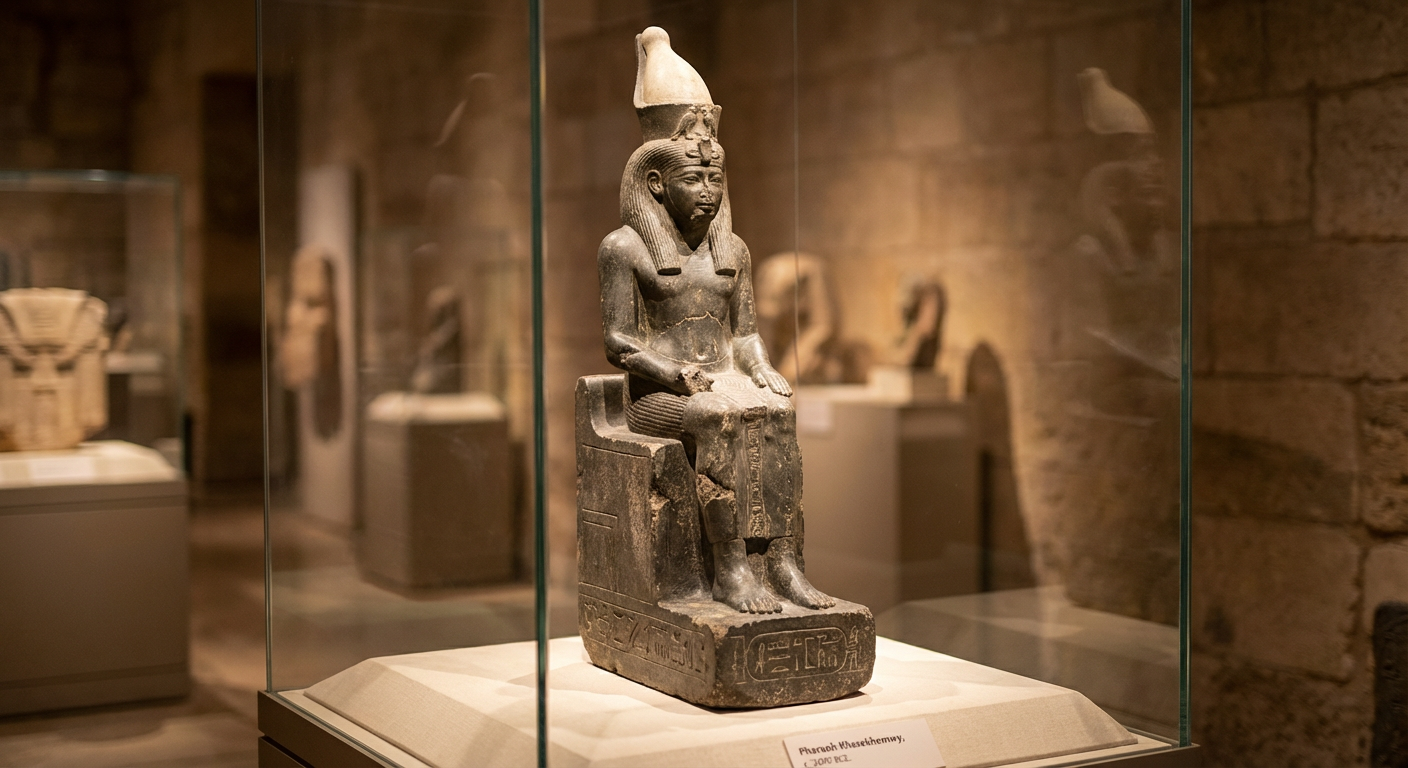
The Statue of King Khasekhemwy is a pivotal artifact from the end of the Early Dynastic Period. It stands as one of the earliest examples of life-size royal sculpture, bridging the gap between archaic forms and the monumental style of the Old Kingdom.
| Object | Seated Statue of King Khasekhemwy |
|---|---|
| Date | Second Dynasty (c. 2686–2649 BCE) |
| Material | Limestone |
| Original Location | Hierakonpolis (Nekhen) |
| Current Location | Ashmolean Museum, Oxford |
Historical Importance
This statue is historically significant because it represents a transitional work between the art of the Early Dynastic Period and the Old Kingdom. It provides tangible evidence of the consolidation of kingship and the emergence of classical royal imagery that would dominate Egyptian art for millennia.
King Khasekhemwy
Khasekhemwy was the last king of the Second Dynasty. His reign is noted for ending internal conflicts and reunifying Upper and Lower Egypt, a feat reflected in his name ("The Two Powers have Arisen"). As the predecessor to the Third Dynasty, his era laid the groundwork for the pyramid age.
Discovery (1898)
The statue was excavated in 1898 by the archaeologist James Quibell at Hierakonpolis (Nekhen), an ancient cult center of Horus. It was found among a cache of ritual objects known as the "Main Deposit," making it a major discovery for understanding early dynastic history.
Original Context
Unlike Djoser's statue which was hidden in a serdab, this statue was likely found in a temple or ritual context. It was associated with ceremonial offerings and royal cult practices, suggesting it was meant to be the focus of active worship within the sacred precinct.
Function of the Statue
The statue served as a cult image of the king and a physical vessel for his Ka (life force). By residing in stone, the king remained present after death, capable of receiving offerings and maintaining his divine authority over the land.
Description
Khasekhemwy is depicted seated on a simple block throne. He wears the White Crown (Hedjet) of Upper Egypt and a close-fitting jubilee robe. His right hand rests on his thigh, usually holding a flail (now damaged), while his left arm is bent across his chest. The posture is calm but radiates suppressed power.
Artistic Style
The style is characterized by strong frontality and block-like proportions. The anatomy is simplified, with limited movement, reflecting the archaic style's emphasis on durability and timelessness. It marks a clear move toward the formal royal style seen in later dynasties.
Facial Features
The king has a broad face with heavy eyelids and a stylized expression. While it is an early attempt at idealization, the features are more symbolic than naturalistic, designed to convey the essence of kingship rather than a portrait of the individual.
Inscription
The base of the statue is carved with the king’s name and figures of slain enemies (symbolizing chaos). This inscription reinforces the theme of unification and victory, proclaiming Khasekhemwy’s triumph over rebels and the restoration of order.
Religious Meaning
In Egyptian belief, statues were essential for survival. They could house the Ka, allowing the deceased king to participate eternally in rituals. This statue guaranteed that Khasekhemwy would continue to receive sustenance and reverence forever.
Funerary Context
This object fits into the broader context of early ancestor cults and royal funerary ideology. It is a precursor to the Old Kingdom practice of placing Ka-statues in tombs and temples, ensuring the king's continued role as an intermediary between gods and men.
Artistic Development
Compared to earlier objects like ivory figurines, this statue is larger in scale and exhibits greater permanence. It shows the clear establishment of royal iconography—crown, throne, posture—that would define pharaonic art. It is a major artistic step forward.
Comparison: Evolution in Stone
| Aspect | Khasekhemwy (Dynasty 2) | Djoser (Dynasty 3) |
|---|---|---|
| Time Period | Early Dynastic | Old Kingdom |
| Style | Transitional | Fully developed |
| Context | Temple / Ritual Deposit | Funerary Serdab |
The evolution from archaic experimentation to classical mastery.
Condition
The statue is largely intact, a rare survival from such an early period. It has suffered some minor surface damage over 4,700 years but has been carefully conserved and is now displayed at the Ashmolean Museum.
Archaeological Significance
As a cornerstone artifact, the statue helps scholars study the origins of royal sculpture and the ideology of early kingship. It provides crucial data on the transition from the formative Early Dynastic Period to the great pyramid age of the Old Kingdom.
Educational Value
The statue is used extensively to teach Early Dynastic art, royal symbolism, and the development of funerary culture. It serves as a foundational object for understanding how the Egyptians conceptualized their rulers.
Simplified Summary
The Statue of Khasekhemwy is one of the earliest royal statues in existence, showing how Egyptian kingship became eternal in stone. It stands at the threshold of classical Egyptian art, capturing the moment when the pharaohs began to immortalize themselves in monuments that would last forever.